
Home » 2013 (Page 3)
Yearly Archives: 2013
The Leukrokottas
Faith M. Boughan at Fantasy Faction has the lowdown on the leukrokottas (or crocutta, corocutta, krokuta, etc.), an obscure creature from Classical mythology. I seem to remember the creature from D&D, and I know some of them show up in one of the Percy Jackson stories.
According to Pliny the Elder’s Natural Historyfrom the 1st-Century A. D., the Leukrokottas lives in Ethiopia and is about the size of a donkey, with the haunches of a stag, the breast/neck/tail of a lion, a badger’s head, cloven hooves, a mouth so enormous that it opens up all the way back to its ears, and bone ridges instead of teeth. In fact, he describes that the monster’s mouth is an unbroken ridge of bone in each jaw that forms a “continuous tooth without any gum” that is “shut up in a sort of case.” (And if you can make sense of that, you’ll be safer than the rest of us!)
It’s a quite obscure creature that doesn’t seem to figure at all in mythology. It’s just out there, apparently accepted as an ordinary—albeit terrifying—beast. Faith suggests the leukrokotta may be what happened when people saw a hyena for the first time and struggled to find words to describe it.
Interactive Map of Odysseus’s Journey
Gisèle Mounzer has created an interactive map of Odysseus’s itinerary in Homer’s Odyssey. You can read about the project in The Journal (Ireland) or go explore it for yourself. (H/T: Rogueclassicism)
Hobbits Have a Kentucky Connection
Apparently, J. R. R. Tolkien was somewhat taken with the Bluegrass, as Alan Cornett of Pinstripe Pulpit reveals:
But it was a chance encounter [Tolkien scholar Guy] Davenport had in Shelbyville, Kentucky with a former classmate of Tolkien—a history teacher named Allen Barnett—that changed Davenport’s perspective about his former professor’s clever tales. To Davenport’s amazement, Barnett had no idea that Tolkien had turned into a writer, and had never read any of the adventures of Middle Earth.
“Imagine that! You know, he used to have the most extraordinary interest in the people here in Kentucky. He could never get enough of my tales of Kentucky folk. He used to make me repeat family names like Barefoot and Boffin and Baggins and good country names like that,” Barnett told Davenport.
“And out the window I could see tobacco barns,” Davenport writes. “The charming anachronism of the Hobbits’ pipes suddenly made sense in a new way….Practically all the names of Tolkien’s hobbits are listed in my Lexington phonebook, and those that aren’t can be found over in Shelbyville. Like as not, they grow and cure pipe-weed for a living.”
Pretty cool.
Carol by J. W. Becton
So a while back, Jennifer Becton, my former colleague and now an honest-to-gosh professional novelist, asked me to recommend some reading for a new fantasy series she was fleshing out. (For some reason, she thought I might know something about souls.) I jokingly told her she could “pay” me by writing me into the work when it finally comes out. Well, for good or ill, Carol is now available as part of a fantasy compilation called Naughty or Nice.
I honestly don’t know what might happen to “me.” The writer has my permission to kill “me” off on the first page if it will make for an excellent story! Whatever happens, The Naughty or Nice project sounds fantastic. I’ll let Jennifer explain:
I’m so excited to have been invited to write a short story for Naughty or Nice, a holiday-themed, fantasy collection whose proceeds will go to the charity Kids Need to Read. Here’s their mission: “Kids Need to Read works to create a culture of reading for children by providing inspiring books to underfunded schools, libraries, and literacy programs across the United States, especially those serving disadvantaged children.” Getting books in the hands of children is a goal I can support.
And so can I! So hop over to Amazon.com and get your Kindle edition today!
Tolkien’s Myth-Making
Dan Berger has produced a wonderful and provocative article at Mythic Scribes titled “J. R. R. Tolkien: Myths that Never Were and the Worlds that They Became.” He explores Tolkien’s motivation for writing The Lord of the Rings and The Silmarillion and why he first wanted them to be published together as a set. It all had to do with what he perceived as a mythological deficit the English suffered when compared to the other great cultures of Europe. Tolkien wrote,
I was from early days grieved by the poverty of my own beloved country: it had no stories of its own (bound up with its tongue and soil), not of the quality that I sought, and found (as an ingredient) in legends of other lands. There was Greek, and Celtic, and Romance, Germanic, Scandinavian, and Finnish (which greatly affected me); but nothing in English, save the impoverished chap-book stuff. Of course there was and is all the Arthurian world, but powerful as it is, it is imperfectly naturalized, associated with the soil of Britain but not with English; and does not replace what I felt to be missing (Carpenter, Humphery. The Letters of J.R.R. Tolkien, p. 144 Houghton Mifflin, 1981).
This thought got Berger to thinking about mythology for Americans, who if anything are in an even poorer state with respect to our myths. He then goes on to explore some possible mythic themes that might resonate with Americans and even fleshes out how these themes might be developed in a fantasy setting. It’s all quite interesting, and well worth the read.
Sunday Inspiration: Mystery
The most beautiful experience we can have is the mysterious. Whoever does not know it and can no longer wonder, no longer marvel, is as good as dead.
—Albert Einstein
The Erlking
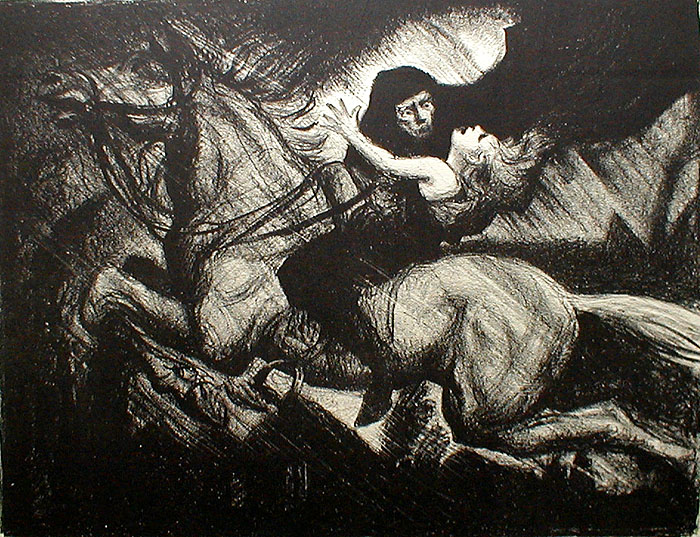
Albert Sterner, Der Erlkönig, c. 1910
We have seen that the powerful and good elves of Norse mythology over time became the powerful and malevolent nightmares of later Germanic folklore. In that vein, I need to say a word or two about the legend of the Erlking. As a distinct figure, the Erlking is a relatively recent addition to elf-lore. Even so, he has deep roots.
The Erlking comes from Scandinavian folklore, from a time when, as in England, elves had become depicted as creatures of dread. Originally, though, “he” was apparently a “she”: a deadly but seductive elfin woman. In his 1778 ballad, Johann Gottfried von Herder freely translated the generic “elfin maid” (Danish, elvermø) as Erlkönigs Tochter (“Erlking’s daughter”). In Danish folklore, old burial mounds were feared to be the dwelling place of the Elverkonge, the king of the elves. Eventually, this figure and his daughter were collapsed into a single character.
“Erlking” is a roundabout translation from the original Danish Elverkonge, “Elf-king.” In a particular Danish dialect, Elverkonge becomes Ellerkonge or Ellekonge, which was later understood with reference to the elletrae or “alder tree.” In other words, the “Elf-king” became the “Alder-king.” Some argue that this is purely a mistranslation. Others suggest that the change is intentional, a euphemism of the sort we have already seen when the superstitious avoid explicit mention of elves once their nature has turned malevolent. For what it’s worth, the alder tree has long been associated with faeries in Celtic folklore.
At any rate, in German, the figure is called the Erlkönig, the “Alder-king.” From German, we get the English semi-translation “Erlking.”
In the original tale, a knight named Sir Oluf is riding to his marriage but is bewitched by the music of elves in the woods. An elfin maiden appears and invites him to dance with her. When he refuses, she strikes him and sends him away. He is dead by the following morning, when his bride-to-be finds him.
The next version of the legend comes from Johann Wolfgang von Goethe. In his 1782 poem Der Erlkönig, the antagonist is the Erlking himself. In this version, the Erlking preys on children and his motives are never made clear. He is a force of death, not merely a magical woodland spirit.
There are a number of English translations of Der Erlkönig. Matthew G. Lewis (PDF) translated the poem in 1796. A contemporary translation has been done by A. Z. Foreman.
Goethe’s poem tells of a father riding through the forest with his feverish young son. The son is aware of the presence of the foreboding presence of the Erlking, who calls to him to leave his father and join him in his faery abode. The father, however, believes the son is merely hallucinating. In the end, the father arrives at home, but not before his son dies in his arms.
Franz Schubert used Der Erlkönig as the text for a Lied or art song for solo voice and piano in 1815. Here is a creepy animation of that piece:
Beowulf
Ryan Howse has provided a excellent brief summary of Beowulf and his contribution not only to Western culture but to fantasy fiction. The piece ends thusly:
Beowulf is one of the most influential texts in history, and it has a particular relevance for fantasy. John Gardner, the famous writer, wrote a take on the novel from the monster’s point of view, called Grendel. In this, Grendel was a figure of existentialism and angst who dies at the hands of the hero. Gardner also used Beowulf as a key text in his writing guide, The Art of Fiction: Notes on the Craft For Young Authors.
Michael Crichton wrote Eaters of the Dead, later turned into the film the 13th Warrior. Neil Gaiman and Roger Avary wrote a script forBeowulf that streamlined the narrative so that it followed causality, rather than the third tale being separate from the other two.
But of course, the most important reason that Beowulf is important is J.R.R. Tolkien. His love of Beowulf influenced Middle-Earth. Smaug is a literary descendant of Beowulf’s dragon, right down to the single piece of stolen treasure awakening him.
Do read it all. It’s short, and you’ll be better for it.
Elves Breaking Bad
Now that we have seen where elves got their beginning, let’s cross the North Sea for the British Isles to hone in a bit more closely on the elves of English folklore. As we do so, we’ll switch from Old Norse to Old English, a related language where we can spot a family resemblance in some of the terms we have already encountered. In Old English, for example, the equivalent of the Norse aesir is ése (singular, ós). The Old English equivalent of Norse álfar is aelfe (singular, aelf).
Kindly Elves
Germanic mythology first came to England with the Angles and Saxons in the fifth century. Early on, English elves enjoyed the same positive reputation as their Scandinavian kin. Aelf is found among terms denoting “good” supernatural beings, and thus fit to be used as an element in personal names. Thus, an Old English speaker might name his or her son Aelfwine (“elf-friend”) as easily as Oswine or Godwine (both meaning “god-friend”).
Other terms denoting “monsters” that pose a threat to humans, are excluded from Old English naming practices. There are no names, for example, that include the elements eoten (“giant”), dweorg (“dwarf”), or thyrs (“ogre”). It goes without saying that nobody who loved their child would put the word “ogre” in his or her name. By the same token, it ought to tell us something that putting the word “elf” in a name was perfectly acceptable.
So, at least in the early centuries of English settlement in Britain, elves were largely the same as the Norse conceived of them: powerful supernatural beings on the side of good. They were also considered to be human-sized. Contrary to much popular opinion, these elves were not diminutive beings. After an involved linguistic analysis, Alaric Hall concludes:
[I]t is unlikely that aelfe in early Old English were considered particularly small, invisible or incorporeal. Although it is not conclusive, the early Old English evidence suggests [that elves were] corporeal anthropomorphic beings mirroring the human in-groups which believed in them. This prospect is eminently well paralleled in medieval north-west Europe by the evidence for álfar, the medieval Irish aes sídhe, the inhabitants of the medieval Welsh Annwn, medieval Latin fatae and Old French fées, Middle English elves, and the Older Scots elvis. (Elves in Anglo-Saxon England, 67–68)
Evil Elves
Within a pagan context, the elves of Norse and early Anglo-Saxon mythology were numbered with the “good guys.” Although they might work in ways unfathomable to mere mortals, they were generally on humanity’s side in the cosmic struggle against giants, dwarves, and ogres.
When Christianity replaced paganism, however, elves were re-interpreted as creatures of darkness.
By the time of Beowulf (8th or 9th century), aelfe were aligned with “monsters” in common understanding. The writer(s) of the Beowulf saga describe Grendel and his kin as descendants of the biblical Cain:
That fierce spirit/guest was called Grendel, the famed border-walker, he who occupied waste-lands, the fen and the fastness, the homeland of the giant-race—the ill-blessed man inhabited them for a time, after the Creator had condemned him; the eternal Lord avenged that killing on the kin of Cain, because he [Cain] slew Abel. He did not profit from that feud, but the Measurer banished him for that crime, from humankind. Thence all misbegotten beings sprang forth, eotenas and aelfe and orcneas, likewise gigantas, which struggled against God for a long while. He gave them repayment for that. (Lines 102–14, end of fitt I; transl. by Hall, 70)
Rather than being on the side of humans against the giants, now the elves and the giants are kin. In the popular imagination, they became associated with physical ailments in humans and livestock, which they inflicted via the magic of elf-shot. The gods or ése didn’t fare any better: an Anglo-Saxon spell against a sudden stabbing pain seeks to protect the victim from harm, be it from “gods’ shot” (esa gescot) or “elves’ shot.”
Furthermore, elves were said to be the cause of nightmares. The German word for nightmare is, in fact, Alpdrücken, literally “elf-pressure.”
These darker, more malevolent elves eventually become the predominant conception not only in England but throughout the Germanic world. In many locales, even the word “elf” came to be avoided because of its sinister connotations. Thus, for example, In Iceland, for example, one finds the term huldufólk, “hidden people” or even liuflingar, “darlings.” This tracks perfectly with the habit in many parts of the world of referring to potentially dangerous spiritual beings with euphemisms lest they overhear and take offense: “the good neighbors,” “the fair folk,” “the kindly ones,” etc.
Nine Christmas Monsters
I’ve already mentioned many of these in my posts on Krampus and the Yule Lads, but I’m grateful for the rundown. Hans Trapp is new to me, but I had at least heard of all the rest.
 Darrell J. Pursiful