
Home » 2014 (Page 10)
Yearly Archives: 2014
The Fair Folk at War
Trooping Faeries

Trooping or social faeries are so named because they have a social organization that mirrors that of human beings with courts, feasts, banquets, royalty—and warfare. (See Ronald Hutton’s Typology of Faeries.) Although solitary faeries can be violent, they aren’t organized enough to engage in true warfare. Domestic faeries (brownies, urisks, and the like) are generally too kindly disposed for belligerent pursuits—although they can be individually malicious to those who don’t treat them with proper honor.
In Celtic lands, the principal social faeries are the daoine sídhe, an overtly aggressive and warlike race. Virtually every aspect of sídhe society has an adversarial element. As many unfortunates learned too late, every interaction with these proud people can become a challenge of honor demanding a swift and merciless response. Even their romantic relationships are often played out in terms of pursuit, conquest, and domination. It should not, then, be surprising that these Fair Folk can be given to organized violence.
On the one hand, tales abound of assaults upon human victims in reprisal for various affronts to honor or faery custom. On the other hand, these fae are often depicted fighting among themselves.
Warfare in the Mortal Realm
In Remains of Nithsdale and Galloway Song (Alexander Gardner, 1810), R. H. Cromek reports that priests warned against having dealings with faeries as they were the “light infantry of Satan” (236). The violent tendencies of faery warriors are enumerated: armed with bows and poisoned arrows, mounted on steeds whose hooves do not leave tracks. He goes on to write,
They visited the flocks, the folds, the fields of coming grain, and the habitations of man;—and woe to the mortal whose frailty threw in their power!—a flight of arrows, tipped with deadly plagues, were poured into his folds, and nauseous weeds grew up in his pastures; his coming harvest was blighted with pernicious breath,—and whatever he had no longer prospered. These fatal shafts were formed of the bog reed, pointed with white field flint, and dipped in the dew of hemlock. They were shot into cattle with such magical dexterity that the smallest aperture could not be discovered, but by those deeply skilled in Fairy warfare, and in the cure of elf-shooting. (237)
This is a fairly commonplace description of the violence faeries might inflict: blighting crops and livestock with elf-shot. Other Gaelic tales warn not only of arrows but also faery darts or javelins inflicting death or disease on unsuspecting mortals.
Other stories indicate the sídhe used their prodigious skills as shapeshifters to achieve tactical advantage: spying out the movements of mortals or gaining proximity to their targets by assuming the form of a deer or some other animal: the perfect camouflage!
The daoine sídhe are also known to take sides in great wars among human beings. W. Y. Evans-Wentz (The Fairy Faith of the Celtic Countries [Froude, 1911]) recounts the role the Tuatha Dé Danann played in the Battle of Clontarf, fought near Dublin on April 23, 1014.
And thus is described the meeting of the two armies at Clontarf, and the demons of the air and the phantoms, and all the hosts of the invisible world who were assembled to scatter confusion and to revel in the bloodshed, and how above them in supremacy rose the Badb:—‘It will be one of the wonders of the day of judgement to relate the description of this tremendous onset. There arose a wild, impetuous, precipitate, mad, inexorable, furious, dark, lacerating, merciless, combative, contentious badb, which was shrieking and fluttering over their heads. And there arose also the satyrs, and sprites, and the maniacs of the valleys, and the witches, and goblins, and owls, and destroying demons of the air and firmament, and the demoniac phantom host; and they were inciting and sustaining valour and battle with them.’ (306)
The “Badb” of which Evans-Wentz writes was the name of a Celtic war-goddess. Originally, however, the word signified “rage, fury, or violence” (Evans-Wentz, 304). In this context, it refers to a kind of glamour or mind-trick, inspiring warriors to lose themselves in battle-lust.
In fact, a number of mind-control tactics are associated with Celtic war-goddesses. The goddesses Neman, Macha, and Morrigan each exercise a particular supernatural power on the battlefield. Neman is a confounder of armies, causing allies to fight amongst themselves. Macha inspires bloodthirsty battle-fury. Morrigan inspires supernatural valor and courage under fire (Evans-Wentz, 302).
Note also that the sídhe have under their command various other types of supernatural beings: satyrs, sprites, “maniacs of the valleys,” witches, goblins, owls, demons, phantoms. They are, after all, “the Gentry,” and what good is being an aristocrat if there are no lower classes to dominate?
A picture is now developing of the Fair Folk at war. This picture includes:
- Arrows and darts capable of inflicting disease and death.
- Destruction of crops and livestock as an offensive tactic.
- Riding faery horses with magical characteristics.
- Shape-shifting to gain tactical advantage.
- Bending the minds of mortal combatants.
- Females actively involved in warfare.
- Commanding various types of faery beings (as “support troops”?)
War in the Faery Realm
Faery warfare is not limited to the mortal realm, of course. There are also tales of battles between the daoine sídhe and other mythical races.
The daoine sídhe are said to be the descendants of the Tuatha Dé Danann, the “people of the goddess Danu.” These Irish deities gained control of the island by going to war against other faery races, mainly the Fir Bolg and the Fomori.
They also fought among themselves. The sons of Midir, for example, rose up in rebellion against Bodh Derg, the son of the Dagda, and fought them in yearly battles. In another story, certain daoine sídhe went to war over “two lovable maidens who dwelt in the elfmound” (Evans-Wentz, 301).
Going to war over women brings to mind the story of the Trojan War. This is an apt comparison. Like the Homeric-era Greeks, it is easy to imagine the daoine sídhe going to war over issues of honor. It seems that most altercations involving mortals have at their root an honor challenge: proper respect has not been paid to the Fair Folk or their taboos. It may be that delivering or answering honor-challenges is a primary reason the Fair Folk go to war.
Warfare would most often be a small-scale affair by modern standards. By necessity, battles would be short, swift, and violent. The objective would be to get in, strike, and withdraw. Such attacks will not win large wars but are well suited to reduce the effectiveness of an enemy force, demoralize a fixed population, reduce the flow of supplies, capture towns for short periods of time, or demonstrate that certain targets, such as villages and civic centers, are in fact vulnerable.
If the daoine sídhe truly reflect or mirror the mortal culture from which they sprang, then it should be no surprise that warfare among them would largely be a matter of raids or ambushes to capture livestock, slaves, women, or valuables or to exact revenge for previous insults. This was how the ancient and early medieval Gaels waged war, after all.
Sunday Inspiration: Gratitude
Feeling gratitude and not expressing it is like wrapping a present and not giving it.
—William Arthur Ward
Critical Thinking Ain’t What It Used to Be
…and what it used to be is better than what often goes by that name today, according to Dennis Hayes. In fact, his latest column at The Conversation is titled “Let’s Stop Trying to Teach Students Critical Thinking.”
As a teacher, you have to have a critical spirit. This does not mean moaning endlessly about education policies you dislike or telling students what they should think. It means first and foremost that you are capable of engaging in deep conversation. This means debate and discussion based on considerable knowledge – something that is almost entirely absent in the educational world. It also has to take place in public, with parents and others who are not teachers, not just in the classroom or staffroom.
The need for teachers to engage in this kind of deep conversation has been forgotten, because they think that being critical is a skill.
It isn’t, Hayes says. It is a trait of character or even, perhaps, a way of life. He goes on to argue that the word “criticism” is often misapplied.
The idea that critical thinking is a skill is the first of three popular, but false views that all do disservice to the idea of being critical. They also allow many teachers to believe they are critical thinkers when they are the opposite:
- “Critical thinking” is a skill. No it is not. At best this view reduces criticism to second-rate or elementary instruction in informal and some formal logic. It is usually second-rate logic and poor philosophy offered in bite-sized nuggets. Seen as a skill, critical thinking can also mean subjection to the conformism of an ideological yoke. If a feminist or Marxist teacher demands a certain perspective be adopted this may seem like it is “criticism” or acquiring a “critical perspective”, but it is actually a training in feminism or Marxism which could be done through tick box techniques. It almost acquires the character of a mental drill.
- “Critical thinking” means indoctrination. When teachers talk about the need to be “critical” they often mean instead that students must “conform”. It is often actually teaching students to be “critical” of their unacceptable ideas and adopt the right ones. Having to support multiculturalism and diversity are the most common of the “correct ideas” that everyone has to adopt. Professional programmes in education, nursing, social work and others often promote this sort of “criticism”. It used to be called “indoctrination”.
- “Critical theories” are “uncritical theories”. When some theory has the prefix “critical” it requires the uncritical acceptance of a certain political perspective. Critical theory, critical race theory, critical race philosophy, critical realism, critical reflective practice all explicitly have political aims.
What, then, is criticism?
Criticism, according to Victorian cultural critic Matthew Arnold, is a disinterested endeavour to learn and propagate the best that is known and thought in the world. We should all be as “bound” by that definition as he was. We need only to teach the best that is known and thought and “criticism” will take care of itself. That is a lesson from 100 years ago that every teacher should learn.
Critical thinking seen as Arnold defined it is more like a character trait – like having “a critical spirit”, or a willingness to engage in the “give and take of critical discussion”. Criticism is always about the world and not about you.
Highway to Hel
Dan McCoy provides all the ins and outs of the Norse afterlife in this interesting article. I was interested to read what he thinks are connections between myths of journeys to the underworld and shamanic journeys described by other northern peoples.
What the sources do describe in uncharacteristic detail, however, is the course that one had to travel in order to reach Hel. Given how precisely they correspond to the narratives of traditional shamanic journeys of other circumpolar peoples,[2] they seem to recount, and possibly provide templates for, the journeys of Norse shamans. Throughout Old Norse literature, we find instances of such journeys to the underworld undertaken by gods or humans in order to recover a dead spirit or obtain knowledge from the dead.
…
Hel was located underground – down and to the north, the realm of cold and general lifelessness. It was reached by descending from a higher point with the help of a guide – an unnamed (dead) woman in Hadding’s case, and Sleipnir in the Prose Edda and the poem Baldrs Draumar (Baldr’s Dreams) in the Poetic Edda. After traveling through darkness and mist, one would come to a river, perhaps a torrential river of water, but more commonly a river of clanging weapons.[10] There was a bridge over the river that one had to cross. After a time, one would finally arrive at the wall surrounding Hel, but, for reasons we don’t entirely understand, it wasn’t thought wise to attempt to enter through the gate. More surreptitious ways were preferred. At that point, one would be, in spirit, in the world of the dead in their graves, and one had to take extreme precaution to ensure that one didn’t become trapped there while accomplishing one’s purpose, which is surely part of the reason why all of the surviving accounts of such journeys from northern Europe involve quests undertaken by gods, heroes, or other specialists rather than ordinary people.
Neolithic Orkney Stone Circle to Be Uncovered
The BBC have just reported that a major archaeological investigation is getting under way at one of Western Europe’s most impressive prehistoric sites.The Ring of Brodgar in Orkney is the third largest stone circle in the British Isles, but little is known about it.
The project will involve the re-excavation and extension of trenches dug in 1973. Geophysical surveys will also be undertaken to investigate the location of standing stones.
Dr Jane Downes of the Archaeology Department, Orkney College, UHI, and Dr Colin Richards of the University of Manchester are the project directors.
Rowling Writes to Grieving Teen
This is what a classy celebrity does.
Fifteen-year-old Cassidy Stay lost both parents and four siblings to a gunman in Texas last month. Cassidy was shot in the head and survived the gunshot wound only because she played dead. Authorities have called her survival a miracle.
Cassidy had seen the unimaginable, but was still thinking about happiness. At a memorial for her family, Cassidy gave a speech in front of media saying she believed her family was “in much a better place.”
Quoting the words of Dumbledore, the wise headmaster of Hogwarts, she said “Happiness can be found even in the darkest of times, if one only remembers to turn on the light.”
The same day Cassidy gave her speech, a Facebook page called “We want JK Rowling to meet Cassidy Stay” formed and quickly gained traction.
While the group page acknowledges that Cassidy is not a follower of the page, the creator claims to know a friend of Cassidy’s who “confirmed that JK Rowling did, in fact, write her a personalized letter from ‘Dumbledore’ (hand-written with purple ink). She was also sent a wand, an acceptance letter to Hogwarts with a school supply list, along with the 3rd book with JK’s autograph” the group post said.
May you find peace, Cassidy Shay. God bless.
If Randy Queen Doesn’t Like Criticism of His Art then He Needs to Take an Anatomy Class
Randy Queen is a comic book artist with… a not great understanding of female anatomy. This landed several of his works on Escher Girls, the tumblr blog that highlights and critiques (and sometimes offers redraws) of ridiculous and needlessly sexualized depictions of female characters (hence the name, and which io9 has featured before).
So, instead of taking heed of said criticism (and it’s sad that no one has screenshots of the taken down posts because they would have been on point) he files some tenuous DMCA takedown notices to Tumblr. Which complies, no questions asked. Now, I’m no legal expert, but I’m pretty sure criticism falls under fair use. Techdirt has a good write up of why that is. And tumblr has not only taken down reposts of Randy Queen’s comic art, but also redraws – works that (to my mind) belong to whoever did the redrawing.
Not content with misusing the law once, this guy has since also threatened Escher Girls with defamation for posting about his DMCA takedown notices (because saying that something that happened happened is now “defamation”), and claiming a very bogus “right to protect the perception of my IP.” Which doesn’t exist. Ever.
(And in spite of his whining about art from 15 years ago, I either can’t find anything more recent from him or his style and understanding of said human anatomy has not changed significantly.)
As Popehat always says, “vagueness in legal threats is a hallmark of meritless thuggery.”
So this post is just me doing my bit to acquaint Randy Queen with the Streisand Effect.
Warning: Comments appearing at the original post may not be suitable for all readers.
Sunday Inspiration: Teachers
The best teachers are the ones who show you were to look but don’t tell you what to see.
—Alexandra K. Trenfor
The Science of Super Heroes
The Week has the rundown courtesy of Sulagra Misna of World Science Festival: “The Science behind Captain America’s Shield, the Hulk’s Anger, and More.”
Balamob: Maya “Masters of the Night”
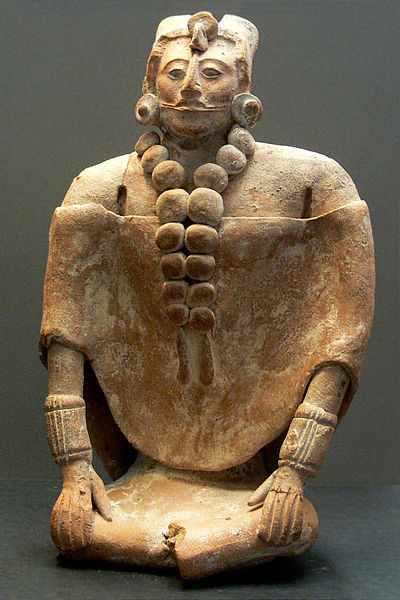
Maya dignitary
In the folklore of the Yucatec Maya exists a type of supernatural being called yumtsilo’b, “worthy or deserving lords.” This term designates a number of protector or guardian spirits who might be divided into three classes according to their functions or attributes:
- The balamob, charged with protecting people, farms, and villages.
- The kuilob-kaaxob (or ah canan k’aax), who watch over mountains.
- The chacob, who control the clouds and send the rain.
Though they can be distinguished by function, these are likely three names designating the same sort of being. According to Ascención Amador Naranjo,
In our opinion, these three categories are no more than invocations of a singular being that manifest according to the functions with which it identifies on a given occasion. In Maxcanú, the term used with the most frequency to refer to them as a whole is balam, which flows together with the other specific names in the references of the informants. (“Yumtsilo’b/balamob: los dueños de la noche,” Perspectivas antropológicas en el mundo maya, ed. María Josefa Iglesias Ponce de León and Francesc Ligorred Perramon [Sociedad Española de Estudios Mayas, 1993] 488. All translations of Dra. Amador Naranjo’s paper are my own)
Balamob (singular, balam) can thus refer either to all of these protective spirits or specifically to the first of Amador Naranjo’s three subtypes. Balam literally means “jaguar.” These beings are also sometimes called balam uincob or “jaguar people,” although the Spanish plural balames is also sometimes heard.
The jaguar was highly respected and venerated by the people of Central America. In pre-Columbian iconography, it is associated with gods and sacred structures. The Maya believed jaguars had the ability to cross between the mortal realm (associated with the day) and the realm of the spirit (associated with the night). Powerful kings and warriors also availed themselves of jaguar iconography.
The earliest depictions of balamob were as gigantic terrifying guardians of the four directions. In modern times, they are seen more as guardians of nature. They protect the people along with their villages and farms. Their main function is seen to be protecting people from evil or calamity during the night. One of Amador Naranjo’s informants describe them thusly:
“They are the ones that walk on the mountain, the masters of the mountain, who watch thus by night—or better said, who watch over us. They are ghosts, balam uincob.” (489)
Although their appearance is very similar to that of human beings—old men with white hair, beards or moustaches, dressed in traditional clothing also colored white—they are not of the same nature. Rather, they are described as creatures of “pure wind” or “pure air.”
Another function of the balamob is to instruct and help the h’men or medicine man. They feel a predilection for certain children, whom they take to their abodes to impart a knowledge of traditional medicine.
Like the mound-warriors of the American Southeast, balamob are sometimes said to dwell in ancient ruins. For this reason, many people fear to touch the ruins lest they provoke their ire.
Humans and balamob have a reciprocal relationship. Whenever a mortal takes something that belongs to the balamob, he or she must repay them. If they don’t, their crops might fail or they might fall ill. In this, the balamob sound quite similar to legends of “little people” all over the world.
Some contemporary Maya have folded their belief in balamob into their Catholic faith. They say, for example, that these beings are subordinate to the will of God although they have power over the forces and phenomena of nature that most influence people’s destiny. For many, the balamob‘s function of protecting mortals during the night takes on special significance on the night following Good Friday when, they say, the rule of the crucified Christ does not prevail upon the earth.
 Darrell J. Pursiful