
Home » 2014 (Page 12)
Yearly Archives: 2014
Agriculture and Food in Worldbuilding
Because lunchtime:
Worldbuilding: Food for the People by B. Pine.
Five Little People from the American Southeast

George Catlin, “Tchow-ee-pút-o-kaw,” 1834
The indigenous peoples of the American Southeast lived alongside one another long enough that many of their beliefs about the little folk have at least partially blended together. Carolyn Dunn has written a short article on Southeastern little people that draws from several cultural sources. The picture that emerges from such a cross-cultural survey of the little folk is more often than not quite coherent. If we think of little folk as a species, then we are dealing with a number of closely related subspecies that generally display the following characteristics:
- These creatures are very good at not being seen. They are selective about whom they permit to see them at all—generally only children or medicine people.
- They are more often mischievous than truly evil, although their pranks can be quite destructive. It is unwise to speak disrespectfully even of those who are well-disposed toward humans, however, as they are quick to take offense.
- They are often more kindly hearted toward children, often leading them home when they get lost in the forest.
- They live deep in the forest or in other out-of-the-way natural settings.
- They are often (but not always) associated with the healing arts. Many of these groups, in fact, serve as spiritual helpers to healers and herbalists and are often instrumental in initiating youngsters into the healing arts.
Here are five types of Southeastern little folk arranged roughly from north and east to south and west.
Yunwi Tsunsdi
There are two prominent groups of faery-like beings in Cherokee legend. There are the nunnehi, tall “spirit warriors” who are indistinguishable from ordinary humans (except for their magical powers), and the yunwi tsunsdi (yoon-wee joons-dee) or “little people,” child-sized beings who live in the rocks and cliffs.
Like the nunnehi, the yunwi tsunsdi prefer to be invisible, although they do sometimes appear to humans. Seeing them, however, is sometimes taken as an omen of impending death. They are well-proportioned and handsome, with hair that reaches almost to the ground.
Yunwi tsunsdi are depicted as helpful, kind, and magically adept. Like many faery creatures, they love music and spend much of their time singing, drumming, and dancing. For all this, they have a very gentle nature and do not like to be disturbed. Even so, they are said to harshly punish those who are disrespectful or aggressive toward them.
In Cherokee lore, the yunwi tsunsdi are divided into three “clans” with varying attitudes toward humans. The Rock clan is most malicious, the Laurel clan is merely mischievous, and the Dogwood clan is most benevolent.
Yehasuri
These Catawba little folk, whose name can be translated roughly “the wild people,” are about two feet tall and usually depicted as hairy. They are trickster spirits that live in the forest. They often live in tree stumps and eat a varied died including acorns, roots, fungi, turtles, tadpoles, frogs and bugs.
These little folk are said to behave in ways very similar to the faeries of Europe. They kidnap children, for example, and like to braid the manes and tails of horses. Like the elves of northern Europe, their magical arrows are deadly to mortals. They are said to attack anyone who gets too close to them.
One of their favorite tricks is to prowl around after dark and place spells on any children’s clothing that had been hung up to dry. This bewitched clothing would give babies colic. Therefore, conscientious Catawba mothers would bring in their infants’ clothes at dusk, wet or dry.
Yehasuris are sometimes used as bogeymen to impress upon children the importance of good behavior. Indeed, they do seem to target children more than anyone else. The only way to stop them is to rub tobacco on one’s hands and recite a particular incantation against them.
Este Lopocke
As with the Cherokee, the Muskogee people (Creeks and Seminoles) distinguish between two sorts of little people, one taller and the other shorter. And among the shorter, some are more benign and others are more harmful to humans. George E. Lankford reports the observation of A. S. Gatshet in the 1800s that
The Creek Indians…call them i’sti lupu’tski, or “little people,” but distinguish two sorts, the one being longer, the others shorter, in stature. The taller ones are called, from this very peculiarity, i’sti tsa’ptsagi [i.e, este cvpcvke, “tall people”—DJP]; the shorter, or dwarfish ones, subdivide themselves again into (a) itu’-uf-asa’ki and (b) i’sti tsa’htsa’na…. The i’sti tsa’htsa’na are the cause of a crazed condition of mind, which makes Indians run away from their lodges. (Native American Legends of the Southeast [University of Alabama Press, 1987/2011] 133)
I don’t know if this tracks perfectly with the Cherokee distinction between taller nunnehi and a number of clans or tribes of shorter yunwi tsunsdi, but it at least seems plausible. I certainly welcome any insight readers might be able to give me!
The este lopocke or este lubutke (ee-stee loh-poach-kee) live in hollow trees, on treetops, or on rocky cliffs. Their homes can be identified by an extra thick growth of small twigs of branches in the trees. Despite their small size, they appear strong and handsome, with fine figures and long but well-kept hair. They might let their toenails grow long, however.
These beings are especially known to appear to medicine people and guide them in finding the herbs they need. Encounters with the little people are considered sacred and not to be shared.
The Muskogee sometimes speak of the little people simply as “Gee” (“Ce” in normalized spelling), meaning “little,” so as to avoid using their full name. Even the helpful ones object to being mentioned in a negative or disrespectful way.
Iyagȧnasha
The little folk of Chickasaw lore are sometimes identified as tribal ancestors who now take up residence in the forest. They are said to be about three feet tall. Although they might help those who are in trouble, they are also likely to play tricks on those who have offended them. They allow themselves to be seen only to a few, mostly hunters or medicine people.
They do, however, interact with children. Sometimes they choose a child to live among them for a while to be given special powers of healing. When this child grows up, he or she becomes a healer or herbalist. They might teach other children how to pursue game, as they are accomplished hunters themselves.
Even so, it is considered ill-advised to live near the iyagȧnashas. The Chickasaw would move away from an area if they thought there were little people there.
The worst enemy of the iyagȧnashas is the wasp, the sting of which is fatal to them.
Hatak Awasa
There are several types of little folk among the Choctaw. One, the kowi anukasha, serves much the same role as the Chickasaw and Muskogee little folk in initiating young children into medicinal lore.
Another type, simply called hatak awasa (or hutuk awasa), “little men,” are similar to both the bogeymen and little folk of European myth. Children are warned to be good lest the hatak awasa snatch them away. Although their role can be sinister, they also preserve otherworldly knowledge handed down from olden times.
Sunday Inspiration: Solitude
I think it’s very healthy to spend time alone. You need to know how to be alone and not be defined by another person.
—Oscar Wilde
A Cashless Fae Society?
In Children of Pride, the Fair Folk do not use money and do not understand the concept of “payment” the way ordinary mortals do. How can an advanced society exist without money? The simple answer, of course, is because magic.
This Crash Course World History video provides an alternative explanation grounded in anthropology.
Bendith y Mamau: Ugly Welsh Faeries
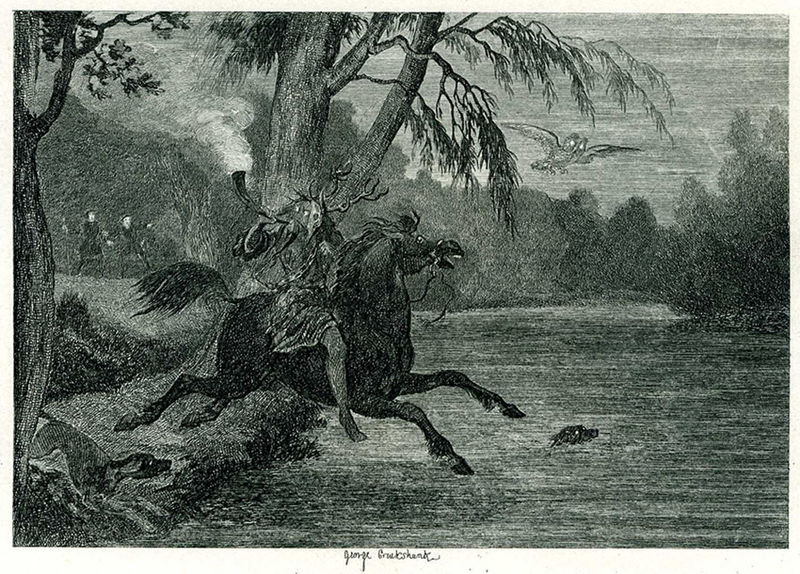
George Cruikshank, Herne the Hunter, 1840s
In Glamorganshire and Carmarthenshire, Wales, bendith y mamau (“mothers’ blessing”; roughly pronounced ben-dith uh mah-may) is a generic term for all faeries. The other Welsh term for faeries is tylwyth teg (“fair family” or “fair folk”). Some see these two terms as synonymous.
As in many faery legends, it was thought best to refer to the bendith y mamau with a flattering euphemism. In fact, there little that is “motherly” or “blessed” about these creatures. More often than not, they are, in fact, malicious and destructive in their dealings with mortals.
According to some accounts, these creatures are a grotesque cross-breed of goblin and faery. They possess the glamour or illusion-magic of faeries but the stunted and ugly appearance of goblins. Some say they have an affinity with either brownies or the pisgies (pixies) of the West Country.
The bendith y mamau are known to kidnap mortal children and replace them with their own hideous offspring, called crimbils. Stories suggest, however, that these mortal children might be returned many years later with only the faintest memory of their time among the Fair Folk. Bendith y mamau can be envious creatures, particularly of another’s beauty. They generally treat their captives well, however.
These faeries are also associated with Welsh underworld hounds. These beasts, usually called cwn annwn (“hounds of the underworld”) are sometimes also known as cwn bendith y mamau or simply cwn mamau. The appearance of these spectral dogs is thought to be an omen of death. They are also associated with the Wild Hunt.
Despite these unseemly characteristics, these faeries are also often skilled musicians and singers. Their music is capable of producing a trance-like reverie that erases a person’s memory, leaving them with only a faint recollection of the sweet music itself.
The Changing Face(s) of Fantasy
Adam Dalton describes the continuing relevance of the fantasy genre in this insightful article over at Fantasy Faction. He writes,
Things move on. Things evolve. It’s healthy that the fantasy genre does so too – it keeps it fresh, vibrant, progressive and alive. It keeps is strongly ‘relevant’ to new readers. There are some genres that are far less progressive (in literary terms), and that are beginning to fail. A clear example is the genre of horror. Book sales have all but died off entirely (although in TV and film horror still does well). Many Waterstones stores have entirely done away with their horror sections (hiding them in their Scifi/Fantasy sections or relabeling them as Dark Fantasy sections). Unless you’re Stephen King or James Herbert (RIP), you simply aren’t going to sell many books if your book is labelled ‘horror’. Horror is literally dead. Ironically dead. Dead. Justin Cronin’s The Passage was first launched as a horror, and it hardly sold. It was relabelled scifi and relaunched. Again no sales. Then it was launched as a literary fiction and it became a best-seller.
Because scifi in terms of book sales is also in massive trouble. Brian Aldiss…puts is down to the fact that we now ‘live in a scifi world’ and that we therefore no longer need to read scifi so much. ‘Every week there’s some new device or invention that comes out and we don’t know how it works! Strange and confusing technology is all around us.’ Mr Aldiss has put his finger on it for me – current readers just don’t see scifi literature as being as ‘relevant’ to them as past readerships did.
Yet fantasy survives and thrives! Where it was the poor cousin to scifi in the 1970s, it now utterly dwarfs (interesting verb!) scifi. How does fantasy do it? What’s the secret? Well, it’s the magic of fantasy, isn’t it? Magic is at the heart of that genre. It tricks, distracts, bewitches and bespells, where other genres merely appal or confuse. And it’s learnt to be relevant, to reflect the shifting dreams and fantasies of its readership, to reflect the current state of society. ‘The current state?’ you might frown. ‘But fantasy isn’t real. It’s precisely the opposite of that.’ Precisely. Look, you can’t get a job as a philosopher these days, so you have to become a reader or writer of fantasy. Fantasy is the fairground mirror to the real, the extension and twisted exploration of the real, the different way of seeing that enables real change.
I feel as if I owe an apology to the professors of philosophy I know for that line about not being able to get a job as a philosopher these days. But I didn’t say it, so you’re on your own.
More Page Views from Finland than the US Today?
What’s up with that? Do I need to put some haltias or tonttus in my next novel?
Tervetuloa.
And Kiitos.
Sunday Inspiration: Taking Chances
Some failure in life is inevitable. It is impossible to live without failing at something, unless you live so cautiously that you might as well not have lived at all—in which case, you fail by default.
—J. K. Rowling
Ronald Hutton’s Typology of Faeries
In the video I mentioned in this post, Prof. Hutton provided a concise classification system for the faeries of northern Europe. It is but one part of a fascinating and expertly presented lecture, and I’m summarizing it here because it fits nicely (though not perfectly) with the way I developed the Fair Folk one meets in Children of Pride. Hutton speaks of three basic categories of faeries in the British Isles:
1. Faeries proper, which Hutton describes as “the neighbors from hell.” These are the frightening and often malicious faeries one encounters in the oldest strands of faerie lore: the daoine sídhe and their cohorts. They live underground in a society that mirrors that of human beings, with courts, royalty (usually queens), banqueting, dancing, and the like.
2. Household helpers, including all manner of brownies, hobs, fenodyrees, and the like. These creatures are more mischievous than malicious, and they can sometimes be persuaded to help with the domestic and agricultural chores. But be careful, because they are easily offended and may just leave if one does something of which they don’t approve.
3. Faerie tricksters such as Robin Goodfellow. These are practical jokers, generally harmless or amusing rather than hostile. They are a rather late invention according to Hutton, largely under the influence of Shakespeare’s Puck. He is most assuredly not a pooka, which would better be understood as a dreaded “night being.” He further compares Robin Goodfellow to Native American trickster archetypes like Coyote as a trickster and buffoon, but also sometimes a powerful cosmic force. (Hutton does not use the specific terminology of “faery trickster,” but I think this is a fair description.)
He also notes a fourth category:
4. Nature spirits such as the pans and nymphs of Greek mythology. Properly speaking, Hutton says there are relatively few of these in the folklore of the British Isles. He further insists that these creatures are not, properly speaking, faeries at all since they fit into the natural realm in a way that traditional Anglo-Celtic faeries do not. Unlike faeries proper, beings of this type seem to be nearly universal in human cultures. Although Hutton insists such creatures are not faeries, he does say that the trolls or faeries of Iceland (and the related trows of the Orkney and Shetland Islands) are something of a hybrid between this category and the first. They are “land wights” who exercise guardianship over the land, but they are also said to live in underground communities and are often less than hospitable to human beings.
If you’re interested in the faery lore of the British Isles, you really owe it to yourself to listen to Prof. Hutton’s lecture.
Faery Beliefs on the Isle of Man
The Celtic Myth Podshow has posted a video of Prof. Ronald Hutton discussing Manx faery traditions.
Watch and listen to this fantastic lecture given by the wonderful Prof. Ronald Hutton about the Fairy Folklore on the Isle of Man. As always, not only is the Prof. exceedingly entertaining to listen to, but his gives us some superb information about the Fae history of the Island as well its traditional folklore. He finally regales us with a personal tale to have you in stitches! Superb stuff!
In this lecture Professor Ronald Hutton looks at how the Isle of Man is famous as an island full of fairy traditions: in some ways it may be regarded as having the greatest concentration of them in the British Isles. It therefore seems a good place in which to address the question of what traditional fairy beliefs – those shared by ordinary people until recent times – actually were.
You might be interested to know that the title of Children of Pride comes from Manx cloan ny moyrn, which can be translated something like “children of pride” or “children of ambition.”
 Darrell J. Pursiful