
Home » 2014 (Page 13)
Yearly Archives: 2014
D&D’s New Edition
I haven’t played Dungeons & Dragons since college, but it still has a special place in my heart. Here is a rundown of how the 5th edition, shortly to be released, stacks up against the 4th edition. To judge by this review, it sounds like a return to the kind of storytelling-based gameplay that first hooked me way back in 5th or 6th grade.
Si’lats: Middle Eastern Shapeshifters
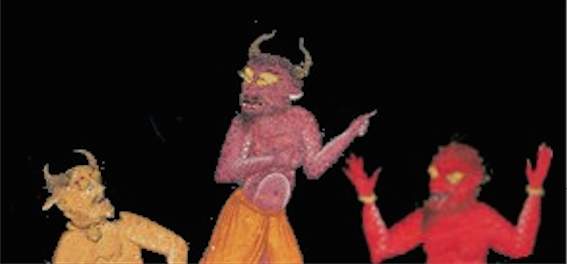
Ahsan-ol-Kobar, Ali and the Jinn (cropped), 1568
Si’lat, si’lah, or sila (plural sa’alin) literally means “she-jinn” or “she-ghul.” They are one of many types of jinn to inhabit the Middle Eastern world. In fact, they are often considered the smartest of jinn. They are talented shapeshifters who can easily pass as ordinary humans.
Sources vary on the morality of si’lats. Some assert they are the wickedest type of ghul; others that they are merely capricious tricksters who might either help or cause trouble for mortals.
Si’lats often dwell in woodlands, where they might capture travelers and force them to dance for their amusement.
Pre-Islamic traditions describe this jinn as sudden in appearance and disappearance, with a cat-like face, canine teeth, and a forked tongue.
Optics and Elvish Eyesight
Of course, this video doesn’t take account of magical elvish eyes! Still, I’m more and more convinced that a basic grasp of science and mathematics is a valuable tool for fiction writing in any genre.
Bracketology for Story Plotting?
Well, I certainly didn’t expect this! But it just might work, if you’ve got the mindset to pull it off:
Brackets in sports are used to match up opponents, and then show how the winners from those matchups go on to compete in turn.
The simplest kind of story to use this pattern would involve different characters who were each out to kill the others, ruin them, best them in a competition, or otherwise force them out of the plot.
Little Folk and Zoning: Not Just in Iceland
In September of 2012, a developer trying to build housing in Montville, Connecticut received some surprising news during a town hearing. They would need to alter their project because it threatened small stone structures that had been made by magical, dwarf-like creatures that lived underground.
Readers may be familiar with situations like this from Iceland, where construction projects are not allowed to harm the dwelling places of elves. But they are rare here in New England, where most people don’t believe in fairies, elves, and dwarves. (Bigfoot, ghosts, and UFOs are another story…)
However, magical little people are an ancient tradition among the Algonquian tribes that are native to this area, and the developer was planning to build 120 units of housing on Mohegan Hill, which is the historic and spiritual home of the sovereign Mohegan Tribe. Although the hill is not technically within the boundaries of the tribe’s reservation, it is still very important to them.
There follows an excellent introduction to the Makiawisug, the Fair Folk of the Algonquian traditions of New England.
Sunday Inspiration: Progress
If you can’t fly, then run,
if you can’t run, then walk,
if you can’t walk, then crawl,
but whatever you do, you have to keep moving forward.
—Martin Luther King Jr.
500 New Fairy Tales Discovered
Please hurry, English translators!
A whole new world of magic animals, brave young princes and evil witches has come to light with the discovery of 500 new fairytales, which were locked away in an archive in Regensburg, Germany for over 150 years. The tales are part of a collection of myths, legends and fairytales, gathered by the local historian Franz Xaver von Schönwerth (1810–1886) in the Bavarian region of Oberpfalz at about the same time as the Grimm brothers were collecting the fairytales that have since charmed adults and children around the world.
…
Von Schönwerth spent decades asking country folk, labourers and servants about local habits, traditions, customs and history, and putting down on paper what had only been passed on by word of mouth. In 1885, Jacob Grimm said this about him: “Nowhere in the whole of Germany is anyone collecting [folklore] so accurately, thoroughly and with such a sensitive ear.” Grimm went so far as to tell King Maximilian II of Bavaria that the only person who could replace him in his and his brother’s work was Von Schönwerth.
Outlining till It Hurts
While I’m waiting for The Devil’s Due to come back from my beta readers, I’m trying not to jump ahead and start working on the things I’m fairly certain they’re going to tell me about where the story could use some work. But I am filing away this nice piece of advice from Charlie Jane Anders about getting rid of the extraneous verbiage and making one thing flows from another in a logical manner.
Are you ready? Here’s the surefire advice for cutting without hitting muscle or bone: outlining. Specifically, keep outlining until it hurts. Outline things you’ve already rewritten a ton. Outline backwards. Do micro-outlines of every scene that’s not working.
The magic of outlining something you’ve already written and rewritten is, you can see where the actual beats are, and get a rough sense of just how much space each of the beats needs to have. (Not that pacing is an exact science, of course. Quite the reverse.) Outlining and re-outlining lets you see where you might have jumped a groove or had someone behave illogically, and also where you’re repeating steps.
And outlining backwards is magic. Start with the end, and then put “because” after that, and keep going back. This happens because this happens, because that other thing happens, and so on, back to the beginning. If you can’t stick a “because” between two things that are supposedly causally linked, that’s a bad sign.
Piecin’ a Quilt Is Like Livin’ a Life
“Did you ever think, child,” she said, presently, “how much piecin’ a quilt’s like livin’ a life? And as for sermons, why, they ain’t no better sermon to me than a patchwork quilt, and the doctrines is right there a heap plainer’n they are in the catechism. Many a time I’ve set and listened to Parson Page preachin’ about predestination and free-will, and I’ve said to myself, ‘Well, I ain’t never been through Centre College up at Danville, but if I could jest git up in the pulpit with one of my quilts, I could make it a heap plainer to folks than parson’s makin’ it with all his big words.’ You see, you start out with jest so much caliker; you don’t go to the store and pick it out and buy it, but the neighbors will give you a piece here and a piece there, and you’ll have a piece left every time you cut out a dress, and you take jest what happens to come. And that’s like predestination. But when it comes to the cuttin’ out, why, you’re free to choose your own pattern. You can give the same kind o’ pieces to two persons, and one’ll make a ‘nine-patch’ and one’ll make a ‘wild-goose chase,’ and there’ll be two quilts made out o’ the same kind o’ pieces, and jest as different as they can be. And that is jest the way with livin’. The Lord sends us the pieces, but we can cut ’em out and put ’em together pretty much to suit[75] ourselves, and there’s a heap more in the cuttin’ out and the sewin’ than there is in the caliker. The same sort o’ things comes into all lives, jest as the Apostle says, ‘There hath no trouble taken you but is common to all men.’
“The same trouble’ll come into two people’s lives, and one’ll take it and make one thing out of it, and the other’ll make somethin’ entirely different. (Eliza Calvert Hall, Aunt Jane of Kentucky)
 Darrell J. Pursiful