
Home » 2014 (Page 14)
Yearly Archives: 2014
Kowi Anukasha: Choctaw Forest Folk
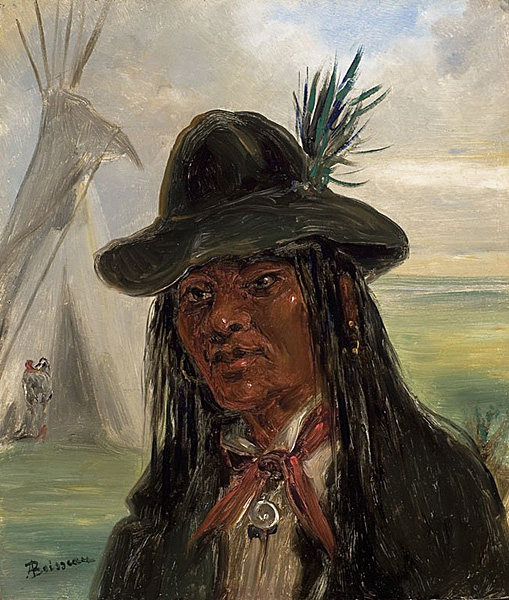
Alfred Boisseau, “A Choctaw Man in Louisiana,” 1844–48
Kowi Anukasha (also kówi anúkvsha, kwanokasha) are the little people Choctaw folklore. Their name literally means “forest dwellers.” They have powerful magic and can be very dangerous, although they are more often mischievous than malicious. They are often equated with another Choctaw figure, Bohpoli or “Thrower.” These beings were never seen by the common Choctaws, only the prophets and herb doctors. These reported that the kowi anukasha assisted them in the manufacture of their medicines. Some stories even give the account that Bohpoli would “steal” little young boys (from two to four years old) and take them into the woods, to teach them about herbs and medicines. The initiation follows a distinctive pattern:
When the little one is well out of sight from his home, “Kwanokasha,” who is always on watch, seizes the boy and takes him away to his cave, his dwelling place…. When they finally reach the cave Kwanokasha takes him inside where he is met by three other spirits, all very old with long white hair. The first one offers the boy a knife; the second one offers him a bunch of poisonous herbs; the third offers a bunch of herbs yielding good medicine. If the child accepts the knife, he is certain to become a bad man and may even kill his friends. If he accepts the poisonous herbs he will never be able to cure or help his people. But, if he accepts the good herbs, he is destined to become a great doctor and an important and influential man of his tribe and win the confidence of all his people. When he accepts the good herbs the three old spirits will tell him the secrets of making medicines from herbs, roots and barks from certain trees, and of treating and curing various fevers, pains, and other sickness.
A Muskogee equivalent is called este fasta or fastachee, guardian spirits associated with Seminole shamanic practices, providing the medicines contained in a medicine bundle and acting as intermediaries between the Creator and the people. They are said to provide both corn and medicine.
Harry Potter Rap
Just for fun. 🙂
Trinity Syndrome, or: What Was I Thinking, Writing a Female Protagonist??
Tasha Robinson laments the loss of many Strong Female Characters (a term she acknowledges is “more a marketing term than a meaningful goal”) to what she calls Trinity Syndrome:
For the ordinary dude to be triumphant, the Strong Female Character has to entirely disappear into Subservient Trophy Character mode. This is Trinity Syndrome à la The Matrix: the hugely capable woman who never once becomes as independent, significant, and exciting as she is in her introductory scene.
I’ll be the first to admit I have a lot to learn about writing female characters—which is kind of sad, since Children of Pride and its coming sequel, The Devil’s Due, are chock-full of them! Readers can decide if I’ve written “strong” female characters. Following the checklist Tasha provided, I’m at least on the right track. At any rate, I’m at least fairly sure I’ve written interesting female (and male) characters: motivated, complex, fallible, and, on some level, familiar.
The concluding paragraph is an excellent diagnostic:
So maybe all the questions can boil down to this: Looking at a so-called Strong Female Character, would you—the writer, the director, the actor, the viewer—want to be her? Not want to prove you’re better than her, or to have her praise you or acknowledge your superiority. Action movies are all about wish-fulfillment. Does she fulfill any wishes for herself, rather than for other characters? When female characters are routinely “strong” enough to manage that, maybe they’ll make the “Strong Female Characters” term meaningful enough that it isn’t so often said sarcastically.
Sunday Inspiration: Friendship
Friendship…is born at the moment when one man says to another, “What! You too? I thought that no one but myself…”
—C. S. Lewis
Griffins: Notes on Physiology and Ecology
Following on yesterday’s post on science in fantasy novels, I thought I’d share some of my musings on griffins. Next year, my daughter will start at a new school the mascot of which is the griffin. So even though I don’t have an immediate plans to put some of these creatures in a story, I do have a bit of a vested interest in wondering about them! Anyway, here is one way to envision griffins working in something like a scientifically plausible setting. I am quite certain there are others!
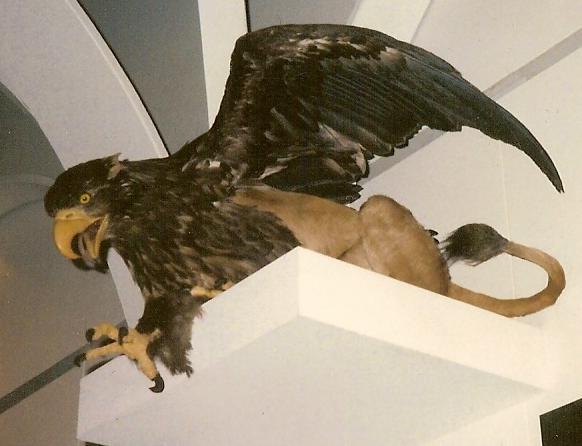
“Stuffed griffin,” Zoological Museum, Copenhagen, photo by Wikimedia user Funkysayri
Griffins appear to be a hybrid of bird and mammal. In fact, they are neither. Rather, they are descendants of therapod dinosaurs. They thus share a common ancestor with birds. While birds quickly learned to fly, however, the ancestors of griffins first became quadrupedal hunters for millions of years before finally taking to the skies. These proto-griffins filled the same ecological niche that the great cats did in more recent times. Their closest fantastic relatives are the hieracosphinx or hawk-headed lion of Egypt and the alce or wingless griffin of Central Asia.
The prehistoric ancestors of griffins were sufficiently bird-like to share several avian adaptations. Even the felid-like portions of their bodies maintain the strong, stiff (but lightweight) bone structure associated with birds. Their muscles are lighter than those of a true cat. Overall, modern griffins and their fantastic cousins weigh only between one-fourth and one-half of what a similar-sized felid would weigh.
A griffin’s feathers graduate from true avian feathers on the head, shoulders, and forelimbs, to downy feathers or protofeathers on the hindquarters that give aerodynamic contour to the body while at the same time making it appear more bulky than it actually is. From a distance, these feathers are easily interpreted as fur. In many species, this graduation ends with a scaly serpentine tail.
In other ways, griffins share a physiology and anatomy similar to both avians and therapods. For example:
- They have three digits on each fore foot and four on each hind foot.
- They have a distinctive carpal bone in the wrist (the semilunate).
- They have a wishbone.
- They lay ornithoid eggs and incubate them in a nest.
- They have a unique and highly efficient bird-like respiratory system.
- Their ribcage is braced by uncinate processes.
Griffins and related species all possess beaks resembling those of ceratopsians. Their young often retain teeth for the first year or so of life. Like birds, they vocalize through an organ in the throat called the syrinx. They are capable of various chirps, hoots, and shrieks similar to those of eagles and other large birds.
Due to a bizarre and unprecedented mutation, a population of winged, hexapodal true griffins developed some time in the early Cenozoic. These creatures possess enormous wings sprouting from their shoulders. In fact, a griffin’s wings and flight muscles make up nearly half of its total body weight. Griffins molt their flight feathers once per year, usually in late summer to early fall, but some evidence of molting can be seen at almost any time of year.
Griffins are soarers like eagles or vultures, relying on thermals and orographic updrafts to sustain their flight. Their strong wing muscles are capable of short bursts of (energetically costly) speed, and their relatively low aspect ratio makes them surprisingly maneuverable flyers for their size.
The archetypal griffin species is the Asian or Scythian griffin (Gryphus asiaticus). This creature is found in the Altai and Tian Shan Mountains of central Asia. It is easily recognized by its swept-back, pointed ears tufts (like a horned owl) and its long, tapering snake-like tail that may be as long as its entire body.
The largest of the griffins, G. asiaticus is comparable in size to a large lion but weighing only about 200 pounds. A large male has a wingspan of up to 25–26 feet. As might be expected, the creature has a voracious appetite. It must consume at least one-tenth of its body weight every day in order to power its flight. These creatures can consume up to one-third of their body weight at a single sitting, storing part of the meal in their crop so they don’t have to hunt every day. Depending on the population density of prey animals, the home range of a northern griffin can extend from 50 to over 300 square miles, roughly 18–20 times that of an eagle.
Asian griffins prey on deer, elk, wild goats, wild boar, and other fauna, but they have a particular fondness for horse meat. For this reason, they are apt to target foals in the spring and summer months. A 120 to 150-pound foal can easily be snatched on the wing by an adult male griffin and will provide enough meat for the male and his mate to eat for several days. A 550-pound yearling will feed a griffin hunting pair for over a week. (Like both lions and eagles, griffins will eat carrion if it is available.)
Although it doesn’t have the strength or body mass of a lion, a griffin can take down prey animals larger than itself by diving upon them at high speed like a falcon and quickly tearing into them with beak and talons. (Note that the Haast’s eagle of New Zealand hunted moas that weighed 15 times more than it did.)
Griffin feathers are tawny like a lion’s fur, but lighter—even white—on the underside of its body and wings. The feathers of the neck are variegated white, tawny, and blue.
Like all griffins, the northern griffin mates for life and rarely seeks a new mate if its first mate dies. The female lays her eggs, usually a clutch of three, in a nest she builds in a cave. These eggs are about the size of ostrich eggs but resemble striated agates.
Science in Fantasy Novels
So, I was just tinkering with a formula to quantify the relative magic-inhibiting capacities of iron on faery magic (1 horseshoepower = the amount of inhibition produced by a 4 kg wrought-iron horseshoe at a distance of 1 m) when I stopped long enough to check my RSS feeds. Well, what should I find but this observation from i09’s Annalee Newitz: “Science in Fantasy Novels is More Accurate than in Science Fiction.”
Here’s a snippet:
One might argue that good worldbuilding in fantasy always involves hard science. Authors from N.K. Jemisin to George R.R. Martin and Ursula Le Guin have created alternate worlds whose geology, climate, and ecosystems are so good that they’ve captured the imaginations of scientists. These stories represent earnest attempts to create new environments based on what we know from studying the deep history of our own world.
And this:
Given what I already pointed out about how magic and advanced technology are basically indistinguishable in science fiction, we’re going to have to admit that there’s something other than magic that divides “fantasy” from “science fiction.” It seems to be the kinds of science the two genres tackle. The hallmarks of rigorous science fantasy are a focus on Earth science, as well as biology and ecosystems. Science fiction, on the other hand, tends to focus on physics, cosmology, and engineering. Both genres often incorporate anthropology and political science.
What do you think? Does she have a point? And, what sorts of scientific accuracy do you enjoy reading in a fantasy novel?
Christine Amsden’s Review of Maleficent
Thinking about going to see Maleficent? According to Christine Amsden, you should! At her blog Into the Dreaming, she has written a glowing review.
I don’t really want to spoil this movie for you. I did see bits of it coming, but I didn’t even mind because the delivery was excellent. The acting was strong, especially by Angelina Jolie (Maleficent). I cannot recommend this movie enough to adults and older children (not the young ones — I’m on the fence about letting my 6-year-old watch).
Fairy Mythology at Mythic Scribes
Alice Leiper gives a succinct introduction to fairies in myth and literature over at Mythic Scribes.
Sunday Inspiration: Simplicity
Sometimes the questions are complicated and the answers are simple.
—Dr. Seuss
 Darrell J. Pursiful