
Home » 2014 (Page 19)
Yearly Archives: 2014
Sunday Inspiration: Mystery
The most beautiful thing we can experience is the mysterious. It is the source of all true art and science. He to whom this emotion is a stranger, who can no longer pause to wonder and stand rapt in awe, is as good as dead: his eyes are closed.
—Albert Einstein
Who Doesn’t Need a Few Pterosaur Facts?
The American Museum of Natural History is putting together a first-of-its-kind pterosaur exhibit called “Pterosaurs: Flight in the Age of Dinosaurs.” Mark Norell, chair of the museum’s paleontology division, was instrumental in putting the exhibit together. He offered the fine folks at mental_floss an early look, and Erin McCarthy has posted a run-down of ten interesting facts you might not have known about this fascinating creatures.
Five Fantastic Beasts of North America
J. K. Rowling’s Fantastic Beasts and Where to Find Them is going to become a movie trilogy. The movies, billed as an “extension” of the wizarding world rather than a true prequel to Harry Potter, will no doubt feature Newt Scamander, renowned magizoologist, in his quest to describe and catalogue the many magical creatures that live just beyond the reach of Muggle science.
I enjoyed the Fantastic Beasts book quite a bit, and it will be interesting to see what sort of narrative Rowling manages to weave around it. At the same time, I must confess I was a bit disappointed with Rowling’s treatment of the fantastic beasts of the New World. It seemed several really obvious creatures from Native American mythology as well as later folklore were passed over in favor of made-up beasties which, though clever, didn’t quite resonate with me the way the dragons, unicorns, hippogriffs, and other European creatures did.
Here, then, are five fantastic beasts I wish Newt Scamander had encountered in his travels through North America.
1. The Horned Serpent
 Horned serpents are powerful magical beings in many Native American mythologies. I’m thinking particularly, however, about the uktena of Cherokee folklore. These malevolent and deadly monsters inhabit deep underwater pools as well as the high mountains.
An uktena is as large around as a tree trunk. Its scales glitter like sparks of fire. It has horns on its head, naturally, and a bright, diamond-like crest on its forehead. This crest is greatly prized, as one who can retrieve it is supposedly imbued with the power to become a great wonder-worker. This is a dangerous quest, however, because the uktena’s dazzling appearance draws people toward the creature when they should be running away.
2. The Water Panther
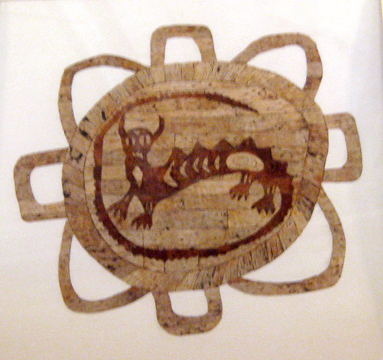 The mishipeshu or mishibijiw is a figure found in the folklores of Algonquian-speaking peoples throughout North America. It is called by various groups the water panther, underwater panther, or great lynx.
This fantastic beast is essentially a cross between a large cat (a cougar or wildcat) and a dragon. It is covered in scales, with dagger-like spikes on its back and tail. The Iroquois have their own version of this creature that actually breathes fire!
The water panther is a powerful underworld being, master of all water creatures, including snakes. In the Great Lakes region, it is said to guard great treasures of copper.
3. The Thunderbird
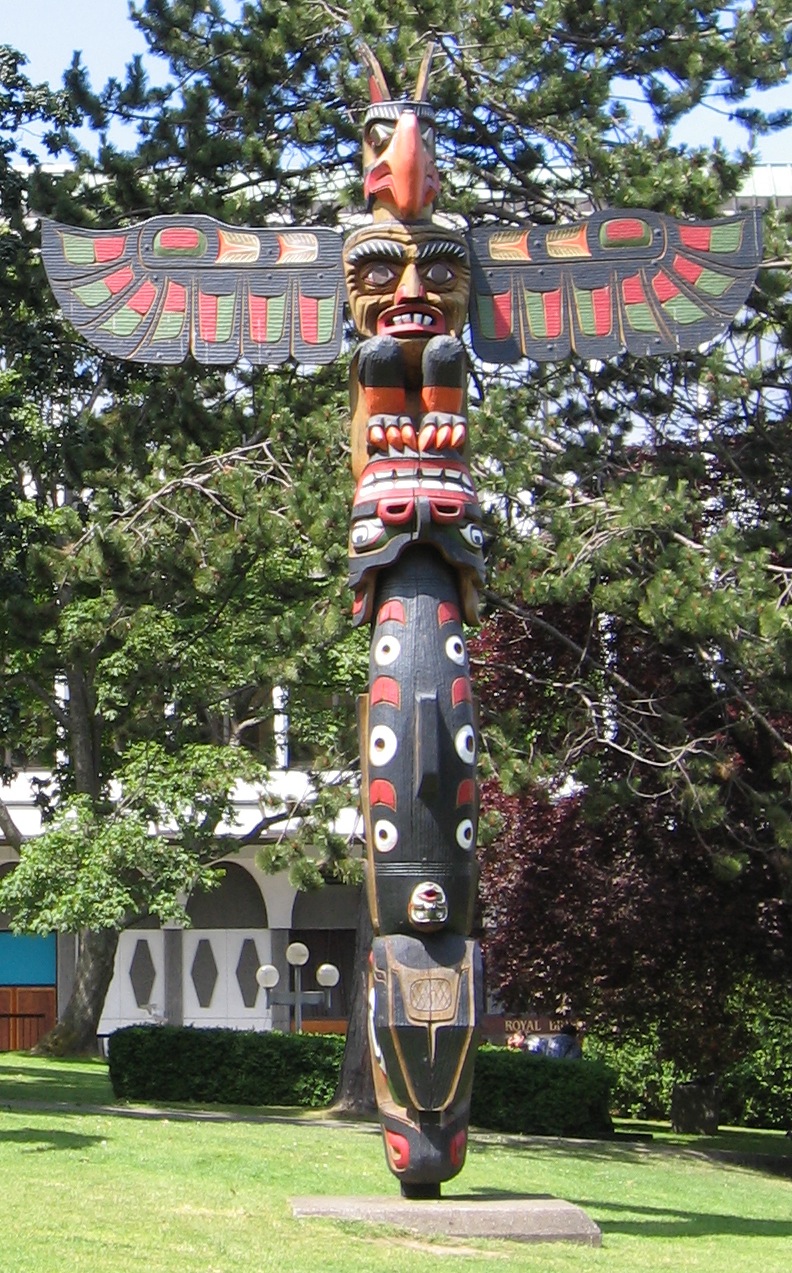 According to many Northwestern tribes, thunderbirds are formidable creatures large enough to carry a killer whale in its talons as an eagle carries a fish. It is essentially a huge predatory bird of supernatural origins, perhaps related to the eagle or the vulture. The thunderbird is responsible for the sound of thunder and, in some cases, lightning as well.
Native American groups have different traditions regarding these creatures. In some tribes, they are considered extremely sacred forces of nature. In others, they are considered powerful but otherwise ordinary members of the animal kingdom.
4. The Jackalope
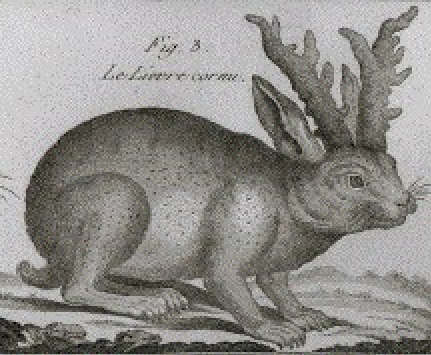 The first three fantastic beasts come from mythology. This one doesn’t have quite such a lengthy pedigree, although I think it would be a perfect fit in any revised edition of Fantastic Beasts and Where to Find Them. The jackalope is a rabbit- or hare-like creature from the American West, but is distinctive in that it possesses antlers like antelope. Although reportedly a shy creature, it is also said to be quite aggressive when threatened.
Jackalopes are also known for their uncanny ability to mimic the sounds of the human voice. They are especially vocal before thunderstorms, and it is theorized that this is because they only mate when lightning flashes.
Some reports suggest the jackalope is near extinction.
5. The Jersey Devil
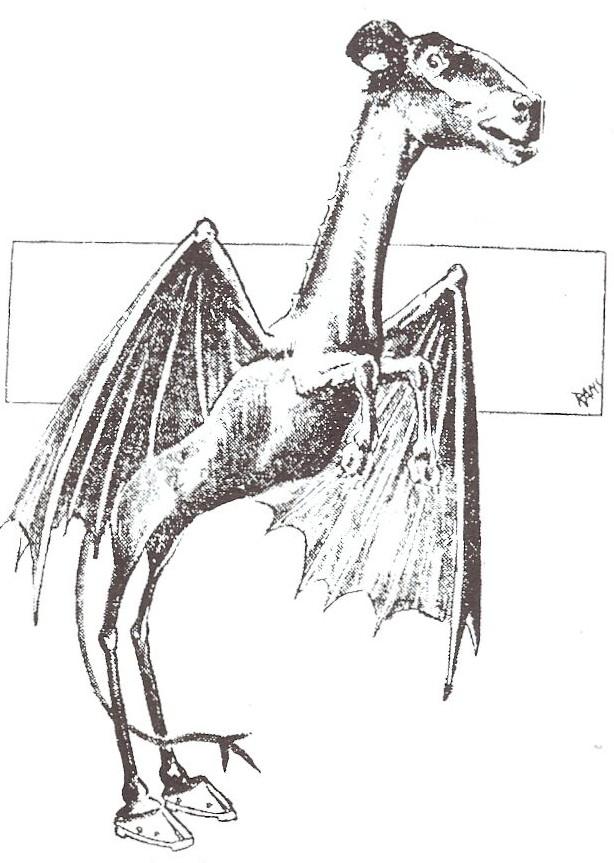 The origins of the Jersey Devil lie in colonial times, although sightings of the creature continue to this day. It is a creature of the Pine Barrens region of New Jersey, but it has also been sighted in adjacent parts of New York and Pennsylvania. Although descriptions vary, certain features seem to be most prevalent: bat-like wings, hooves, tail, bipedal posture, glowing eyes, and an elongated head like a horse’s (or perhaps a dog’s). It is an omnivorous creature that has been sighted scavenging in trash cans as well as preying on smaller farm animals such as goats.
The Jersey Devil makes a number of discrete vocalizations, including a piercing scream and a dog-like bark.
Based on the legends concerning the origins of this creature, I suspect Newt Scamander would theorize that this is not an ordinary beast but rather the product of some sort of Dark magic.
The Museum of Wonder
Yeah, like I’m not going to link to this! From Atlas Obscura:
The Museum of Wonder is the work of Alabama artist Butch Anthony who has been collecting discarded items and other junk since he was ten years old. After becoming selling a friend’s painting of a turnip almost by accident, Anthony realized that there could be money in art made from the items he had simply collected as a matter of course for his whole life. Using everything from animal bones to rusted metal to jars full of creepy looking dead critters, Anthony filled his former taxidermy shop with homemade pieces of art and objects of curiosity.
Sunday Inspiration: Kindness
Kindness is a language which the deaf can hear and the blind can read.
—Mark Twain
Mmoatia: Ghanaian Tricksters of the Forest
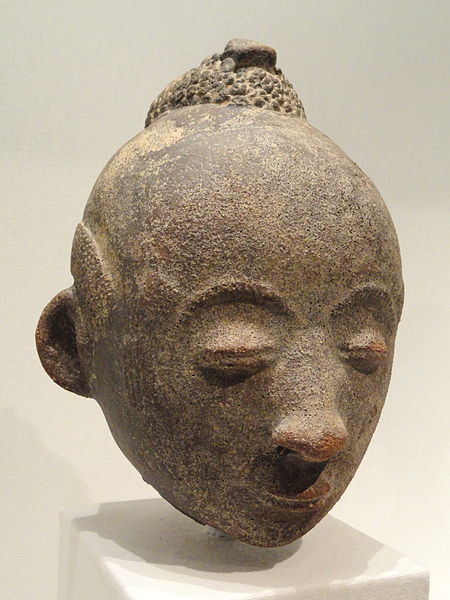
Terracotta head (mma), art of the Akan people of Ghana
Mmoatia (singular, aboatia) are forest dwellers known to the Akan or Ashanti people of Ghana. In traditional religious thought, they are seen as a subclass of abosom, intermediary spirits or deified ancestors. They are believed to be very short in stature, standing not more than one foot high—although this may be a reference to carved wooden representations of them and not to the beings themselves. They have curved noses and yellowish skin. Their feet are said to point backwards.
These beings communicate with each other through a unique whistle language, and whistling in the bush is a sure way to draw their attention.
They are credited with a phenomenal knowledge of medicines, which they are willing to impart to herbalists or medicine men. Sometimes Ghanaians are taken by mmoatia that live deep in the woods. Some who are captured by the mmoatia begin to learn their ways and emerge after several years as herbalists. The mmoatia have always lived in the jungle and know how to use its plentiful resources to cure to all diseases. Their favorite food is bananas.
Mmoatia are divided into three tribes or bands: Black Mmoatia are harmless, but Red and White Mmoatia are always up to some kind of trickery—though they are not truly malevolent like the sasabonsam, a vampire-like ogre. Mmoatia signify unpredictability, mockery, and trickery. They function as messengers between the realms of spirit and corporeality—messengers of the abosom.
If You Ever Wanted to Visit a Stone Age Settlement…
Denmark has a theme park for that. Land of Legends (Sagnlandet Lejre) features living-history type recreations of life in several historical eras: Stone Age, Iron Age, Viking, and even some nineteenth-century farming cottages. As Atlas Obscura explains,
From the Stone Age to the Iron Age, Land of Legends attempts to mix fun with the gritty realities of pre-industrial society. The park was actually established in 1964 as a site where archeologists and anthropologists could attempt to recreate ancient civilizations among the natural bogs, lakes, and woodland of the area. The researchers would reconstruct Iron Age farming equipment and housing, attempting to learn more about era’s in the distant past by experiencing them. The actual benefit of the experiments were controversial, but people flocked to the site to watch the pioneering scientists work.
Today, the site has embraced the public’s interest in its work and evolved into a park that invites visitors to come and experience life in the past for themselves, all while the experimental reconstruction continues. The major historical reconstructions at the site now include the original Iron Age village, a Stone Age camp, a Viking market, and a smattering of 19th century farm-cottages. Visitors can try their hand at some labor intensive farming, ancient handicraft, or simply watch the archeologists work.
Environmental and Historical Preservation of Faery “Homes”
Whether out of respect for faeries, the environment, or history, a number of archeological sites and stunning natural vistas have been preserved in northern Europe, as Melissa Marshall describes in an article at Atlas Obscura titled “Fairy Forts, Dens, & Glens: When Places Are Preserved by Mythical Belief.”
In an effort to avoid the wrath of the fairies, communities of the British Isles and Ireland have protected the fairy “homes,” and as a result have preserved sites of great beauty from development and destruction, which is a kind of magic in itself. Conversely, more than a few lovely spots have become damaged and even threatened with destruction by enthusiastic fairy hunters.
Ireland’s Fairy Forts — more properly known as ring forts — are the remains of strongholds and other dwellings dating back as far as the Iron Age. However, local tradition holds that fairies make their home in these ring forts and terrible luck will come to anyone who participates in their destruction. These folk beliefs seem to only date back to the 12th century, but they were strong enough to allow thousands of ring forts to grow wild as the rest of the land was being cultivated for human use.
In modern times, folk beliefs alone have often not been enough to preserve these archaeological sites. In Iceland, protection of elf homes (elves being supernatural cousins of faeries) is codified into building codes and even made a semi-official vocation at Elf School, and yet some cynics avow that non-believing environmentalists might be exploiting folk beliefs to protect the island’s pristine eco system.
It’s a very interesting article that addresses the many conflicting motivations—and results—of setting aside certain places “for the faeries.”
Hercules Trailer
This trailer for the Hercules movie starring Dwayne “the Rock” Johnson looks a lot more herculean than the other Hercules movie that came out a while back. Apparently, it takes place after the famous Twelve Labors, but there are flashbacks. I spotted Cerberus, the Hydra, the Nemean Lion, and the Erymanthian Boar. At least we’ll be treated to a Hercules who actually bears some resemblance to his myths.
I’d still love to see a Hercules movie where the hero is called by his Greek name, Herakles. Especially if his immortal father is called Zeus, not Jupiter.
(H/T: io9)
I’ll Be Back!
I haven’t posted much lately for a few reasons:
(1) I’ve recently gotten back from a business trip and have needed to get back up to speed at my day job.
(2) I’ve been busy celebrating my little girls’s thirteenth birthday.
(3) The MERCER BEARS and their NCAA championship run have consumed a fair bit of my attention span.
But don’t lose hope. I’ve also managed to get a fair bit of writing done on The Devil’s Due, the sequel to Children of Pride.
If you have a question or a topic you’d like me to blog about, please feel free to leave me a comment!
 Darrell J. Pursiful