
Home » 2014 (Page 21)
Yearly Archives: 2014
Sunday Inspiration: What Should I Do?
When you get your “Who am I?” question right, all the “What should I do?” questions tend to take care of themselves.
—Richard Rohr
Robert Kirk’s Secret Commonwealth
The Celtic Myth Podshow has a brief introduction to the life of Robert Kirk, an Irish clergyman most famous for his 1691 book The Secret Commonwealth of Elves, Fauns, and Fairies.
Kirk’s account of the secret commonwealth combines the banal with the surreal. They live in houses underground that are large and fair, lit with lamps and fires but without fuel to sustain them. They may abduct mortal women to nurse their children. Their clothing and speech is that of the country they live in. Their life span is longer than ours, but eventually they die. They have rulers and laws but no discernible religion. Moreover, unlike us, they do not have a dense, material form but have, in Kirk’s words,
“Bodies of congealed Air”.
Every Quarter they travel to fresh lodgings, a reference perhaps to the elemental tides of the seasons.
Build Diversity into Your Fantasy Setting
As Alice Leiper explains, the best way to build diversity into your fantasy setting is, well, to world-build it.
By considering diversity from the outset, you can create a world in which diversity is natural and normal without it feeling “unrealistic”, by developing geographies and cultures organically rather than defaulting to pseudo-medieval European.
Yumboes: Senegalese Little Folk
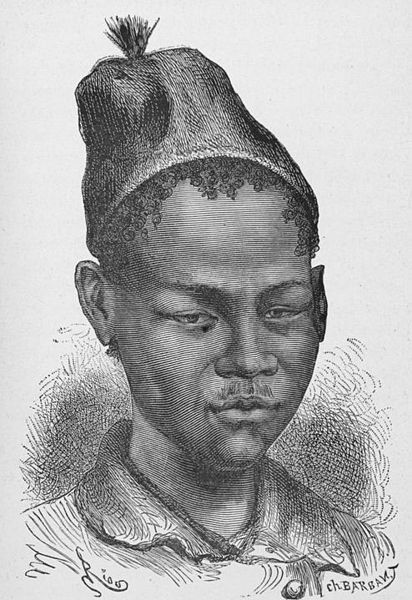
Wolof type by Edouard Riou
Yumboes are part of the Wolof folklore of Senegal. These beings are also called bakhna rakhna, “Good People.” They are described as about two feet in height, and of a pearly-white color. (White skin is often a property of supernatural beings in African beliefs). They also have silver hair.
The “Good People” attach themselves to a chosen family and love and care for them. When a member of that family dies, they develop great compassion for the grieving family members and try their best to lament them. It is also traditional that the Yumboes dance upon the grave of the deceased victim.
The Yumboes live beneath the Paps hills, three miles inland from Goree Island, and come out to dance in the moonlight. They feast on large tables, served by partially invisible servants (only feet and hands are visible). They invite both natives and foreigners to their feasts.
The Wolof say Yumboes live just like people. They have been spotted at night in their fishing boats hoping to catch a late snack. They bring this fish to the land in search for some fire to roast it. Unlike humans, the Yumboes do not make their own fire but they steal the burning wood of campfires from human natives but they only take as much as is needed to roast their fish. They are also very fond of corn, which they also steal. Yumboes are very fond of plum wine. When the wine turns sour, they drink it with great joy until they become very drunk. In such a drunken state they sing loudly, make much noise by beating on drums and generally acting wild.
The Science of Dragons
In the Memoirs of Lady Trent series, Marie Brennan does something somewhat unique with her dragons: she attempts to ground them in science. She explains why in an essay posted over at io9.
Maybe we should blame dinosaurs. Giant reptilian creatures did exist once upon a time; why couldn’t giant reptilian creatures with wings exist? Well, because physics — but the inner eight-year-old, the wide-eyed child who shelves books about dinosaurs right alongside fantasy stories with no regard for boundaries, doesn’t care about the equations. (One wonders what the long-term effect will be of the realization that dinosaurs actually had feathers. Will we see more feathered dragons cropping up in genre fiction, a la the Aztec quetzalcoatl?)
Or maybe it’s the sheer nerdy challenge of it. The same impulse that makes people build working computers in Minecraft or postulate the likely outcome of a battle between Alexander the Great and Genghis Khan might lead you to wonder whether dragons couldwork, and if so, how. I know from personal experience that there’s nothing like application to make a dry and tedious topic interesting; no doubt generations of biology students have entertained themselves by fiddling around with matters like bone structure and oxygen exchange, trying to find a way to make dragons fly.
Then, of course, there’s the amusement factor. NORAD — the North American Aerospace Defense Command — tracks Santa’s progress around the world every Christmas. Why? Because in 1955, a Sears ad gave children Santa’s phone number . . . but the number they gave accidentally went to the duty commander at NORAD’s operations center. (Oops.) Utter silliness, but the point isn’t to be serious; it’s just a chance for adults to kick back and enjoy some imaginative play. We’re more willing to allow that to grown-ups now than we used to be, so I think you get more intersections of adult knowledge with childish whimsy as a result.
I love this kind of world-building, having worked out something of the science of both unicorns and griffins—and hoping eventually to work it into my Into the Wonder series in some way. I also know a fair bit more about the physiology and evolution of dwarves than I’ve tipped my hand to so far…
At any rate, I will definitely have to put the Memoirs of Lady Trent series on my wish list!
What do Voldemort, Mordred, and Professor Moriarty Have in Common?
A phonestheme, of course. James Harbeck of The Week explains why so many villains’ names include the element “mor.” Along the way, you’ll learn that a phonestheme is “a part of a word that tends to carry a certain connotation not because of etymology or formal definition but just by association.” So, “mor” words tend to suggest darkness, evil, or death. Words that start with “sn” tend to have to do with the nose (sneeze, snore, sniffle, etc.). Sometimes, words even shift their pronunciation in the direction of the phonestheme once it has reached a certain critical mass. Mordred from the Arthurian legends was originally Medraut.
Keep all this in mind the next time you face down a pack of hungry Morlocks, or decide to take a stroll into Mordor.
Interesting Facts about the Irish Language
Irish is a Celtic language, which means it is distantly related to Welsh. In distant prehistory, Irish and Welsh were married. Eventually, however, they got a divorce. In the settlement, Welsh got custody of most of the consonants while Irish got custody of most of the vowels.
Anyway, with Saint Patrick’s day coming up—and given the importance of Irish language and folklore to the faery mythology—I was pleased to see a Mental Floss article on “8 Fun Facts About the Irish Langauge” by Akira Okrent.
You might also appreciate this Beginner’s Guide to Irish Gaelic Pronunciation. Or just do what I do and find a computer to pronounce it for you.
Sunday Inspiration: Doing Right
You must never be fearful about what you are doing when it is right.
—Rosa Parks
Whence Charlotte’s Web?
In a letter to his editor, reproduced at Letters of Note, E. B. White explained where the idea of Charlotte’s Web came from, and why a farm is an especially appropriate place to reflect on death and dying:
A farm is a peculiar problem for a man who likes animals, because the fate of most livestock is that they are murdered by their benefactors. The creatures may live serenely but they end violently, and the odor of doom hangs about them always. I have kept several pigs, starting them in spring as weanlings and carrying trays to them all through summer and fall. The relationship bothered me. Day by day I became better acquainted with my pig, and he with me, and the fact that the whole adventure pointed toward an eventual piece of double-dealing on my part lent an eerie quality to the thing. I do not like to betray a person or a creature, and I tend to agree with Mr. E.M. Forster that in these times the duty of a man, above all else, is to be reliable. It used to be clear to me, slopping a pig, that as far as the pig was concerned I could not be counted on, and this, as I say, troubled me. Anyway, the theme of “Charlotte’s Web” is that a pig shall be saved, and I have an idea that somewhere deep inside me there was a wish to that effect.
(H/T: io9)
“A Winner!”
I’m grateful to Jan for her very kind review.
Unlike the one-dimensional characters in many books for young readers, the characters in Children of Pride are complex and multi-faceted. Throughout the story’s interesting plot twists and turns, the characters face situations that test and ultimately reveal the direction of their moral compass. The story accomplishes the difficult task of being accessible to the younger readers of this genre, while at the same time offering them intellectual challenges that lead to learning and growth.
 Darrell J. Pursiful