
Home » ITW Exclusive (Page 2)
Category Archives: ITW Exclusive
If Only in My Dreams (Part 2)
“Did you know mortals exchange gifts at Christmas?” Rune said.
“Or course,” Janks said. “You didn’t?”
“I’ve only been on this side a few months. This is my first Christmas.”
“It’s a lot like Yule,” Janks explained. “Usually me and my brothers get together up north and just kinda cut loose.”
“But not this year?”
The troll sighed. “You know how it is. People say things, do things.” He said nothing for several steps, then, “We ain’t talked in a couple of years.”
Family conflicts were the worst. Rune nodded but said nothing.
“So you wanted to get some mortal a present?”
“My landlords have been…very understanding lately. I’m short on cash, but I’ve got good credit with Madam Samarra. You know about her?”
“Runs that New Age bookshop on Bardstown, right? I hear she sells magic stuff—I mean our kind of magic stuff—out of a back room.”
“That’s the one—and yes, she does. But I just wanted some kind of trinket or something for the Colemans. None of ‘the good stuff,’ as she calls it.”
Rune gestured, and he and the troll turned onto Jefferson Street.
“When I got there, she was beside herself. Says a girl had just made off with something from the back: a little hand-held indifference engine.”
Janks sucked in a breath. “What I wouldn’t give for one of those!”
“She couldn’t exactly call the police, given what the girl had stolen, so…”
“So here we are, tracking down a thief.”
“I’d have turned the job down if it weren’t for the Law of Secrecy.”
“I hear you,” Janks said. “You let yourself be known to folks in the Fallow, there’s no telling what kind of backlash it’s gonna bring. One of my brothers had a horn growing out of his forehead for six months.”
“And a child might not be as careful as we would.”
“Crashing waves, you’re right,” Janks said with a gasp. “It’s hard enough for a full-grown troll to remember the rules, but a kid…”
“Yeah.”
“And Madam Samarra says she was a goblin?”
“Looked like one: dusky-skinned, big eyes, four feet tall or maybe a little more. Said she was almost grown, but she could probably pass for a younger human child if you didn’t look too closely. She ran out of the shop and headed north. All I could do was follow her trail”
“And that’s how come you ended up talking to me.”
“Right,” Rune said. “Here we are.” The rescue mission was a block ahead. He didn’t bother to disguise himself with glamour. He had seen humans with high-arching eyebrows, with hair the color of corn silk, and even sometimes with squarish corners at the tops of their ears. People sometimes noticed there was something different about him, but not often.
The mission was lit up with colorful lights. A couple dozen people sat around folding tables. A Christmas tree gave the room a festive feel, and a big guy in an army surplus jacket played carols on an old upright piano. Some sang along while others shared jokes and stories. A few just stared into space, their expressions indecipherable.
Rune drew to himself the airy chaos, the surging creative force from which his magic sprang. The subtle effort sharpened his senses to beyond even elvish levels. He scanned the room for anything out of place, anyone who might be a thieving young in disguise.
Nearly everyone looked old, or at least worn. Their clothes might have been cleaner or better fitting, but they were laughing and enjoying each other’s company. A woman, maybe one of the clients, busied herself collecting people’s dirty paper plates while a man offered to refill his neighbor’s coffee. Supper was apparently over, but nobody seemed inclined to leave.
There were only a few children; that’s where Rune directed his attention. No, all of them seemed perfectly human.
Footfalls caught his attention. A smiling white-haired man approached him. “Merry Christmas!”
Rune nodded.
“Are you hungry? Most of the food is put away, but I can fix you a plate if you’d like.”
“No, thank you,” Rune said, still scanning the crowd.
“I’m starving!” Janks announced. He had just spotted the dessert table at the back of the room, and shouldered past the man to get to it.
The white-haired man chuckled. Rune took him to be the leader—the reverend, father, gesith? He was never sure about titles in the Fallow. The man turned back to Rune. “How about some coffee then? Maybe a slice of cake?”
“Tea, please—if it’s not too much trouble.”
“No trouble at all.”
Rune sat at the end of the nearest table. The man at the piano started a new song, and nearly everyone joined in singing. Rune pretended to mouth the words. He was lost when it came to the fallowmen’s holidays. He did know that the special days familiar to him were often times when the boundary between his world and this one became thin. Might that explain the presence of Madam Samarra’s thief so soon after Midwinter’s Day? Was she someone from the other side?
The white-haired man brought Rune’s tea before the end of the second verse, along with a slice of chocolate cake. At the same time, Janks sat next to him with two paper plates piled high with sweets of every kind.
“Think that’s enough?” Rune said.
“I can always get more,” he said through a mouthful of divinity.
“We can’t stay long. I’m going to ask around, see if anybody remembers—”
“Hold on,” Janks said. He sniffed the air. “Incoming.”
“She’s here?”
“I dunno. Somebody’s coming. Somebody…ooh!” The troll looked like he’d taken a sniff of something pungent but not unpleasant. “Somebody scared, worried, determined, angry…” He licked his lips and looked Rune in the eye. “She’ll put up a fight if she has to.”
The troll subtly gestured toward the door. She was just slipping in, eyes darting left and right. She looked just as Madam Samarra had described her: short, dusky, in a dingy fleece jacket and a floppy green Santa hat.
The girl skirted around the edge of the room toward the dessert table. Rune sipped his tea as she wrapped a stack of cookies in a paper napkin, slid it into her pocket, and reached back for one more to eat. She did the same thing with the fudge, and then again again with the mixed nuts. All the time, she scanned the room, eyes wide and distrusting.
Janks braced himself to stand up.
Rune said set his hand on the troll’s enormous arm. “Secrecy, remember?”
“Right.”
Rune kept his eyes on the girl. When the reverend or whatever he was approached her, she skirted by him without making eye contact. Open mouthed, he let her walk away.
As she reached the door, Rune stood up and nodded for Janks to follow.
The girl had crossed the street and was hurrying eastward.
“Follow her,” Rune said. “I’ll head her off.” Janks nodded.
Rune ducked between the mission and a neighboring building and let the airy chaos swirl around him, growing into a wild and restless whirlwind. He took in a long, deep breath and took flight.
If Only in My Dreams (Part 1)
Who could use a Christmas story? Here is something featuring characters and settings from my work-in-progress, Shadow of the King, in all its unedited glory. Enjoy!
The snow stopped an hour ago, and a starry night was just barely visible behind thinning clouds. Wet, slushy snow crunched beneath Rune’s boots. He zipped his well-worn bomber jacket up to his neck against the icy breeze coming in from the river.
To Rune’s left was the playground at Waterfront Park—deserted this late at night, and with the water play area closed for the season. To his right was the ice-cold Ohio River. His destination lay straight ahead: the Big Four Pedestrian Bridge connecting Louisville with Jeffersonville, Indiana.
He stopped to listen. His sensitive elfish ears had no trouble homing in on the slow, even breaths of massive lungs not too far ahead. He cleared his throat to signal his approach. Rune hadn’t gotten this far in life without learning not to take a troll by surprise.
“Janks?” he called, striding toward the bridge. He tried to make his footsteps louder, then realized, first, that it was nearly impossible for him to do so and, second, that his contact had already marked his coming.
“Rune,” a gravelly voice answered from under the bridge. A figure emerged: nearly seven feet tall, wide-shouldered, big-nosed, bundled in a dark brown long coat, with a green toboggan cap pulled down over his forehead and a matching scarf around his massive neck. “‘Sup?”
Rune took another step forward. “Can’t complain.” He stopped a few yards in front of the troll. “Not much going on around here.”
“It’s Christmas Eve night,” Janks said. “That ain’t exactly peak season for an outdoor playground and water park.”
“I guess not.”
“Kinda like the peace and quiet, though,” the troll continued. “At least every now and then.” He gestured for Rune to approach. “But this ain’t a social call.” There was no malice in his voice and no distrust. He was simply assessing the situation. And, of course, he was right.
“I’m looking for a kid,” Rune said. “A goblin girl. Thought maybe you’d know something.”
“A kid?” The troll’s eyes widened beneath his bushy brow and his froggish mouth curled into something like a grin. “How old?”
“Almost grown.”
Janks frowned. “Too tough,” he said. “A goblin, you say?”
“That’s what my client says. She stole something. I’m supposed to get it back.”
Janks perked up. “So she’s been naughty, eh?” He rubbed his hands together and licked his lips. “That makes things more interesting…”
“Janks,” Rune threatened.
“I’m kidding, I’m kidding!” the troll protested. Rune was not at all sure he was kidding. “Like I said, they’re too tough at that age. I’d rather eat shoe leather.”
“I just wanted to know if you’d heard anything about a goblin girl in these parts. My client says she was wearing shabby clothes and one of those stupid pointy hats everybody wears this time of year.”
“Not a peep,” the troll said. “Far as I’m concerned, you can have her.”
“Too tough?” Rune said, quirking an eyebrow.
The troll spread his hands. “I’m just messing with you. You know that, right? That age, they’re just not fun to scare anymore—and their emotions are all over the place.” He made a face as if something left a bad taste in his mouth.
“Fine. I guess I’ll—” Rune stopped short when what Janks said finally registered. “You pick up on emotions, don’t you?”
“I never knew a river troll that couldn’t.” He puffed out his barrel chest.
Rune considered this for just a second. “D’you have any plans tonight?”
Janks eyed Rune warily. “You want me to help you? That’s gonna cost.”
“I’ll owe you one,” Rune said. “And so will my client.” He turned away. Trolls loved excitement, anything out of the routine. That’s what he was counting on. But Janks wouldn’t be forced or cajoled. He had to make up his own mind.
“Shabby dressed, you say?” the troll called after him. “Maybe check over at the rescue mission on Jeff Street. I mean, just a thought.”
Rune stopped. He wiped the smile off his face before he turned back around. “Sounds like a longshot,” he said, “but we’ve got to start somewhere.”
Janks’s eyes lit up. “Just a minute,” he said, hustling forward. He took off his knit cap and shoved it into his long coat. Then he pulled a different had out of an inside pocket, a battered, plaid flat cap. As soon as he put it on, his trollish features dissolved: his eyebrows, nose, and mouth all shrunk to more human proportions, and he might have even seemed a little bit shorter.
“A shamlee cap?” Rune said. “Impressive.”
“We don’t all blend in as good as elves,” Janks said.
“I suppose not,” Rune said. When the troll caught up to him, he turned his back to the river, and the two trudged away together through the snow.
Gaming in the Realm of Saynim
Yesterday I ran a table-top role-playing game for the first time in 30 years. I’ve mentioned before how Dungeons and Dragons occupied a fair bit of my teenage years and how I’ve used RPG mechanics generally to work out issues of worldbuilding for my writing. Well, over the course of several months and numerous conversations with a friend and coworker whose away-from-work friends have nudged him into the RPG world, I finally got up the nerve to run a one-shot for a couple of coworkers and their spouses. In this post, I’ll offer a quick review of the system we used, a summary of the adventure and game play, and some final thoughts from the writer side of me.
Fate Core

I first picked up the PDF for Fate Core (and several other pay-what-you-want Fate products) from Evil Hat Productions not for the game but for the architecture. As a writer, I wanted a way to quantify (1) how magic works in Saynim, the setting of the story I’m currently working on, and (2) what differentiates the various fantasy kindreds (elves, dwarves, etc.) from one another in that realm. So my original interest in Fate completely ignored whatever “use as directed” warnings may or may not have appeared on the label. But apparently Jim Butcher writes up D&D character sheets for the characters in his novels, so why not?
At the table, though, I saw how Fate could shine. As a game, all of us found the system to be rather elegant. Two of the four players had never tried tabletop RPGing before, but it was very easy for them to grasp the system. Anything they wanted to do that required a dice roll required the same dice roll—four special dice marked with a +, a -, or a blank—add the results, and apply the appropriate skill modifier: Fight, Stealth, Deceive, etc. They didn’t need to understand the terminology Fate associates with these rolls to differentiate between Overcoming, Creating an Advantage, etc. I was able to explain that as we went along.

Building the game was a breeze. Fans of Fate say it’s really more a toolkit than a game system, and that rings true to me. It can be applied to just about any genre—fantasy, science fiction, cyberpunk, superheroes, etc.—with a little bit of tweaking, and there is a strong online community sharing their ideas for how to tweak. For example, one thing I realized early in my prep was that I needed a handle on how 18th-century muskets should work in the game. There isn’t anything like that in the core rules, but a Fate subreddit provided several examples of quick, simple rule hacks to simulate that style of combat. And needless to say, I had already devoured a ton of information about putting together unique magic systems from the Fate System Toolkit, the Fate Freeport Companion (one of the few resources I actually had to pay for!), and a number of other products.
Fate doesn’t have to be rules-crunchy, but i don’t see any reason it couldn’t be if that’s what the players and the GM want. I can imagine more detailed lists of weapons and their capabilities, lists of spells, rules for tracking wealth or ammunition, etc. It’s all good. At its best, though, Fate favors a more cinematic flavor of game. Characters are larger than life, and the rule of cool is expected to trump a strict simulation of the laws of physics.
For my purposes, with a table of newbies or near-newbies, I elected to keep things as rules-light as I could. To be honest, I didn’t even enforce some of my own “rules” about how magic works in the world of Saynim. Introducing the hobby, having fun, and finishing the adventure in a reasonable amount of time were higher priorities!
The Game
The pitch for the game went something like this: I want to run a high fantasy adventure that feels like a Western. By “high fantasy adventure,” I had in mind the kind of old-school D&D tropes I grew up with: elves and dwarves, melee combat, magical powers, etc. By “feels like a Western,” I was thinking of a frontier setting, gunfights, “the code of the West,” and the overall attitude (also present in old-school D&D) that life is cheap. (The tech level of the setting wasn’t 19th-century, though, but 18th. Think Daniel Boone or Last of the Mohicans, not Gunsmoke.)
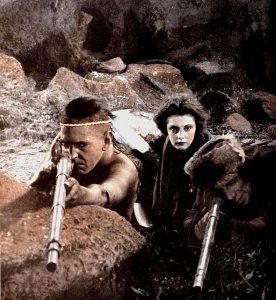
I brought a bunch of pre-generated characters that blended both of those families of tropes in their High Concept aspects, and the party ended up being Anya, the Refined Elven Polymath (and resident “city slicker”), Saba, the Half-elven Gunfighter, Alana, the Elling Scout (an elling is basically a hobbit with the serial numbers filed off), and Culloch, the Shifty Human Horse Thief. I must say that, even for inexperienced players, everybody really got into their roles. Each of them had at least one moment of really neat role play. Special shout-outs go to Culloch and his kleptomaniac tendencies and Alana’s drinking problem!
Given the one-shot format, the adventure was pretty straightforward: the frontier town of Dunswale was beset by a gang of ruthless outlaws, and our intrepid adventurers (jury is still out on whether they were “heroes”) gathered clues, tracked them down, and used a combination of deception, fire power, and magic to drive them off and collect a reward from the town’s beleaguered ree. They no doubt then celebrated at the Drunken Dragon and regaled the tavern keeper with tales of their exploits.
GMing a Fate game was actually surprisingly easy. At least, the “muscle memory” of how I used to do it back in the day was still there. The rules were straightforward enough that I felt confident winging it. I know there were places where I flubbed the rules or couldn’t put my hand on a cheat sheet I know I had prepped beforehand, and I could have done a much better job of keeping the fate point economy moving along. But the game system was very forgiving—and thankfully so were the players! My sense is that a good time was had by all.
The Writer
Running my story world as a game helped me see it from a different perspective. Did I learn anything? I’m not sure. Maybe. But introducing the world to others and seeing it through their eyes will no doubt help me convey it on the page.
I’ll confess to a certain satisfaction in bringing some of my side and background characters to life as the party talked about them or to them as the plot developed. I might have grinned a little when Culloch thought to go visit Goblintown looking for clues, and I was able to show him Brack, one of my favorite sidekick characters, as he argued with Mote Crankshaw over the best way to preserve their community, replaying a scene from early in my novel but in a different context.
In Conclusion
Now that I’ve actually used Fate as an RPG system, I can see why a lot of people like it. It’s fast, versatile, and almost infinitely customizable: 5 out of 5 stars from me!
Of course, the people around the table are what really makes a game. In my experience, even a clunky game system can be fun if the players buy into it and keep the focus on having fun with their friends. In our group, everybody brought something valuable to the table, so I’d also give Dave, Katy, Katie, and Tyler 5 out of 5 stars. It’s a pleasure to have run the game for them.
Humans as a “Fantasy Kindred”
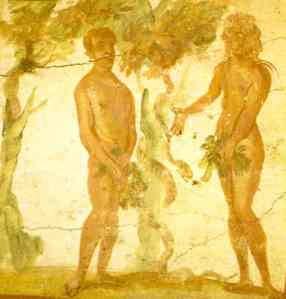
Adam and Eve, Catacombs of Saints Marcellinus and Peter
Here’s a follow-up on my previous post about connections between my current work-in-progress and a D&D setting. One thing I wanted to incorporate was the whole mythology around humans removed from the mortal world to live in the faery realm. Although we usually think of this as a trope European faery-lore, it is actually found in many places throughout the world, and it accounts for the presence of a large minority of humans inhabiting said faery realm in my WIP (to the tune of about 20% of the population).
So, how should I conceive of humans participating in a fantasy realm in which they are in the minority?
The Overbrought
The first thing to note is that humans are not native to this realm. I’m imagining that the humans one encounters in the faery realm are either “overbrought,” taken from the mortal world, or else the descendants of those so taken. They may have originally been taken for any number of reasons, both benign and sinister.
Benignly, some humans were removed as young children from situations of abuse or neglect. Others found refuge in in the faery realm after escaping from similar dire situations: domestic abuse, abject poverty, or systemic oppression. Still others were “recruited”—perhaps with selfish motivation—because they possessed certain qualities deemed desirable to a particular supernatural being or organization. For instance, folklore is riddled with stories of an elf or faery falling in love with a mortal and inviting him or her to join them on “the other side.”
Often, however, humans are overbrought for more sinister reasons. They might, for example, be taken as slaves to serve in either the harems or the armies of a powerful fae lord. They may even have been taken capriciously, for no discernible reason.
The Human Mystique
But why on (any) earth would an elf, troll, or whatever go to the trouble of bringing humans over and keeping them around? We must possess traits that are deemed desirable by at least some in the faery realm. What those traits might be largely boils down to adaptability and versatility. Robert Heinlein’s character Lazarus Long made an apt comment in this regard in Time Enough for Love:
A human being should be able to change a diaper, plan an invasion, butcher a hog, conn a ship, design a building, write a sonnet, balance accounts, build a wall, set a bone, comfort the dying, take orders, give orders, cooperate, act alone, solve equations, analyze a new problem, pitch manure, program a computer, cook a tasty meal, fight efficiently, die gallantly. Specialization is for insects.
I think this gets at why an elf, dwarf, troll, etc. might want to keep humans around: they are versatile and adaptable. They won’t be the most magically gifted, or the strongest, or the smartest, but they tend to acquire a larger and more diverse skill set. They are generalists, the Hufflepuffs of the faery realm. They’re “good enough” at a broad range of things without perhaps excelling at any.
As I’m conceiving it, underlying this versatility is human free will. The way magic works in my setting, the more powerful you are, the less free will you possess. Those at the top of the magical food chain are effectively archetypal figures with limited ability to innovate or even see things from a different point of view: they have a fixed personality, temperament, and overall approach.
Humans don’t experience this bondage of the will to nearly the same extent. To the other members of the fantasy world, therefore, they are fascinating—and formidable—because they are unpredictable.
Humans in Fae Society
So, what roles do humans play in fae society? Most agree they are not suited to be common slaves, although they may be bonded to a lord in a more high-status position of servitude as an adviser, teacher, bodyguard, or in some other capacity where quick, outside-the-box thinking is a bonus. I’m imagining a setting in which some powerful fae lords maintain elite military units of overbrought children raised to be warriors virtually from birth, and comparable to the janissaries of the Ottoman Empire. Whether bond or free, many humans end up in the officer corps of various principalities.
Others find a niche in careers where their adaptability and unpredictability are assets. Humans might be merchants and entrepreneurs, inventors, artists, theoreticians, spies, adventures, and treasure-hunters.
One niche that is filled almost exclusively by humans (and half-humans) is that of the knight (à la Spenser’s Faerie Queene). These individuals are champions who have sworn loyalty to a lord and serve on his or her behest as a champion or agent. Knights need not be strictly military in nature, though many are no doubt daunting fighters. Rather, the essence of knighthood is to serve as a lord’s right hand, furthering their agenda as one’s skills permit.
All of this is certainly not the only way to account for the wealth of mythology about changelings, human babies switched at birth, etc., but it suits my narrative purposes. It certainly, I think, opens up some interesting avenues for characterization and character development—not only of humans but of the majority non-human population.
My Next Novel: Escaping from a Bad D&D Campaign
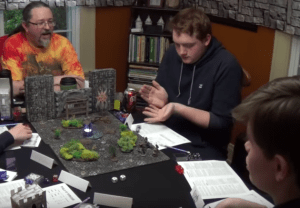 And by “bad,” of course I mean “awesome.” I’ve written before about how Dungeons & Dragons was a pretty important part of my adolescence. Not only did it prod me out of my introverted shell and entice me to interact with a few close friends, it stoked an interest in mythology, fantasy, and adventure that continues to this day.
But let’s face it: Old-school D&D as played by über-nerdy teenagers was usually a hot mess—a glorious hot mess, but a hot mess all the same. If you were first exposed to D&D in the 70s or early 80s, and that corresponded to your junior high or high school years, you know of which I speak. What I mean is that some of the tropes of D&D are a bit unconventional, even within the fantasy genre. For example…
There are Loads and Loads of “Races”
D&D has always been a fantasy kitchen sink. That’s part of its charm. Beings from Norse and Arthurian mythology rub elbows with creatures from ancient Greece, China, the Middle East, and realms even further afield. Add to that the creatures that sprung like Athena fully formed from the minds of Gary Gygax and company.
That diversity extends to the humanoid fantasy “races” found in the game. (I’ve explained before that I don’t care for the terminology of fantasy “races.” But I’m using the term here so you know what I’m talking about.) At first, if you didn’t want to play as a human, your choices were elf, dwarf, or hobbit—the latter quickly adjusted to halfling when the Tolkien estate <ahem> took exception to TSR’s use of the term. It was only a matter of time before half-elves were added. Then came half-orcs, gnomes, various sub-classes of elves, and even more fanciful creatures. And if you look at the intelligent monsters that aren’t (usually) permitted as player classes, you’ve got to add goblins, kobolds, gnolls, lizard men, nymphs and satyrs, giants, dragons, an assortment of demons and devils…you get the idea.
I heard somewhere that Gary Gygax literally couldn’t conceive of why everybody didn’t want to play a plain vanilla human fighter. That’s why those early editions put caps on how high non-humans could advance in levels: he wanted non-humans to be rare!
Soon, however, humans effectively became the minority, if not in the campaign setting then at least in the makeup of the average adventuring party. (Fair play compels me to acknowledge that the Fellowship of the Ring consisted of four hobbits, an elf, a dwarf, a quasi-angelic being, and only two humans!) (Snark compels me to acknowledge that the only thing rarer than Men in LOTR was Women.)
Magic Is Everywhere
I’m pretty sure that every member of my old D&D group operated under the assumption that, if an item existed in the rule books, it was bound to exist somewhere in the campaign setting. Half the point of playing D&D was accumulating the most whiz-bang magical goodies: flaming swords, enchanted armor, various and sundry wands, staves, rings, and potions. And these were the good old days where you could wander into any fair-sized city and find a “magic shop” where some of these items were even available off the shelf.
And this is before considering the vast supernatural powers most player-characters could wield. From the beginning until today, decent D&D parties always have at least one or two decent spell-casters. The parties that don’t tend not to survive for very long, because even if the players don’t have access to spells, you can bet the bad guys do!
But even the non-spell-casting types are usually capable of physics-defying feats of strength, stealth, endurance, or what have you. And don’t get me started on psionics! In short, the genre of D&D has always favored larger-than-life heroes with access to powers and abilities far beyond those of mortals. (Seems I’ve heard that line before…) In the early days when I was playing, we didn’t worry about that in the least; it was all part of the awesome.
So What?
In short, D&D has tended from the start to favor a great diversity of non-human characters interacting in a setting in which, far from being the stuff of misguided superstition, magic is as commonplace as blackberry bushes. That’s a marvelous setting for a game of fantasy adventure. But it isn’t the “real world.” Now, I don’t mean it’s a flaw that D&D has wizards and dragons and such because they don’t actually exist. I’m not that thick! I’m saying the classic D&D setting isn’t even the “real world” in the sense that people alive in the Middle Ages would never have recognized it as theirs, notwithstanding the fact that they would have been earnestly afraid of witches and ghosts and truly awed by the fantastical creatures scholars described in their bestiaries.
It is, however, a world that those medieval people would have heard of, be they peasant or king. It’s the world in which many of their favorite stories were set, a world that shaped their imagination and their cultural ideals by setting them against a place so obviously different that the conventional rules no longer applied.
It is, in a word, Faery Land.
It’s the place heroes go to fight dragons and rescue princesses before eventually finding their way back to the ordinary world to live happily ever after.
So, what if somebody who’d grown up in this high-powered, magic-rich, and decidedly non-human-centric D&D campaign found it advisable to leave? Where would he go? What would he do? What alliances might he forge with the inhabitants of whatever new world he landed in? What foes might he have to face there?
And what if this new world was ours?
Sneak Preview: The Pooka’s Day
The release of Fell Beasts and Fair is now two weeks away! I’m about 2/3 of the way through the anthology, and every story has been a winner. You can pre-order your (electronic) copy today—see my previous post for details.
To whet your appetite, here’s a snippet from my contribution, “The Pooka’s Day.”
***
Danny stopped cold as the end of the woman’s walking stick poked him in the chest.
“We don’t want any trouble,” she whispered. “You can just move along.”
He should have heard them coming—five of them all told, but he hadn’t been paying attention. Too much on his mind. He just charged across the cow path on his way back to the creek, and there they were.
As it was, he barely had time to throw on a decent husk. He was pretty sure they didn’t notice, though, when his ears and nose shortened to more human proportions and the glow faded from his amber eyes.
Whoever these people were, their leader meant business. One of the others sucked in a labored breath. Two more, children, whimpered in the dark.
“M-miss Claudia?” a different woman whispered, “Lige… he ain’t looking so good.” This woman was helping the only man in the group to stand. Danny sniffed the air. Amid the soil and grass and growing things was the unmistakable iron scent of blood. He spied a ripped and bloody trouser leg.
The first woman’s eyes blazed. She and her friends were dressed in dingy, patched clothes barely fit for a brownie. That and their dark skin was all he could make out.
He raised his hands. “Whatever you say, ma’am.” He wasn’t in a mood for any mischief. Well, that wasn’t entirely true. He still had three more farms to case before daybreak. But he didn’t have time for anybody else’s mischief. Not tonight. Not with him liable to show up at any minute.
“And not one word, you hear?” The rumble in her voice demanded Danny’s full cooperation.
He was about to say something when he caught the sound of dogs barking.
“Lord have mercy!” the other woman gasped. The younger child, no more than four years old, started to cry, but his big sister slapped a hand across his mouth.
The first woman spun and raised her stick horizontal to the ground.
“Head for the woods,” she ordered. “Go!”
Four shadows stumbled past.
“Those are my woods!” Danny’s throat went dry. Something settled in the pit of his stomach. He was fairly sure he shut the door…
“You want to make something of it, mister?”
“You don’t understand. You ain’t got no business poking around over there. It could be… dangerous.”
“It’s about to be dangerous right here, now that those slave catchers have caught up with us.”
Slave catchers! It suddenly made sense. He’d stumbled upon a group of runaways. Seems he’d overheard something about a new law the deathlings had passed. Folks at the Crawford farm were talking about it. Even in a free state like Indiana, runaway slaves could be rounded up and sent back down south.
There was no way they were going without a fight.
Two hound dogs burst into view. The woman, Claudia, held out her walking stick with her right hand and angled her body away from them. She let a worn leather satchel slip off her shoulder to the ground. Danny dropped to a crouch.
“If you know what’s good for you, mister, you’ll stay nice and still till I say differently.”
“But—”
“Shh!”
The dogs bounded forward.
The woman uttered a word. The nearest dog flew backward with a yelp.
Magic! Danny stood mystified as the woman trained her walking stick on the second dog. She blasted it just as she had the first one.
“You’re a witch?”
“Later,” she said. She held her walking stick upright. “They’re coming.”
Claudia was right; Danny heard the sound of approaching footsteps.
She began to chant a singsong tune.
“You find ‘em, boys?” a man said. He lumbered into view on the edge of the corn field—big and swaggering, with a shotgun in one hand and a lantern in the other. “Chief? Banjo? Here, boys!”
Something told Danny Chief and Banjo were taking the rest of the night off.
Two more shadows joined the first. The woman kept chanting. Her voice was barely audible beneath the cold autumn breeze.
The three men trudged forward a few more steps, but slowly. The closer they came, the slower they got.
The first man toppled to his knees by the time he came even with the first of the unconscious dogs. The second brought his shotgun to his shoulder… but wobbled backward with the effort. A minute later, all three lay on the grass, mumbling and snoring.
“That was some mighty slick conjuring,” Danny said.
“Not now,” the woman hissed. She had spun around to see where her friends had gone. She gave an exasperated sigh. “They were right there!” she said.
“Uh oh!” Danny said. The others were nowhere to be seen—and Danny had a sinking feeling he knew where they had gone.
Random Thoughts on Renaissance “Clerics”
I’ve previously written about how I’ve found it helpful to think of worldbuilding in terms of RPG game mechanics. I’ve shared with you a little of how the magic of my current WIP can be quantified in terms of the Fate Core RPG rules, not because it’s necessarily the best system out there but because the rule set seems rather intuitive and well-suited to what I’m aiming for as a writer. I’ve described the rules for faery magic as well as (human-centered) arcane magic. With both systems, I’ve attempted to stay reasonably true to beliefs about what magic could or could not do as perceived in the late Medieval and early Modern periods, circa 1350–1700.
Old-school D&D nerds might well be wondering about divine magic: the realm of those characters that Gary Gygax dubbed “clerics.” And the truth is, I don’t foresee the need for any “clerics” in my WIP. But if I did, how might one go about quantifying the religious-oriented magic of this time period? I don’t have any suggestions for actual game mechanics here, just a few random notes about how I might proceed.
Arcane Magic, Re-skinned
The first thing to note is that the boundary between “arcane” and “divine” magic is blurry and often contentious. What one person may describe as “sacraments” and “prayers,” another might perceive as “spells” and “incantations.” Much of what I’ve already described as arcane magic could simply be “re-skinned” and applied to divine magic.
In rural areas especially, the practices of old religions often live on beneath the veneer of orthodox faith. The parish priest, for example, might well be called upon to perform rituals that mix “magic” or “superstition” with orthodox rites. For example, they might perform a ritual of sympathetic magic to make fields fertile. In general, these kinds of folk magic were permitted as long as they were used to help people and never to harm.
So, in keeping with what I previously proposed for mages, clerics might take levels of “Arcane Magic” skill, but instead of specializing in “Folk Magic,” for example, they might specialize in “Sacramentals,” minor rituals or prayers that vary in flavor depending on the specifics of the religious tradition.
In Judaism, for example, the “practical kabbalah” related to mystic contemplations of the divine names of God would be an appropriate template. Instead of an arcane ritual, the kabbalist might simply recite a divine name or formula, or perhaps inscribe it on a piece of parchment or some other surface.
For a parish priest in the Highlands of Scotland, the prayers, incantations, charms, and poems of the Carmina Gadelica might be an excellent place to start in depicting the flavor of such a re-skinned system.
Healing rituals would pretty much be a no-brainer for clerics of nearly any tradition. One might also propose “Insight” or “Prophecy” as a re-skinned version of “Divination.” Note, however, that the actual practice of divination through horoscopes, tarot cards, crystal balls, etc., is generally forbidden in the monotheistic religions. If you really wanted a high-powered divine magic system (which I don’t think would be period-accurate), you could allow a cleric to specialize in “Miracles” as a re-skinned version of “Theurgy”—though definitely impose limits on what sorts of miracles are possible based on the specific spiritual tradition the cleric follows.
Arcane Magic and Orthodox Faith
Christian and Jewish clerics in fact pursued certain disciplines of arcane magic during the Renaissance. Leonardo de Candia Pistoia and Marsilio Ficina, responsible for bringing the Corpus Hermeticum to the West, were a Byzantine monk and a Catholic priest, respectively. The Baal Shem of London was both an alchemist and a rabbi.
The great monotheistic faiths generally drew lines to distinguish “permitted” and “forbidden” arcane magic. Depending on the specifics of each religious tradition, the forbidden category generally involved magic that summoned supernatural entities (demons, angels, etc.) to do a mage’s bidding as well as magic intended to harm others in any way.
The Power of Faith
Divine magic, the kind of things that D&D clerics can do but D&D wizards can’t, works on the principle of faith. Rather than bending to the will of the practitioner, these forms of magic bend the practitioner to the will of his or her perceived ultimate reality—God, the gods, the universe, or what have you. Divine magic can only be practiced by someone of amazing piety and upstanding morals (as interpreted by the faith community). It can only be performed to advance the agenda of the highest values and aspirations of the practitioner’s spiritual worldview.
Different spiritual paths manifest different divine powers. In general, divine magic in the monotheistic religions should be quite rare, with the most spectacular displays of power tied to saints or bearers of sacred relics.
Indigenous Religions of Europe
Some spiritual paths followed in Renaissance Europe originated in indigenous traditions that predate the coming of Christianity. Sometimes, these faiths have themselves been re-skinned as Christian: gods or spirits have been made into saints, for example, or rituals have been recast to incorporate Christian iconography and patterns of belief. This spiritual “makeover” is more thoroughgoing in some cases than in others, and in at least one case never happened at all. Here are two examples:
Benandanti
The Benandanti or “good walkers” were the Christianized remnant of an older pagan fertility cult from the Friuli region of northern Italy. Rather than a learned skill, they believed their magic was something bestowed upon them at birth. They regarded themselves as Christian, fighters in service of Christ against malevolent witches to preserve the well-being of their lands. The Inquisition accused some of them of being witches or heretics, and benandante remains a regional term synonymous with stregha or “witch.” They were closely associated with the arcane specialties of “Spirit-riding” and “Healing.”
Vadilos
The vaidilos or pagan priests of Lithuania are probably the closest to ancient Druids to be found in Renaissance Europe. The Grand Duchy of Lithuania only formally embraced Christianity in 1387, and the new religion was not accepted by its various states until the fifteenth century—and only then for political reasons.
The modern revival of Lithuanian paganism is called Romuva, meaning “temple” or “sanctuary.” The old religion apparently emphasized the sanctity of nature as well as ancestor worship. The divine is represented by fire, and ceremonies are performed before a fire altar.
For the most part, Lithuanian pagan priests can be “re-skinned” druids with maybe a few tweaks.
The Larger World
Of course, other systems of divine magic could be identified and quantified for this period. This was an era of growing global trade, and the mages and divines of Europe were coming into more frequent contact with other spiritual traditions.
Someone who can do it justice might work out how “magic” might work in terms of practitioners of Vodun, Santería, or the spiritual traditions of other indigenous groups. But such a project should only be attempted by someone with the necessary sensitivity and permission from the relevant groups, who must be the final arbiters of what is an offensive appropriation and what is an acceptable depiction of their spiritual traditions.
A Sevenfold Medieval Magic System
This is a follow-up to a previous post in which I talked about using role-playing game rules to work out a magic system for my current work-in-progress. In that post, I described a magic system that works well with my conception of faery or supernatural beings, but then my story took an unexpected detour, and I realized I needed to flesh out how the magic of mortal practitioners works.
One thing I knew I wanted was something that felt like it could be at home in the same historical era from which I drew my faery folk—namely, the Renaissance/Elizabethan era. This was the era not only of witch trials but of alchemists and esoteric philosophers who dabbled in the arcane arts.
From an RPG point of view, the mechanics work pretty much the same. A hypothetical player spends a point of Refresh to buy the Arcane Magic skill. They can then build stunts off of that skill if they so choose.
There is, however, a twist in that Arcane Magic can be divided into a number of discrete disciplines. Each of these correspond to some aspect of magic at it was understood in Europe circa 1400–1700. Our hypothetical player can learn one of these disciplines for free; after that, he can only get more by buying them as stunts. A truly versatile wizard, therefore, must allocate most if not all of his or her “character build” into magic, with little room for other pursuits.
Here are the arcane disciplines I have in mind. In terms of the Fate Core system, each discipline works in conjunction with a different “supporting” skill:
Alchemy (Crafts) involves the transmutation of substances as preparatory to the “Great Work” of personal spiritual transformation.
Divination (Lore) is a technique of magical self-analysis and a help in learning the language of symbols. Using a divinatory device (a scrying bowl, runes, tarot cards, casting bones, etc.), the diviner sees the world from a higher perspective, from which he or she examines the probabilities of what may happen next.
Goety (Provoke) involves channeling one’s primal emotions in order to manifest the power and “will” of some cosmic force or entity to which the mage is beholden. (D&D calls this kind of mage a “warlock,” but with very little linguistic justification, in my opinion.)
Healing (Empathy) uses herbs, incantations, amulets, etc., to effect healing of mind, body, and spirit.
Spirit-Riding (Investigate) employs astral projection to gather information, attack enemies, or to engage in dealings with “otherworld folk”—either to make pacts with them to gain their supernatural assistance or to battle against those who threaten others.
Theurgy (Will) involves wending elemental forces to create tangible effects in the world: what most people understand as “magic.”
Witchcraft (Various skills) uses sympathetic magic to harness the magical potentialities of herbs, minerals, incantations, gestures, animal parts, and other objects to achieve practical results in areas such as dowsing, love and marriage, fertility, money, and so forth.
And no, I haven’t forgotten about Qabbalah. I envision it not as a distinct discipline, however, but as a Lore-based stunt permitting bonuses to roles involving magical research. (And the character I had in mind when I threw these ideas together is definitely a skilled Qabbalist.)
Let’s Make an RPG Magic System (or Three)
So lately I’ve been thinking about role-playing games. So when I saw Codey Amprim’s post at Mythic Scribes on “Using Role-Playing to Rein in Your WIP,” I knew I had to read it. Codey’s point is quite simple, to the point of being self-evident: you can learn a lot about your world-building, characters, settings, etc. simply by inviting your friends to role-play in your setting. If you’re into RPGs (and have some friends that are, too), running a session in which your friends can not just read your WIP but experience bits of it firsthand can open your eyes to what is working and what isn’t. Codey writes,
In my opinion, this is just as valuable, if not more (depending on how serious your role-playing companions get), than using beta readers. You get to take in their reactions, not just their words. You get the chance to see how they respond to your WIP, by directly engaging them and their imaginations – without a manuscript. It’s a great chance to test the waters of your work while having a good time.
I’ve been world-building a new WIP to within an inch of its life lately, and I’ve been intentionally thinking of the magic system in terms of “game mechanics.” What should the characters I’m imagining be able to do? What would be too hard? What shouldn’t be possible at all? As a former old-school gamer (from back before there was a new school!), I find it helpful to quantify things like that—even if I eventually scrap or retcon some things in the course of actually writing!
To me, the easiest system to “hack” with a home-brewed magic system is Fate Core, which has the advantage of an excellent online source reference document (SRD) where you can read pretty much the whole rule set for free. There’s also Fate Accelerated, a stripped-down version especially suitable for new or younger gamers. From here on, I’m going to say Fate, but I’m talking specifically about Fate Core. As a system, Fate is immensely customizable to fit any conceivable genre.
Disclaimer: I’ve never played Fate, so I can’t comment on how it works at the table. I understand it’s not every gamer’s cup of tea. But from a writing point of view, it was just what I was looking for.
If you’ve never heard of Fate, the basic mechanic revolves around aspects, which are brief phrases or descriptors that describe a character (or a scene, or a magical artifact, etc.). Aspects underline what is most crucial to understand about something, both positively or negatively. Harry Potter might have aspects like “Lord Voldemort’s Nemesis” or “Good at Flying.” Percy Jackson might have aspects like “Son of Poseidon” or “Would Do Anything for his Friends.” Your aspects can give you advantages on certain dice rolls, but they can also be used against you to complicate your character’s life.
There are also skills, drawn from a fairly limited set—although these can be customized to fit the needs of the genre of game you’re playing. Finally, there are stunts, which are essentially “super-skills,” the signature moves or amazing, unique abilities that characters possess. Where skills are somewhat narrowly defined, stunts can be pretty much anything. Hermione Granger probably has a stunt that lets her do magic far beyond her baseline ability as long as she has time to do the appropriate research. Annabeth Chase definitely has a stunt that lets her analyze conditions on a battlefield and use what she learns to create advantages for herself or her teammates.
You get a certain number of stunts for free. After that, you have to “buy” them with points of Refresh. This number indicates how many Fate Points a character starts each game session with, generally set at 3. You use Fate Points to invoke your aspects, using them to get dice bonuses. You gain Fate Points when someone invokes your aspects against you (called “compelling”). (This is important to playing Fate, maybe not so much to using the Fate system to describe a work of fiction!)
So here’s what I was aiming at, and some rough notes about how I think it can be translated into a Fate rule set.
- First, the basic conceit of my WIP is the existence of supernatural beings—elves, dwarves, mermaids, trolls, etc.—living undercover, beneath the radar, in the contemporary, mundane world. Some are just passing through. Some have been exiled from the supernatural realm and can’t get back. Some, however, are on the run from someone or something and never want to go back. The classic American immigrant story, just with magic!
- A secondary conceit is that these beings roughly correspond to the elemental spirits described in the 16th century by Paracelsus: sylphs, undines, gnomes, and salamanders, each spinning off with bewildering diversity of form and power level, but generally corresponding to one of the four classical elements: air, water, earth, or fire. (I eventually added a few others just to keep it interesting.)
I found it actually quite easy to translate what I was looking for into Fate terms. Actually, works similarly to the Stormcallers magic system suggested in the supplemental Fate System Toolkit. My system favors magic that is more versatile and yet more subtle than Stormcallers, however. For example, you can’t use the basic Magic skill for combat rolls—if you want to lob fireballs or whatever, you need to buy a stunt for that.
Here’s the 30-second version:
- Each character must buy an aspect that indicates their kindred (elf, dwarf, etc.), the “flavor” of their magic (Air Magic, Earth Magic, etc.), or both.
- Buy the (newly invented) Wild Magic skill. Reduce the character’s Refresh by 1.
- Declare which elemental chaos powers the character’s magic: Air, Earth, Fire, Ice, Lightning, Metal, Water, or Wood.
- If desired, buy additional Wild Magic skills in other elemental chaoses. A second Wild Magic aspect does not reduce refresh, but a third aspect requires another one-step reduction.
- If desired, build one or more stunts related to the characters magical skill(s).
From there, it’s mostly a matter of figuring out what each elemental chaos is all about. Here, I turn to classical alchemy, neo-paganism, and pervasive cultural symbolism surrounding each element. So Water Magic also has to do with intuition, the subconscious, and healing arts, for example, while Air Magic also governs thoughts and perceptions. Anything suitably subtle can be done with the basic skill. Anything flashy or notably dangerous has to be bought as a stunt.
In my WIP, it’s also possible for mortals to practice magic, although theirs works a bit differently…and will have to be addressed in another post down the road.
Some Ships Were Never Meant to Sail, But…
So my biggest fans remain my daughter and her friends. I’m actually cool with that; writing is a hobby for me, not a retirement plan. I’m pleased to have been able to bond with Rebecca through my writing projects, and I’m pleased that my books have given her a way to bond with some of her classmates. With the first copies of Oathbreaker heading our way, interest in my novels is on an uptick in Macon, Georgia.
Recently (okay, yesterday) a new friend was first initiated into the Wonder through a gift of book 1, Children of Pride. Somewhere in an early chapter, she made the same reading leap that another friend had made a year or so before in “shipping” the protagonist, Taylor, with her soon-to-be mentor, Danny. This is fascinating to me:
- Danny is explicitly described (while impersonating a teenager) as socially awkward, not too bright, and not very good looking.
- In that scene, Taylor explicitly hopes Danny isn’t developing a crush on her.
- A chapter or two later, it is revealed that Danny is actually over 200 years old and not at all interested in Taylor.
Apparently even that last part isn’t enough to dissuade them from hoping for this ship to sail. (One girl said, “That’s not as bad as Edward and Bella.” Rebecca said, “Don’t you dare compare my father’s novels to that book!”)
I choose to believe the utterly unforeseen Taylor-Danny ship says something positive about the quality of friends my daughter has chosen to associate with. They are the kind of people who look beyond outward appearances. They are the kind of people who aren’t ready to write anybody off too soon.
And I’m actually cool with that, too.
 Darrell J. Pursiful