
Home » Mythology (Page 10)
Category Archives: Mythology
The Fairy Investigation Society
I may have to check these folks out. I’ll definitely be taking their online survey of faery beliefs.
The Fairy Investigation Society (FIS) was founded in 1927 by a British man named Quentin Crauford. Attracting mostly Theosophists who believed that fairies were elemental beings, the Society continued sporadically through the 20th century until finally disappearing in the 1990s.
In 2013 the Society was re-booted by Simon Young, an English historian living in Italy. While membership in the original Society was limited to people who believed in fairies, the current society is open to “all those who have an interest in fairylore, be they believers or ultra skeptics.” I’m proud to be a member myself!
Pooka’s Day
November 1 is the Pooka’s Day. If you’re a farmer, please be sure to have your harvest in by tonight, lest the pookas steal or despoil it!
Five Weird Werecreatures
 Werewolves are probably the most commonly encountered werecreature in mythology by far. But they are not the only kind of shapeshifting monster. Other examples are known from just about every culture on earth. Some are friendly; many are deadly dangerous. Some are animals who can transform into humans while others are humans (perhaps witches or sorcerers) who can transform into animals.
In my previous post, I looked specifically at werewolves. Now, it’s time to track down some more unusual shapeshifters. Here, then, are five interesting and distinctive werecreatures from around the world.
Wereseals
Selkies are found in the traditions of Ireland, Scotland, and the Orkney and Faeroe Islands. They are a race of shapeshifters, switching between human and seal forms by removing or putting on a seal’s skin. They are generally perceived to be gentle creatures who love to dance on the shore and occasionally fall in love with humans. Both male and female selkies are said to be lithe and attractive. A common story tells of a female selkie forced to marry a mortal man when he steals her sealskin. Eventually, she finds the hidden skin and uses it to return to the sea.
Selkies are related to the Finfolk, which are essentially the same sort of creature but with malevolent tendencies.
Wereowls
In Muskogee legend, stiginis (or stikinis) take the form of animals. Although they might take on the shape of any sort of wild predator, they strongly favor owls. In fact, stigini means “screech owl.”
By day, stiginis look like ordinary humans. By night, however, they vomit up their souls—along with their internal organs—and become monsters who like to feed on human hearts. Hearing the cry of a stigini is an omen of approaching death.
In some stories, mentioning these creatures by name puts one at risk of becoming one. Therefore, stories about stiginis are only told by certain medicine men and women. In other communities, however, they are more of a bogeyman figure casually discussed to frighten children.
Perhaps related is Hoklonote’she, a Choctaw evil spirit who often takes the form of an owl. Hoklonote’she can read peoples’ minds and apparently enjoys creeping people out by reciting their thoughts back to them.
Werehyenas
Werehyenas are common in the folklore of North Africa, the Horn of Africa, and the Middle East. In addition to being humans who can assume the form of a hyena, some legends tell of hyenas who are able to take on human form.
In the region around Lake Chad, it is believed that whole villages might be populated by werehyenas.
In Ethiopia, it is traditionally believed that every blacksmith (a hereditary occupation) is actually a bouda: a wizard with the power to change in to a hyena, in which form they rob graves at midnight. It should go without saying that they are viewed with suspicion by most of their neighbors! Many Ethiopian Christians believe that Ethiopian Jews are bouda and accuse them of digging up and eating the corpses of Christians.
Weredolphins
Brazilian folklore has the legend of the encantado or “enchanted one.” These are dolphin shape-shifters similar in some respects to faeries. They are thought to be dolphins with the ability to take on human form and not the other way around. Specifically, most of these legends involve the boto or freshwater dolphin of the Amazon River. Occasionally, the stories involve snakes rather than dolphins.
Encantados come from an underwater faery-land called the Encante. They are excellent singers and musicians who love parties and are often give to romantic liaisons with mortals. They only rarely take on human form, generally at night.
In addition to shapeshifting, encantados have other magical powers. They are able to control storms and exert a form of mind control over humans. They can sometimes turn mortals into encantados like themselves.
Encantados are dangerous, and many people in the Amazon region are terrified of them. They can inflict disease, insantity, and death, and are said to be fond of abducting humans they fall in love with and taking them to live in the Encante.
A Possible Weremesonychid
Mesonychids are an extinct group of carnivores that are most often described as a sort of wolf with hooves. Even though there haven’t been any mesonychids around for millions of years, a mysterious beast that terrorized France in the 1760s apparently bore a striking resemblance to one. Some witnesses described the so-called “Beast of Gévaudan” as a huge (horse-sized) creature combining features of wolf, bear, panther, and hyena. Some reported that it had cloven hooves, or that each digit was tipped with a hoof. Others said its claws were so heavy and thick that they merely resembled hooves. Such a creature would come close to matching the description of a large hyena-like mesonychid like the Pachyaena or Harpagolestes.
Furthermore, the locals claimed that this beast was, in fact, a sorcerer who shapeshifted into a fearsome creature. In other words, the Beast of Gévaudan was a human who apparently assumed the form of a prehistoric nightmare.
Five Classic (or Not) Werewolves
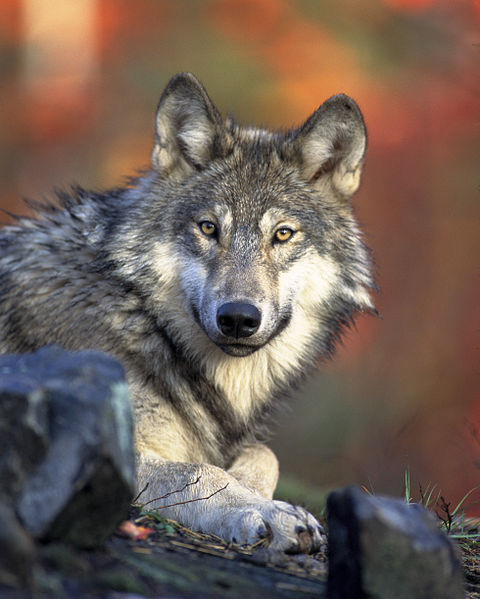 Having discussed vampires in my last post, let’s move on to werewolves. There are plenty of other werecreatures out there, and I’ll get to them in my next post. For now, however, I’d like to look specifically at humans who turn into wolves.
One thing to note up front is that certain aspects of werewolf-lore don’t go back any further than the 1940s and Lon Chaney, Jr. The idea that werewolves only transform at the full moon, for example, does not seem to be rooted in any actual folk beliefs that I have been able to track down. The whole silver bullet thing is obviously no older than the invention of firearms (although many cultures say that silver is effective in repelling evil.)
What we do find in world mythology is a great variety in terms of how a person transforms into a wolf and whether such people should be looked upon with fear or reverence—or perhaps a mixture of both.
Wolf-straps
One form of werewolf coming from German and Polish folklore involves the use of a magical wolf-skin belt or pelt (sometimes known as a “wolf-strap”). Anyone, it is said, could become a werewolf by fastening such a strap around him- or herself, but the artifact is sometimes associated specifically with witches. In addition to belts of wolf-skin, the skin of a hanged man might also work to effect the transformation from human to wolf.
The wolf-strap is the product of evil magic, however. In fact, it is seen as a gift from the devil himself. Those who possess such a strap couldn’t get rid of it no matter how much they wanted to.
The use of an animal pelt is also common in some Native American cultures. Among the Navajo, for example, evil “skin walkers” are sometimes said to take on animal form by donning the appropriate pelt.
Wolf-coats
According to Aðalheiður Guðmundsdóttir, there are two types of werewolves in medieval Icelandic literature. In one, a person undergoes a physical transformation; in the other, the soul or spirit enters into an animal’s body (“The Werewolf in Medieval Icelandic Literature,” The Journal of English and Germanic Philology 106/3 [Jul 2007] 281–82).
The most familiar example of the first type is the berserker, a warrior who is supernaturally endowed with the strength and ferocity of a wild animal, usually a wolf or bear. The wolf-warrior was called an úlfheðinn or vargstakkr, both roughly translated “wolf-coat.” As Guðmundsdóttir explains,
One of the most recognizable attributes of the berserks is that they fall into a “berserk frenzy.” They run wild in battle, become crazed, and roar or howl. No weapons can harm them and they tolerate wounds better than other men. The berserk frenzy is actually closely related to shape-shifting, for in both cases men acquire the attributes of animals. The main difference resides, perhaps, in the fact that with shape-shifting it is assumed that either the soul is transported to another body, that is, into an animal’s body (and thus people are described as eigi einhamir, “not restricted to one form”), or that the body undergoes a transformation, whereas in the berserk frenzy men acquire the attributes of wild animals; one could thus say that the berserk is a wild animal in the shape of a man. The condition is therefore psychological in the case of the berserk, but physical in the case of werewolves and other shape-shifters.
Thus, a “berserk” undergoes a psychological change were a “wolf-coat” undergoes an actual physical change. But, of course, this distinction is not always clear-cut and is sometimes a matter of how specific texts are interpreted.
Böðvarr Bjarki and Úlfr Bjálfason
The other form of Norse were-creature, in which a human soul or spirit departs from the body and takes on the form of an animal, is found in the story of Böðvarr bjarki in a text called Hrólfs saga kraka.
In this story, Böðvarr bjarki attacks his opponents in the form of a bear while his body remains asleep, sitting still at some distance from the battlefield. This is said to be an innate ability inherited from his father, not based on any kind of spell or magical device.
Although this is the story of a werebear, werewolves of this sort were also apparently possible. In Egils saga, a shapeshifter named Úlfr Bjálfason, more commonly called Kveld-Úlfr or “night-wolf,” is said to have become ill-tempered as evening approached. Guðmundsdóttir explains, “He had a tendency to sleep in the evening, which has been seen as suggesting that his soul left his body when he slept and entered a wolf’s shape” (278 n. 5).
What is not clear (at least to me) is where the animal form comes from. Does this sort of shapeshifter “hijack” a passing animal and inhabit its body? Or is he able to conjure up an animal’s body out of his own psychic reserves? Either way, this is a type of werecreature I don’t think I’ve ever seen depicted in popular media.
Kurtadams
Not all werewolves are evil. Some, in fact, are revered members of the community. This is the case of Turkic kurtadams, who through long and grueling ritual processes achieved an altered state of consciousness in order to experience a psychological transformation from human to wolf.
Frank Joseph describes this phenomenon as
a man or woman achiev[ing] an altered state of consciousness to spiritually identify with the soul of a non-human animal. In Turkish, for example, the Kurtadam is not only a werewolf, but also a shaman. In fact, the totemic ancestor of the Turks is the wolf. (Unlocking the Prehistory of America [Rosen, 2014] 255)
According to some legends, this transformation was physical as well as psychological, resulting in an upright-walking humanoid wolf-creature.
From the same general region, Herodotus speaks of a Scythian tribe called the Neuri “who annually transformed themselves into werewolves during a cultic warrior festival” (Joseph, 254)
Hounds of God
Finally, there is an account of certain werewolves in Livonia in the Baltic region, one of whom claimed in 1692 to have been given their power of shapeshifting in order to battle the forces of evil.
Carlo Ginzburg offers this account of the proceedings:
In 1692 at Jurgensburg in Livonia an eighty-year-old man named Thiess, whom the townsmen considered an idolater, confessed to the judges interrogating him that he was a werewolf. Three times a year, he said, on St Lucy’s Night before Christmas, the night of St John, and of the Pentecost, the werewolves of Livonia go into hell, “at the end of the sea” (he later corrected himself: “underground”), to fight with the devil and the sorcerers. Women also fight with the werewolves: but not young girls. The German werewolves go to a separate hell. Similar to dogs (they are the dogs of God, Thiess said), and armed with iron whips, the werewolves pursue the devil and sorcerers, who are armed with broomsticks wrapped in horse tails. Many years before, Thiess explained, a sorcerer (a peasant named Skeistan, now dead) had broken his nose. At stake in the battles was the fertility of the fields: the sorcerers steal the shoots of the grain, and if they cannot be wrested from there will be famine. However, that year the Livonian and the Russian werewolves had both won. The harvest of barley and of rye was going to be abundant. There was also going to be enough fish for everyone. In vain the judges tried to induce the old man to admit that he had made a pact with the devil. Thiess obstinately continued to repeat that the worst enemies of the devil and the sorcerers were werewolves like himself: after death, they would go to paradise.
Five Vampires from Around the World

I grew up on Bela Lugosi’s interpretation of Bram Stoker’s Dracula. For the longest time, that was what a vampire was—and it was the only thing a vampire could be! Vampires were suave, aristocratic, and spoke with an Eastern European accent. They turned into bats, drank the blood of their victims, slept in a coffin, and were destroyed by sunlight.
Needless to say, it was an eye-opener when I learned there were other kinds of vampires out there. When I first read Dracula, I was amazed at how new and fresh Stoker’s original Count Dracula was compared to Lugosi and all of his many imitators. (Dracula can walk around in the daytime? Why didn’t I know this??)
In honor of Halloween, I thought I’d write a little about some of the unusual vampires or vampire-like creatures found in world mythology. These are not necessarily my “favorites,” but they perhaps show a little bit of the diversity of vampire lore.
Estrie
The estrie is a type of female vampire found in Jewish folklore. It is said to prey mainly on Jewish men, but it also has a taste for the blood of children. Estries are sometimes seen as comparable to succubi, seductive female demons. They are also shapeshifters, able to turn into birds or cats at will.
The earliest estrie legends describe them as demonic entities. Later stories depict them living among mortals as part of the community, possibly victims of some sort of demonic possession.
Unlike other demons or creatures of the night, estries are undeterred by holy symbols or holy places.
Neamh-mairbh
This Gaelic word signifies “the walking dead.” One famous example of a neamh-mairbh was the evil magician Abhartach, whose story is told in Patrick Weston Joyce’s The Origin and History of Irish Names of Places (1875). He says of Abhartach,
This dwarf was a magician, and a dreadful tyrant, and after having perpetrated great cruelties on the people he was at last vanquished and slain by a neighbouring chieftain; some say by Fionn Mac Cumhail. He was buried in a standing posture, but the very next day he appeared in his old haunts, more cruel and vigorous than ever. And the chief slew him a second time and buried him as before, but again he escaped from the grave, and spread terror through the whole country. The chief then consulted a druid, and according to his directions, he slew the dwarf a third time, and buried him in the same place, with his head downwards; which subdued his magical power, so that he never again appeared on earth. The laght raised over the dwarf is still there, and you may hear the legend with much detail from the natives of the place, one of whom told it to me.
In some versions of the tale, Abhartach rises from the grave to drink the blood of his former subjects. He is sometimes tauted as the (or an) inspiration for Bram Stoker’s Dracula.
Vetala
A vetala (also vetaal or baital) is a type of evil spirit from Indian folklore. They take possession of human or animal corpses to use as vehicles in which to hunt for blood to drink—although they are also able to move about without the aid of a material “host.” They can also possess living victims.
The vetala is not simply an aspect or residue of person it inhabits. It doesn’t possess that person’s memories. They are malicious creatures in every way. In addition to their blood-drinking, cannibalistic tendencies, they are also known to kill children, cause miscarriages, and drive people insane.
In at least one instance, however, these creatures are presented in a more positive light. In the story of Baital Pachisi, the vetala is a heroic character who saves the life of the king, the protagonist of the story.
Vetalas can be repelled by chanting and released from their undead condition by performing the proper funeral rituals on their behalf.
Ekimmu
Unlike many conventional understandings of vampires, the ekimmu (or edimmu) of ancient Mesopotamia (Assyria) do not drink the blood of their victims. Rather, they are phantom, demon-like creatures that draw sustenance from the “breath” of others, often babies or young children. (Other sources say the ekimmu drained both blood and life-force.)
Ekimmu were the spirits of deceased humans who could not find peace in death. It was possible to become an ekimmu in a variety of ways including dying violently from murder, dying young, being improperly buried, etc.
An ekimmu’s victims generally die after a few days. These creatures could also inflict disease or inspire criminal behavior.
Leannán Sídhe
The leannán sídhe (Scottish leannan sith, Manx lhiannan shee) or “faery lover” is another “psychic vampire” like the ekimmu. Rather than being an undead monster, however, this is a faery being. Specifically, it is a beautiful female faery that compels a mortal man to fall in love with her. In return for her love, she imparts great artistic or creative abilities. The price of this inspiration, however, is often insanity or a premature death. According to W. B. Yeats’s Fairy and Folk Tales of the Irish Peasantry (1888),
The Leanhaun Shee (fairy mistress) seeks the love of mortals. If they refuse, she must be their slave; if they consent, they are hers, and can only escape by finding another to take their place. The fairy lives on their life, and they waste away. Death is no escape from her. She is the Gaelic muse, for she gives inspiration to those she persecutes. The Gaelic poets die young, for she is restless, and will not let them remain long on earth—this malignant phantom.
Although Yeats focused on the parasitic aspects of the leannán sídhe, others highlight her positive role as a muse.
Repost: Boo! Five Bogeymen to Run Away From
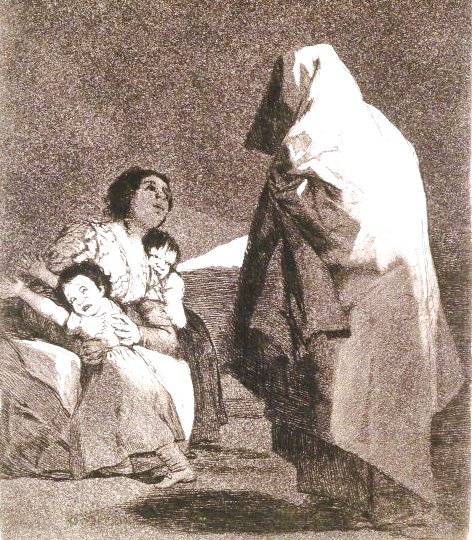
Francisco de Goya, “Que viene el Coco” (Here Comes the Bogeyman), 1797–98
In addition to the powerful, awe-inspiring sídhe nobles, wild satyrs, and helpful little folk, the world of Faerie is also inhabited by a variety of creatures whose purpose seems to be striking fear in the hearts of children. These are the bogeymen, also known as bogles, boggarts, boogers, bugaboos, etc.
The word “bogeyman” is derived from Middle English bogge or bugge. It is thought to be related to other words such as Scots bogle, Norse puki, and Gaelic púca. Whatever these creatures are called and whatever their appearance, they are the bane of children, especially those who misbehave! They might also lure people beyond the bounds of civilization—deep into the woods or too close to the water. They thus serve as cautionary tales to keep people in line be they young or old.
Here are five bogeymen that have inhabited the nightmares of children around the world.
1. El Hombre del Saco
Also known as el hombre del costal. Both mean “the sack man” or “the bag man.” This is a bogeyman found in many Latin countries including Brazil, Portugal, and Spain. He is portrayed carrying a sack in which he carries off naughty children.
2. El Coco (or el Cuco, el Cucuy)
El Coco is known in many Spanish-speaking countries. He is described as a ghost with a pumpkin head, an evil monster that hides under children’s beds at night and kidnaps or eats them when they don’t obey their parents or go to sleep at bedtime. In Latin America, el Coco more often takes the form of a small humanoid with glowing red eyes that hides in closets or under the bed.
3. Grindylow
Grindylows feature prominently in Harry Potter and the Goblet of Fire. The grindylow of folklore is an aquatic bogeyman from England (Yorkshire and Lancashire, to be specific). This creature is associated with marshes, bogs, and lakes. They are said to grab little children if they come too close to the water’s edge and drag them away Some have suggested that the name “grindylow” is related to the name of the monster Grendel from the Beowulf saga. .
4. Nalusa Falaya
The nalusa falaya or “Long Black Being” is a bogeyman from Choctaw legend who is also called impa shilup or “Soul-eater.” He is somewhat similar to Bigfoot as he is described as a hairy, manlike creature with wizened face, small eyes, and pointed ears. Some describe him as slithering on his stomach like a snake. These creatures call to unwary travelers in the woods. He sometimes frightens hunters. Seeing a nalusa falaya is said to be so horrifying that it will cause one to faint. While unconscious, the nalusa falaya transfers some of his own evil into his victim, making him aggressive and malevolent.
5. Abu Rigl Maslukha
For my money, this is one of the creepier bogeymen out there because his malevolence is rooted in his own experience of suffering. This Egyptian Arabic creature’s name means “the Man with the Burnt Leg.” The Abu Rigl Maslukha is a monster that got burnt when he was a child because he did not listen to his parents. Now, he hunts down naughty children to cook and eat them.
Japanese Demons Just in Time for Halloween
I don’t write much at all about Far Eastern myths and legends simply because I don’t feel competent to do so. Thankfully, the good folks at mental_floss have put together a list of “10 Horrifying Demons and Spirits from Japanese Folklore.” Enjoy!
Paissake: Forest Spirits of the American Midwest
 Paissake are magical little people of Central Algonquian folklore, similar to European gnomes or fairies. Paissa is singular; the proper plural form is paissake. There is a wide range of spellings in the various Central Algonquian languages (Sauk, Fox, Kickapoo, Menominee, Miami-Illinois, etc.), but the pronunciation is roughly similar across languages, approximately pah-ee-sah.
Paissake means “little ones,” and they are said to be diminutive creatures—perhaps as little as two feet tall. In most stories, paissake are portrayed as mischievous but generally benign nature spirits who live in the forest and play tricks on mortals. Though they are tricky, they are not generally dangerous.
In other stories, however, paissake have more formidable magic powers and pose a threat to humans or even to the divine culture hero Wisake, but usually only if they are provoked. In some Miami traditions, paissake played a more important religious role as guides to lead the spirits of the dead along the Milky Way to the afterlife.
In the Fox and Sauk tribes, the native names for the Little People also include the twin heroes Lodge Boy and Thrown Away. These heroes are also little people, but are not really dwarves or pygmies. Rather, they are magical children who never grow up. In the folklore of these peoples, the names “Paia’shiwuk” or “Apayashihaki” can be seen referring either to the magical boys or to the forest-dwelling tricksters. In other Algonquian cultures, these magical twins are not referred to as paissake.
The paissake have been associated with the so-called “Piasa Bird,” a kind of Native American dragon depicted in a mural in Illinois on the bluffs above the Mississippi River. This creature is not, however a paissa at all. The name became attached to it due to misunderstanding or simple ignorance on the part of early European settlers in the region. Piasa (by any spelling) definitely does not mean “the bird that devours men” or anything of that nature.
Cernunnos: The Antlered God
The horned or antlered human is a very old symbol found in many parts of the world from prehistoric times. At the Welsh Mythology blog, Gwilym Morus-Baird takes a look at a particular Celtic representation of this figure and what it might mean: the ancient horned god Cernunnos.
Scholars have interpreted this figure [on the Gundestrup Cauldron] as being a representation of an old Celtic god called Cernunnos, which translates as the ‘horned one’. Its rather obvious why he’s called that, but this also gives us a clue as to what potentially conflicting elements have been harmonised in this symbolic figure. If this mythic symbol is an expression of the collective unconscious, according to Jung we should be able to perceive within it some conflicting influences that have been brought together in a more or less stable form.
The Boobrie
For some reason, horses and faeries often go together in Celtic folklore. Not only are faeries sometimes depicted riding ghostly horses with bells adorning their tack, there are also pookas and other creatures that often assume the form of a horse. And then there are water horses (or kelpies)—horses that live underwater, as the name might suggest. There are also, it turns out, faeries who turn into water horses.
The boobrie is such a faery, and Flossie Benton Rogers has provided us an introduction to these creatures over at her blog, Conjuring the Magic:
Not to be confused with a Kelpie, the Boobrie is a Scottish fae that possesses the wondrous ability to shapeshift into a water horse. Since the Boobrie salivates at the thought of cows and fat lambs—its favorite snacks, along with succulent otters, ships transporting barnyard animals along the coast of Scotland risk being accosted. Boobries can even gallop on top of the waves to reach their destinations and are often mistaken by sailors for ghost horses.
In addition to a water horse, the Boobrie can take the appearance of a black feathered waterbird, something akin to a fierce cormorant. This is perhaps the Boobrie’s default form. Its strange claws appear like the wizened hands of a demon, and its caw roars like the bellow of a bull. Some legends insist the bull is one of the Boobrie’s possible forms and that it can stray from the coast to nestle among thickets of purple heather. Whether or not this fae can hug the land, it’s a rare loch in Scotland without the menacing presence of a resident Boobrie. As a bird it loves flying low over the turbulent seacoast, its huge ebony wings casting sinister shadows on the moon spattered waters below.
 Darrell J. Pursiful