
Home » Mythology (Page 11)
Category Archives: Mythology
New Book Claims Merlin was from Glasgow, Scotland

Another Famous Glaswegian
Via Celtic Myth Podshow:
Tradition has it that King Arthur’s magician was either English or Welsh.
But in the book Finding Merlin: The Truth Behind the Legend, author Adam Ardrey claimed he actually hailed from Scotland. [Amazon]
Mr Ardrey, who spent six years researching the subject, told a newspaper he believed the wizard had lived in Partick “where the River Kelvin meets the Clyde”.
He told the paper:
I am thrilled that Glasgow has recognised Merlin as a Glaswegian and that almost 1,400 years after his death he can take an official place in Glasgow’s glorious history.
The Lowdown on the Minotaur
Alice Leiper has written a nice introduction to the Greek myth of the Minotaur over at Mythic Scribes:
The story of the Minotaur was never forgotten, but it wasn’t just in modern stories that it has been reused. Dante’s Inferno contains mention of the Minotaur, where Dante and Virgil encounter it guarding the entrance to the Seventh Circle of hell, the circle of violence. The Minotaur is here seen as representing all three rings of the circle: violence against others, for he ate people; violence against oneself, whereby in Dante’s version the Minotaur is seen as biting itself; and violence against nature, for what could be more unnatural than the product of a human mating with an animal?
More recently, CS Lewis used the Minotaur not as a single individual but a whole species, aligned with the White Witch and thereby retaining the evilness of their origins, albeit without the myth behind it. And from there, minotaurs became a fantasy race, used as monsters to battle in Dungeons & Dragons and various games stemming from it. In World of Warcraft the Minotaur’s appearance has inspired the Tauren race, but their temperament is quite a contrast to the angry, flesh-eating Minotaur of the Greek myth.
The Minotaur has been reimagined in other ways too. In the slightly bizarre fantasy webcomic Gunnerkrigg Court by Tom Siddell, there is a minotaur called Basil, who lives peacefully in a labyrinth hidden behind a secret door in the library of the Court. Basil gives his version of events in which Theseus is a drunk, party-crashing jerk.
Spriggan Sighting
Flossie Benton Rogers is featuring spriggans, those irascible Cornish faeries, in today’s “Mythic Monday” feature.
If spriggans are your thing, you might want to read my last year’s post about the beasties.
An Elf by Any Other Name
In the world of Into the Wonder, “faery” is not always considered a politically correct word. It is thought too forward or aggressive, and therefore it is considered better to use euphemisms like “the Fair Folk.” Another option available to those in the know is to refer to various eldritch beings by their specific faery “species” or kindred: pooka, duine sídhe, etc.
Something similar happened in Iceland with respect to the ancient Norse álfar or “elves.” So as not to appear disrespectful, Icelanders began referring to these supernatural creatures with the euphemism huldufólk, “the hidden people.”
You Keep Using That Word…
Elves will make their formal appearance in The Devil’s Due, the second installment of Into the Wonder. Though I like the idea of people avoiding the word “elf” as (at least mildly) offensive, huldufólk doesn’t really work for my purposes as an appropriate alternative. “My” elves come mainly from England, not Scandinavia. So I’ve been working on a short list of euphemisms to refer to these creatures that come from the same Old English context from which I’ve derived the creatures themselves.
I have been surprised to see how little evidence there actually is for likely terms. Almost all of what follows comes from a doctoral dissertation that I have found extremely helpful in imagining how elves were perceived in Anglo-Saxon culture: Alaric Hall’s “The Meanings of Elf and Elves in Medieval England,” Ph.D. dissertation, University of Glasgow, 2004 (PDF). (There is also a brief summary page with PDFs of individual chapters.)
Here, then, are some of the options I’ve discovered.
Terms Describing Grendel
In Beowulf, the monster Grendel is depicted as a cousin of numerous dangerous supernatural beings including giants, ogres…and elves. According to the author of Beowulf, all of these are descendants of the biblical Cain. Some of the terms used to describe Grendel might work as a description of his supposed kinfolk, the elves. (I should perhaps note that the elves of Anglo-Saxon England were a fair bit more sinister than the elves Tolkien described in The Lord of the Rings. If Tolkien had drawn his elves from England rather than the Vikings, they’d have been fighting alongside the orcs and trolls. Or, more likely, calling the shots behind the scenes.)
- maercstapa, “creeper/stalker in the marches” (103). When Grendel first appears by name, he is called a “border-stalker.”
- Caines cyn, “kin of Cain” (107). This term might work except that, in context, it can refer to a number of monstrous beings, only one of which is elfkind. Also, it calls for a particular theological interpretation of elf-kind that I’m not sure all elves would buy into.
- ellengaést, “powerful/bold spirit” (86). This term has great promise, I think. The meaning is obviously something the elves would take as a compliment, and it even sounds right.
- ellorgást, “alien, alien spirit” (807). Might work for the sort of thing humans would call elves, but I don’t see elves calling themselves “aliens.”
- sceadugenga, “shadow-walker/wanderer” (703). Probably the coolest option.
Terms Describing Elves Proper
All of the above terms have potential, but none of them apply strictly to elves. Let’s see what happens when we look specifically for roundabout ways of talking about elves as such. Unfortunately, there are no Old English narratives that feature elves. There are, however, a number of medical texts that give treatments for the various afflictions for which elves might be responsible. A couple of these describe elves in roundabout ways that might serve as a general euphemism for “elf.”
- nihtgenga, “night-walker/wanderer.” The text Wið aelfcynne (“For Elf-kin”) gives us this term, which ranks with “shadow-walker” on the coolness scale.
- hy, “they.” The first half of another medical text, Wið færstice (“For a Sudden Stitch”), uses a number of roundabout terms for dangerous spiritual beings before naming them explicitly in the second half. In lines 1, 2, and 7, these threatening powers are simply called “they.” I can see humans hesitate to name elves at all, and simply calling them “they” or “them.” Such a practice has parallels with Manx expressions such as “themselves” and “them what’s in it.”
- smiðas, “smiths/craftsmen.” This term is found in lines 11 and 14 of Wið færstice, where it refers to elves as fashioners of supernatural weapons to use against mortals (i.e., elf-shot).
Terms Describing Female Elves (or Something)
Wið færstice also mentions a class of supernatural female that is closely associated with elves. It isn’t entirely clear that these females are elves, however. They might be human witches. Or, they might be something like waelcyrigan (“valkyries”), which Hall argues are female counterparts of elves. Hall comments that, for the given time period, the boundary between a supernatural woman and a woman who has supernatural powers is quite blurry, so it’s probably not worth splitting hairs (see p. 174). At any rate, these females are called by two different names:
- mihtigan wif, “mighty/powerful women.”
- haegtessan, “hedge-riders” or “hedge-faeries.”
Haegtessan (singular, haegtesse) needs a little bit of explanation. The first element, haeg, is probably a variation of haga, meaning “hedge” or “enclosure.” Other Germanic languages have the expression “hedge-rider” for this sort of being. In Old English, the second element, tesse, might be related to Norwegian tysja in the sense of “faery.”
Conclusions
That, then is my raw data. What, though, am I to make of it?
- I’m thinking English-derived elves may not be quite as touchy about the word “elf” as faeries are by the word “faery.” (Their Icelandic cousins may well think differently, however!)
- At the same time, if the elves of c. AD 800 were still around today, would they appreciate the way the word “elf” has changed in meaning? How fiercely would they resist being lumped in with Christmastide toy-makers or mischievous, diminutive house-faeries?
- Assuming there is a need for an alternative term, there are some decent options out there. I’m personally partial to either ellengaést or nihtgenga. Furthermore, there are some possibilities from mixing and matching among them: haegstapan (“hedge-stalkers”), ellenfolc (“powerful/bold people”), etc., while not truly authentic, might at least be plausible.
That’s probably more than anybody wanted to read, but I suppose I’m just a stickler for getting the names right.
The Fair Folk at War
Trooping Faeries

Trooping or social faeries are so named because they have a social organization that mirrors that of human beings with courts, feasts, banquets, royalty—and warfare. (See Ronald Hutton’s Typology of Faeries.) Although solitary faeries can be violent, they aren’t organized enough to engage in true warfare. Domestic faeries (brownies, urisks, and the like) are generally too kindly disposed for belligerent pursuits—although they can be individually malicious to those who don’t treat them with proper honor.
In Celtic lands, the principal social faeries are the daoine sídhe, an overtly aggressive and warlike race. Virtually every aspect of sídhe society has an adversarial element. As many unfortunates learned too late, every interaction with these proud people can become a challenge of honor demanding a swift and merciless response. Even their romantic relationships are often played out in terms of pursuit, conquest, and domination. It should not, then, be surprising that these Fair Folk can be given to organized violence.
On the one hand, tales abound of assaults upon human victims in reprisal for various affronts to honor or faery custom. On the other hand, these fae are often depicted fighting among themselves.
Warfare in the Mortal Realm
In Remains of Nithsdale and Galloway Song (Alexander Gardner, 1810), R. H. Cromek reports that priests warned against having dealings with faeries as they were the “light infantry of Satan” (236). The violent tendencies of faery warriors are enumerated: armed with bows and poisoned arrows, mounted on steeds whose hooves do not leave tracks. He goes on to write,
They visited the flocks, the folds, the fields of coming grain, and the habitations of man;—and woe to the mortal whose frailty threw in their power!—a flight of arrows, tipped with deadly plagues, were poured into his folds, and nauseous weeds grew up in his pastures; his coming harvest was blighted with pernicious breath,—and whatever he had no longer prospered. These fatal shafts were formed of the bog reed, pointed with white field flint, and dipped in the dew of hemlock. They were shot into cattle with such magical dexterity that the smallest aperture could not be discovered, but by those deeply skilled in Fairy warfare, and in the cure of elf-shooting. (237)
This is a fairly commonplace description of the violence faeries might inflict: blighting crops and livestock with elf-shot. Other Gaelic tales warn not only of arrows but also faery darts or javelins inflicting death or disease on unsuspecting mortals.
Other stories indicate the sídhe used their prodigious skills as shapeshifters to achieve tactical advantage: spying out the movements of mortals or gaining proximity to their targets by assuming the form of a deer or some other animal: the perfect camouflage!
The daoine sídhe are also known to take sides in great wars among human beings. W. Y. Evans-Wentz (The Fairy Faith of the Celtic Countries [Froude, 1911]) recounts the role the Tuatha Dé Danann played in the Battle of Clontarf, fought near Dublin on April 23, 1014.
And thus is described the meeting of the two armies at Clontarf, and the demons of the air and the phantoms, and all the hosts of the invisible world who were assembled to scatter confusion and to revel in the bloodshed, and how above them in supremacy rose the Badb:—‘It will be one of the wonders of the day of judgement to relate the description of this tremendous onset. There arose a wild, impetuous, precipitate, mad, inexorable, furious, dark, lacerating, merciless, combative, contentious badb, which was shrieking and fluttering over their heads. And there arose also the satyrs, and sprites, and the maniacs of the valleys, and the witches, and goblins, and owls, and destroying demons of the air and firmament, and the demoniac phantom host; and they were inciting and sustaining valour and battle with them.’ (306)
The “Badb” of which Evans-Wentz writes was the name of a Celtic war-goddess. Originally, however, the word signified “rage, fury, or violence” (Evans-Wentz, 304). In this context, it refers to a kind of glamour or mind-trick, inspiring warriors to lose themselves in battle-lust.
In fact, a number of mind-control tactics are associated with Celtic war-goddesses. The goddesses Neman, Macha, and Morrigan each exercise a particular supernatural power on the battlefield. Neman is a confounder of armies, causing allies to fight amongst themselves. Macha inspires bloodthirsty battle-fury. Morrigan inspires supernatural valor and courage under fire (Evans-Wentz, 302).
Note also that the sídhe have under their command various other types of supernatural beings: satyrs, sprites, “maniacs of the valleys,” witches, goblins, owls, demons, phantoms. They are, after all, “the Gentry,” and what good is being an aristocrat if there are no lower classes to dominate?
A picture is now developing of the Fair Folk at war. This picture includes:
- Arrows and darts capable of inflicting disease and death.
- Destruction of crops and livestock as an offensive tactic.
- Riding faery horses with magical characteristics.
- Shape-shifting to gain tactical advantage.
- Bending the minds of mortal combatants.
- Females actively involved in warfare.
- Commanding various types of faery beings (as “support troops”?)
War in the Faery Realm
Faery warfare is not limited to the mortal realm, of course. There are also tales of battles between the daoine sídhe and other mythical races.
The daoine sídhe are said to be the descendants of the Tuatha Dé Danann, the “people of the goddess Danu.” These Irish deities gained control of the island by going to war against other faery races, mainly the Fir Bolg and the Fomori.
They also fought among themselves. The sons of Midir, for example, rose up in rebellion against Bodh Derg, the son of the Dagda, and fought them in yearly battles. In another story, certain daoine sídhe went to war over “two lovable maidens who dwelt in the elfmound” (Evans-Wentz, 301).
Going to war over women brings to mind the story of the Trojan War. This is an apt comparison. Like the Homeric-era Greeks, it is easy to imagine the daoine sídhe going to war over issues of honor. It seems that most altercations involving mortals have at their root an honor challenge: proper respect has not been paid to the Fair Folk or their taboos. It may be that delivering or answering honor-challenges is a primary reason the Fair Folk go to war.
Warfare would most often be a small-scale affair by modern standards. By necessity, battles would be short, swift, and violent. The objective would be to get in, strike, and withdraw. Such attacks will not win large wars but are well suited to reduce the effectiveness of an enemy force, demoralize a fixed population, reduce the flow of supplies, capture towns for short periods of time, or demonstrate that certain targets, such as villages and civic centers, are in fact vulnerable.
If the daoine sídhe truly reflect or mirror the mortal culture from which they sprang, then it should be no surprise that warfare among them would largely be a matter of raids or ambushes to capture livestock, slaves, women, or valuables or to exact revenge for previous insults. This was how the ancient and early medieval Gaels waged war, after all.
Highway to Hel
Dan McCoy provides all the ins and outs of the Norse afterlife in this interesting article. I was interested to read what he thinks are connections between myths of journeys to the underworld and shamanic journeys described by other northern peoples.
What the sources do describe in uncharacteristic detail, however, is the course that one had to travel in order to reach Hel. Given how precisely they correspond to the narratives of traditional shamanic journeys of other circumpolar peoples,[2] they seem to recount, and possibly provide templates for, the journeys of Norse shamans. Throughout Old Norse literature, we find instances of such journeys to the underworld undertaken by gods or humans in order to recover a dead spirit or obtain knowledge from the dead.
…
Hel was located underground – down and to the north, the realm of cold and general lifelessness. It was reached by descending from a higher point with the help of a guide – an unnamed (dead) woman in Hadding’s case, and Sleipnir in the Prose Edda and the poem Baldrs Draumar (Baldr’s Dreams) in the Poetic Edda. After traveling through darkness and mist, one would come to a river, perhaps a torrential river of water, but more commonly a river of clanging weapons.[10] There was a bridge over the river that one had to cross. After a time, one would finally arrive at the wall surrounding Hel, but, for reasons we don’t entirely understand, it wasn’t thought wise to attempt to enter through the gate. More surreptitious ways were preferred. At that point, one would be, in spirit, in the world of the dead in their graves, and one had to take extreme precaution to ensure that one didn’t become trapped there while accomplishing one’s purpose, which is surely part of the reason why all of the surviving accounts of such journeys from northern Europe involve quests undertaken by gods, heroes, or other specialists rather than ordinary people.
Balamob: Maya “Masters of the Night”
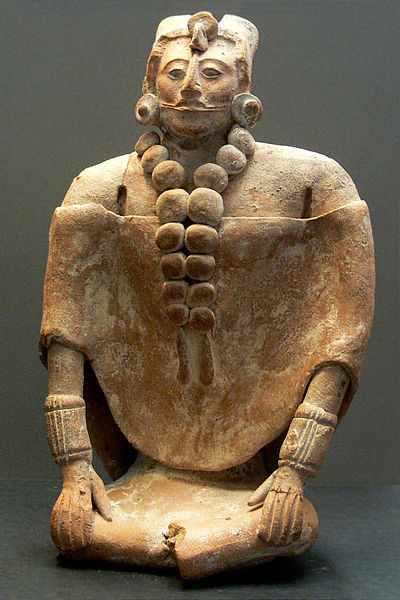
Maya dignitary
In the folklore of the Yucatec Maya exists a type of supernatural being called yumtsilo’b, “worthy or deserving lords.” This term designates a number of protector or guardian spirits who might be divided into three classes according to their functions or attributes:
- The balamob, charged with protecting people, farms, and villages.
- The kuilob-kaaxob (or ah canan k’aax), who watch over mountains.
- The chacob, who control the clouds and send the rain.
Though they can be distinguished by function, these are likely three names designating the same sort of being. According to Ascención Amador Naranjo,
In our opinion, these three categories are no more than invocations of a singular being that manifest according to the functions with which it identifies on a given occasion. In Maxcanú, the term used with the most frequency to refer to them as a whole is balam, which flows together with the other specific names in the references of the informants. (“Yumtsilo’b/balamob: los dueños de la noche,” Perspectivas antropológicas en el mundo maya, ed. María Josefa Iglesias Ponce de León and Francesc Ligorred Perramon [Sociedad Española de Estudios Mayas, 1993] 488. All translations of Dra. Amador Naranjo’s paper are my own)
Balamob (singular, balam) can thus refer either to all of these protective spirits or specifically to the first of Amador Naranjo’s three subtypes. Balam literally means “jaguar.” These beings are also sometimes called balam uincob or “jaguar people,” although the Spanish plural balames is also sometimes heard.
The jaguar was highly respected and venerated by the people of Central America. In pre-Columbian iconography, it is associated with gods and sacred structures. The Maya believed jaguars had the ability to cross between the mortal realm (associated with the day) and the realm of the spirit (associated with the night). Powerful kings and warriors also availed themselves of jaguar iconography.
The earliest depictions of balamob were as gigantic terrifying guardians of the four directions. In modern times, they are seen more as guardians of nature. They protect the people along with their villages and farms. Their main function is seen to be protecting people from evil or calamity during the night. One of Amador Naranjo’s informants describe them thusly:
“They are the ones that walk on the mountain, the masters of the mountain, who watch thus by night—or better said, who watch over us. They are ghosts, balam uincob.” (489)
Although their appearance is very similar to that of human beings—old men with white hair, beards or moustaches, dressed in traditional clothing also colored white—they are not of the same nature. Rather, they are described as creatures of “pure wind” or “pure air.”
Another function of the balamob is to instruct and help the h’men or medicine man. They feel a predilection for certain children, whom they take to their abodes to impart a knowledge of traditional medicine.
Like the mound-warriors of the American Southeast, balamob are sometimes said to dwell in ancient ruins. For this reason, many people fear to touch the ruins lest they provoke their ire.
Humans and balamob have a reciprocal relationship. Whenever a mortal takes something that belongs to the balamob, he or she must repay them. If they don’t, their crops might fail or they might fall ill. In this, the balamob sound quite similar to legends of “little people” all over the world.
Some contemporary Maya have folded their belief in balamob into their Catholic faith. They say, for example, that these beings are subordinate to the will of God although they have power over the forces and phenomena of nature that most influence people’s destiny. For many, the balamob‘s function of protecting mortals during the night takes on special significance on the night following Good Friday when, they say, the rule of the crucified Christ does not prevail upon the earth.
Seeing Fairies
This review of Marjorie T. Johnson’s Seeing Fairies: From the Lost Archives of the Fairy Investigation Society, Authentic Reports of Fairies in Modern Times may be of interest to some.
Five Little People from the American Southeast

George Catlin, “Tchow-ee-pút-o-kaw,” 1834
The indigenous peoples of the American Southeast lived alongside one another long enough that many of their beliefs about the little folk have at least partially blended together. Carolyn Dunn has written a short article on Southeastern little people that draws from several cultural sources. The picture that emerges from such a cross-cultural survey of the little folk is more often than not quite coherent. If we think of little folk as a species, then we are dealing with a number of closely related subspecies that generally display the following characteristics:
- These creatures are very good at not being seen. They are selective about whom they permit to see them at all—generally only children or medicine people.
- They are more often mischievous than truly evil, although their pranks can be quite destructive. It is unwise to speak disrespectfully even of those who are well-disposed toward humans, however, as they are quick to take offense.
- They are often more kindly hearted toward children, often leading them home when they get lost in the forest.
- They live deep in the forest or in other out-of-the-way natural settings.
- They are often (but not always) associated with the healing arts. Many of these groups, in fact, serve as spiritual helpers to healers and herbalists and are often instrumental in initiating youngsters into the healing arts.
Here are five types of Southeastern little folk arranged roughly from north and east to south and west.
Yunwi Tsunsdi
There are two prominent groups of faery-like beings in Cherokee legend. There are the nunnehi, tall “spirit warriors” who are indistinguishable from ordinary humans (except for their magical powers), and the yunwi tsunsdi (yoon-wee joons-dee) or “little people,” child-sized beings who live in the rocks and cliffs.
Like the nunnehi, the yunwi tsunsdi prefer to be invisible, although they do sometimes appear to humans. Seeing them, however, is sometimes taken as an omen of impending death. They are well-proportioned and handsome, with hair that reaches almost to the ground.
Yunwi tsunsdi are depicted as helpful, kind, and magically adept. Like many faery creatures, they love music and spend much of their time singing, drumming, and dancing. For all this, they have a very gentle nature and do not like to be disturbed. Even so, they are said to harshly punish those who are disrespectful or aggressive toward them.
In Cherokee lore, the yunwi tsunsdi are divided into three “clans” with varying attitudes toward humans. The Rock clan is most malicious, the Laurel clan is merely mischievous, and the Dogwood clan is most benevolent.
Yehasuri
These Catawba little folk, whose name can be translated roughly “the wild people,” are about two feet tall and usually depicted as hairy. They are trickster spirits that live in the forest. They often live in tree stumps and eat a varied died including acorns, roots, fungi, turtles, tadpoles, frogs and bugs.
These little folk are said to behave in ways very similar to the faeries of Europe. They kidnap children, for example, and like to braid the manes and tails of horses. Like the elves of northern Europe, their magical arrows are deadly to mortals. They are said to attack anyone who gets too close to them.
One of their favorite tricks is to prowl around after dark and place spells on any children’s clothing that had been hung up to dry. This bewitched clothing would give babies colic. Therefore, conscientious Catawba mothers would bring in their infants’ clothes at dusk, wet or dry.
Yehasuris are sometimes used as bogeymen to impress upon children the importance of good behavior. Indeed, they do seem to target children more than anyone else. The only way to stop them is to rub tobacco on one’s hands and recite a particular incantation against them.
Este Lopocke
As with the Cherokee, the Muskogee people (Creeks and Seminoles) distinguish between two sorts of little people, one taller and the other shorter. And among the shorter, some are more benign and others are more harmful to humans. George E. Lankford reports the observation of A. S. Gatshet in the 1800s that
The Creek Indians…call them i’sti lupu’tski, or “little people,” but distinguish two sorts, the one being longer, the others shorter, in stature. The taller ones are called, from this very peculiarity, i’sti tsa’ptsagi [i.e, este cvpcvke, “tall people”—DJP]; the shorter, or dwarfish ones, subdivide themselves again into (a) itu’-uf-asa’ki and (b) i’sti tsa’htsa’na…. The i’sti tsa’htsa’na are the cause of a crazed condition of mind, which makes Indians run away from their lodges. (Native American Legends of the Southeast [University of Alabama Press, 1987/2011] 133)
I don’t know if this tracks perfectly with the Cherokee distinction between taller nunnehi and a number of clans or tribes of shorter yunwi tsunsdi, but it at least seems plausible. I certainly welcome any insight readers might be able to give me!
The este lopocke or este lubutke (ee-stee loh-poach-kee) live in hollow trees, on treetops, or on rocky cliffs. Their homes can be identified by an extra thick growth of small twigs of branches in the trees. Despite their small size, they appear strong and handsome, with fine figures and long but well-kept hair. They might let their toenails grow long, however.
These beings are especially known to appear to medicine people and guide them in finding the herbs they need. Encounters with the little people are considered sacred and not to be shared.
The Muskogee sometimes speak of the little people simply as “Gee” (“Ce” in normalized spelling), meaning “little,” so as to avoid using their full name. Even the helpful ones object to being mentioned in a negative or disrespectful way.
Iyagȧnasha
The little folk of Chickasaw lore are sometimes identified as tribal ancestors who now take up residence in the forest. They are said to be about three feet tall. Although they might help those who are in trouble, they are also likely to play tricks on those who have offended them. They allow themselves to be seen only to a few, mostly hunters or medicine people.
They do, however, interact with children. Sometimes they choose a child to live among them for a while to be given special powers of healing. When this child grows up, he or she becomes a healer or herbalist. They might teach other children how to pursue game, as they are accomplished hunters themselves.
Even so, it is considered ill-advised to live near the iyagȧnashas. The Chickasaw would move away from an area if they thought there were little people there.
The worst enemy of the iyagȧnashas is the wasp, the sting of which is fatal to them.
Hatak Awasa
There are several types of little folk among the Choctaw. One, the kowi anukasha, serves much the same role as the Chickasaw and Muskogee little folk in initiating young children into medicinal lore.
Another type, simply called hatak awasa (or hutuk awasa), “little men,” are similar to both the bogeymen and little folk of European myth. Children are warned to be good lest the hatak awasa snatch them away. Although their role can be sinister, they also preserve otherworldly knowledge handed down from olden times.
Bendith y Mamau: Ugly Welsh Faeries
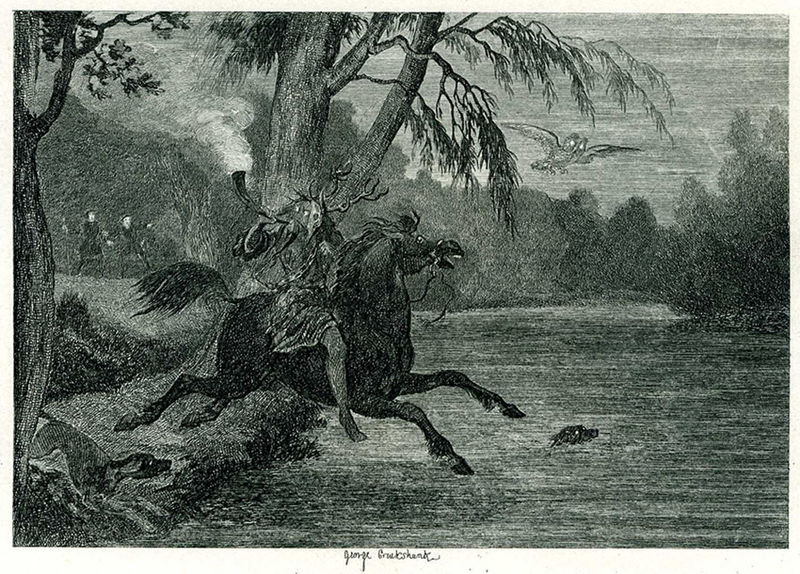
George Cruikshank, Herne the Hunter, 1840s
In Glamorganshire and Carmarthenshire, Wales, bendith y mamau (“mothers’ blessing”; roughly pronounced ben-dith uh mah-may) is a generic term for all faeries. The other Welsh term for faeries is tylwyth teg (“fair family” or “fair folk”). Some see these two terms as synonymous.
As in many faery legends, it was thought best to refer to the bendith y mamau with a flattering euphemism. In fact, there little that is “motherly” or “blessed” about these creatures. More often than not, they are, in fact, malicious and destructive in their dealings with mortals.
According to some accounts, these creatures are a grotesque cross-breed of goblin and faery. They possess the glamour or illusion-magic of faeries but the stunted and ugly appearance of goblins. Some say they have an affinity with either brownies or the pisgies (pixies) of the West Country.
The bendith y mamau are known to kidnap mortal children and replace them with their own hideous offspring, called crimbils. Stories suggest, however, that these mortal children might be returned many years later with only the faintest memory of their time among the Fair Folk. Bendith y mamau can be envious creatures, particularly of another’s beauty. They generally treat their captives well, however.
These faeries are also associated with Welsh underworld hounds. These beasts, usually called cwn annwn (“hounds of the underworld”) are sometimes also known as cwn bendith y mamau or simply cwn mamau. The appearance of these spectral dogs is thought to be an omen of death. They are also associated with the Wild Hunt.
Despite these unseemly characteristics, these faeries are also often skilled musicians and singers. Their music is capable of producing a trance-like reverie that erases a person’s memory, leaving them with only a faint recollection of the sweet music itself.
 Darrell J. Pursiful