
Home » Mythology (Page 12)
Category Archives: Mythology
Ronald Hutton’s Typology of Faeries
In the video I mentioned in this post, Prof. Hutton provided a concise classification system for the faeries of northern Europe. It is but one part of a fascinating and expertly presented lecture, and I’m summarizing it here because it fits nicely (though not perfectly) with the way I developed the Fair Folk one meets in Children of Pride. Hutton speaks of three basic categories of faeries in the British Isles:
1. Faeries proper, which Hutton describes as “the neighbors from hell.” These are the frightening and often malicious faeries one encounters in the oldest strands of faerie lore: the daoine sídhe and their cohorts. They live underground in a society that mirrors that of human beings, with courts, royalty (usually queens), banqueting, dancing, and the like.
2. Household helpers, including all manner of brownies, hobs, fenodyrees, and the like. These creatures are more mischievous than malicious, and they can sometimes be persuaded to help with the domestic and agricultural chores. But be careful, because they are easily offended and may just leave if one does something of which they don’t approve.
3. Faerie tricksters such as Robin Goodfellow. These are practical jokers, generally harmless or amusing rather than hostile. They are a rather late invention according to Hutton, largely under the influence of Shakespeare’s Puck. He is most assuredly not a pooka, which would better be understood as a dreaded “night being.” He further compares Robin Goodfellow to Native American trickster archetypes like Coyote as a trickster and buffoon, but also sometimes a powerful cosmic force. (Hutton does not use the specific terminology of “faery trickster,” but I think this is a fair description.)
He also notes a fourth category:
4. Nature spirits such as the pans and nymphs of Greek mythology. Properly speaking, Hutton says there are relatively few of these in the folklore of the British Isles. He further insists that these creatures are not, properly speaking, faeries at all since they fit into the natural realm in a way that traditional Anglo-Celtic faeries do not. Unlike faeries proper, beings of this type seem to be nearly universal in human cultures. Although Hutton insists such creatures are not faeries, he does say that the trolls or faeries of Iceland (and the related trows of the Orkney and Shetland Islands) are something of a hybrid between this category and the first. They are “land wights” who exercise guardianship over the land, but they are also said to live in underground communities and are often less than hospitable to human beings.
If you’re interested in the faery lore of the British Isles, you really owe it to yourself to listen to Prof. Hutton’s lecture.
Faery Beliefs on the Isle of Man
The Celtic Myth Podshow has posted a video of Prof. Ronald Hutton discussing Manx faery traditions.
Watch and listen to this fantastic lecture given by the wonderful Prof. Ronald Hutton about the Fairy Folklore on the Isle of Man. As always, not only is the Prof. exceedingly entertaining to listen to, but his gives us some superb information about the Fae history of the Island as well its traditional folklore. He finally regales us with a personal tale to have you in stitches! Superb stuff!
In this lecture Professor Ronald Hutton looks at how the Isle of Man is famous as an island full of fairy traditions: in some ways it may be regarded as having the greatest concentration of them in the British Isles. It therefore seems a good place in which to address the question of what traditional fairy beliefs – those shared by ordinary people until recent times – actually were.
You might be interested to know that the title of Children of Pride comes from Manx cloan ny moyrn, which can be translated something like “children of pride” or “children of ambition.”
Si’lats: Middle Eastern Shapeshifters
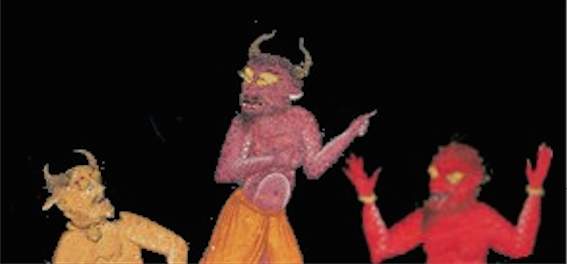
Ahsan-ol-Kobar, Ali and the Jinn (cropped), 1568
Si’lat, si’lah, or sila (plural sa’alin) literally means “she-jinn” or “she-ghul.” They are one of many types of jinn to inhabit the Middle Eastern world. In fact, they are often considered the smartest of jinn. They are talented shapeshifters who can easily pass as ordinary humans.
Sources vary on the morality of si’lats. Some assert they are the wickedest type of ghul; others that they are merely capricious tricksters who might either help or cause trouble for mortals.
Si’lats often dwell in woodlands, where they might capture travelers and force them to dance for their amusement.
Pre-Islamic traditions describe this jinn as sudden in appearance and disappearance, with a cat-like face, canine teeth, and a forked tongue.
Little Folk and Zoning: Not Just in Iceland
In September of 2012, a developer trying to build housing in Montville, Connecticut received some surprising news during a town hearing. They would need to alter their project because it threatened small stone structures that had been made by magical, dwarf-like creatures that lived underground.
Readers may be familiar with situations like this from Iceland, where construction projects are not allowed to harm the dwelling places of elves. But they are rare here in New England, where most people don’t believe in fairies, elves, and dwarves. (Bigfoot, ghosts, and UFOs are another story…)
However, magical little people are an ancient tradition among the Algonquian tribes that are native to this area, and the developer was planning to build 120 units of housing on Mohegan Hill, which is the historic and spiritual home of the sovereign Mohegan Tribe. Although the hill is not technically within the boundaries of the tribe’s reservation, it is still very important to them.
There follows an excellent introduction to the Makiawisug, the Fair Folk of the Algonquian traditions of New England.
Kowi Anukasha: Choctaw Forest Folk
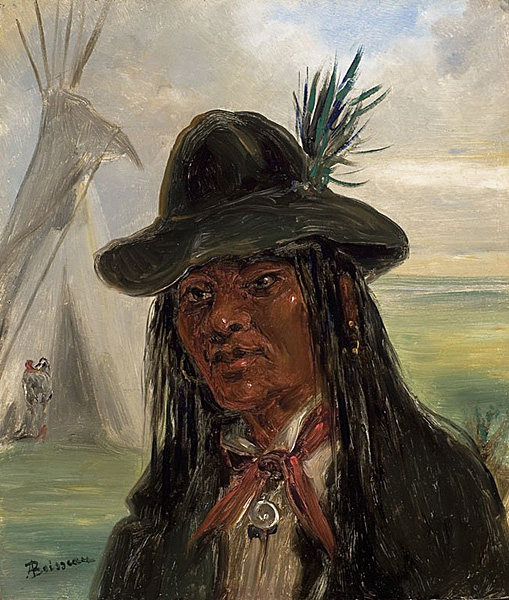
Alfred Boisseau, “A Choctaw Man in Louisiana,” 1844–48
Kowi Anukasha (also kówi anúkvsha, kwanokasha) are the little people Choctaw folklore. Their name literally means “forest dwellers.” They have powerful magic and can be very dangerous, although they are more often mischievous than malicious. They are often equated with another Choctaw figure, Bohpoli or “Thrower.” These beings were never seen by the common Choctaws, only the prophets and herb doctors. These reported that the kowi anukasha assisted them in the manufacture of their medicines. Some stories even give the account that Bohpoli would “steal” little young boys (from two to four years old) and take them into the woods, to teach them about herbs and medicines. The initiation follows a distinctive pattern:
When the little one is well out of sight from his home, “Kwanokasha,” who is always on watch, seizes the boy and takes him away to his cave, his dwelling place…. When they finally reach the cave Kwanokasha takes him inside where he is met by three other spirits, all very old with long white hair. The first one offers the boy a knife; the second one offers him a bunch of poisonous herbs; the third offers a bunch of herbs yielding good medicine. If the child accepts the knife, he is certain to become a bad man and may even kill his friends. If he accepts the poisonous herbs he will never be able to cure or help his people. But, if he accepts the good herbs, he is destined to become a great doctor and an important and influential man of his tribe and win the confidence of all his people. When he accepts the good herbs the three old spirits will tell him the secrets of making medicines from herbs, roots and barks from certain trees, and of treating and curing various fevers, pains, and other sickness.
A Muskogee equivalent is called este fasta or fastachee, guardian spirits associated with Seminole shamanic practices, providing the medicines contained in a medicine bundle and acting as intermediaries between the Creator and the people. They are said to provide both corn and medicine.
Fairy Mythology at Mythic Scribes
Alice Leiper gives a succinct introduction to fairies in myth and literature over at Mythic Scribes.
English Devil Dogs
Dolly Stolze has this intriguing post up at Atlas Obscura: “The Skeletal Remains of a Hellhound in the Folklore of Devil Dogs.”
Last year DigVentures, a London-based archaeology group, unearthed the bones of a gigantic dog from a shallow grave, about 20 inches deep, in the ruins of Leiston Abbey, Suffolk. Archaeologists estimate that the canine stood more than seven-feet-tall on its hind legs and weighed about 200 pounds. DigVentures researchers believe the canine bones likely date to when the abbey was active, so are likely medieval, but they are awaiting confirmation from testing.
English folklore is full of stories about a supernatural dog, known as Black Shuck, that prowled the countryside around Leiston Abbey about 500 years ago. Due to the size and date of the bones, many have speculated that these large canine remains could be connected to the legend of Black Shuck.
For some reason, The Devil’s Due is shaping up to be pretty heavy with unearthly hounds of various types. I hope they’re not stalking me.
Woof!
Korreds: The Underground Folk of Brittany
Korreds (also called Korrs) are guardians of treasures and standing stones in the folklore of Brittany (northwestern France). They prefer to live underground, in caves under the dolmens. They might also live under heaths, in sea-cliff caves, or in natural caverns. The related teuz and poulpikan types live in bogs or swamps.
Korreds have the strength of giants despite their small stature. They are said to live beneath the dolmen stones of Brittany. They have bright red eyes, dark skin, and often a hunched back. They are prophets as well as magicians, and are said to know the secrets of all treasures hidden in their neighborhood. They congregate around stone circles and love dancing but are more malevolent than other Gallic faeries. They are sometimes called bogul noz, “Children of the Night.”
The main delight of korreds is in dancing, which they do so vigorously that the grass burns in circles under their feet. They only dance at night, and usually on Wednesday, their traditional day off. They react with violence to mortals who disturb their dance-rituals, although mortals may be swept up in the ecstasy of the dance. Korreds are not always unkind to mortals, but they are never overly friendly.
In ancient times, Phoenician dwarves or sprites arrived in Brittany and intermarried with certain families of korreds. These dwarves were both kouretes (courètes) and karkinoi, another word for kabeiroi (carikines). Modern korreds are divided into the “old korreds,” the original pure lineage, and the “new korreds” who have a bit of this foreign heritage. Old Korred lineages include: Jetins (somewhat shorter), Vihans (also shorter), Hommes Cornus (from Gascony), Corics, Kerions, Kouricans, Gwazig-Gan, Kourils (or Courils), and Korandon. New Korred lineages include: Corriquets, Guerrionets, Korriks, Boudiguets, C’Horriquets, Corrandonnets, and Kornikaned (carry small horns on their belts).
In other parts of France, these beings are known as crions. They are also found in the Pyrenees and in Cornwall, where they are known as spriggans. Unlike spriggans, korreds are apparently unable able to grow to giant size.
The Evolution of Fae
Alas, the title of Leo Elijah Cristea’s most recent post on the fae is not a reference to how these beings emerged and diversified through random mutation and natural selection. It is, however, a wonderful discussion of the varieties of Fair Folk one encounters in myth and literature. In particular, this post tries to tackle those elements that are recognizable as at least suggestive of faeries in world mythology, always admitting that whatever overlap (or identity) is claimed must only be claimed with due appreciation for how the source cultures themselves do different things with their various nature spirits, angels, or what have you.
If we delve back in time and focus on the birth of these various stories, even widening our net and including other “fae-like” beings whose appearance or vocation has led them to be tangled up in the same net as faeries—such as the short, stout Northern Dwarves, the elfin Álfar and Svartálfar who could become the aos sí, as well as the creatures already discussed—it becomes clear that appearance alone is sometimes enough to define the beings from different realms as fae.
In this way, we can trace the evolution of the faeries through their alteration and adaptation, drawing up lines of likeness between similar beings, as well as their manmade transformations throughout literature and popular culture.
This is an excellent article, well worth the read!
 Darrell J. Pursiful