
Home » Mythology (Page 14)
Category Archives: Mythology
Yumboes: Senegalese Little Folk
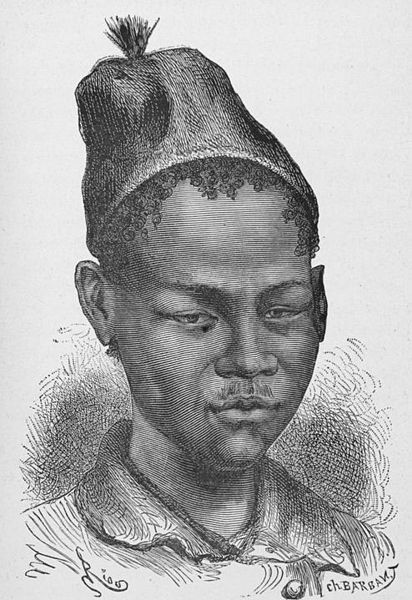
Wolof type by Edouard Riou
Yumboes are part of the Wolof folklore of Senegal. These beings are also called bakhna rakhna, “Good People.” They are described as about two feet in height, and of a pearly-white color. (White skin is often a property of supernatural beings in African beliefs). They also have silver hair.
The “Good People” attach themselves to a chosen family and love and care for them. When a member of that family dies, they develop great compassion for the grieving family members and try their best to lament them. It is also traditional that the Yumboes dance upon the grave of the deceased victim.
The Yumboes live beneath the Paps hills, three miles inland from Goree Island, and come out to dance in the moonlight. They feast on large tables, served by partially invisible servants (only feet and hands are visible). They invite both natives and foreigners to their feasts.
The Wolof say Yumboes live just like people. They have been spotted at night in their fishing boats hoping to catch a late snack. They bring this fish to the land in search for some fire to roast it. Unlike humans, the Yumboes do not make their own fire but they steal the burning wood of campfires from human natives but they only take as much as is needed to roast their fish. They are also very fond of corn, which they also steal. Yumboes are very fond of plum wine. When the wine turns sour, they drink it with great joy until they become very drunk. In such a drunken state they sing loudly, make much noise by beating on drums and generally acting wild.
The Science of Dragons
In the Memoirs of Lady Trent series, Marie Brennan does something somewhat unique with her dragons: she attempts to ground them in science. She explains why in an essay posted over at io9.
Maybe we should blame dinosaurs. Giant reptilian creatures did exist once upon a time; why couldn’t giant reptilian creatures with wings exist? Well, because physics — but the inner eight-year-old, the wide-eyed child who shelves books about dinosaurs right alongside fantasy stories with no regard for boundaries, doesn’t care about the equations. (One wonders what the long-term effect will be of the realization that dinosaurs actually had feathers. Will we see more feathered dragons cropping up in genre fiction, a la the Aztec quetzalcoatl?)
Or maybe it’s the sheer nerdy challenge of it. The same impulse that makes people build working computers in Minecraft or postulate the likely outcome of a battle between Alexander the Great and Genghis Khan might lead you to wonder whether dragons couldwork, and if so, how. I know from personal experience that there’s nothing like application to make a dry and tedious topic interesting; no doubt generations of biology students have entertained themselves by fiddling around with matters like bone structure and oxygen exchange, trying to find a way to make dragons fly.
Then, of course, there’s the amusement factor. NORAD — the North American Aerospace Defense Command — tracks Santa’s progress around the world every Christmas. Why? Because in 1955, a Sears ad gave children Santa’s phone number . . . but the number they gave accidentally went to the duty commander at NORAD’s operations center. (Oops.) Utter silliness, but the point isn’t to be serious; it’s just a chance for adults to kick back and enjoy some imaginative play. We’re more willing to allow that to grown-ups now than we used to be, so I think you get more intersections of adult knowledge with childish whimsy as a result.
I love this kind of world-building, having worked out something of the science of both unicorns and griffins—and hoping eventually to work it into my Into the Wonder series in some way. I also know a fair bit more about the physiology and evolution of dwarves than I’ve tipped my hand to so far…
At any rate, I will definitely have to put the Memoirs of Lady Trent series on my wish list!
Shedim: Eldritch Beings from Jewish Folklore

Lady Lilith by Dante Gabriel Rossetti
Shedim are beings from Jewish folklore. They only appear twice in the Hebrew Bible, both times in the plural (although the singular form would be shēd or sheid). Psalm 106:37 says, “They sacrificed their own sons and daughters to demons!” (CEB). In a similar context, Deuteronomy 32:17 says,
They sacrificed to demons, not to God,
to deities of which
they had no knowledge—
new gods only recently on the scene,
ones about which your ancestors
had never heard.
Shedim are therefore obviously bad news in the Bible. Oddly enough, the term seems to be related to Akkadian shedu, the word for spirit-beings generally. In Mesopotamian mythology, a shedu might be a benevolent or protective spirit, perhaps what we might think of as a guardian angel. Perhaps they are cast in a negative light in the Bible because of their associations with foreign gods and foreign worship. The biblical writers were obviously interested in discouraging infatuation with lesser protective spirits and the kind of devotion their neighbors offered to such beings.
Despite this minimal treatment in the Bible, a good bit of legendary embellishment grew up around shedim in later times. There are, for example, a number of theories as to their origin. Some say they sprung from serpents—maybe even the serpent in the garden of Eden. Others say they were humans that God left unfinished when he rested on the seventh day of Creation. Still others say they are the descendants of Adam and his first wife, Lilith.
According to the Talmud, shedim are not fallen angels, but rather a distinct order of creation between angels and human beings:
Our Rabbis taught: Six things are said concerning shedim: in regard to three, they are like the ministering angels; and in regard to three, like human beings. ‘In regard to three they are like the ministering angels’: they have wings like the ministering angels; and they fly from one end of the world to the other like the ministering angels; and they know what will happen like the ministering angels…. ‘And in regard to three, they are like human beings’: they eat and drink like human beings; they propagate like human beings; and they die like human beings. (Hagigah 16a)
They thus look and act much more like the jinn of Arabic tradition than the “fallen angels” of Christian theology. Also like jinn, they can be defeated with iron weapons.
Although their name is usually translated “demons,” shedim are not always seen as malevolent spirits. (There is, in fact, a different word strictly used for malevolent shedim: maziqin or “harmers.”) A story is even told in Leviticus Rabbah 24 about a water-sheid who warned a holy man about the threat posed by a harmful fellow sheid.
Some Qabbalistic rituals actually invoke “benevolent” shedim, and humans can consult them about the future by means of rituals involving oil and eggshells. The Talmud forbids this on the Sabbath, however (Shabbat 101a). The revered scholars Hillel and Johanan ben Zakkai are said to have understood the speech of shedim just as King Solomon did (another overlap with Arabic jinn-lore).
Even when they are not purely malicious, these creatures’ sense of morality can be quite alien to human norms. In one story from Russia, we see shedim acting in a capricious manner befitting the faeries of northern Europe. A hunchback wandering in the forest came upon a large and festive party of shedim, who grabbed him and pulled him into their wild dance. The shedim were so delighted with his participation that they demanded he come back the next day. Furthermore, they demanded his hump as a pledge that he would return. They took it, and the man went home delighted to have been made whole.
This man had a twin brother who, jealous of his brother’s new physique, asked him how he had achieved it. The man told him, and so the twin set out to do the same thing. When the shedim appeared to him in the woods, he also joined in their dancing. Then, assuming this was the same man as they encountered before, they returned his pledge, and he left with two humps—one on his back and the other on his chest! (Carol K. Mack and Dinah Mack, A Field Guide to Demons, Vampires, Fallen Angels, and Other Subversive Spirits [New York: Arcade, 2011]).
Shedim are described in various ways—and are often shapeshifters—but they are usually invisible by default and said to have have chicken-like feet. Other birdlike characteristics are sometimes attributed to them. Their presence can be detected by scattering dust or ashes on the ground and looking for their footprints.
Unicorn Infographic
Michelle Enemark at Atlas Obscura has posted a great infographic on unicorns. It leaves out one of my favorite unicorn facts, however: a group of unicorns is called a “blessing.” 
There used to be actual unicorns in the world, but scientists call them elasmotheres.
Five Dwarfish Varieties from Around the World
Properly speaking, dwarves are a feature of Norse mythology. They are a tribe of subterranean smiths and craftsmen noted for their arcane knowledge and especially their skill in fashioning powerful magical items.
But these aren’t the only wise and secretive earth-spirits in world mythology, although they are probably the most frequently encountered in fantasy fiction. Here is a list of five fantastic beings that combine (in various proportions) affinities for (1) the underground world, including associations with mining, metals, and precious stones and (2) secret skills or knowledge—craftsmanship, magic, the healing arts, etc.—which they may or may not share with mortals.
Dvergar

Alberich the dwarf and the Nibelungs
Let’s proceed roughly from the north and west to the south and east. We begin, therefore, with the dwarves of Scandinavia and their cousins in other Germanic cultures. The dwarves of northern England’s Simonside Hills, for example, are of this sort. These dwarves formed the basis for J. R. R. Tolkien’s depiction of dwarves. In fact, the dwarves in The Hobbit all have names drawn from Norse mythology. They are also seen in characters such as Alberich the dwarf in the Middle High German Nibelungenlied. As already stated, these dwarves are renowned metalworkers and blacksmiths. In Norse mythology, they fashioned many of the magical items used by gods and heroes, including Thor’s magic hammer Mjölnir and the chain that bound the great wolf Fenrir. In some later legends, they are also accomplished healers. They can, however, be highly distrusting of outsiders. They also have a reputation for being greedy.
Dvergar are ill-tempered, greedy, miserly, and grudging. They are known to curse objects they are forced to make or that are stolen from them. They almost never willingly teach their magical knowledge. At the same time, they can be surprisingly friendly and loyal to those who treat them kindly. Contrary to popular misconceptions, dvergar are not particularly illustrious warriors—although their strength and overall hardiness suggest they would generally be able to hold their own in a fight.
Like trolls, Norse dwarves are sometimes depicted as turning to stone if exposed to direct sunlight.
Karliki

Wrocław Krasnal, photo by Wikimedia user Puchatech K. / GFDL
Karliki (singular, karlik) are fiendish dwarves from eastern Europe, inhabitants of the lowest recesses of the underground world. In Polish, the appropriate terms are krasnal, karzeł, or karzełek, although they are sometimes called Skarbnik, “the Treasurer.” These beings are very similar to dvergar, living in mines and guarding hoards of metals, gems, and crystals. Apparently they are even more prone to malicious behavior than their Nordic cousins. According to Slavic Christian folk beliefs, these beings are, in fact demonic. One source relates, “When Satan and all his hosts were expelled from heaven, says a popular legenda, some of the exiled spirits fell into the lowest recesses of the underground world, where they remain in the shape of Karliki or dwarfs” (see Ralston, The Songs of the Russian People, 106–107).
Karliki can be helpful toward miners, willing to lead them to rich veins of ore and protect them from danger. To those who offend them, however, they can be deadly, sending tunnels crashing down upon them or pushing them into dark chasms.
Dactyls
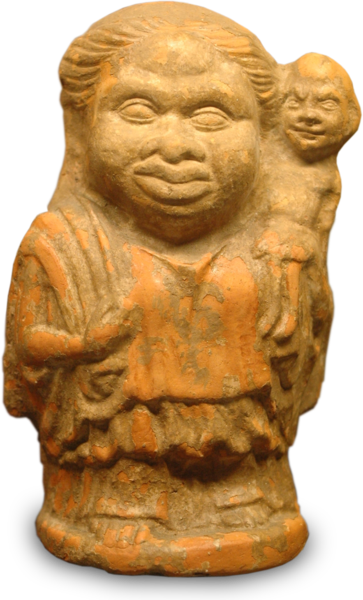 The daktyloi or dactyls are the dwarves of Greece and the Aegean. They are renowned smiths and healing magicians. In some legends, they taught metalworking, mathematics, and the alphabet to humans. The sisters of the dactyls are called hekaterides (singular, hekateris).
- Cretan dactyls are especially adept at healing magic, but they are also known for working in copper and iron.
- Idean (or Phrygian) dactyls may be the oldest tribe of dwarves in the Mediterranean region. They are rustic creatures from around Mount Ida in Phrygia and perhaps have their origin in earlier Hittite or Pelasgian earth-spirits. They claim to have invented the art of metalworking and even to have discovered iron.
- Kabeiroi are an offshoot of the Idean tribe that settled at Lemnos, Samothrace, and Thebes. They are divine craftsmen said to be descended from the god Hephaestus. They have an association with the sea and sailors that is quite unusual for dwarfkind. In some accounts, they are raucous wine-drinkers.
- Rhodian dactyls are dangerous underworld smiths and magicians sometimes called telkhines.
Khnumu
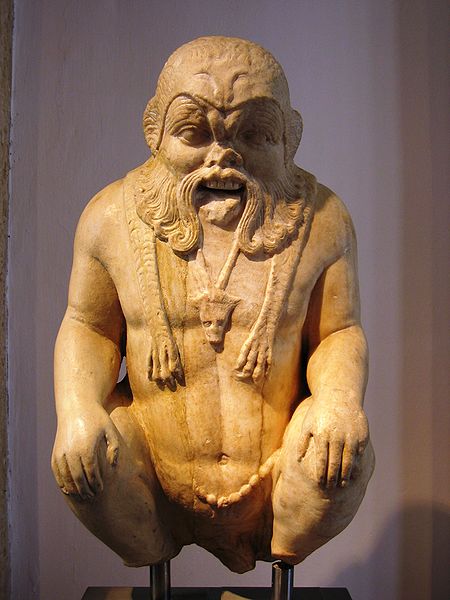
Bes, photo by Wikimedia user Archeologo / GFDL
Dwarves have an esteemed place in Egyptian mythology. Mundane dwarfs or little people apparently suffered little or no prejudice in ancient Egypt. Some gods, most notably Bes, were depicted as dwarfs. These gods were originally protectors of households.
In addition to Bes, there were the khnumu (singular, khnum), subterranean earth-spirits who were helpers of the god Ptah, the creator of the world. Their name means “the modellers.” They are represented with muscular bodies, bent legs, long arms, large broad heads, and intelligent faces. Some wear long mustaches; others have bushy beards. By some accounts, they have the power to reconstruct the decaying bodies of the dead. Other accounts say they were the ones who first taught humans the magical arts.
In later times, khnumu might be called pataikoi (singular, pataikos), “little Ptahs” in Greek. Phoenicians carved images of pataikoi on the prows of their ships. The Greek historian Herodotus compared them to the seafaring kabeiroi.
A similar figure occurs on early Babylonian seal cylinders, where it is given the Sumerian name “the god Nugidda” or “the dwarf.” This figure is sometimes depicted dancing before the goddess Ishtar. It is a matter of speculation whether this Mesopotamian dwarf-figure was the inspiration for the Egyptians and Phoenicians or whether it was the other way around.
Yakshas

Yaksha, photo by Wikimedia user Shakti / GFDL
Yakshas hail from India. They are found in Hindu, Jain, and Buddhist literature. They are a broad class of nature-spirits and caretakers of treasures hidden in the earth and in tree-roots. Their king is Kubera, the god of wealth and protector of the world. He is often depicted as a fat man holding a money-bag and adorned with jewels.
Yakshas function as stewards of the earth and of the wealth buried beneath it. Depending on the story, yakshas may be either benign nature-spirits associated with woods and mountains or foreboding monsters that ambush travelers.
Male yakshas are portrayed either as warriors or as stout, dwarf-like beings. Female yakshas, called yakshis or yakshinis, are often depicted as young, beautiful, and voluptuous.
Like the Egyptian dwarf-god Bes, yakshas are often protector figures. In Thai Buddhism, yakshas often feature in architecture as guardians of temples. These fearsome yakshas are depicted as green-skinned with bulging eyes and fangs. In Thai folklore, yakshas often figure alongside ogres and giants.
In Jainism, yakshas are often propitiated to bring fertility, health, and prosperity.
Satyrs: Greek Spirits of the Wild

Michelangelo, “Satyr’s Head”
Satyrs are associated with forests and mountains in both Greek and Roman mythology. Hesiod (7th cent. BC) considered them the “brothers” of the mountain nymphs and Kouretes. Whatever their genealogy, they are uninhibited children of nature: earthy, reckless, seductive—and dangerous if threatened. They are the quintessential “bad boys” of the faery world, brazenly flouting the norms of civilized society. In keeping with their untamed nature, their traditional garment is a panther pelt.
Despite their wildness, satyrs do have an appreciation for at least some of the gifts of human culture. They love music and dance, for example. In fact, they have a special form of grotesque, vulgar dance called the sikinnis. They are also associated both with Pan, the Greek god of the wild, and Dionysus, the god of wine. They are notably hardy and resistant to fatigue, able to dance for hours on end, for example, or remain (relatively) sober no matter how much alcohol they consume. They are lovers of wine, women, and revels. They have a particular infatuation with nymphs.
There are two common depictions of satyrs in Greco-Roman art. Young satyrs are called satyrisci (singular, satyriscus). They are graceful beings with elfin features and pointed ears. Praxilites’s sculpture “Resting Satyr” depicts a satyriscus.
The earlier depiction of satyrs made them older, more animalistic, but also more powerful. These satyrs are classified as sileni (singular, silenus). Sileni are bearded and strongly built. They have the ears of a horse, a horse-like tail, and sometimes even the hooves (or the entire lower body) of a horse. Sileni are the oldest, wisest, and most magically adept of satyrs.
It should be noted, then, that satyrs are not to be confused with fauns or “goat-men.” As time progressed, Greek satyrs became blended with Roman fauns in the telling of the myths. The two, however, were originally different sorts of beings. Satyrs are, in fact, fully humanoid (at least in their youth). Medieval bestiaries often compared satyrs not to goats but to apes or monkeys.
World-building: Extensive, Minimal, Top-down, and Bottom-up
Philip Overby has a new post up at Mythic Scribes about that perennial topic among fantasy writers, world-building. Philip lays out the pros and cons of both “extensive” and “minimal” approachs to world building, and he does it quite well. I’ll go ahead and state my preference for extensive world-building—as long as it doesn’t bog down the story.
I commented:
I think of it sort of like a flower garden. People who come by to admire your roses and petunias don’t really care what sort of fertilizer you use or how you decide when to plant or the brand of your favorite set of clippers. They care about the finished product, not the process. And yet, when the other members of the local gardening society come around, they love to talk shop, share tips, etc.
I’m not sure what proportion of fantasy readers are like the members of the gardening society and want to delve deeply into the appendices in the back of the book (or the Wiki or whatever). I am fairly confident, however, that that number is greater than zero. 🙂
In addition to “extensive” and “minimal,” I find it helpful to think in terms of either “top-down” or “bottom-up” world-building. Top-down world-building gives you the big picture of what is actually possible in this new, fantastical world—and why, given this broad context, things actually happen the way they do.
I’m thinking here of the basic mechanics of the world, the elements that inform the overall direction of the story. Top-down world-building looks at the sorts of broad subject matter one could study about our own world: history, technology, geography, religion, politics, etc. Add to this the things that would be a part of a well-rounded education in our world if, in fact, our world was a fantasy setting: How does magic work? What sapient species (elves, dwarves, fauns, talking animals, etc.) exist, and how do they all get along?
It’s a good idea for writers to have a pretty firm handle on these sorts of issues. Philip is right that at least some of this work really should be done before writing commences. I would urge, however, that writers spare us the info dump. If the world is engaging enough, I’ll certainly ask for more “behind the scenes” information. But I don’t want all this fascinating detail to get in the way of a great story. Rather, let these kinds of issues bubble up organically from within the story itself.
Bottom-up world-building is different. These are the elements that lend a certain tone or “color” to the narrative. They may very well be the sorts of things writers dream up on the spot to give their world a greater sense of verisimilitude or simply to entertain the readers.
One good example of what I mean by bottom-up world-building is the in-universe terminology characters use to talk about the various features of their world. What sort of slang, shorthand, technical terminology, or even profanity grows naturally out of the way your world is put together? You can develop an entire magical system using generic terms like “non-magical person,” but doesn’t it add something to the story’s texture to call such a person a “Muggle” (if you’re Harry Potter) or a “straight” (if you’re Harry Dresden)? For me, bottom-up world-building usually begins when I say, “I need a term used by group X to refer to concept Y” or “I need a weird or magical way people in my world would perform ordinary activity Z.”
I’ll be honest and admit that some of my bottom-up world-building takes the form of puns and gags. My purpose is to entertain, after all. So maybe my protagonist is listening to a country-western song in which the cowboy-wizard’s three-headed dog runs away. Or maybe my elves fire “elf-shot” from a twelve-gauge rather than a bow and arrow. (I actually decided to include that last one in Children of Pride fairly late in the writing process. Fortunately, I already had enough of the magic system worked out to explain [to myself!] how it could work. Maybe someone will explain it to my protagonist in a later volume…)
Top-down and bottom-up complement each other. In fact, the two can even build upon each other as the writer reflects on how his or her world is taking shape.
I Almost Missed the End of the World
I somehow missed the fact that the “Viking apocalypse” is scheduled for this coming weekend. After all the hullabaloo about the Mayans and Harold Camping, and somehow I missed this one? My deepest apologies to Norsemen everywhere! I can’t be too mad at myself, however. The reason this vital piece of information slipped my mind is (1) there is no such thing as a “Viking apocalypse” and (2) the whole thing is apparently a promotional gimmick for a Viking-themed festival being held this week in York, England. Dan McCoy has all the gory details, and a fine explanation of how “time” works in most animistic/polytheistic cultures, at his Norse Mythology blog.
Five More Prehistoric Beasts that Could Stand In for Mythical Monsters
If the past week of web stats are any indication, my readers are really into prehistoric beasts. At least, you all really seemed to appreciate last Friday’s post on the subject. In that vein, I thought I’d write about a few more interesting beasties and how they might find their way into world mythology…
1. Teratorns
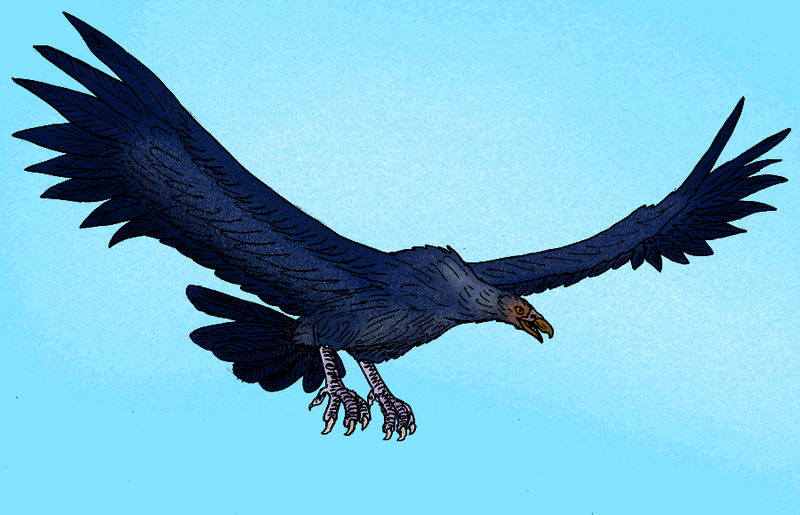
Argentavis magnificense by Wikimedia user: Stanton F. Fink / GFDL
Members of the family Teratornithidae were huge, condor-like birds. There were numerous species with wingspans ranging from 12 up to 20 feet. One of their number, Argentavis magnificens, is the largest flying bird ever discovered. Traditionally, teratorns have been thought of as large scavengers, very much like oversized condors, owing to considerable similarity with these birds. Their long beaks and wide gapes, however, are more like the beaks of eagles and other actively predatory birds than those of carrion-eaters. Most likely, teratorns swallowed their prey whole. Argentavis could have swallowed up to hare-sized animals in a single gulp.
Teratorns have long be hypothesized as the basis of the Thunderbird legend in Native American mythology. This formidable spiritual power is described an enormous bird—according to many Northwestern tribes, large enough to carry a killer whale in its talons as an eagle carries a fish. The Thunderbird is responsible for the sound of thunder and, in some cases, lightning as well.
Native American groups have different traditions regarding the Thunderbird. In some tribes, they are considered extremely sacred forces of nature. In others, they are considered powerful but otherwise ordinary members of the animal kingdom.
2. Amphicyonids
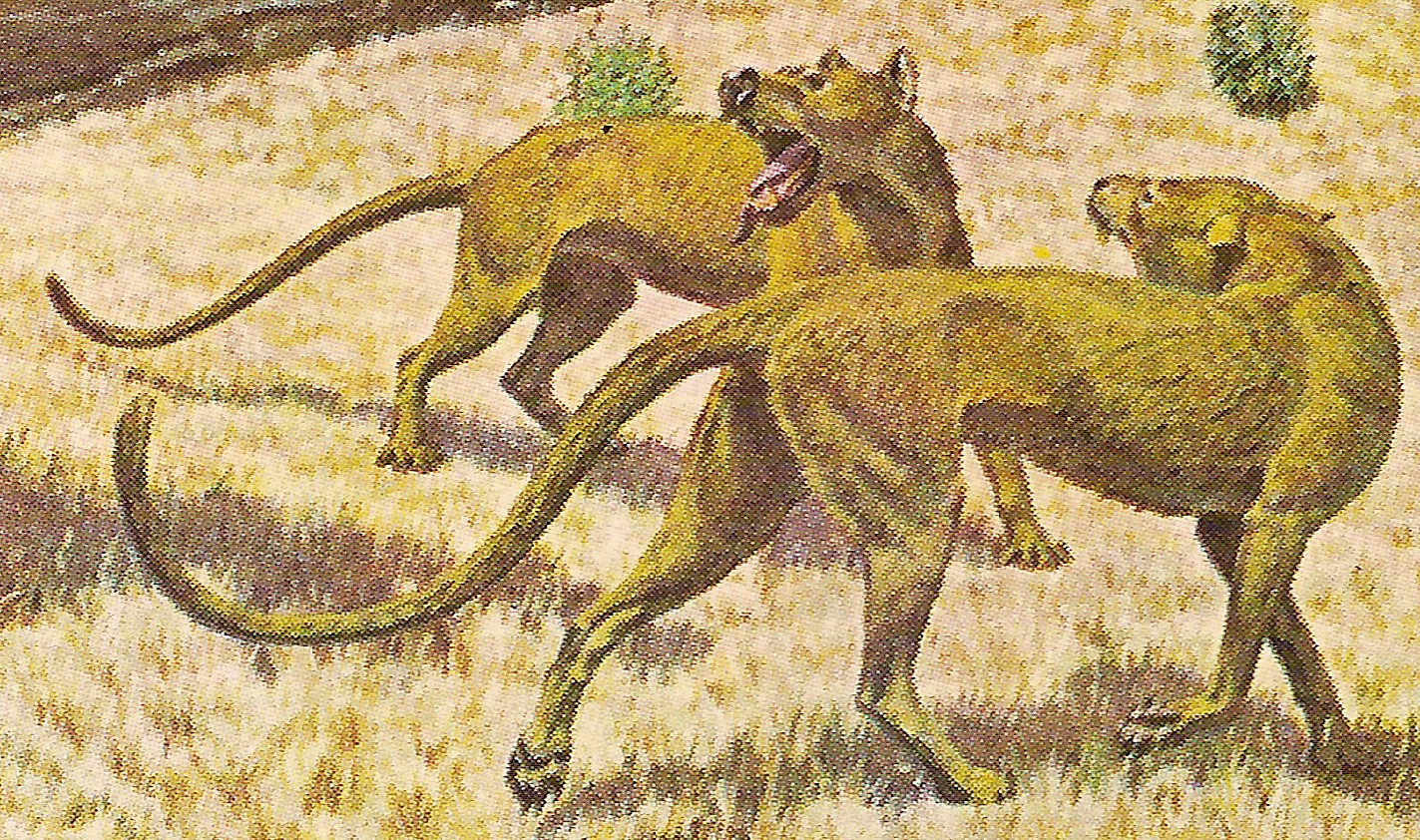 Amphicyonids or “bear dogs” bear a similarity to both bears and dogs (obviously). They are members of the order Carnivora and the suborder Caniforma (i.e, “dog-shaped” carnivores). Early amphicyonids such as Daphoenodon had a digitigrade posture, the same as dogs and cats. Many later and larger species walked flat-footed like bears, however.
Although many amphicyonids were no larger than ordinary foxes or wolves, some of these creatures were enormous. Euroamphicyon was one of the larger and heavier members of this family, with a body mass estimated to c. 310 pounds. Other genera (Amphicyon, Cynelos, Pliocyon) boasted members who weighed in at around 200 pounds.
In mythology, amphicyonids would seem to make a great stand-in for the hell hounds of Greek legend or perhaps some of the hunting dogs associated with the Wild Hunt of northern Europe.
Another possibility, admittedly more of a stretch, would be to find in amphicyonids a template for the Foo Dogs (or Lion Dogs) of the Far East. These figures seem to be related more closely to architecture and home décor than to folklore, and many insist the “dog” name is in error: they say these figures, which often appear in pairs outside homes, temples, and Chinese restaurants, are simply stylized representations of lions.
3. Entelodonts
 If amphicyonids represent hell hounds, we might think of members of the family Entelodontidae as “hell hogs”! These creatures from the forests and plains of North America, Europe, and Asia were not properly of the family Suidae (that is, swine) but rather a closely related group. They were the apex predators in their various ecologies, but they were also indiscriminate omnivores who ate everything from live animals to carrion to plant matter.
Entelodonts had bulky bodies, slender legs, and long muzzles. The largest North American genus, Daeodon, stood almost 7 feet tall at the shoulder. They had heavy, bony lumps on their heads similar to a warthog’s.
Perhaps when king Oeneus of Calydon offended the goddess Artemis, the fierce Calydonian Boar she sent to the region as punishment was a type of Entelodont.
4. Protocetids

Georgiacetus vogtlensis by Wikimedia user: Nobu Tamura / GFDL
Protocetidae are a diverse family of early cetaceans. They were the first cetaceans to disperse from the region of India and Pakistan to all the shallow oceans of the world. They were probably amphibious, and some were probably able to support their weight on land—although others could not. Although there is some controversy over the matter, some believe they gave birth on land.
Grampus (or “Grumpus”) is a dolphin- or porpoise-like creature. Although it presumably lives in the sea, one legend claims a specimen once dwelled in a yew tree near Highclere Church in Hampshire, England. It was apparently not especially dangerous, although its presence terrified the villagers until the local priest banished it to the Red Sea.
Other amphibious creatures might be identified with family Protocetidae. For example, the dobhar-chú (loosely “water hound”) of Ireland might be some sort of otter-like proto-whale. This creature is said to have characteristics of both a dog and an otter, though it is sometimes described as half-dog, half-fish. It is definitely a mammal, though, as it has fur. The word is often Anglicized as doyarchu or dhuragoo.
5. Mesonychids

Synoplotherium vorax by Wikimedia user: Dmitry Bogdanov / GFDL
Simply put, mesonychids are hooved carnivores. Although most often described as “wolves with hooves,” this was, in fact, a rather diverse mammalian family. Various species looked liked hoofed bears, hoofed cats, hoofed wolves, etc. Their digits were tipped with hooves rather than claws.
The strongest possibility for inserting mesonychids into world folklore is probably the “Beast of Gévaudan” from France in the 1760s. Some witnesses describe this beast as a huge (horse-sized) creature combining features of wolf, bear, panther, and hyena. Some reported that it had cloven hooves, or that each digit was tipped with a hoof. Others said the claws were so heavy and thick that they merely resembled hooves. This beast would seem to be a great match for a hyena-like mesonychid like the Pachyaena or Harpagolestes.
Maybe the coolest thing about the Beast of Gévaudan is that locals claimed it was a werecreature or a sorcerer who shapeshifted into a fearsome creature. The prospect of a werepachyaena terrorizing the French countryside has awesome written all over it!
A cat-like mesonychid, perhaps a larger cousin of genus Sinonyx, might provide an interesting template for the Far Eastern creature called a bai ze (in Chinese) or hukutaku (in Japanese). This sacred animal is monstrous in appearance, as large as an ox, with both bovine and leonine characteristics. It has hooves and a lion-like body. It is sometimes said to have nine eyes (three on its face and three on each flank) and six horns (two on its head and two on each flank). Alternatively, it has just one extra eye in the center of its forehead, and either one or multiple horns on its head. Perhaps this detail reflects some sort of unusual coat pattern? Or, of course, the extra eyes and horns may be of purely magical origin…
The Irish God of Love
From Celtic Myth Podshow:
It is said that Aengus was troubled by dreams and visions of a beautiful, young maiden. He fell in love with her immediately and started to waste away because he could not find her. His mother Boann searched the whole of Ireland for the maiden, but after a year she still had not found her. The mighty Dagda did the same and also could not find her. Then the great and wise Dagda called on Bodb Dearg, king of the Sidhe in Munster and the Dagda’s aide, to go and find the girl, and she was found at Loch Bel Dracon (the Loch of the Dragon’s Mouth), chained to fifty other girls, all of whom turn into birds.
I wouldn’t recommend asking a King of the Sídhe for help unless you’ve got some serious god cred of your own, however.
 Darrell J. Pursiful