
Home » Mythology (Page 15)
Category Archives: Mythology
Five Prehistoric Beasts That Could Stand In for Mythical Monsters
Following up on this post about cryptids, here are some semi-random thoughts about how speculative paleontology could flesh out some of the creatures of myth and folklore. In particular, here are some possible connections that I kind of love.
1. Creodonts
 Creodonts share a common ancestor with members of the order Carnivora. They bear a superficial similarity to large cats or enormous weasels, but are actually quite distinct. I’m thinking the claims about various large Appalachian predators known as the glawackus, the Ozark howler, and the Beast of Bladenboro might fit the bill as contemporary members of this extinct order of mammals. All three of these cryptids are described as being vaguely feline, but not quite. The glawackus, for example, is described as combining the most fearsome characteristics of a lion, a panther, and a bear. The Ozark howler is bear-sized, but seems mostly to resemble a shaggy feline creature. The Beast of Bladenboro seems to combine features of both cats and dogs.
All of this suggests some member of the order Creodonta. Perhaps they would be of the family Oxyaenidae, cat-like beasts that walked on flat feet like a bear. They had a short, broad skull, deep jaws, and teeth designed for crushing rather than shearing.
A further possible creodont is the water panther of Algonquian legend. This creature might be a member of genus Patriofelis, which was about the same size as a panther and thought to be a good swimmer but a poor runner.
2. Short-faced Bears

Wikimedia user: Dantheman9758 / GFDL
This Pleistocene predator, Arctodus simus, was possibly the largest carnivorous land mammal that ever lived in North America. These enormous predators might give us a template for the “man-eater,” “naked bear,” or “stiff-legged bear” of many Native American mythologies. This creature was apparently a gigantic, stiff-legged and hairless beast as big as an elephant.
Some even speculate that legends of the man-eater represent the dim memory of mammoths and mastodons that once roamed North America. But there are a number of arguments against this theory. First, the creature is described as being a gigantic bear—a creature that Native Americans would have known quite well. Second, as the name might suggest, the man-eater is a carnivore, while mammoths and mastodons were herbivores. Finally, man-eaters are never mentioned as having a trunk.
3. Gigantopithecus
 This one is actually fairly commonplace. Among those who believe creatures like the yeti or sasquatch are real, many assert that they are, in fact, gigantopithecines. Gigantopithecus blacki was the largest primate that ever lived, reaching almost ten feet in height if it stood upright. Paleontologists are actually fairly certain this enormous creature walked on all fours like a gorilla, but a minority view holds that they were bipedal.
Members of genus Gigantopithecus are pongines, meaning they are close relatives of the orangutan. Darren Naish follows this same reasoning in the Cryptozoologicon, explaining that the yeti or sasquatch is a bipedal pongine, “convergently similar to hominins in some ways but different with respect to the details of anatomy, gait and behaviour.” In most legends, sasquatch (by whatever name) are incapable of human speech and communicate, rather, by means of whistles, grunts, and gestures.
Depending on what you imagine as far as a sasquatch’s intelligence or behavior, one might also suggest it is more closely related to humans. Several Native American legends have a bigfoot-like creature that is described as an ogre, perhaps an over-large descendant of Paranthropus boisei or something similar. In some legends, sasquatch are able to mate with human women. This would not be genetically possible by either of these theories, however, barring some sort of magical intervention.
4. Elasmotheres
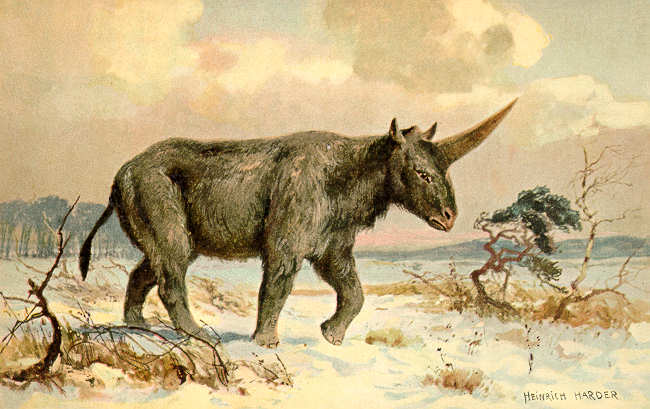 Members of the genus Elasmotherium are close relatives of the rhinoceros, as evidenced by the prominent horn of keratin protruding from their forehead. They are also fairly closely related to horses and tapirs as members of the order Perissodactyla. A conjectural “pygmy” elasmothere might be a Clydesdale-sized creature adapted for fast running on open grassland. With longer legs than rhinos, they would have a galloping, horse-like gait.
Of course, I am describing a unicorn—or at least something very similar to the unicorns first described by Ctesias and Pliny in ancient times. Such creatures would have hooved toes, four on their forelegs and three on their hindlegs, precisely as some medieval sources describe. Behaviorally, they might well be every bit as irascible as their rhinoceros cousins, also in keeping with the earliest strands of unicorn-lore.
5. Prehistoric Giraffids
 Giraffids are a family of even-toed ungulates. Today they are represented solely by giraffes and okapis. In prehistoric times, however, they were much more diverse. I suspect one or another genus of prehistoric giraffids might make a fine template by which to understand the qilin or “Chinese unicorn“—which isn’t properly a unicorn at all as it is usually depicted with two horns. Perhaps something like Shansitherium fuguensis would fit the bill.
Giraffids are ruminants closely related to cattle and deer. Their horns, called ossicones, are covered in skin. Like the ossicones of giraffes, those of the qilin are reported to be blunt rather than sharp, which has been taken as an indication of the animal’s peaceful nature. A tesselated coat pattern like a giraffe’s might give the impression that the creature has scales on its back. Like the okapi (and unlike giraffes), the qilin is apparently a solidary creature.
In Asian art, qilin show great variety in physical appearance. All qilin have a deer-like body and cloven hooves. Japanese, Korean, and the earliest Chinese depictions agree that the qilin bears at least a superficial resemblance to a deer.
Cryptozoology + Paleontology = Awesomeness
Paleontologist Darren Naish and artists John Conway and C.M. Kosemen have collaborated to explore cryptids from around the world and speculate about how these monsters might actually fit into our world from an ecological and biological point of view. Their work is titled Cryptozoologicon: The Biology, Evolution, and Mythology of Hidden Animals (Irregular Books, 2013). Based on Annalee Newitz’s review at i09, it looks really interesting. Newitz writes,
What’s so fascinating about this book, written by paleontologist Darren Naish, and artists John Conway and C.M. Kosemen, is that it respects both the legends behind these monsters and the science that debunks them. It’s a complicated merger between speculative fiction and scientific analysis, which the group also showcased in their previous collaboration, All Yesterdays.In that book, the group explored new directions in how to depict ancient animals, with often mind-blowing results. WithCryptozoologicon, they are trying something more speculative still. They’ve put together an extensive collection of cryptids from around the world, drawn them in gorgeous panels, and provided both a scientific debunkery as well as an enthusiastic, fictional endorsement of the creature’s existence.
Each entry contains three sections: (1) the accounts of the creature that others have given, (2) an evaluation of those accounts, and (3) a speculative description of what that creature might be, if in fact it existed (and apparently their assessments of this range from “no way” to “well, maybe”).
For example, the writers come to the following creative explanation for the notorious chupacabra:
Clearly, the Chupacabra is a semi-bipedal, nocturnal, predatory marsupial, the likes of which is unknown to science. Equipped with a long, robust tail, forelimbs proportioned something like those of a primate, and an ability to leap and climb, this sharp-toothed predator (which we name Deinoroo caprophagus) is convergently similar to the Australasian macropods in some respects but is actually a very large opossum. Indeed, the formidable dentition, strong jaws and enlarged upper canines of opossums required little evolutionary modification to produce a large-bodied predator.
This whole project sound a lot like what I have attempted to do with the various eldritch races in Into the Wonder as well as my (as yet unpublished) musings about how Jersey devils, Ozark howlers, unicorns, and other creatures of myth might work from an evolutionary/paleontological perspective.
The Dragons of Europe
Leo Elijah Cristea discusses the dragon-lore of Europe, specifically from Norse and Slavic mythologies, in the last installment of his series on dragons at Fantasy Faction. At the bottom of the post, you’ll also find links to other installments in this series.
A Brief History of Werewolves
If you ever wanted a quick and easy introduction to werewolf-lore, this post from Just the Juicy Bits is a pretty good place to start. (H/T: Werewolves.com)
From it’s first written appearance in 1.A.D to the present day we have never lost our morbid fascination with this most changeable of creatures. Almost every established culture features tales of Werewolves, simply replacing the ‘wolf’ with the dominant apex predator of that society. The Egyptian God Anubis for example had the head of a jackal and there are Chinese legends depicting cursed individuals transforming into tigers at will.
Despite our familiarity with the Werewolf, our contemporary understanding of a creature transforming with the full moon howling at the night sky, is very different to the perception of the Werewolf in the 15th-17th centuries. During this period Werewolves were not a fairytale, but a real and present threat- unnatural beings associated with Satan in a time when religious persecution was rife. The accounts of the Werewolf Trials, which ran parallel to the Witch Trials, present us with insight into a politically unstable world shaped by religion, politics and fear.
Newfoundland Faery Traditions
Here is an awesome collection of online resources for Newfoundland faery traditions compiled by Dale Gilbert Jarvis and Nicole Penney.
Nicole Penney and I have been busy little elves this morning, working on a project we both love: Newfoundland fairylore!
We have had some requests from people about the tradition of fairies in Newfoundland and Labrador, so we’ve pulled together some links to online material that we think might be useful to people doing projects or heritage fair displays on the faerie folk, fairy belief, tradition and superstition.
Jinn: Fair Folk of the Middle East
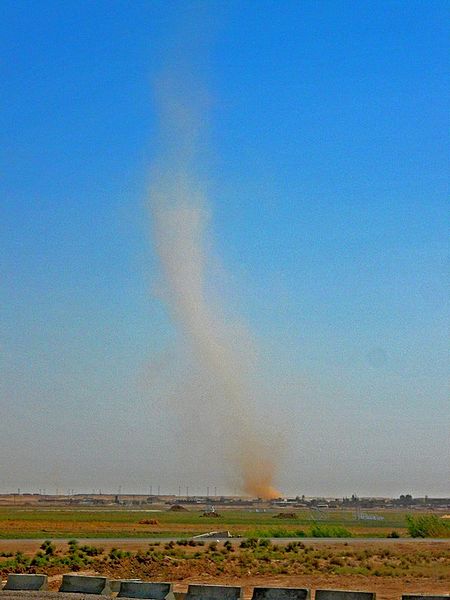 Jinn is a catch-all Arabic term for a variety of beings that, in Muslim doctrine, are neither humans nor angels but something in between. Whereas Adam, the first man, is said to have been created from earth and angels are beings of pure light, jinn were created from “smokeless fire.”
There are a couple of terminological traps that need to be addressed before we go any further. In Arabic, the singular masculine form is jinni. The singular feminine is jinniyah. Jinn is the plural form. Sometimes the words are spelled with a “d” in it (for example, djinn). Jinni is sometimes rendered in English as “genie,” but this isn’t technically correct. The “genie” spelling creates the false impression that the word is related to Latin genius, meaning “spirit.” In fact, jinni (and related forms) comes from an Arabic word meaning “hidden.” These beings are thus more or less “the hidden folk.”
Also, the jinn of the Arabic world have a close counterpart in the peris of Persia (modern Iran). It is a matter of speculation which came first, but the two mythologies clearly cross-pollinated each other throughout the Middle Ages. Both groups are said to live primarily in Koh-e-Qaf, the Mountains of Qaf (i.e., the Caucasus Mountains).
The image of jinn as magical slaves trapped inside lamps or bottles is largely derived from the Thousand and One Nights. What is often overlooked is that these stories depict individual jinn who have been reduced to slavery by powerful magicians. Jinn are naturally free beings that may be either helpful or malicious toward human beings.
Jinn are not immortal, though their lifespans far exceed that of humans. Like humans, they marry, have children. Sometimes they even marry humans and produce hybrid children with characteristics of both parents. (A Syrian legal treatise from the fourteenth century condemns such marriages.) They eat and drink as mortals do. They can also be killed either by other jinn or by mortals.
Even so, jinn are decidedly magical beings. They have the ability to travel quickly from place to place, and they are especially known as accomplished shapeshifters, often appearing in the forms of snakes, vultures, dogs, cats, or other animals. They can also take on human form, although evil jinn often appear hideously deformed.
In stories, jinn inject a note of unpredictability. They might reward the protagonist or unfairly punish him or her.
There are more than a few points of connection between the faery lore of Europe and the jinn lore of the Middle East. Both types of beings possess great magical powers, including invisibility and shapeshifting. Both are sometimes said to intermarry with humans—although jinn, like the elves of Scandinavia, seem to have a better track record in this regard than the Fair Folk of the Celtic nations.
Finally, like the faeries of Celtic folklore, jinn are vulnerable to iron. If anything, they are even more frightened of the substance, and in some legends can be put to flight by even the threat of iron.
There are many varieties of jinn within Middle Eastern folklore. In addition, under Muslim influence, many cultures outside the Middle East have adjusted their own indigenous beliefs about supernatural beings to conform to jinn-lore, often explicitly equating these previously existing entities with jinn. Some of these “hybridized” jinn types are: the asaid or zar of Ethiopia, the bori of northern Nigeria, the gnena or guinné of West Africa, and the bidadari or bediadari of Malaysia.
Dwarves: Cantankerous Norse Craftsmen
 The best known dwarves are the dvergar of Norse myth, although cognate beings are found in all Germanic cultures. Norse dwarves are associated with rocks, earth, metalworking, and mining. They are subterranean and nocturnal beings. The are sometimes depicted as having pale, chalky skin. At other times, they are said to be blue-skinned, suggestive of a dead body. Death and decay seem to be prominent themes in dwarf-lore. It is even said that they made from the maggots in the body of Ymir, the world-giant.
Dwarves are master craftsmen. In Norse mythology, they fashioned many of the magical items used by gods and heroes, including Thor’s magic hammer Mjölnir and the chain that bound the great wolf Fenrir. They are also ill-tempered, greedy, miserly, and grudging. They are known to curse objects they are forced to make or that are stolen from them. They almost never willingly teach their magical knowledge. They can be highly distrusting of outsiders.
At the same time, these beings can be surprisingly friendly and loyal to those who treat them kindly. Contrary to popular misconceptions, dwarves are not particularly illustrious warriors in the original mythology.
Dwarves are by nature subterranean and nocturnal creatures. According to some accounts, sunlight even has an adverse effect on them. One legend has it that the god Thor entered into a riddle contest with Alvíss, a dwarf, which lasted until dawn. Exposed to direct sunlight, the dwarf was promptly turned to stone.
It is not at all certain that dwarves were originally conceived as being any shorter than humans. This detail only arises in the 1200s and later, and usually adds a note of humor to their depiction. Another later development is that, in later legends, dwarves are sometimes depicted as accomplished healers as well as smiths and craftsmen.
The Ophiotaurus
The most recent installment of Faith M. Broughan’s series on monsters in Greek mythology focuses on the Ophiotaurus. There is only one extant reference to this creature in all of Greco-Roman literature, but it does feature prominently in The Titan’s Curse by Rick Riordan.
Jogaoh: Iroquois Fair Folk

Masked Iroquois dancer
The Iroquois Confederacy was made up of the Seneca, Cayuga, Onondaga, Oneida, and Mohawk tribes. In the folklore of all of these are stories of the jogaoh. Like the nunnehi of the Cherokee, jogaoh are generally more favorable toward humans than their European counterparts. (The Cherokee and the Iroquois are actually distantly related; the Cherokee language is in fact classified as “Southern Iroquoian.”) The Fair Folk of the Huron-Wyandot peoples, another Iroquoian group, are of a similar nature.
Their name is sometimes translated as “dwarves,” “pygmies,” or “little people.” They often appear as tiny humanoids, perhaps only inches tall. As with most Fair Folk, however, appearances can be deceiving as some of these beings are expert shapeshifters.
These beings are actually an alliance or confederacy of three distinct “tribes.”
Gahongas
Of the three tribes of jogaoh, gahongas most often have dealings with humans. They inhabit rocks and rivers. In Huron-Wyandot lore, these beings are able to come and go through living rock. Guardians of streams, they dwell in caves along the banks. They are especially concerned with fishing. They direct the movements of fish, give them shelter in their deep-water caves, and protect them from those who would over-fish their waters. They can command a fruitful or a barren fishing season, and frequently punish wrongdoing with famine.
Gahongas are sometimes called “stone-throwers” because of their love of a particular game that involves tossing large stones back and forth. They thus possess incredible strength, far in excess to what might be expected given their size. In fact, is is said that “they can uproot the largest tree by a twist of the hand, and hurl massive rocks into the rivers, to lift the waters when floods threaten” (William M. Beauchamp, Iroquois Folk Lore [Dehler, 1922] 46).
Gahongas sometimes visit mortals and lead them to their dwelling-places, where they challenge them to feats of strength. Other mortal visitors are instructed in the Gahongas’ magical secrets: mysticism, exorcism, and dances. As with many stories from Europe, when these visitors return to the mortal realm, they may discover that many years have passed, while it seemed to them they were only gone for a short while.
Gandayahs
Gandayahs are associated with plants and plant growth. As a kindred of the fruits and grains, they are the most favored of humankind and most beloved by them. They are beings of sunshine who bring joy and happiness to mortals. In the springtime, they hide in dark, sheltered places and coax the earth to bring forth its fruit. Then, in the summer, they wander over the fields, tinting the grains and ripening the fruits. They also fend of blights and diseases of plants that threaten the harvest.
In times of drought, the Iroquois might search in the wilderness for small cup-shaped hollows in the soft earth. These are fashioned into “dew cup charms” meant to attract the gandayahs and coax them to begin their work.
It is said that they are especially fond of strawberries. According to one legend, an evil spirit once stole the strawberry plant and hid it under the ground for centuries until it was finally rescued by a sunbeam, who carried it back to the mortal world. Ever after, the gandayahs have kept a special guard over this fruit, the ripening of which marks the beginning of their yearly work.
They frequently visit the mortal realm in various forms, especially birds. If they come as a robin, it bodes good tidings. An owl, however, is a word of warning that an enemy is coming to deceive. A bat denotes a life-and-death struggle close at hand. Even harmless insects and worms might bear important messages for the attentive mortal to discern.
Ohdowas
These beings are devoted to hunting. Although they are small, they are sturdy and brave. They dwell deep beneath the soil in subterranean realms where no sunlight penetrates. Many different kinds of animals inhabit this land, many of which are dangerous to mortals. The ohdowas strive to prevent the poisonous serpents and other grim creatures from reaching the surface of the earth. Beauchamp explains,
In the dim world where the Oh-do-was live are deep forests and broad plains, where roam the animals whose proper abode is there, and though all that live there wish to escape, yet both good and bad, native and captive, are bidden to be content and dwell where fate has placed them. Among the mysterious underearth denizens are the white buffaloes, who are tempted again and again to gain the earth’s surface, but the paths to the light are guarded, and the white buffalo must not climb to the sunlight, to gallop with his brown brothers over the plains. Sometimes they try to rush up and out, and then the Oh-do-was rally their hunters, and thin out the unruly herds with their arrows. ‘Tis then that a messenger is sent above to tell the sunlight elves that the chase is on, and the earth elves hang a red cloud high in the heavens, as a sign of the hunt. Ever alert for signals the Indian reads the symbol of the red cloud, and rejoices that the Little People are watchful and brave. (48)
In addition to protecting the surface world from monsters, ohdowas are also the “warriors” of jogaoh culture, charged with hunting down wrongdoers and bringing them to justice.
The Wild Hunt
Imagine a horde of ghostly hunters, sounding their horns as they ride through the countryside at night on black horses (and sometimes black stags) behind black dogs with eerie, glowing eyes. Such a ghostly experience is common to European folklore, but especially in the most northerly countries. It is called the Wild Hunt, and Dan McCoy has posted an excellent brief summary of the legend.
As McCoy explains, the Wild Hunt (also called Odin’s Hunt, Odin’s Army, the Terrifying Ride, etc.) is usually said to take place in midwinter, the coldest and darkest part of the year. Those who came upon it by accident were caught up in the ghostly procession. Others, witches and such, might join in voluntarily in a kind of astral projection.
The leader of the Hunt is variously named and variously described, but the Hunt is most often associated with the god Odin or Wotan in Germanic lands.
What is the meaning of the Hunt? As McCoy explains, it has strong ties to death and the cult of the dead:
In the body of lore surrounding the Wild Hunt, we find a number of themes that connect it powerfully with the dead and the underworld. For one thing, there’s the ghostly character of the hunters or warriors themselves. Dogs and horses, animals that were closely associated with death (amongst a great many other things), were almost invariably present. In some accounts of the Hunt, the riders can hardly, if at all, be distinguished from land spirits, who were themselves often conflated with the dead, as if the two were thought of as being in some sense one and the same. Finally, for the ancient Germanic peoples, the worlds of the living and the dead were especially permeable during midwinter, which goes a long way toward explaining why this troop of apparitions haunted the land during that particular part of the year. In the words of Claude Lecouteux, “[T]he Wild Hunt fell into the vast complex of ancestor worship, the cult of the dead, who are the go-betweens between men and the gods.”
It was as if the very elements of midwinter – the menacing cold, the almost unrelenting darkness, the eerie, desolate silence broken only by the baying winds and galloping storms – manifested the restless dead, and the ancient northern Europeans, whose ways of life and worldviews predisposed them to sense the spiritual qualities in the world around them, recorded the sometimes terrifying fruits of such an engagement with the more-than-human world in their accounts of the Wild Hunt.
 Darrell J. Pursiful