
Home » Mythology (Page 16)
Category Archives: Mythology
Deer People: Native American Forest Folk
 Several Native American peoples have legends of a half-deer, half-human being that lives in the forest and is sometimes dangerous to humans. In the Southeast, the Choctaw tell of a mischievous deer man called kashehotapolo. Cherokee folklore has a shapeshifting “deer woman.” These two apparently have little in common except their deer-like attributes and the general part of the world in which they live.
The kashehotapolo love to frighten hunters in the woods but are otherwise more mischievous than malicious.They inhabit the marshes and swampy woodlands. The Choctaw say these beings screech and wail as they dash past lone hunters at lightning speed.
What does a kashehotapolo look like? Reports vary. Some say its true form is an antlered humanoid, although it can take the form of an ordinary deer. Others report the creature has an undersized head. Yet others say he has a shriveled face, the body of a man and the legs and hooves of a deer. This confusion about its appearance is explained by the Choctaw by saying the creature ran so fast that few ever saw it clearly enough to clearly state what it looked like.
In contrast to the Choctaw deer man’s mostly harmless demeanor, the Cherokee “deer woman” is a seductive shapeshifter. They are able to assume the form of a deer, although they may retain some deer characteristics even in human form (most often possessing hooves instead of human feet). Although they can be helpful to women, especially those hoping to conceive children, they are often dangerous to men. Men who are adulterous or promiscuous are their favorite targets. Deer women might lead such men to their deaths or else leave them to pine away from lovesickness.
Deer women are also found in the folklore of the Great Plains. In the Lakota language, they are called Anukite (“double face”) or Sinté Sapela Win (“black-tailed woman”). Plains legends tend to paint them as irredeemably evil. In Cherokee and other eastern folklore, however, they can be helpful to humans, although they are still considered dangerous and unpredictable.
Huldras: Scandinavian Wood Nymphs
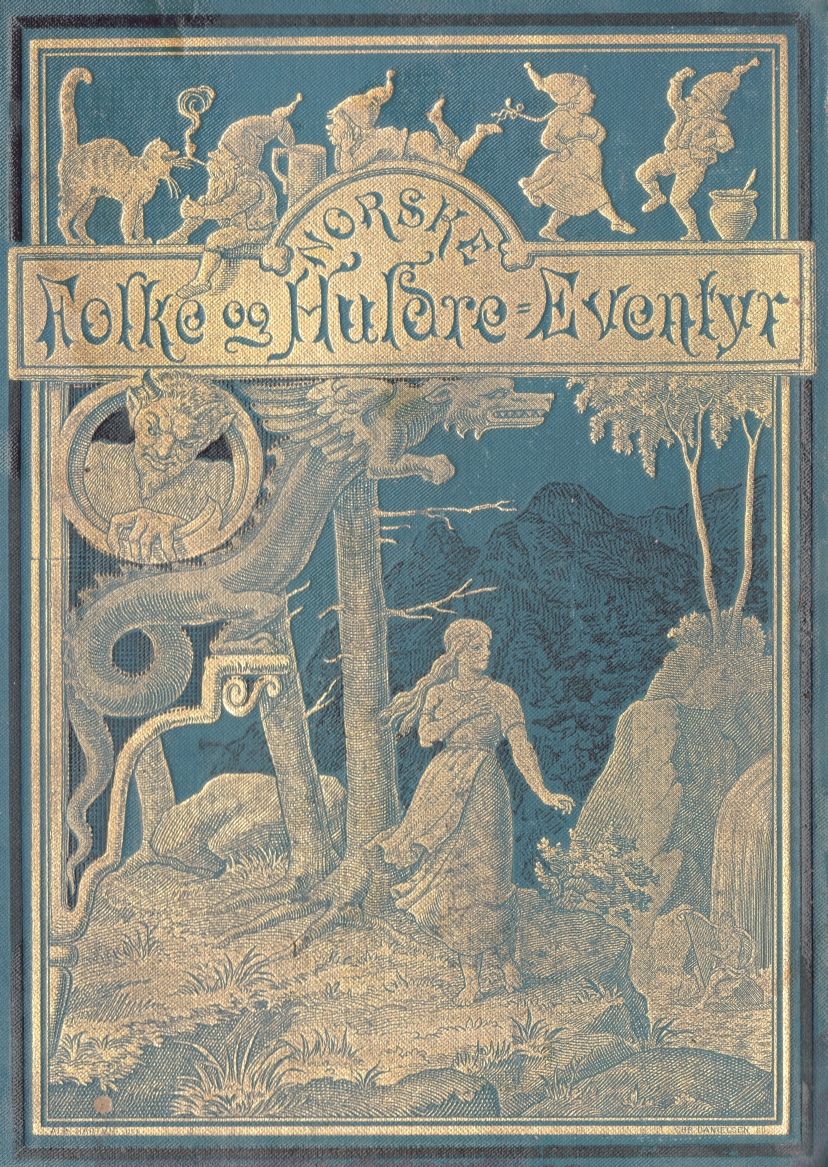 The word huldra comes a Scandinavian word “hidden” or “secret.” This word also lies behind the Icelandic term huldufólk, a euphemism used to avoid speaking directly about elves. Huldras are not the same as the bright and benevolent elves of Norse mythology, however. They are, in fact dangerous and seductive woodland sprites.
Huldras appear as stunningly beautiful women who are sometimes dressed in simple peasant garb. They are usually depicted with uncanny or animalistic features when viewed from behind, however. They might have a cow’s tail, for example, and in some stories, they have a hollow or bark-covered back.
In some legends, huldras lure men into the woods for romantic encounters. If a child results, they might reappear to the father to present him with their unearthly child. In other stories, they steal human infants and replace them with their own babies
Sometimes, it seems, a huldra finds true love with a mortal, but the glamour or illusion that conceals her inhuman aspects is broken at her wedding, either when she enters the church or when the priest places his hand on her. At the same time, other stories state that, once married to a Christian man, the huldra will loose her tail but retain her beauty.
Huldras can be fiercly vindictive if they are mistreated or betrayed. They are sometimes depicted with superhuman strength.
Huldras are known by other terms as well. In Norway, she might be called a skogsfru or skovfrue, “lady (or mistress) of the forest.” She might also be called a skogsrå (“forest-guardian”) or Tallemaja (“pine-tree Mary”) in Sweden or, among the Sámi, Ulda. She is likely related to the Germanic myth of Holda, a protectress of agriculture and women’s crafts.
The male counterpart of a huldra is called a huldu or (in Norway) a huldrekarl. By all accounts, the males are often just as seductive—and dangerous—as the females.
La Befana: Italy’s Christmastide Gift-giver
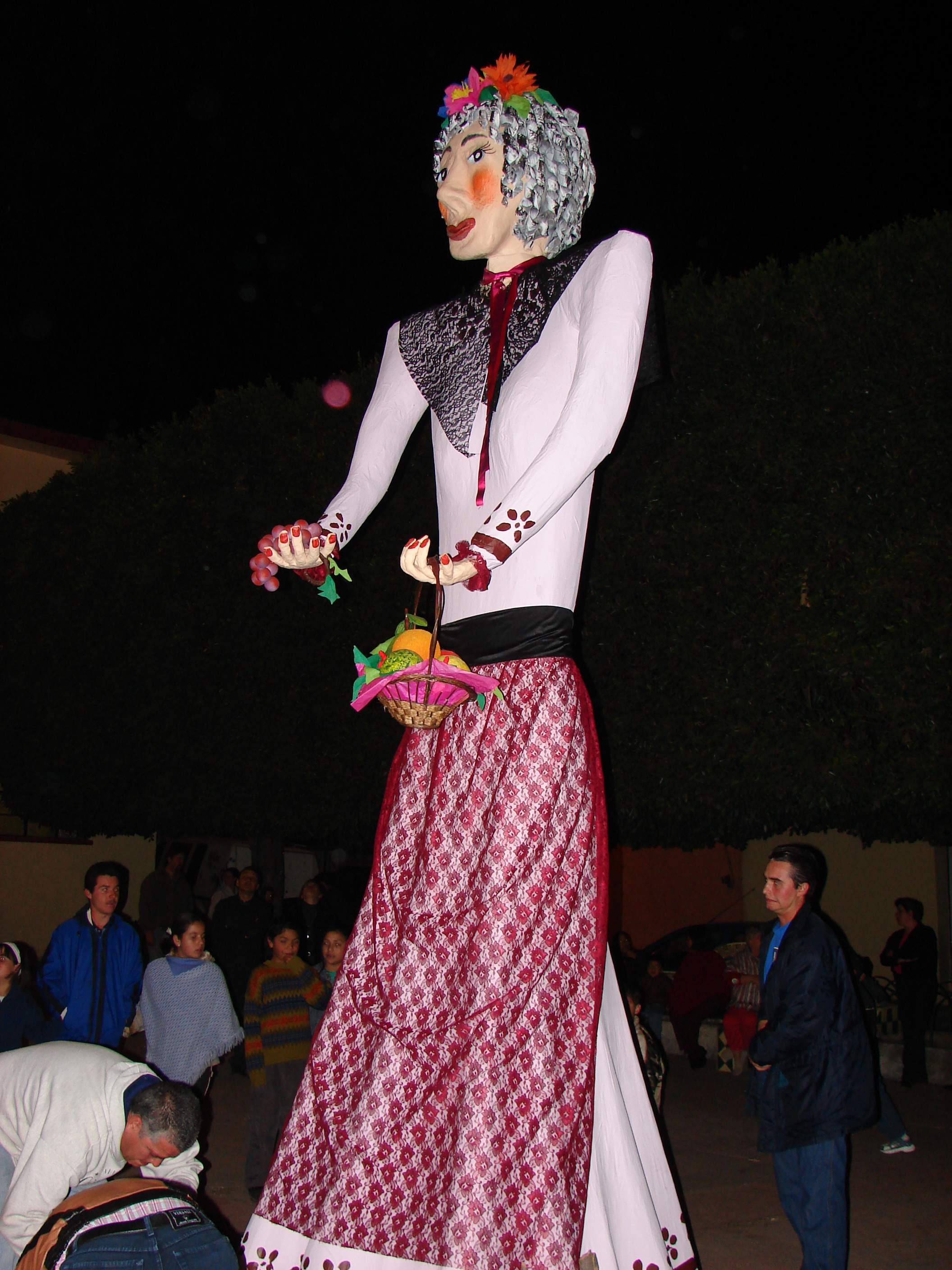 Tomorrow is the twelfth day of Christmas. That means that tomorrow night, Epiphany Eve, marks the yearly journey of La Befana, Italy’s answer to Santa Claus, as she brings gifts to children far and wide.
Where did La Befana (or simply Befana) come from? One possibility is that her origins lie in the ancient Roman goddess Strina or Strenia, who was associated with new-year gift-giving. Both Strina and La Befana are said to give gifts of figs, dates, and honey. Both, also, were/are celebrated with noisy, rowdy observances.
In folklore, La Befana showed hospitality to the three wise men on their journey to visit the Christ Child (which is the point of the Feast of the Epiphany, January 6). She passed up, however, the opportunity to see him for herself, protesting that she had too much housework to do. Later, she had a change of heart and tried to catch up with the wise men. Legend says she is still searching for the infant Jesus to this day.
La Befana’s name is a corruption of Epifania, the Italian rendition of Epiphany.
Like Santa Claus, La Befana enters houses via the chimney in order to fill children’s stockings with candy and presents of they are good or with a lump of coal if they were bad. She may be somewhat more lenient than Santa, however, because misbehaving children might find dark candy in their stocking. In Sicily, however, they might just find a stick!
Despite her Santa-like attributes, La Befana is often depicted in a decidedly witchy manner. She is said to look like an old lady riding a broomstick and wrapped in a black shawl. Like Clement Moore’s Saint Nicholas, she is covered in soot because of her chimney-based entrances. She is a friendly witch, however, often smiling as she carries her bag of treats.
Also unlike Santa, La Befana has a domestic streak. She might, in fact, sweep the floor before she leaves–interpreted by some to be sweeping away the problems of the old year.
Finally, this being Italy, it is traditional to leave her not milk and cookies but a glass of wine and a few morsels of food.
Yunwi Tsunsdi: Cherokee Little Folk
In addition to the nunnehi, who are powerful supernatural warriors, there is another group of faery beings in Cherokee folklore. These are the yunwi tsunsdi or “little people” (the singular form is yvwi usdi). Like the nunnehi, the yunwi tsunsdi prefer to be invisible, although they do sometimes appear to humans as miniature people—child-sized or smaller. They are well-proportioned and handsome, with hair that reaches almost to the ground. It is said that twins are especially adept at seeing these tiny creatures.
Yunwi tsunsdi are depicted as helpful, kind, and magically adept. Like many faery creatures, they love music and spend much of their time singing, drumming, and dancing. For all this, they have a very gentle nature and do not like to be disturbed. Even so, they are said to harshly punish those who are disrespectful or aggressive toward them.
In Cherokee lore, the yunwi tsunsdi are divided into three “clans”:
- The Rock clan is the most malicious, quick to get even when offended. Some say they are like this because their space has been invaded. Like many types of European fae, they are known to steal human children.
- The Laurel clan is generally benevolent, humorous, and joyful. They are also mischievous, however, and love to play tricks on the unsuspecting.
- The Dogwood clan is the most favorably disposed to humans, though they are also stern, serious, and prefer to be left alone.
Each of these clans, it is said, teaches a moral lesson. The Rock clan teaches not to mistreat others lest misfortune come back against us in return. It is important to respect the limits and boundaries of others.
The lesson of the Laurel clan is not to take the world too seriously. People must always have joy and share that joy with others.
Finally, the Dogwood clan’s lesson is to treat others kindly out of the goodness of one’s heart and not in hope of reward.
Yunwi tsunsdi are perhaps the most common type of faery being in the American Southeast. Legends about the Choctaw hatak awasa and the Muskogee este lopocke, both also meaning “little people,” are quite similar to what the Cherokee say of the yunwi tsunsdi. The Catawba know of creatures that are essentially identical, which they call yehasuri (“not human ones”).
The Darkling Diet?
I’ll admit, this article about goblins, trolls, and vitamin D deficiency has got me thinking. I really like it when fantasy fiction interacts with modern scientific knowledge, like when Harry Dresden comments about the law of conservation of energy and how it can effect the spell he is trying to cast. I even wrote a scene into Children of Pride that discusses the implications of the square-cube law to size-shifting faeries. I’m also kind of a fan of Food Network, so what follows might have been predicted.
In short, I’m wondering what sunlight-avoiding humanoids might eat on a regular basis.
Now, “sunlight-avoiding humanoids” (let’s call them “heliophobes”) is a pretty big, broad category. Many cultures have legends about creatures that live underground, only come out at night, or are in some way harmed by exposure to direct sunlight. For my purposes, I’ll eliminate vampires from consideration, as we all know what they’re having for dinner!
Let me, then, consider one small slice of the heliophobe population: the dwarves and trolls of Norse mythology. Both of these classes of beings are averse to sunlight. Various legends claim that both of them are turned to stone by the sun’s rays. Whether this is permanent or temporary—or whether this affects all members of these classes or only an unlucky few—are interesting questions, but not entirely relevant.
By narrowing my focus, maybe I can make some educated guesses about what the well-fed Scandinavian heliophobe is having for dinner. I expect it will be (1) some variation of a traditional Viking or later Scandinavian cuisine that is (2) altered where possible to provide increased consumption of foods rich in vitamin D.
So, what might a health-conscious Scandinavian denizen of the dark be eating? Here are a few suggestions.
1. Fish, and lots of it. Freshwater salmon would be readily accessible through night-time fishing expeditions in mountain streams and lakes, and it is a vitamin D goldmine with over twice the recommended daily dose in a 100g (~3.5-ounce) serving—assuming dwarves and trolls have the same nutritional needs as humans. Typically, raw fish contains more vitamin D than cooked, and fatty cuts more than lean cuts. I would imagine that salmon appears on the average troll’s menu nearly as often as chicken appears on the menu for North Americans.
Other freshwater fish would also be available, but most of the other oily fishes that are such a great source of vitamin D are ocean-going species like herring, mackerel, and tuna. I’m not sure trolls or dwarves are the deep-sea fishing types, but who knows? And of course, there may be underground lakes and streams in which light-averse creatures might fish. Gollum seemed to do all right in that regard.
Furthermore, our heliophobes are not likely to let any protein go to waste. Whatever is not consumed immediately would likely be preserved via drying, smoking, or pickling in salt water. Dried “stockfish” (the ancestor of lutefisk) is rock-hard, but can be pounded to break up the fibers and then served with butter. Pickled herring might be a delicacy if these heliophobes have access to the sea.
UPDATE: Wild-caught salmon, sardines, and herring are also an excellent source of DHA, the fatty acid that is a crucial component of the retina’s photoreceptors. They thus contribute to improved night vision.
2. Other proteins. It isn’t difficult to imagine trolls as nocturnal hunters, and some stories even describe them keeping livestock the way humans do. A health-conscious heliophobe will likely consider wild boar an especially valuable quarry. A 100g (3.5) ounce serving of pork ribs contains about 16% of the daily recommended value of vitamin D, although other cuts vary considerably. There is hardly any vitamin D in ham, for example. If pork isn’t their thing, beef liver is about half as rich in vitamin D as pork ribs. Venison of all types (red deer, elk, etc.) would also be a likely protein, though not a significant vitamin D source.
Trolls and dwarves might prepare sausages made with pork, beef liver, or other proteins mixed with herbs and spices. If they have access to grains (see below), they might bake their meat into meat pies or even serve it on an open-faced sandwich. The most common preparation for meat among the Vikings, however, was simply to boil it in a pot.
If folklore is to be believed, at least some of these creatures supplement their protein needs with human captives and/or each other.
3. Dairy products. If heliophobes either raise their own cattle or raid the cattle of their human neighbors, the milk may be more precious to them than the meat. A quarter-liter (~1 cup) of grass-fed cow’s milk contains nearly 40% of the daily recommended amount of vitamin D. I haven’t been able to track down the vitamin D content of reindeer milk, but it is definitely worth considering for inhabitants of northern Scandinavia!
Milk might be consumed raw, but would more likely be processed in various ways, creating other dairy foods that would last longer. Scandinavian heliophobes would certainly use butter as their primary cooking fat. Curds and cheese would likely be prominent in their diet. They might drink buttermilk or whey (which can also be used as a preservative to pickle meats). They might even let the whey ferment until it becomes blaand, a beverage similar to wine in alcohol content. Finally, they might enjoy a bit of skyr, similar to strained yoghurt, as a treat.
4. Mushrooms and such. This one should really go without saying, as it is probably the food most famous for growing without sunlight. Some species, such as the white bottom and the shiitake, are excellent sources of vitamin D. Scandinavian heliophobes might also gather other cave-dwelling organisms like cave-dwelling snails, salamanders, and insects.
5. Cereals. Like the Inuit and other human populations from the far north, cereals are not likely to form a significant part of a heliophobe’s diet. Unless we assume dwarves and trolls maintain above-ground farms, such items will have to be acquired through trade with others. This would also include products made from cereals such as ale made from barley.
6. Fruits and vegetables. Once again, we probably have to assume trade with others to account for many fruits and vegetables in a dwarfish or trollish diet. But there is no reason these beings couldn’t forage for wild plants at night. Wild apples and berries of many sorts could be found in abundance and dried for storage. Wild leeks, onions, and radishes might be prized as seasonings for otherwise bland foods. Wild cabbage, carrots, or turnips would likely be common fare.
UPDATE: Fennel and bilberries both contribute to enhanced night vision.
7. Other ingredients. Trade with non-heliophobic populations would likely be necessary for items beyond those mentioned above. Eggs, another good source of vitamin D, would be high on this list (unless we assume trolls and dwarves keep their own livestock). Unless these heliophobes have access to the sea, oysters would also be a desirable commodity.
UPDATE: Not only are they high in vitamin D, oysters and other shellfish are high in zinc, which works in concert with vitamin A to enhance night vision. (Dark chocolate is also high in zinc, though obviously not part of a traditional Norse diet.)
Dwarves and trolls would also likely trade for herbs and spices with which to season their food: garlic, dill, coriander, poppyseed, horseradish, etc., and even more exotic (from a Viking point of view) ingredients such as ginger, cinnamon, and bay leaves.
I can imagine a number of dietary scenarios for the heliophobes of Scandinavian folklore based on such factors as (1) the severity of their sunlight-aversion, (2) their access to seafaring technology, (3) the nature of their relations with non-heliophobes. One could definitely conceive of these creatures as malnourished, at best barely surviving in a food-poor environment. With the right set of circumstances, however, they might eat very well indeed in their underground domains.
Kindly Elves
The most recent development in elf-lore is to see them neither as tall, powerful, benevolent beings as in Norse mythology, nor as tall, powerful, sinister beings, as in later Germanic folklore, but rather as small, shy beings who are usually quite helpful to humans. Although they may still be mischievous, they are rarely malicious.
Germanic “House Elves”
One early depiction of this sort of elf is in 1812, in the Brothers Grimm fairy tale Die Wichtelmänner, known to English readers as the story of “The Elves and the Shoemaker.” In this story, two tiny naked imps help the shoemaker with his work. When he seeks to reward them with clothing, however, they are so delighted that they run away and are never seen again.
It is debatable whether these Wichtelmänner should be interpreted as elves at all or rather as some other sort of fairy being: kobolds, dwarves, or brownies, for example. The word, itself a diminutive of German Wicht, “wight,” which might better be translated imp or goblin. They seem to have a bit in common with the nisse or tomte of Scandinavia, kindly, diminutive sprites similar to the hobs and brownies of England. At any rate, due to the common translation, they have entered the constellation of images to which English-speakers attach the word “elf.”
Dobby and Company
The depiction of tiny, helpful, industrious elves certainly influenced the house elves of Harry Potter more than either of the previous types. There is even a mythological basis for their aversion to conventional clothing. In English folklore, brownies are a type of sprite that secretly tidy up the house and perhaps do other domestic chores. It is said that they always dress in rags, but are deeply offended if ever anyone offered them more suitable clothing to wear. Do this, the legends say, and they will promptly disappear, never to return.
These domestic sprites are often attached to a particular family. In fact, they are believed by some to be the departed spirits of an ancestor. Such is the case, for example, of the domovoi of Slavic folklore. They may be especially associated with the hearth.
In addition to the nisse and tomte already discussed, other iterations of this sort of “elf” are the Spanish duende, the Irish grogan, the Welsh bwbach. There are also an assortment of faery creatures involved in a number of “working-class” functions: the vazila of Russia takes care of horses; the bodachan buachailleen of the Scottish highlands is a herdsman while his neighbor, the bodachan sabhaill, inhabits the barn; the kilmouli of the Border region is a spinner.
Christmas Elves
Louisa May Alcott first mentioned elves in a Christmas story in 1856. Sadly, the publisher declined to print the story. A year later, however, Harper’s Weekly published an anonymous poem titled “The Wonders of Santa Claus,” which begins:
Beyond the ocean many a mile,
And many a year ago,
There lived a wonderful queer old men [sic]
In a wonderful house of snow;
And every little boy and girl,
As Christmas Eves arrive,
No doubt will be very glad to hear,
The old man is still alive.
In his house upon the top of a hill,
And almost out of sight,
He keeps a great many elves at work,
All working with all their might,
To make a million of pretty things,
Cakes, sugar-plums, and toys,
To fill the stockings, hung up you know
By the little girls and boys.
It would be a capital treat be sure,
A glimpse of his wondrous ‘shop;
But the queer old man when a stranger comes,
Orders every elf to stop;
And the house, and work, and workmen all
Instantly take a twist,
And just you may think you are there,
They are off in a frosty mist.
Thus, Christmas elves appear on the scene only thirty-five years after Clement Moore gave us the “canonical” depiction of Santa Claus himself. The depiction of these beings varies from story to story, but they are almost always shorter than normal humans. By temperament, they are cheerful and jolly—as befits Santa’s helpers. They usually dress in bright, festive colors.
The Leukrokottas
Faith M. Boughan at Fantasy Faction has the lowdown on the leukrokottas (or crocutta, corocutta, krokuta, etc.), an obscure creature from Classical mythology. I seem to remember the creature from D&D, and I know some of them show up in one of the Percy Jackson stories.
According to Pliny the Elder’s Natural Historyfrom the 1st-Century A. D., the Leukrokottas lives in Ethiopia and is about the size of a donkey, with the haunches of a stag, the breast/neck/tail of a lion, a badger’s head, cloven hooves, a mouth so enormous that it opens up all the way back to its ears, and bone ridges instead of teeth. In fact, he describes that the monster’s mouth is an unbroken ridge of bone in each jaw that forms a “continuous tooth without any gum” that is “shut up in a sort of case.” (And if you can make sense of that, you’ll be safer than the rest of us!)
It’s a quite obscure creature that doesn’t seem to figure at all in mythology. It’s just out there, apparently accepted as an ordinary—albeit terrifying—beast. Faith suggests the leukrokotta may be what happened when people saw a hyena for the first time and struggled to find words to describe it.
Tolkien’s Myth-Making
Dan Berger has produced a wonderful and provocative article at Mythic Scribes titled “J. R. R. Tolkien: Myths that Never Were and the Worlds that They Became.” He explores Tolkien’s motivation for writing The Lord of the Rings and The Silmarillion and why he first wanted them to be published together as a set. It all had to do with what he perceived as a mythological deficit the English suffered when compared to the other great cultures of Europe. Tolkien wrote,
I was from early days grieved by the poverty of my own beloved country: it had no stories of its own (bound up with its tongue and soil), not of the quality that I sought, and found (as an ingredient) in legends of other lands. There was Greek, and Celtic, and Romance, Germanic, Scandinavian, and Finnish (which greatly affected me); but nothing in English, save the impoverished chap-book stuff. Of course there was and is all the Arthurian world, but powerful as it is, it is imperfectly naturalized, associated with the soil of Britain but not with English; and does not replace what I felt to be missing (Carpenter, Humphery. The Letters of J.R.R. Tolkien, p. 144 Houghton Mifflin, 1981).
This thought got Berger to thinking about mythology for Americans, who if anything are in an even poorer state with respect to our myths. He then goes on to explore some possible mythic themes that might resonate with Americans and even fleshes out how these themes might be developed in a fantasy setting. It’s all quite interesting, and well worth the read.
The Erlking
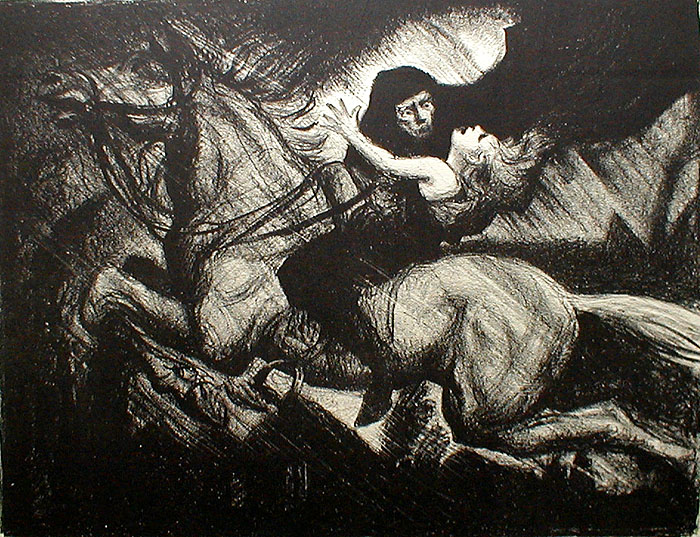
Albert Sterner, Der Erlkönig, c. 1910
We have seen that the powerful and good elves of Norse mythology over time became the powerful and malevolent nightmares of later Germanic folklore. In that vein, I need to say a word or two about the legend of the Erlking. As a distinct figure, the Erlking is a relatively recent addition to elf-lore. Even so, he has deep roots.
The Erlking comes from Scandinavian folklore, from a time when, as in England, elves had become depicted as creatures of dread. Originally, though, “he” was apparently a “she”: a deadly but seductive elfin woman. In his 1778 ballad, Johann Gottfried von Herder freely translated the generic “elfin maid” (Danish, elvermø) as Erlkönigs Tochter (“Erlking’s daughter”). In Danish folklore, old burial mounds were feared to be the dwelling place of the Elverkonge, the king of the elves. Eventually, this figure and his daughter were collapsed into a single character.
“Erlking” is a roundabout translation from the original Danish Elverkonge, “Elf-king.” In a particular Danish dialect, Elverkonge becomes Ellerkonge or Ellekonge, which was later understood with reference to the elletrae or “alder tree.” In other words, the “Elf-king” became the “Alder-king.” Some argue that this is purely a mistranslation. Others suggest that the change is intentional, a euphemism of the sort we have already seen when the superstitious avoid explicit mention of elves once their nature has turned malevolent. For what it’s worth, the alder tree has long been associated with faeries in Celtic folklore.
At any rate, in German, the figure is called the Erlkönig, the “Alder-king.” From German, we get the English semi-translation “Erlking.”
In the original tale, a knight named Sir Oluf is riding to his marriage but is bewitched by the music of elves in the woods. An elfin maiden appears and invites him to dance with her. When he refuses, she strikes him and sends him away. He is dead by the following morning, when his bride-to-be finds him.
The next version of the legend comes from Johann Wolfgang von Goethe. In his 1782 poem Der Erlkönig, the antagonist is the Erlking himself. In this version, the Erlking preys on children and his motives are never made clear. He is a force of death, not merely a magical woodland spirit.
There are a number of English translations of Der Erlkönig. Matthew G. Lewis (PDF) translated the poem in 1796. A contemporary translation has been done by A. Z. Foreman.
Goethe’s poem tells of a father riding through the forest with his feverish young son. The son is aware of the presence of the foreboding presence of the Erlking, who calls to him to leave his father and join him in his faery abode. The father, however, believes the son is merely hallucinating. In the end, the father arrives at home, but not before his son dies in his arms.
Franz Schubert used Der Erlkönig as the text for a Lied or art song for solo voice and piano in 1815. Here is a creepy animation of that piece:
Beowulf
Ryan Howse has provided a excellent brief summary of Beowulf and his contribution not only to Western culture but to fantasy fiction. The piece ends thusly:
Beowulf is one of the most influential texts in history, and it has a particular relevance for fantasy. John Gardner, the famous writer, wrote a take on the novel from the monster’s point of view, called Grendel. In this, Grendel was a figure of existentialism and angst who dies at the hands of the hero. Gardner also used Beowulf as a key text in his writing guide, The Art of Fiction: Notes on the Craft For Young Authors.
Michael Crichton wrote Eaters of the Dead, later turned into the film the 13th Warrior. Neil Gaiman and Roger Avary wrote a script forBeowulf that streamlined the narrative so that it followed causality, rather than the third tale being separate from the other two.
But of course, the most important reason that Beowulf is important is J.R.R. Tolkien. His love of Beowulf influenced Middle-Earth. Smaug is a literary descendant of Beowulf’s dragon, right down to the single piece of stolen treasure awakening him.
Do read it all. It’s short, and you’ll be better for it.
 Darrell J. Pursiful