
Home » Sighted Elsewhere (Page 22)
Category Archives: Sighted Elsewhere
Unicorn Infographic
Michelle Enemark at Atlas Obscura has posted a great infographic on unicorns. It leaves out one of my favorite unicorn facts, however: a group of unicorns is called a “blessing.” 
There used to be actual unicorns in the world, but scientists call them elasmotheres.
World-building: Extensive, Minimal, Top-down, and Bottom-up
Philip Overby has a new post up at Mythic Scribes about that perennial topic among fantasy writers, world-building. Philip lays out the pros and cons of both “extensive” and “minimal” approachs to world building, and he does it quite well. I’ll go ahead and state my preference for extensive world-building—as long as it doesn’t bog down the story.
I commented:
I think of it sort of like a flower garden. People who come by to admire your roses and petunias don’t really care what sort of fertilizer you use or how you decide when to plant or the brand of your favorite set of clippers. They care about the finished product, not the process. And yet, when the other members of the local gardening society come around, they love to talk shop, share tips, etc.
I’m not sure what proportion of fantasy readers are like the members of the gardening society and want to delve deeply into the appendices in the back of the book (or the Wiki or whatever). I am fairly confident, however, that that number is greater than zero. 🙂
In addition to “extensive” and “minimal,” I find it helpful to think in terms of either “top-down” or “bottom-up” world-building. Top-down world-building gives you the big picture of what is actually possible in this new, fantastical world—and why, given this broad context, things actually happen the way they do.
I’m thinking here of the basic mechanics of the world, the elements that inform the overall direction of the story. Top-down world-building looks at the sorts of broad subject matter one could study about our own world: history, technology, geography, religion, politics, etc. Add to this the things that would be a part of a well-rounded education in our world if, in fact, our world was a fantasy setting: How does magic work? What sapient species (elves, dwarves, fauns, talking animals, etc.) exist, and how do they all get along?
It’s a good idea for writers to have a pretty firm handle on these sorts of issues. Philip is right that at least some of this work really should be done before writing commences. I would urge, however, that writers spare us the info dump. If the world is engaging enough, I’ll certainly ask for more “behind the scenes” information. But I don’t want all this fascinating detail to get in the way of a great story. Rather, let these kinds of issues bubble up organically from within the story itself.
Bottom-up world-building is different. These are the elements that lend a certain tone or “color” to the narrative. They may very well be the sorts of things writers dream up on the spot to give their world a greater sense of verisimilitude or simply to entertain the readers.
One good example of what I mean by bottom-up world-building is the in-universe terminology characters use to talk about the various features of their world. What sort of slang, shorthand, technical terminology, or even profanity grows naturally out of the way your world is put together? You can develop an entire magical system using generic terms like “non-magical person,” but doesn’t it add something to the story’s texture to call such a person a “Muggle” (if you’re Harry Potter) or a “straight” (if you’re Harry Dresden)? For me, bottom-up world-building usually begins when I say, “I need a term used by group X to refer to concept Y” or “I need a weird or magical way people in my world would perform ordinary activity Z.”
I’ll be honest and admit that some of my bottom-up world-building takes the form of puns and gags. My purpose is to entertain, after all. So maybe my protagonist is listening to a country-western song in which the cowboy-wizard’s three-headed dog runs away. Or maybe my elves fire “elf-shot” from a twelve-gauge rather than a bow and arrow. (I actually decided to include that last one in Children of Pride fairly late in the writing process. Fortunately, I already had enough of the magic system worked out to explain [to myself!] how it could work. Maybe someone will explain it to my protagonist in a later volume…)
Top-down and bottom-up complement each other. In fact, the two can even build upon each other as the writer reflects on how his or her world is taking shape.
The Empire Striketh Back
What if William Shakespeare wrote The Empire Strikes Back?
Is that Really a Cat Wearing a Jetpack?
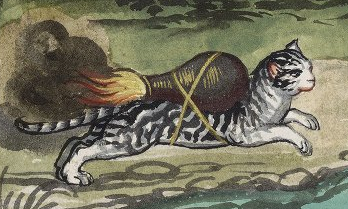 No, I’m afraid not. It’s actually a depiction of a pretty twisted siege-warfare tactic proposed by a German artillery master named Franz Helm. In 1535, Herr Helm proposed strapping incendiary devices to the backs of cats and doves and then letting them loose to set fires within the walls of besieged cities. Atlas Obscura has the gory details.
Nobody knows if anybody actually tried this method of capturing a city, but apparently the idea was entertained in many regions of the world. Historical texts from Scandinavia and Russia to South Asia discuss the strategic advantages of animal-borne pyrotechnics.
But you’ve got to admit, a cat wearing a jetpack would be pretty cool.
The Rhyme as Reason Effect
There’s a reason all those old-timey aphorisms rhyme:
Want to convince someone of something? Make up a rhyme. They may think it’s cutesy, but they’ll still believe it more readily than if it were stated plainly. At least until they are asked to think about it a little.
Rhymes are easy to remember because they contain their conclusion in their premise. “Red sky at morning, sailors take warning,” and “birds of the feather, flock together,” and, “leaves of three, let it be,” all provide a guide in the first half of the phrase that lets us remember the last half. A couple of experiments show that they do more than jog our memory. They slip past the guard of our rational mind. We are more likely to believe a message when it’s put in the form of a rhyme.
In other news, Children of Pride is a fun-filled ride! 😉
I Almost Missed the End of the World
I somehow missed the fact that the “Viking apocalypse” is scheduled for this coming weekend. After all the hullabaloo about the Mayans and Harold Camping, and somehow I missed this one? My deepest apologies to Norsemen everywhere! I can’t be too mad at myself, however. The reason this vital piece of information slipped my mind is (1) there is no such thing as a “Viking apocalypse” and (2) the whole thing is apparently a promotional gimmick for a Viking-themed festival being held this week in York, England. Dan McCoy has all the gory details, and a fine explanation of how “time” works in most animistic/polytheistic cultures, at his Norse Mythology blog.
The Staff of Serapis
I know someone who’s going to be very excited to hear this news from Rick Riordan:
As a Valentine’s Day treat for my fans, I’m announcing a new short story, “The Staff of Serapis,” that will appear in the paperback of THE MARK OF ATHENA, publishing onApril 8. In this adventure, Annabeth encounters more oddities in the subway than usual, including a two-headed monster and a younger blond girl who reminds her a little of herself. . . .
Yes, folks, this is the story you’ve asked for, in which Annabeth Chase teams up with Sadie Kane. Dang, it was fun to write the dialogue between those two! This story is a follow-up to “The Son of Sobek,” in which Carter met Percy. Staff of Serapis is even longer, sixty pages, and I hope you like it as much as I enjoyed writing it.
Here’s an excerpt to whet your appetite!
Cryptozoology + Paleontology = Awesomeness
Paleontologist Darren Naish and artists John Conway and C.M. Kosemen have collaborated to explore cryptids from around the world and speculate about how these monsters might actually fit into our world from an ecological and biological point of view. Their work is titled Cryptozoologicon: The Biology, Evolution, and Mythology of Hidden Animals (Irregular Books, 2013). Based on Annalee Newitz’s review at i09, it looks really interesting. Newitz writes,
What’s so fascinating about this book, written by paleontologist Darren Naish, and artists John Conway and C.M. Kosemen, is that it respects both the legends behind these monsters and the science that debunks them. It’s a complicated merger between speculative fiction and scientific analysis, which the group also showcased in their previous collaboration, All Yesterdays.In that book, the group explored new directions in how to depict ancient animals, with often mind-blowing results. WithCryptozoologicon, they are trying something more speculative still. They’ve put together an extensive collection of cryptids from around the world, drawn them in gorgeous panels, and provided both a scientific debunkery as well as an enthusiastic, fictional endorsement of the creature’s existence.
Each entry contains three sections: (1) the accounts of the creature that others have given, (2) an evaluation of those accounts, and (3) a speculative description of what that creature might be, if in fact it existed (and apparently their assessments of this range from “no way” to “well, maybe”).
For example, the writers come to the following creative explanation for the notorious chupacabra:
Clearly, the Chupacabra is a semi-bipedal, nocturnal, predatory marsupial, the likes of which is unknown to science. Equipped with a long, robust tail, forelimbs proportioned something like those of a primate, and an ability to leap and climb, this sharp-toothed predator (which we name Deinoroo caprophagus) is convergently similar to the Australasian macropods in some respects but is actually a very large opossum. Indeed, the formidable dentition, strong jaws and enlarged upper canines of opossums required little evolutionary modification to produce a large-bodied predator.
This whole project sound a lot like what I have attempted to do with the various eldritch races in Into the Wonder as well as my (as yet unpublished) musings about how Jersey devils, Ozark howlers, unicorns, and other creatures of myth might work from an evolutionary/paleontological perspective.
A. C. Smyth: Crowchanger
A. C. Smyth is Philip Overby’s featured fantasy writer for February. She has given a very informative interview about writing in general and about her debut novel, Crowchanger, in particular.
The Dragons of Europe
Leo Elijah Cristea discusses the dragon-lore of Europe, specifically from Norse and Slavic mythologies, in the last installment of his series on dragons at Fantasy Faction. At the bottom of the post, you’ll also find links to other installments in this series.
 Darrell J. Pursiful