
Home » Uncategorized (Page 11)
Category Archives: Uncategorized
Griffins: Notes on Physiology and Ecology
Following on yesterday’s post on science in fantasy novels, I thought I’d share some of my musings on griffins. Next year, my daughter will start at a new school the mascot of which is the griffin. So even though I don’t have an immediate plans to put some of these creatures in a story, I do have a bit of a vested interest in wondering about them! Anyway, here is one way to envision griffins working in something like a scientifically plausible setting. I am quite certain there are others!
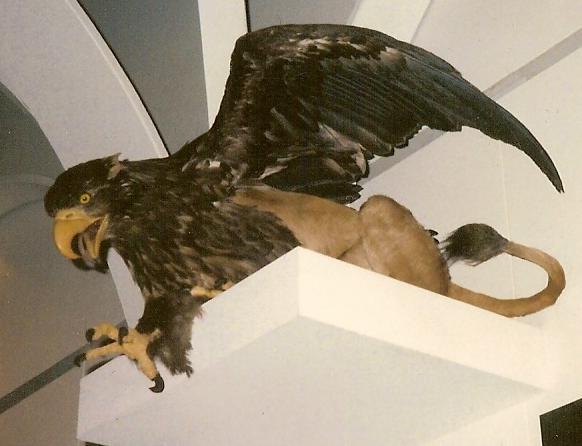
“Stuffed griffin,” Zoological Museum, Copenhagen, photo by Wikimedia user Funkysayri
Griffins appear to be a hybrid of bird and mammal. In fact, they are neither. Rather, they are descendants of therapod dinosaurs. They thus share a common ancestor with birds. While birds quickly learned to fly, however, the ancestors of griffins first became quadrupedal hunters for millions of years before finally taking to the skies. These proto-griffins filled the same ecological niche that the great cats did in more recent times. Their closest fantastic relatives are the hieracosphinx or hawk-headed lion of Egypt and the alce or wingless griffin of Central Asia.
The prehistoric ancestors of griffins were sufficiently bird-like to share several avian adaptations. Even the felid-like portions of their bodies maintain the strong, stiff (but lightweight) bone structure associated with birds. Their muscles are lighter than those of a true cat. Overall, modern griffins and their fantastic cousins weigh only between one-fourth and one-half of what a similar-sized felid would weigh.
A griffin’s feathers graduate from true avian feathers on the head, shoulders, and forelimbs, to downy feathers or protofeathers on the hindquarters that give aerodynamic contour to the body while at the same time making it appear more bulky than it actually is. From a distance, these feathers are easily interpreted as fur. In many species, this graduation ends with a scaly serpentine tail.
In other ways, griffins share a physiology and anatomy similar to both avians and therapods. For example:
- They have three digits on each fore foot and four on each hind foot.
- They have a distinctive carpal bone in the wrist (the semilunate).
- They have a wishbone.
- They lay ornithoid eggs and incubate them in a nest.
- They have a unique and highly efficient bird-like respiratory system.
- Their ribcage is braced by uncinate processes.
Griffins and related species all possess beaks resembling those of ceratopsians. Their young often retain teeth for the first year or so of life. Like birds, they vocalize through an organ in the throat called the syrinx. They are capable of various chirps, hoots, and shrieks similar to those of eagles and other large birds.
Due to a bizarre and unprecedented mutation, a population of winged, hexapodal true griffins developed some time in the early Cenozoic. These creatures possess enormous wings sprouting from their shoulders. In fact, a griffin’s wings and flight muscles make up nearly half of its total body weight. Griffins molt their flight feathers once per year, usually in late summer to early fall, but some evidence of molting can be seen at almost any time of year.
Griffins are soarers like eagles or vultures, relying on thermals and orographic updrafts to sustain their flight. Their strong wing muscles are capable of short bursts of (energetically costly) speed, and their relatively low aspect ratio makes them surprisingly maneuverable flyers for their size.
The archetypal griffin species is the Asian or Scythian griffin (Gryphus asiaticus). This creature is found in the Altai and Tian Shan Mountains of central Asia. It is easily recognized by its swept-back, pointed ears tufts (like a horned owl) and its long, tapering snake-like tail that may be as long as its entire body.
The largest of the griffins, G. asiaticus is comparable in size to a large lion but weighing only about 200 pounds. A large male has a wingspan of up to 25–26 feet. As might be expected, the creature has a voracious appetite. It must consume at least one-tenth of its body weight every day in order to power its flight. These creatures can consume up to one-third of their body weight at a single sitting, storing part of the meal in their crop so they don’t have to hunt every day. Depending on the population density of prey animals, the home range of a northern griffin can extend from 50 to over 300 square miles, roughly 18–20 times that of an eagle.
Asian griffins prey on deer, elk, wild goats, wild boar, and other fauna, but they have a particular fondness for horse meat. For this reason, they are apt to target foals in the spring and summer months. A 120 to 150-pound foal can easily be snatched on the wing by an adult male griffin and will provide enough meat for the male and his mate to eat for several days. A 550-pound yearling will feed a griffin hunting pair for over a week. (Like both lions and eagles, griffins will eat carrion if it is available.)
Although it doesn’t have the strength or body mass of a lion, a griffin can take down prey animals larger than itself by diving upon them at high speed like a falcon and quickly tearing into them with beak and talons. (Note that the Haast’s eagle of New Zealand hunted moas that weighed 15 times more than it did.)
Griffin feathers are tawny like a lion’s fur, but lighter—even white—on the underside of its body and wings. The feathers of the neck are variegated white, tawny, and blue.
Like all griffins, the northern griffin mates for life and rarely seeks a new mate if its first mate dies. The female lays her eggs, usually a clutch of three, in a nest she builds in a cave. These eggs are about the size of ostrich eggs but resemble striated agates.
Science in Fantasy Novels
So, I was just tinkering with a formula to quantify the relative magic-inhibiting capacities of iron on faery magic (1 horseshoepower = the amount of inhibition produced by a 4 kg wrought-iron horseshoe at a distance of 1 m) when I stopped long enough to check my RSS feeds. Well, what should I find but this observation from i09’s Annalee Newitz: “Science in Fantasy Novels is More Accurate than in Science Fiction.”
Here’s a snippet:
One might argue that good worldbuilding in fantasy always involves hard science. Authors from N.K. Jemisin to George R.R. Martin and Ursula Le Guin have created alternate worlds whose geology, climate, and ecosystems are so good that they’ve captured the imaginations of scientists. These stories represent earnest attempts to create new environments based on what we know from studying the deep history of our own world.
And this:
Given what I already pointed out about how magic and advanced technology are basically indistinguishable in science fiction, we’re going to have to admit that there’s something other than magic that divides “fantasy” from “science fiction.” It seems to be the kinds of science the two genres tackle. The hallmarks of rigorous science fantasy are a focus on Earth science, as well as biology and ecosystems. Science fiction, on the other hand, tends to focus on physics, cosmology, and engineering. Both genres often incorporate anthropology and political science.
What do you think? Does she have a point? And, what sorts of scientific accuracy do you enjoy reading in a fantasy novel?
A Scientific Paper on Mermaids
I’ll definitely be looking this over soon. Too bad I didn’t have it while I was at the beach this past week!
“Mermaids: Their Biology, Culture, and Demise” by Karl Banse (PDF)
(H/T: io9)
Sunday Inspiration: Comparisons
Don’t compare your beginning with someone else’s middle.
—Jon Acuff
Large Flying Beasties
Speaking of dragons, I’ve been trying to nail down the physiology of some large mythological flyers for possible inclusion in my third Into the Wonder novel. I’ve come across the following rules of thumb that may prove helpful to others trying to imagine dragons, griffins, and other creatures in something like a realistic way:
- Birds have a wingspan of roughly 2 times their head-body length (falcons average around 2.5)
- Bats have a wingspan of roughly 5 times their head-body length
- Pterosaurs had a wingspan of roughly 6 times their body length (first dorsal to last sacral vertebra)
Within these parameters—and assuming the creature is not too heavy to fly at all!—a smaller ratio (like a finch) provides greater maneuverability while a larger ratio (like an albatross) provides greater endurance.
Furthermore, you can make a guess about the weight of a flying creature, or at least avoid something impossible, by taking wing loading into account. This has to do with how much weight and pressure a wing can manage. For birds, five pounds of body weight per square foot of wing surface is about the limit.
Some cool sources I found along the way:
Oxford City Council, You’re a Bunch of Idiots
Through centuries and across countries, it has remained a staple of traditional Easter celebrations.
But that rich history, it seems, has been rather lost on one council bureaucrat – who forced a church to cancel its Passion play because he apparently thought it was a sex show.
The performance, telling the story of the crucifixion of Christ, had been planned for Good Friday by St Stephen’s House Theological College and Saints Mary and John Church in Oxford.
That was until an official at the local Labour council refused to rubber-stamp the event, forcing the church to scrap it at short notice.
Oxford City Council banned the re-enactment of the crucifixion of Jesus Christ…wrongly believing the play was a sex show and could cause ‘grave offence’
Actors had planned to walk through the streets of Oxford on Friday to re-enact the lead up to the crucifixion of Jesus Christ has they had done previously in 2012.
The worker in question apparently did not know that a Passion play was a religious affair – and thought it was an obscene production.
Last night ministers, MPs and religious groups criticised the ‘unbelievable’ actions of Oxford City Council, saying it showed Christians were becoming increasingly marginalised in society.
A Passion play is a dramatic performance of the Passion of Christ, depicting the trial, crucifixion and death of Jesus. The name comes from the Latin verb ‘pati’, meaning ‘to suffer’.
The Oxford performance was previously held in 2012, without a licence, when an audience of some 200 watched Mischa Richards, playing Jesus, haul a wooden cross from Cowley Road Methodist church to Saints Mary and John.
This year, the organisers decided to stage a repeat, but were told they must apply for a council licence – and were astonished when they were turned down.
A church source told MailOnline: ‘A council official didn’t read the paperwork properly and didn’t realise it was a religious play, so told us we needed an events licence when we didn’t.
‘If they’d told us 24 hours earlier, we would have had time to apply for and get one, but we ran out of time. It’s frustrating because we didn’t need one in any case – they just hadn’t read what the play was about.’
SS Mary and John vicar, Adam Romanis, said: ‘It’s very upsetting because so many people were looking forward to it.
‘Someone said to me: “You can’t hold a crucifixion these days without a licence”.’
Chozen: A Passover Parody
For those of you who aren’t sick to death of the music from Frozen—and its various covers and parodies—here’s one for Passover:
Everything You Ever Wanted to Know about Thor’s Hammer
Dan McCoy has the scoop at Norse Mythology for Smart People, and he deserves a link purely on the name of his website!
Thor’s hammer was certainly a weapon – the best weapon the Aesir had, in fact – but it was more than just a weapon. It also occupied a central role in rituals of consecration and hallowing.
The hammer was used in formal ceremonies to bless marriages, births, and probably funerals as well.[4] In one episode from medieval Icelandic historian Snorri Sturluson’s Prose Edda, Thor once killed and ate his goats, then brought them back to life by hallowing their bones with his hammer[5] (talk about having your cake and eating it, too). The medieval Danish historian Saxo Grammaticus records that huge hammers were kept in one of Thor’s temples in Sweden, and that periodically the people would hold a ritual there that involved beating the hammers against some kind of drum that would resound like thunder.[6] This could have been a ceremony to bless and protect the community and ward off hostile spirits.
There’s lots, lots more.
Five Fantastic Beasts of North America
J. K. Rowling’s Fantastic Beasts and Where to Find Them is going to become a movie trilogy. The movies, billed as an “extension” of the wizarding world rather than a true prequel to Harry Potter, will no doubt feature Newt Scamander, renowned magizoologist, in his quest to describe and catalogue the many magical creatures that live just beyond the reach of Muggle science.
I enjoyed the Fantastic Beasts book quite a bit, and it will be interesting to see what sort of narrative Rowling manages to weave around it. At the same time, I must confess I was a bit disappointed with Rowling’s treatment of the fantastic beasts of the New World. It seemed several really obvious creatures from Native American mythology as well as later folklore were passed over in favor of made-up beasties which, though clever, didn’t quite resonate with me the way the dragons, unicorns, hippogriffs, and other European creatures did.
Here, then, are five fantastic beasts I wish Newt Scamander had encountered in his travels through North America.
1. The Horned Serpent
 Horned serpents are powerful magical beings in many Native American mythologies. I’m thinking particularly, however, about the uktena of Cherokee folklore. These malevolent and deadly monsters inhabit deep underwater pools as well as the high mountains.
An uktena is as large around as a tree trunk. Its scales glitter like sparks of fire. It has horns on its head, naturally, and a bright, diamond-like crest on its forehead. This crest is greatly prized, as one who can retrieve it is supposedly imbued with the power to become a great wonder-worker. This is a dangerous quest, however, because the uktena’s dazzling appearance draws people toward the creature when they should be running away.
2. The Water Panther
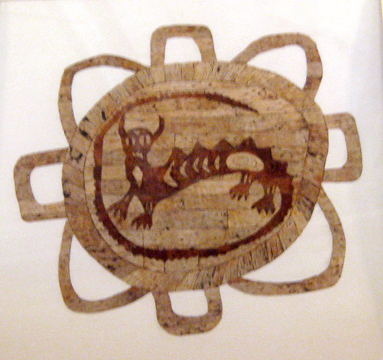 The mishipeshu or mishibijiw is a figure found in the folklores of Algonquian-speaking peoples throughout North America. It is called by various groups the water panther, underwater panther, or great lynx.
This fantastic beast is essentially a cross between a large cat (a cougar or wildcat) and a dragon. It is covered in scales, with dagger-like spikes on its back and tail. The Iroquois have their own version of this creature that actually breathes fire!
The water panther is a powerful underworld being, master of all water creatures, including snakes. In the Great Lakes region, it is said to guard great treasures of copper.
3. The Thunderbird
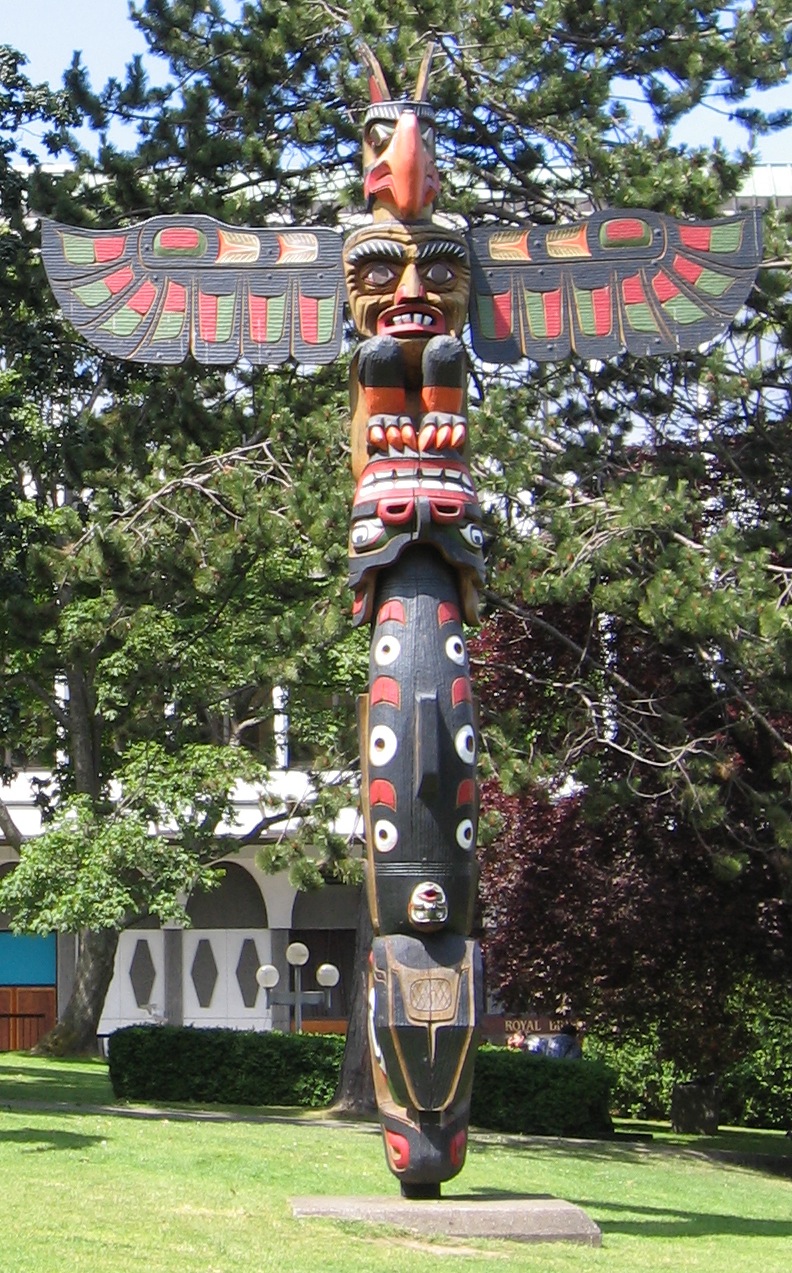 According to many Northwestern tribes, thunderbirds are formidable creatures large enough to carry a killer whale in its talons as an eagle carries a fish. It is essentially a huge predatory bird of supernatural origins, perhaps related to the eagle or the vulture. The thunderbird is responsible for the sound of thunder and, in some cases, lightning as well.
Native American groups have different traditions regarding these creatures. In some tribes, they are considered extremely sacred forces of nature. In others, they are considered powerful but otherwise ordinary members of the animal kingdom.
4. The Jackalope
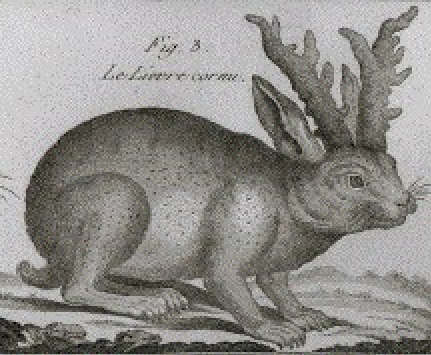 The first three fantastic beasts come from mythology. This one doesn’t have quite such a lengthy pedigree, although I think it would be a perfect fit in any revised edition of Fantastic Beasts and Where to Find Them. The jackalope is a rabbit- or hare-like creature from the American West, but is distinctive in that it possesses antlers like antelope. Although reportedly a shy creature, it is also said to be quite aggressive when threatened.
Jackalopes are also known for their uncanny ability to mimic the sounds of the human voice. They are especially vocal before thunderstorms, and it is theorized that this is because they only mate when lightning flashes.
Some reports suggest the jackalope is near extinction.
5. The Jersey Devil
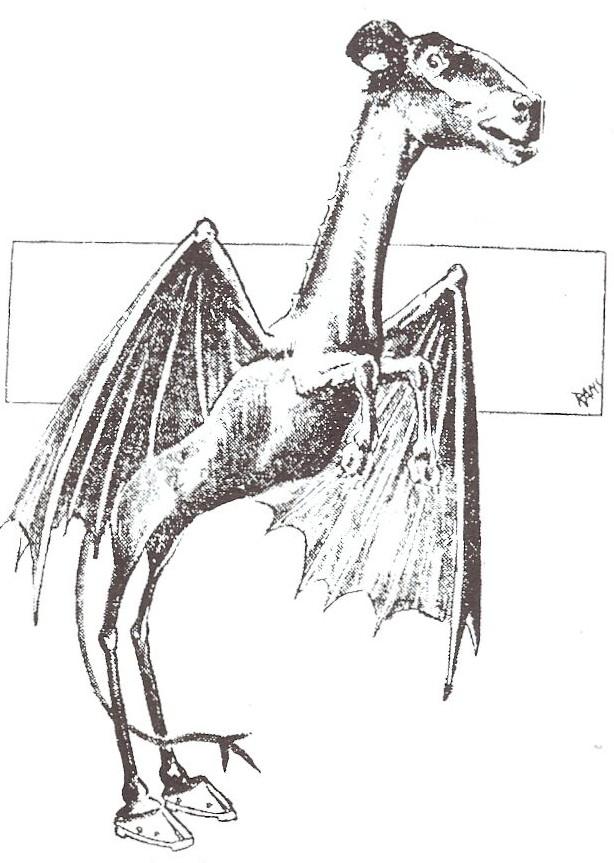 The origins of the Jersey Devil lie in colonial times, although sightings of the creature continue to this day. It is a creature of the Pine Barrens region of New Jersey, but it has also been sighted in adjacent parts of New York and Pennsylvania. Although descriptions vary, certain features seem to be most prevalent: bat-like wings, hooves, tail, bipedal posture, glowing eyes, and an elongated head like a horse’s (or perhaps a dog’s). It is an omnivorous creature that has been sighted scavenging in trash cans as well as preying on smaller farm animals such as goats.
The Jersey Devil makes a number of discrete vocalizations, including a piercing scream and a dog-like bark.
Based on the legends concerning the origins of this creature, I suspect Newt Scamander would theorize that this is not an ordinary beast but rather the product of some sort of Dark magic.
Best Book Excerpt Ever
Peter Enns’s new book (coming out in August) looks like a winner, not least because of this riveting excerpt:
The book is just over 65,000 words long, and I am proud of each and every one of them. All that remains for me now is to arrange them in the right order and make sentences out of them (at which time I will give an exerpt or two).
Until then, here are some of the words that will appear in the book, some more than once.
- the
- a
- Jesus
- dipwad
- Alexander Graham Bell
- New Jersey
- Kansas
- Bible
- Megatron
- Yankees
- Balrog
- God
- went
- lawyer
- iPhone 17
- tube socks
- Klingon
- Red Sox
- Herman Munster
- White Russian
- moron
- Screen Actors Guild
- have
- dagnabbit
- Justin Bieber
- of
- cagefighting
That’s the first paragraph.
I can’t wait!
 Darrell J. Pursiful