
Home » Uncategorized (Page 14)
Category Archives: Uncategorized
Classical Timeline
Just sighted: interactive timelines for classical philosophy and early Christianity. Check out ClassicalTimeline. Although still in beta, it looks like it could be very cool.
Have Scientist Finally Tracked Down the Yeti?
 Research by a leading British geneticist on some unidentified hair samples from the Himalayas suggests a possible answer to the mystery of the Yeti or “Abominable Snowman.” Bryan Sykes, a professor of genetics at Oxford University, found a 100% match with DNA recovered from the remains of a Norwegian polar bear dating back 40,000–120,000 years. Sykes says,
“But we can speculate on what the possible explanation might be. It could mean there is a subspecies of brown bear in the High Himalayas descended from the bear that was the ancestor of the polar bear. Or it could mean there has been more recent hybridization between the brown bear and the descendant of the ancient polar bear.”
This will, no doubt, come as a shock and a bit of a disappointment to Yeti and Bigfoot enthusiasts.
Fairies in the Bible?
Joel Hoffman is blogging today about unicorns and other mythological creatures in the Bible—or at least in the King James Version. As he usually does, Dr. Hoffman raises an intriguing question about how the original Hebrew words the KJV rendered as “dragon,” “unicorn,” and so forth should be handled. Did the original writers intend their readers to understand these as real-world creatures (e.g., as serpents, rhinoceroses, etc.) or did they mean to depict creatures of fantasy? He writes,
More generally, I think the real translation question with all of these creatures is whether they were intended to be mythic or — for want of a better word — real.
Even if they were intended to be real, “dragon” and “unicorn” may have been right once. It seems that people thought that both existed. (As late as the 17th century, scholars in Europe argued that griffins were real, and the only reason we didn’t see them was that, quite naturally, these magnificent creatures tended to stay away from people who would steal their gold). But now those translations wrongly take the real and turn them into fantasy.
On the other hand, if they were not meant to be real, then attempts to identify the exact species may be misguided, and maybe we should stick with “dragon” and “unicorn” and so forth.
Hoffman deals mainly with “unicorns” (re’em) and “dragons” (tannin), although he makes passing reference to a possible merperson in the character of Dagon, the god of the Philistines.
Along these same lines, I would suggest that there are a handful of possible reference to fairies in the Bible—at least if the rabbis of the medieval period were interpreting these passages rightly.
Two Hebrew words are of interest: shedim and se’irim, both translated daimonia (“demons”) in the Septuagint. Shedim only appear twice in the Hebrew Bible, both times in the plural (although the singular form would be shed). Psalm 106:37 says, “They sacrificed their own sons and daughters to demons!” (CEB). In a similar context, Deuteronomy 32:17 says,
They sacrificed to demons, not to God,
to deities of which
they had no knowledge—
new gods only recently on the scene,
ones about which your ancestors
had never heard.
Shedim are therefore obviously bad news in the Bible. Oddly enough, the term seems to be related to the Akkadian shedu, a benevolent or protective spirit, perhaps something we might think of as a guardian angel. Then again, people around the world have made offerings to various local protective spirits to secure their goodwill. The biblical writers were obviously interested in discouraging such a practice. Thus, in the Bible, they are depicted not as helpful minor spirits but as false gods to be avoided.
The next word is se’irim (singular se’ir), meaning “hairy beings” or “shaggy beings.” In the KJV, the word is translated “satyrs.” There are a few more references to se’irim than there are to shedim. According to Leviticus 17:7, “The Israelites must no longer sacrifice their communal sacrifices to the goat demons that they follow so faithlessly. This will be a permanent rule for them throughout their future generations.” The LXX renders se’irim as mataiois, “to empty or vain things.”
Se’irim dwell in the desolate wilderness and are apparently fond of dancing. According to Isaiah 13:21,
Wildcats will rest there;
houses will be filled with owls.
Ostriches will live there,
and goat demons (LXX, daimonia) will dance there.
And again in Isaiah 34:14:
Wildcats will meet hyenas,
the goat demon will call to his friends,
and there Lilith will lurk
and find her resting place.
I saw you wondering about Lilith in that verse. We’ll come back to her in a minute. It should be noted, that the Septuagint translation removes Lilith from the picture but possibly gives us a completely new mythological creature. My fairly wooden translation of the Greek is as follows:
Demons will meet onocentaurs
and they will shout one to the other,
There onocentaurs will rest
for they found a resting place for themselves.
If you’re not up to speed on medieval bestiaries, let me quickly explain that an onocentaur is part man, part ass. (And please refrain from any comments about half-ass blog posts. Thank you.)
According to the Jewish Encyclopedia, the se’irim are “are satyr-like demons, described as dancing in the wilderness…identical with the jinn of the Arabian woods and deserts.” Azazel, the goat-like wilderness demon (Lev 16:10ff) and Lilith (whom we already encountered in Isa 34:14) are said to be of the same class of beings. Further, it should be noted that some see in Lilith a prototype for later vampire legends. The Jewish Encyclopedia also raises the possibility that “the roes and hinds of the field” (gazelles and wild deer in the CEB) in Song of Songs 2:7 and 3:5 are “faunlike spirits similar to the se’irim, though of a harmless nature.”
How does all this apply to fairies? Thomas Keightley argued in The Fairy Mythology (1870) that the prototypes of European fairy legends were to be found not only in the nymphs and satyrs of Greco-Roman mythology but also in Near Eastern stories of jinns and peris (or jinn and parian, to use the correct Arabic and Persian plurals). He even argued that our English word “fairy” derives ultimately from Persian pari (or peri). This linguistic argument may or may not hold, but anyone who looks at Persian peri-stories will find many parallels to what was believed about fairies in rural Europe until fairly recent times.
If Keightley is correct, then the European conception of fairies owes a good deal to the Mediterranean and Near Eastern world(s) in which the Bible was written. It therefore would not be unusual to find references to the such creatures in biblical and other early Semitic materials.
After tracing the fairy mythology throughout northern Europe, Keightley makes quick reference to Jewish legends about similar creatures found in the rabbinic corpus. These beings are in fact called shedim and seirim (although Keightley transliterates them shedeem and shehireem). Another term, maziqin (or mazikeen in Keightley’s transliteration), is Aramaic and applies specifically to a malevolent spirit. According to rabbinic tradition, all these beings are in fact directly analogous to the jinn of Arabic folklore. Keightley writes,
It has long been an established article of belief among the Jews that there is a species of beings which they call Shedeem, Shehireem, or Mazikeen. These beings exactly correspond to the Arabian Jinn; and the Jews hold that it is by means of them that all acts of magic and enchantment are performed.
The Talmud says that the Shedeem were the offspring of Adam. After he had eaten of the Tree of life, Adam was excommunicated for one hundred and thirty years. “In all those years,” saith Rabbi Jeremiah Ben E’liezar, “during which Adam was under excommunication, he begat spirits, demons, and spectres of the night, as it is written, ‘Adam lived one hundred and thirty years, and begat children in his likeness and in his image,’ which teaches, that till that time he bad not begotten them in his own likeness.” In Berasbith Rabba, R. Simon says, “During all the one hundred and thirty years that Adam was separate from Eve, male spirits lay with her, and she bare by them, and female spirits lay with Adam, and bare by him.”
These Shedeem or Mazikeen are held to resemble the angels in three things. They can see and not be seen; they have wings and can fly; they know the future. In three respects they resemble mankind: they eat and drink; they marry and have children; they are subject to death. It may be added, they have the power of assuming any form they please; and so the agreement between them and the Jinn of the Arabs is complete.
Keightley shares three Jewish legends about the shedim: “The Broken Oaths,” “The Moohel,” and “The Mazik-Ass.”
As with dragons and unicorns, there are probably some who will pounce on “rational” or “scientific” explanations for fairies. Some do, in fact, attribute European fairy-lore to dim memories of diminutive tribes driven underground—and ultimately to extinction—by later invaders with the advantage of iron weapons (in both Europe and the Middle East, iron is a potent weapon against the Fair Folk).
In my experience, however, I think most interpreters would see shedim and se’irim as terms intended to describe supernatural or otherworldly beings and not merely misidentified pygmies or “wild men”—whether or not they judge such creatures to be “real.”
Reclaiming Mystery
Bosco Peters links to a story about a fascinating character, the Wizard of New Zealand. Since New Zealand is the stunt double for Middle Earth, it really shouldn’t surprise me that they have their very own “non-fictional, non-commercial, wizard” whose mission in life is to conduct “a largely solo attempt to re-enchant the world, making use of [his] training as an academic sociologist and psychologist.”
Peters elaborates a bit on the importance of mystery for and in the church. His comments are worth a thorough reading, but I’ll simply share a few paragraphs to give you the gist:
Fundamentalists, antitheists, and the insipid are three natural results of the disenchantment.
Fundamentalists reject the enchantment of our spiritual world, accepting instead a flat rationalistic literalism. Antitheists are the shadow side of fundamentalists. Like fundamentalists, they also do not go beyond a flat rationalistic literalism. Rather than accepting the flat literalism as the fundamentalists do, antitheists reject it. For fundamentalists God is scary. For antitheists God is silly.
The third category, that I here call the insipid, is that category that one meets so often in churches: led by clergy who, if they have training at all – it consists in a university degree in the dismembering of the scriptures. These clergy have little to no liturgical study and training. Sacraments have been desiccated to things that occur solely in one’s head. Bells, smells, and symbols are reduced to a couple of candles on a table (if you are lucky). Vesture is degraded to what the majority of Christian history would regard essentially as underwear. They hold to the last vestiges of the outward form of godliness but deny its power.
Indeed.
Μάμμη ἐπατήθην ὑπ᾽ ἐλάφου
My little contribution to the decline of western civilization:
Μάμμη ἐπατήθην ὑπ᾽ ἐλάφου.
περὶ προτὰς χείμονος ἔβαινεν.
περὶ Ἁγίου Νικολάου ένδιαζεις;
πάππος γε κἀγὼ πιστεύομεν.
I would translate the verses, but that would mean actually studying the lyrics of the song, and I just don’t have the inclination to do that.
If I had the time, however, I think this has the makings of a great Lenaia carol. Perhaps “Grandma Got Run Over by a Maenad”?
Carmina Nativitatis in Lingua Latina!
Laura Gibbs of Bestiaria Latina has rounded up a month’s worth of Latin Christmas carols (and two Hanukkah songs, too!). I’m not just talking about “real” Latin hymns like “Adeste fideles,” “Gaudete,” “Hodie Christus natus est,” etc. She has also compiled Latin versions to more modern carols and holiday songs such as “Deck the Halls” (Aquifolia Ornate), “Silent Night” (Silens nox), and even “Grandma Got Run Over by a Reindeer” (Avia Renone Calcabatur).
Caucasian Rednecks?
Google.org has launched a new initiative called the Endangered Languages Project. According to the website,
With the Endangered Languages Project, Google puts its technology at the service of the organizations and individuals working to confront the language endangerment by documenting, preserving and teaching them. Through this website, users can not only access the most up to date and comprehensive information on endangered languages as well as samples being provided by partners, but also play an active role in putting their languages online by submitting information or samples in the form of text, audio or video files. In addition, users will be able to share best practices and case studies through a knowledge sharing section and through joining relevant Google Groups.
This is a commendable goal that a language-junkie like myself can only applaud.
I found one slight problem, however. Exploring on their interactive map, I decided to zoom in on the United States to see what endangered languages might be spoken near me. There are no state boundaries on the map, but I believe the dot representing the Bezhta language is placed somewhere in north Georgia.
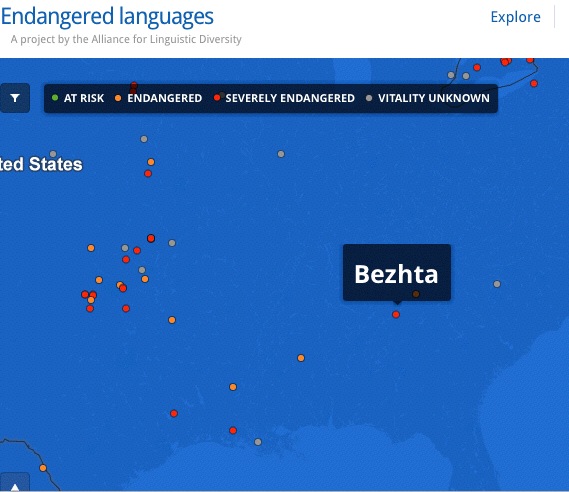 I had never heard of this language. Assuming it was a Native American dialect, I clicked for more information. This is what I found:
Caucasian language and it belongs to the Dido subgroup of the northwestern group (Avar-Ando-Dido) of the Dagestan languages. Bezhta is also called the Kapucha language, a name which originates in the Georgian name for the village of Bezhita. There is no scholarly agreement on the genealogical classification of the Bezhta (Kapucha) language. E. Bokarev considers it to belong to the Dido subgroup, whereas Georgian linguist, E. Lomatadze, thinks it is a dialect of the Kapucha-Hunzib language. Bezhta is divided into three dialects: Bezhta, Tljadali and Hochar-Hota. The vocabulary has been greatly affected by Avar and Georgian, through which there have also been some borrowings from Arabic, Turkish and Persian. During the Soviet era the biggest influence was Russian. (The Red Book of the Peoples of the Russian Empire)
As they say, I see what you did there. Someone apparently confused the STATE of Georgia in the USA with the REPUBLIC of Georgia in the Caucasus. There is, however, another dot for the Bezhta language in the Caucasus region where it belongs.
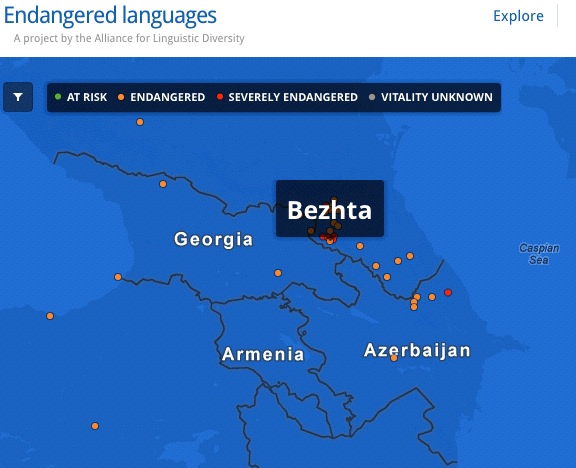 If there are, in fact, Bezhta-speakers hanging out somewhere between Rome and Chattanooga, I’d love to hear from you. Otherwise, I’m going to put this in the “somebody needs a geography lesson” file.
Thank you, Endangered Language Project, not only for the important work you’re undertaking, but also for providing me a much-needed chuckle today.
On Shakespeare
Here’s an apt description of William Shakespeare’s contribution to the English language. If you follow the link, there’s also an interesting story to go with it:
You know when you’re making a pot you put it on a wheel, you make it round, and then you put it in the fire and it gets hard? It was the same with English, and the fire was Shakespeare.
Let’s Hear It for Regional Accents, Y’all!
According to CNN, American regional accents are thriving quite nicely.
Celebrities Who Look Like Historical Personalities
Some of these are brilliant. I’m glad I wasn’t sipping a Pepsi when I saw Keith Richards and….
 Darrell J. Pursiful