
Home » Posts tagged 'Bogeyman'
Tag Archives: Bogeyman
A Field Guide to Mythological Humanoids
In order to avoid having loads and loads of races in the Into the Wonder series, I’ve devised the following system to evaluate and categorize the entities found in various world mythologies. Mind you, this system won’t work in every fictional universe, so caveat lector!
Contrasted with a run-of-the-mill, plain vanilla human…
- Does this humanoid display vast magical powers?
It’s probably a fae (sídhe, elf, jinni, nunnehi, etc.)
Is it unusually good-looking?
Definitely a fae! - Is this humanoid secretive and crafty?
It’s probably a dwarf (dvergr, dactyl, etc.).
Does it live underground?
Definitely a dwarf! - Is this humanoid unusually short?
It’s probably one of the little people (brownie, kobold, yunwi tsunsdi, etc.).
Does it try to play tricks on you?
Could be a little person if the tricks aren’t too mean.
Does it try to clean your house or do your chores?
Definitely a little person! - Is this humanoid unusually tall?
It’s probably a giant (slant-eye, stonecoat, ispolini, etc.).
No other distinctive features like powerful magic or a taste for human flesh?
Definitely a giant! - Does this humanoid want to eat you?
It’s probably an ogre (Laestrygonian, zimwi, water cannibal, etc.).
But it’s no bigger than an ordinary human!
Doesn’t matter, it’s probably an ogre! - Does this humanoid want to scare you?
It’s probably a bogeyman (boggart, hey-hey man, nalusa falaya, etc.).
There’s no such thing as a bogeyman.
Tell that to him! - Is this humanoid just plain weird?
It’s probably a troll (jaettertroll, fomor, stallos, etc).
But I thought trolls were…
You thought wrong. Trolls are just plain weird.
Repost: Boo! Five Bogeymen to Run Away From
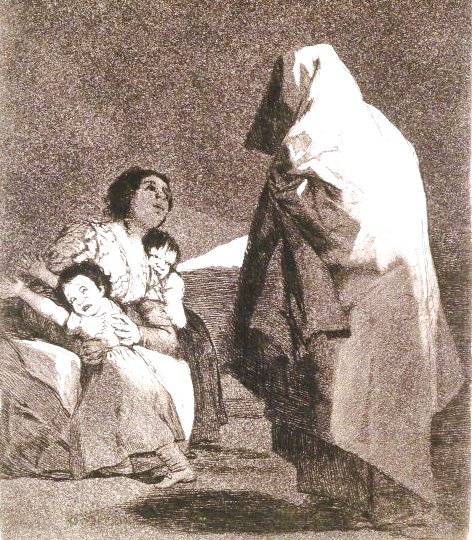
Francisco de Goya, “Que viene el Coco” (Here Comes the Bogeyman), 1797–98
In addition to the powerful, awe-inspiring sídhe nobles, wild satyrs, and helpful little folk, the world of Faerie is also inhabited by a variety of creatures whose purpose seems to be striking fear in the hearts of children. These are the bogeymen, also known as bogles, boggarts, boogers, bugaboos, etc.
The word “bogeyman” is derived from Middle English bogge or bugge. It is thought to be related to other words such as Scots bogle, Norse puki, and Gaelic púca. Whatever these creatures are called and whatever their appearance, they are the bane of children, especially those who misbehave! They might also lure people beyond the bounds of civilization—deep into the woods or too close to the water. They thus serve as cautionary tales to keep people in line be they young or old.
Here are five bogeymen that have inhabited the nightmares of children around the world.
1. El Hombre del Saco
Also known as el hombre del costal. Both mean “the sack man” or “the bag man.” This is a bogeyman found in many Latin countries including Brazil, Portugal, and Spain. He is portrayed carrying a sack in which he carries off naughty children.
2. El Coco (or el Cuco, el Cucuy)
El Coco is known in many Spanish-speaking countries. He is described as a ghost with a pumpkin head, an evil monster that hides under children’s beds at night and kidnaps or eats them when they don’t obey their parents or go to sleep at bedtime. In Latin America, el Coco more often takes the form of a small humanoid with glowing red eyes that hides in closets or under the bed.
3. Grindylow
Grindylows feature prominently in Harry Potter and the Goblet of Fire. The grindylow of folklore is an aquatic bogeyman from England (Yorkshire and Lancashire, to be specific). This creature is associated with marshes, bogs, and lakes. They are said to grab little children if they come too close to the water’s edge and drag them away Some have suggested that the name “grindylow” is related to the name of the monster Grendel from the Beowulf saga. .
4. Nalusa Falaya
The nalusa falaya or “Long Black Being” is a bogeyman from Choctaw legend who is also called impa shilup or “Soul-eater.” He is somewhat similar to Bigfoot as he is described as a hairy, manlike creature with wizened face, small eyes, and pointed ears. Some describe him as slithering on his stomach like a snake. These creatures call to unwary travelers in the woods. He sometimes frightens hunters. Seeing a nalusa falaya is said to be so horrifying that it will cause one to faint. While unconscious, the nalusa falaya transfers some of his own evil into his victim, making him aggressive and malevolent.
5. Abu Rigl Maslukha
For my money, this is one of the creepier bogeymen out there because his malevolence is rooted in his own experience of suffering. This Egyptian Arabic creature’s name means “the Man with the Burnt Leg.” The Abu Rigl Maslukha is a monster that got burnt when he was a child because he did not listen to his parents. Now, he hunts down naughty children to cook and eat them.
Boo! Five Bogeymen to Run Away From
Francisco de Goya, “Que viene el Coco” (Here Comes the Bogeyman), 1797–98
In addition to the powerful, awe-inspiring sídhe nobles, wild satyrs, and helpful little folk, the world of Faerie is also inhabited by a variety of creatures whose purpose seems to be striking fear in the hearts of children. These are the bogeymen, also known as bogles, boggarts, boogers, bugaboos, etc.
The word “bogeyman” is derived from Middle English bogge or bugge. It is thought to be related to other words such as Scots bogle, Norse puki, and Gaelic púca. Whatever these creatures are called and whatever their appearance, they are the bane of children, especially those who misbehave! They might also lure people beyond the bounds of civilization—deep into the woods or too close to the water. They thus serve as cautionary tales to keep people in line be they young or old.
Here are five bogeymen that have inhabited the nightmares of children around the world.
1. El Hombre del Saco
Also known as el hombre del costal. Both mean “the sack man” or “the bag man.” This is a bogeyman found in many Latin countries including Brazil, Portugal, and Spain. He is portrayed carrying a sack in which he carries off naughty children.
2. El Coco (or el Cuco, el Cucuy)
El Coco is known in many Spanish-speaking countries. He is described as a ghost with a pumpkin head, an evil monster that hides under children’s beds at night and kidnaps or eats them when they don’t obey their parents or go to sleep at bedtime. In Latin America, el Coco more often takes the form of a small humanoid with glowing red eyes that hides in closets or under the bed.
3. Grindylow
Grindylows feature prominently in Harry Potter and the Goblet of Fire. The grindylow of folklore is an aquatic bogeyman from England (Yorkshire and Lancashire, to be specific). This creature is associated with marshes, bogs, and lakes. They are said to grab little children if they come too close to the water’s edge and drag them away Some have suggested that the name “grindylow” is related to the name of the monster Grendel from the Beowulf saga. .
4. Nalusa Falaya
The nalusa falaya or “Long Black Being” is a bogeyman from Choctaw legend who is also called impa shilup or “Soul-eater.” He is somewhat similar to Bigfoot as he is described as a hairy, manlike creature with wizened face, small eyes, and pointed ears. Some describe him as slithering on his stomach like a snake. These creatures call to unwary travelers in the woods. He sometimes frightens hunters. Seeing a nalusa falaya is said to be so horrifying that it will cause one to faint. While unconscious, the nalusa falaya transfers some of his own evil into his victim, making him aggressive and malevolent.
5. Abu Rigl Maslukha
For my money, this is one of the creepier bogeymen out there because his malevolence is rooted in his own experience of suffering. This Egyptian Arabic creature’s name means “the Man with the Burnt Leg.” The Abu Rigl Maslukha is a monster that got burnt when he was a child because he did not listen to his parents. Now, he hunts down naughty children to cook and eat them.
 Darrell J. Pursiful