
Home » Posts tagged 'Celtic' (Page 2)
Tag Archives: Celtic
Warfare in Iron Age Britain
Looking ahead to some plot points in later books in my Into the Wonder series, I’ve needed a bit of background on ancient tribal warfare that could be tweaked into something suitable for armies of Fair Folk. I’ll definitely be looking at Sue Carter’s thoughts on Warfare in Iron Age Britain preserved at the Celtic Myth Podshow blog.
Irish Fairy Tales
Irish Fairy Tales by Edmund Leary is now available in the public domain. According to the Celtic Myth Podshow,
The author of the tales contained in this volume was one of the brightest and most poetic spirits who have appeared in Ireland in the last half century. It is needless to say that he was also one of the most patriotic Irishmen of his generation–patriotic in the highest and widest sense of that term, loving with an ardent love his country, its people, its historic traditions, its hills and plains, its lakes and streams, its raths and mounds. Like all men of his type, he lived largely in the past, and his fancy revelled much in fairy scenes of childhood and youth. So reads the introduction to this book, originally published in 1906 and containing some great Fairy Tales.
You can read or download Irish Fairy Tales at Project Gutenberg.
Cernunnos: The Antlered God
The horned or antlered human is a very old symbol found in many parts of the world from prehistoric times. At the Welsh Mythology blog, Gwilym Morus-Baird takes a look at a particular Celtic representation of this figure and what it might mean: the ancient horned god Cernunnos.
Scholars have interpreted this figure [on the Gundestrup Cauldron] as being a representation of an old Celtic god called Cernunnos, which translates as the ‘horned one’. Its rather obvious why he’s called that, but this also gives us a clue as to what potentially conflicting elements have been harmonised in this symbolic figure. If this mythic symbol is an expression of the collective unconscious, according to Jung we should be able to perceive within it some conflicting influences that have been brought together in a more or less stable form.
The Boobrie
For some reason, horses and faeries often go together in Celtic folklore. Not only are faeries sometimes depicted riding ghostly horses with bells adorning their tack, there are also pookas and other creatures that often assume the form of a horse. And then there are water horses (or kelpies)—horses that live underwater, as the name might suggest. There are also, it turns out, faeries who turn into water horses.
The boobrie is such a faery, and Flossie Benton Rogers has provided us an introduction to these creatures over at her blog, Conjuring the Magic:
Not to be confused with a Kelpie, the Boobrie is a Scottish fae that possesses the wondrous ability to shapeshift into a water horse. Since the Boobrie salivates at the thought of cows and fat lambs—its favorite snacks, along with succulent otters, ships transporting barnyard animals along the coast of Scotland risk being accosted. Boobries can even gallop on top of the waves to reach their destinations and are often mistaken by sailors for ghost horses.
In addition to a water horse, the Boobrie can take the appearance of a black feathered waterbird, something akin to a fierce cormorant. This is perhaps the Boobrie’s default form. Its strange claws appear like the wizened hands of a demon, and its caw roars like the bellow of a bull. Some legends insist the bull is one of the Boobrie’s possible forms and that it can stray from the coast to nestle among thickets of purple heather. Whether or not this fae can hug the land, it’s a rare loch in Scotland without the menacing presence of a resident Boobrie. As a bird it loves flying low over the turbulent seacoast, its huge ebony wings casting sinister shadows on the moon spattered waters below.
New Book Claims Merlin was from Glasgow, Scotland

Another Famous Glaswegian
Via Celtic Myth Podshow:
Tradition has it that King Arthur’s magician was either English or Welsh.
But in the book Finding Merlin: The Truth Behind the Legend, author Adam Ardrey claimed he actually hailed from Scotland. [Amazon]
Mr Ardrey, who spent six years researching the subject, told a newspaper he believed the wizard had lived in Partick “where the River Kelvin meets the Clyde”.
He told the paper:
I am thrilled that Glasgow has recognised Merlin as a Glaswegian and that almost 1,400 years after his death he can take an official place in Glasgow’s glorious history.
Spriggan Sighting
Flossie Benton Rogers is featuring spriggans, those irascible Cornish faeries, in today’s “Mythic Monday” feature.
If spriggans are your thing, you might want to read my last year’s post about the beasties.
The Fair Folk at War
Trooping Faeries

Trooping or social faeries are so named because they have a social organization that mirrors that of human beings with courts, feasts, banquets, royalty—and warfare. (See Ronald Hutton’s Typology of Faeries.) Although solitary faeries can be violent, they aren’t organized enough to engage in true warfare. Domestic faeries (brownies, urisks, and the like) are generally too kindly disposed for belligerent pursuits—although they can be individually malicious to those who don’t treat them with proper honor.
In Celtic lands, the principal social faeries are the daoine sídhe, an overtly aggressive and warlike race. Virtually every aspect of sídhe society has an adversarial element. As many unfortunates learned too late, every interaction with these proud people can become a challenge of honor demanding a swift and merciless response. Even their romantic relationships are often played out in terms of pursuit, conquest, and domination. It should not, then, be surprising that these Fair Folk can be given to organized violence.
On the one hand, tales abound of assaults upon human victims in reprisal for various affronts to honor or faery custom. On the other hand, these fae are often depicted fighting among themselves.
Warfare in the Mortal Realm
In Remains of Nithsdale and Galloway Song (Alexander Gardner, 1810), R. H. Cromek reports that priests warned against having dealings with faeries as they were the “light infantry of Satan” (236). The violent tendencies of faery warriors are enumerated: armed with bows and poisoned arrows, mounted on steeds whose hooves do not leave tracks. He goes on to write,
They visited the flocks, the folds, the fields of coming grain, and the habitations of man;—and woe to the mortal whose frailty threw in their power!—a flight of arrows, tipped with deadly plagues, were poured into his folds, and nauseous weeds grew up in his pastures; his coming harvest was blighted with pernicious breath,—and whatever he had no longer prospered. These fatal shafts were formed of the bog reed, pointed with white field flint, and dipped in the dew of hemlock. They were shot into cattle with such magical dexterity that the smallest aperture could not be discovered, but by those deeply skilled in Fairy warfare, and in the cure of elf-shooting. (237)
This is a fairly commonplace description of the violence faeries might inflict: blighting crops and livestock with elf-shot. Other Gaelic tales warn not only of arrows but also faery darts or javelins inflicting death or disease on unsuspecting mortals.
Other stories indicate the sídhe used their prodigious skills as shapeshifters to achieve tactical advantage: spying out the movements of mortals or gaining proximity to their targets by assuming the form of a deer or some other animal: the perfect camouflage!
The daoine sídhe are also known to take sides in great wars among human beings. W. Y. Evans-Wentz (The Fairy Faith of the Celtic Countries [Froude, 1911]) recounts the role the Tuatha Dé Danann played in the Battle of Clontarf, fought near Dublin on April 23, 1014.
And thus is described the meeting of the two armies at Clontarf, and the demons of the air and the phantoms, and all the hosts of the invisible world who were assembled to scatter confusion and to revel in the bloodshed, and how above them in supremacy rose the Badb:—‘It will be one of the wonders of the day of judgement to relate the description of this tremendous onset. There arose a wild, impetuous, precipitate, mad, inexorable, furious, dark, lacerating, merciless, combative, contentious badb, which was shrieking and fluttering over their heads. And there arose also the satyrs, and sprites, and the maniacs of the valleys, and the witches, and goblins, and owls, and destroying demons of the air and firmament, and the demoniac phantom host; and they were inciting and sustaining valour and battle with them.’ (306)
The “Badb” of which Evans-Wentz writes was the name of a Celtic war-goddess. Originally, however, the word signified “rage, fury, or violence” (Evans-Wentz, 304). In this context, it refers to a kind of glamour or mind-trick, inspiring warriors to lose themselves in battle-lust.
In fact, a number of mind-control tactics are associated with Celtic war-goddesses. The goddesses Neman, Macha, and Morrigan each exercise a particular supernatural power on the battlefield. Neman is a confounder of armies, causing allies to fight amongst themselves. Macha inspires bloodthirsty battle-fury. Morrigan inspires supernatural valor and courage under fire (Evans-Wentz, 302).
Note also that the sídhe have under their command various other types of supernatural beings: satyrs, sprites, “maniacs of the valleys,” witches, goblins, owls, demons, phantoms. They are, after all, “the Gentry,” and what good is being an aristocrat if there are no lower classes to dominate?
A picture is now developing of the Fair Folk at war. This picture includes:
- Arrows and darts capable of inflicting disease and death.
- Destruction of crops and livestock as an offensive tactic.
- Riding faery horses with magical characteristics.
- Shape-shifting to gain tactical advantage.
- Bending the minds of mortal combatants.
- Females actively involved in warfare.
- Commanding various types of faery beings (as “support troops”?)
War in the Faery Realm
Faery warfare is not limited to the mortal realm, of course. There are also tales of battles between the daoine sídhe and other mythical races.
The daoine sídhe are said to be the descendants of the Tuatha Dé Danann, the “people of the goddess Danu.” These Irish deities gained control of the island by going to war against other faery races, mainly the Fir Bolg and the Fomori.
They also fought among themselves. The sons of Midir, for example, rose up in rebellion against Bodh Derg, the son of the Dagda, and fought them in yearly battles. In another story, certain daoine sídhe went to war over “two lovable maidens who dwelt in the elfmound” (Evans-Wentz, 301).
Going to war over women brings to mind the story of the Trojan War. This is an apt comparison. Like the Homeric-era Greeks, it is easy to imagine the daoine sídhe going to war over issues of honor. It seems that most altercations involving mortals have at their root an honor challenge: proper respect has not been paid to the Fair Folk or their taboos. It may be that delivering or answering honor-challenges is a primary reason the Fair Folk go to war.
Warfare would most often be a small-scale affair by modern standards. By necessity, battles would be short, swift, and violent. The objective would be to get in, strike, and withdraw. Such attacks will not win large wars but are well suited to reduce the effectiveness of an enemy force, demoralize a fixed population, reduce the flow of supplies, capture towns for short periods of time, or demonstrate that certain targets, such as villages and civic centers, are in fact vulnerable.
If the daoine sídhe truly reflect or mirror the mortal culture from which they sprang, then it should be no surprise that warfare among them would largely be a matter of raids or ambushes to capture livestock, slaves, women, or valuables or to exact revenge for previous insults. This was how the ancient and early medieval Gaels waged war, after all.
Bendith y Mamau: Ugly Welsh Faeries
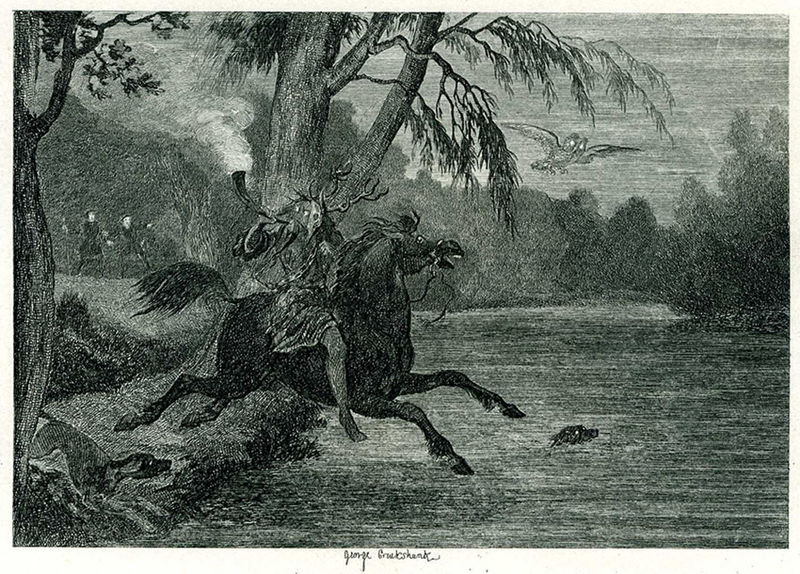
George Cruikshank, Herne the Hunter, 1840s
In Glamorganshire and Carmarthenshire, Wales, bendith y mamau (“mothers’ blessing”; roughly pronounced ben-dith uh mah-may) is a generic term for all faeries. The other Welsh term for faeries is tylwyth teg (“fair family” or “fair folk”). Some see these two terms as synonymous.
As in many faery legends, it was thought best to refer to the bendith y mamau with a flattering euphemism. In fact, there little that is “motherly” or “blessed” about these creatures. More often than not, they are, in fact, malicious and destructive in their dealings with mortals.
According to some accounts, these creatures are a grotesque cross-breed of goblin and faery. They possess the glamour or illusion-magic of faeries but the stunted and ugly appearance of goblins. Some say they have an affinity with either brownies or the pisgies (pixies) of the West Country.
The bendith y mamau are known to kidnap mortal children and replace them with their own hideous offspring, called crimbils. Stories suggest, however, that these mortal children might be returned many years later with only the faintest memory of their time among the Fair Folk. Bendith y mamau can be envious creatures, particularly of another’s beauty. They generally treat their captives well, however.
These faeries are also associated with Welsh underworld hounds. These beasts, usually called cwn annwn (“hounds of the underworld”) are sometimes also known as cwn bendith y mamau or simply cwn mamau. The appearance of these spectral dogs is thought to be an omen of death. They are also associated with the Wild Hunt.
Despite these unseemly characteristics, these faeries are also often skilled musicians and singers. Their music is capable of producing a trance-like reverie that erases a person’s memory, leaving them with only a faint recollection of the sweet music itself.
Korreds: The Underground Folk of Brittany
Korreds (also called Korrs) are guardians of treasures and standing stones in the folklore of Brittany (northwestern France). They prefer to live underground, in caves under the dolmens. They might also live under heaths, in sea-cliff caves, or in natural caverns. The related teuz and poulpikan types live in bogs or swamps.
Korreds have the strength of giants despite their small stature. They are said to live beneath the dolmen stones of Brittany. They have bright red eyes, dark skin, and often a hunched back. They are prophets as well as magicians, and are said to know the secrets of all treasures hidden in their neighborhood. They congregate around stone circles and love dancing but are more malevolent than other Gallic faeries. They are sometimes called bogul noz, “Children of the Night.”
The main delight of korreds is in dancing, which they do so vigorously that the grass burns in circles under their feet. They only dance at night, and usually on Wednesday, their traditional day off. They react with violence to mortals who disturb their dance-rituals, although mortals may be swept up in the ecstasy of the dance. Korreds are not always unkind to mortals, but they are never overly friendly.
In ancient times, Phoenician dwarves or sprites arrived in Brittany and intermarried with certain families of korreds. These dwarves were both kouretes (courètes) and karkinoi, another word for kabeiroi (carikines). Modern korreds are divided into the “old korreds,” the original pure lineage, and the “new korreds” who have a bit of this foreign heritage. Old Korred lineages include: Jetins (somewhat shorter), Vihans (also shorter), Hommes Cornus (from Gascony), Corics, Kerions, Kouricans, Gwazig-Gan, Kourils (or Courils), and Korandon. New Korred lineages include: Corriquets, Guerrionets, Korriks, Boudiguets, C’Horriquets, Corrandonnets, and Kornikaned (carry small horns on their belts).
In other parts of France, these beings are known as crions. They are also found in the Pyrenees and in Cornwall, where they are known as spriggans. Unlike spriggans, korreds are apparently unable able to grow to giant size.
Celtic Mythology Reading List
Dan McCoy suggests the Five Best Books on Celtic Mythology over on his Norse Mythology blog. Plenty of folks are interested in both mythologies, so it makes sense that an expert in one would have credible opinions about the other.
There’s a ridiculous number of introductory books on Celtic mythology out there. Figuring out which ones are the best can be a daunting task. This already difficult quest is further complicated by the fact that most of these books have extremely generic titles like “Celtic Myths and Legends” or “Celtic Mythology.” At first glance, they all appear to be more or less identical.
But anyone who’s well-acquainted with this field will tell you that nothing could be further from the truth. Some are far superior to others in terms of the scope and accuracy of the information they present, as well as in writing style. Some are written for scholars or an educated audience, while some are written for a more general audience and are written in a more entertaining and engaging way.
 Darrell J. Pursiful