
Home » Posts tagged 'Celtic' (Page 3)
Tag Archives: Celtic
The Breastplate of Saint Patrick
Happy Saint Patrick’s Day to all who are observing it. Perhaps you’ll appreciate the discussion of the Lorica of Saint Patrick posted today at the Celtic Myth Podshow. A lorica (literally, “breastplate”) is a poetic prayer form especially associated with Ireland. It is a prayer of protection by which the pray-er claims divine protection from various threats and enemies, hence the “breastplate” imagery.
As with much early Irish Christian religiosity, this traditional prayer (not likely to actually go back to St. Patrick himself) is steeped in earlier pagan or druidic forms:
It is written in the style of a druidic incantation for protection on a journey. It is part of the Liber Hymnorum, a collection of hymns found in two manuscripts kept in Dublin. This beautiful prayer of St. Patrick, popularly known as “St. Patrick’s Breast-Plate”, is supposed to have been composed by him in preparation for this victory over Paganism. It’s fascinating to compare the structure of this prayer with many of the incantations found in the Carmina Gadelica as well as many of the meditations and rituals seen in Druidry, Wicca and Ceremonial Magic today.
The text of the prayer is included both in its most familar English form and in a more literal translation from Old Irish.
In the interest of full disclosure, I’m wearing green today only because it’s 38° F in Charlotte, where I’m currently away from home on business, and green is the color of the only clean long-sleeved shirt I have with me!
The Lady of the Lake
Here’s an interesting summary of the origins of the Lady of the Lake from the legends of King Arthur. The writer explains that, in her earliest form, she is actually a Celtic water goddess or nymph known as Coventina.
Spriggans: Unpleasant Cornish Sprites
 Spriggans are a type of faery being from Cornish mythology. They are associated both with storms and stone ruins. By most accounts, they are closely related to pisgies (aka pixies). In fact, some suggest they are the same sort of being, with pisgies more mischievous and spriggans more outright malevolent. Others say spriggans came originally from Brittany, where they were called korreds. If this is so, their affinity for winds suggest they may be descended from the Crion family of korreds, those most firmly associated with whirlwinds. Spriggans send storms to blight crops.
These fae are also closely associated with the cromlechs or standing stones that dot the Cornish countryside. Like all fae, they love to cause mischief to those who offend them. They sometimes steal away mortal children, leaving their ugly changelings in their place.
They are often found at old ruins, cromlechs, and barrows guarding buried treasure and generally acting as faery bodyguards. As guards to both standing stones and hidden treasures, they correspond very closely to the Breton korred. They are also busy thieves and expert kidnappers of children.
Spriggans serve as slaves or warriors of more powerful fae. Some believe they are the ghosts of former giants, as they have the ability to swell to enormous size. They are also said to have a giant’s strength. They are often charged with guarding buried treasure.
In addition to their sour disposition, these fae are described as being grotesquely ugly. Like their korred cousins, spriggans love music and dance. Though their appearance and temperament are often distasteful, it is said that their music is quite beautiful.
Daoine Sídhe: Celtic Fae Nobility
The daoine sídhe (Scots Gaelic, daoine sith) are said to be the descendants of the Tuatha Dé Danann (“People of the Goddess Danu”), a race of deities that figures prominently in Irish mythology.
These gods are, in fact, common to various Celtic cultures. Danu herself was known as Dôn in Wales, for example. Both names go back to a Proto-Celtic form Danona. Likewise, the earliest Celts worshipped deities named Lugus (Lugh, Lleu), Noudans (Nuada, Nudd), Ogmios (Ogma, Eufydd), etc. They arrived in Ireland in the distant, mythic past. Some legends say they arrived in flying ships. At any rate, they brought with them several powerful magical artifacts: the Lia Fail or “Stone of Destiny” that helped select successive kings of Ireland, the spear of Lugh, the sword of Nuada, and the cauldron of the Dagda. After defeating the indigenous Fomorians, they became the undisputed rulers of Ireland.
It is said that only iron weapons could injure them. The Tuatha Dé Danann were eventually defeated by the Iron-Age Milesians—the ancestors of the contemporary Irish—and driven to the Otherworld, which homeland they access via the ancient burial mounds that dot the Irish countryside. They continue to live, it is said, as invisible beings. In Irish thinking, the Otherworld is closer to this world at dawn and dusk. This is thus a special time at which sightings of these fae are more likely.
The descendants of the Tuatha Dé Danann are known by a bewildering diversity of names, including:
- Daoine sídhe or aes sídhe, both meaning “people of the mounds.” The simple term sídhe is also commonly seen.
- “Still-moving people” or “people of peace,” alternate interpretations of the term daoine sídhe.
- Daoine uaisle, meaning “lordly ones” or “gentry.”
- Cloan ny moyrn (“children of pride/ambition”) or adhene (“themselves”), names favored on the Isle of Man.
- The Fair Folk, the Good Folk, or the Good Neighbors.
All of these terms are euphemisms to avoid using the straightforward Gaelic term siabhra (Irish) or siabhrach (Scottish) “faery.” Use of this term is thought to be far too forward for mortals to use with impunity lest the sídhe take notice of the perceived slight.
By all accounts, the daoine sídhe are powerful magicians. In early Irish manuscripts, they are described as “gods and not gods.” They are generally described as stunningly beautiful, although they can also be hideous monsters. It is likely a duine sídhe can look like whatever he or she wants to. In addition, these fae are often accomplished shapeshifters.
Pookas: Shapeshifting Irish Tricksters
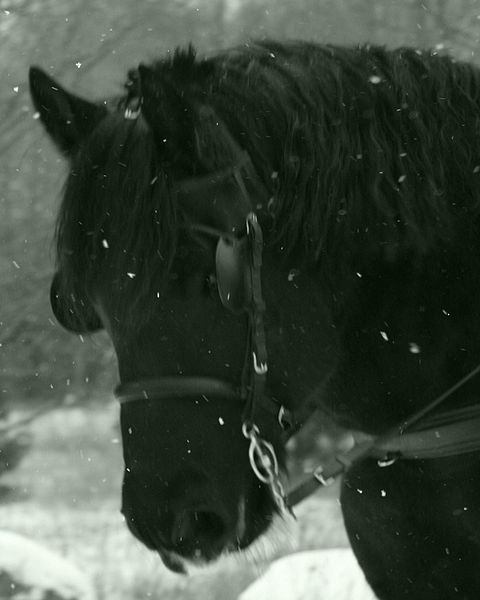 The word “pooka” (or phouka, puka, etc.) derives from Gaelic púca, meaning “spirit, ghost, or goblin.” Originally an earth-spirit associated with fields and herds, these beings are best known as trickster figures, either malevolent or simply mischievous. The worst among them have been accused of crimes including child molestation, kidnapping, and murder.
Pookas often pass through the mortal realm invisibly, but they are also accomplished shapeshifters. A pooka’s animal form is almost always a type of animal that lives in close proximity to humans: cats, dogs, horses and ponies, goats, cattle, rabbits, etc.—another indication of their original agrarian connection. In Waterford and Wexford, however, they have been known to take the form of a huge eagle. No matter the form, its fur or feathers are almost always dark.
As an agricultural spirit, pookas are associated with Samhain, the Gaelic harvest festival when the last of the crops are brought in. The pooka is acknowledged to have a right to anything that remains in the fields after November 1, “the pooka’s day.” Thereafter, pookas might render crops inedible or unsafe—perhaps by spitting or defecating on them. In some locales, reapers leave a small share of the crop to placate the hungry creature.
Pookas can also be helpful to farmers. In at least one story, pookas helped a poor farmer by milling his grain for him in the dead of night.
The Border Region has a variety of pooka known as a brag. These beings are noted for their kindness to animals. They still enjoy playing tricks on humans, however.
 Darrell J. Pursiful