
Home » Posts tagged 'Elf' (Page 2)
Tag Archives: Elf
The Erlking
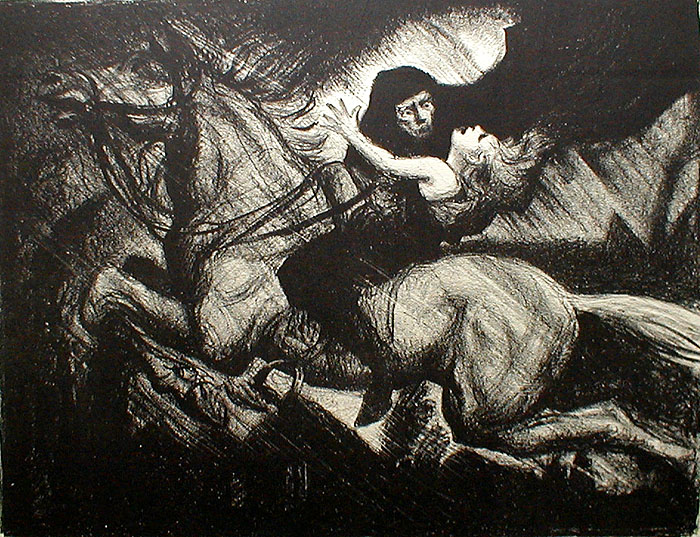
Albert Sterner, Der Erlkönig, c. 1910
We have seen that the powerful and good elves of Norse mythology over time became the powerful and malevolent nightmares of later Germanic folklore. In that vein, I need to say a word or two about the legend of the Erlking. As a distinct figure, the Erlking is a relatively recent addition to elf-lore. Even so, he has deep roots.
The Erlking comes from Scandinavian folklore, from a time when, as in England, elves had become depicted as creatures of dread. Originally, though, “he” was apparently a “she”: a deadly but seductive elfin woman. In his 1778 ballad, Johann Gottfried von Herder freely translated the generic “elfin maid” (Danish, elvermø) as Erlkönigs Tochter (“Erlking’s daughter”). In Danish folklore, old burial mounds were feared to be the dwelling place of the Elverkonge, the king of the elves. Eventually, this figure and his daughter were collapsed into a single character.
“Erlking” is a roundabout translation from the original Danish Elverkonge, “Elf-king.” In a particular Danish dialect, Elverkonge becomes Ellerkonge or Ellekonge, which was later understood with reference to the elletrae or “alder tree.” In other words, the “Elf-king” became the “Alder-king.” Some argue that this is purely a mistranslation. Others suggest that the change is intentional, a euphemism of the sort we have already seen when the superstitious avoid explicit mention of elves once their nature has turned malevolent. For what it’s worth, the alder tree has long been associated with faeries in Celtic folklore.
At any rate, in German, the figure is called the Erlkönig, the “Alder-king.” From German, we get the English semi-translation “Erlking.”
In the original tale, a knight named Sir Oluf is riding to his marriage but is bewitched by the music of elves in the woods. An elfin maiden appears and invites him to dance with her. When he refuses, she strikes him and sends him away. He is dead by the following morning, when his bride-to-be finds him.
The next version of the legend comes from Johann Wolfgang von Goethe. In his 1782 poem Der Erlkönig, the antagonist is the Erlking himself. In this version, the Erlking preys on children and his motives are never made clear. He is a force of death, not merely a magical woodland spirit.
There are a number of English translations of Der Erlkönig. Matthew G. Lewis (PDF) translated the poem in 1796. A contemporary translation has been done by A. Z. Foreman.
Goethe’s poem tells of a father riding through the forest with his feverish young son. The son is aware of the presence of the foreboding presence of the Erlking, who calls to him to leave his father and join him in his faery abode. The father, however, believes the son is merely hallucinating. In the end, the father arrives at home, but not before his son dies in his arms.
Franz Schubert used Der Erlkönig as the text for a Lied or art song for solo voice and piano in 1815. Here is a creepy animation of that piece:
Elves Breaking Bad
Now that we have seen where elves got their beginning, let’s cross the North Sea for the British Isles to hone in a bit more closely on the elves of English folklore. As we do so, we’ll switch from Old Norse to Old English, a related language where we can spot a family resemblance in some of the terms we have already encountered. In Old English, for example, the equivalent of the Norse aesir is ése (singular, ós). The Old English equivalent of Norse álfar is aelfe (singular, aelf).
Kindly Elves
Germanic mythology first came to England with the Angles and Saxons in the fifth century. Early on, English elves enjoyed the same positive reputation as their Scandinavian kin. Aelf is found among terms denoting “good” supernatural beings, and thus fit to be used as an element in personal names. Thus, an Old English speaker might name his or her son Aelfwine (“elf-friend”) as easily as Oswine or Godwine (both meaning “god-friend”).
Other terms denoting “monsters” that pose a threat to humans, are excluded from Old English naming practices. There are no names, for example, that include the elements eoten (“giant”), dweorg (“dwarf”), or thyrs (“ogre”). It goes without saying that nobody who loved their child would put the word “ogre” in his or her name. By the same token, it ought to tell us something that putting the word “elf” in a name was perfectly acceptable.
So, at least in the early centuries of English settlement in Britain, elves were largely the same as the Norse conceived of them: powerful supernatural beings on the side of good. They were also considered to be human-sized. Contrary to much popular opinion, these elves were not diminutive beings. After an involved linguistic analysis, Alaric Hall concludes:
[I]t is unlikely that aelfe in early Old English were considered particularly small, invisible or incorporeal. Although it is not conclusive, the early Old English evidence suggests [that elves were] corporeal anthropomorphic beings mirroring the human in-groups which believed in them. This prospect is eminently well paralleled in medieval north-west Europe by the evidence for álfar, the medieval Irish aes sídhe, the inhabitants of the medieval Welsh Annwn, medieval Latin fatae and Old French fées, Middle English elves, and the Older Scots elvis. (Elves in Anglo-Saxon England, 67–68)
Evil Elves
Within a pagan context, the elves of Norse and early Anglo-Saxon mythology were numbered with the “good guys.” Although they might work in ways unfathomable to mere mortals, they were generally on humanity’s side in the cosmic struggle against giants, dwarves, and ogres.
When Christianity replaced paganism, however, elves were re-interpreted as creatures of darkness.
By the time of Beowulf (8th or 9th century), aelfe were aligned with “monsters” in common understanding. The writer(s) of the Beowulf saga describe Grendel and his kin as descendants of the biblical Cain:
That fierce spirit/guest was called Grendel, the famed border-walker, he who occupied waste-lands, the fen and the fastness, the homeland of the giant-race—the ill-blessed man inhabited them for a time, after the Creator had condemned him; the eternal Lord avenged that killing on the kin of Cain, because he [Cain] slew Abel. He did not profit from that feud, but the Measurer banished him for that crime, from humankind. Thence all misbegotten beings sprang forth, eotenas and aelfe and orcneas, likewise gigantas, which struggled against God for a long while. He gave them repayment for that. (Lines 102–14, end of fitt I; transl. by Hall, 70)
Rather than being on the side of humans against the giants, now the elves and the giants are kin. In the popular imagination, they became associated with physical ailments in humans and livestock, which they inflicted via the magic of elf-shot. The gods or ése didn’t fare any better: an Anglo-Saxon spell against a sudden stabbing pain seeks to protect the victim from harm, be it from “gods’ shot” (esa gescot) or “elves’ shot.”
Furthermore, elves were said to be the cause of nightmares. The German word for nightmare is, in fact, Alpdrücken, literally “elf-pressure.”
These darker, more malevolent elves eventually become the predominant conception not only in England but throughout the Germanic world. In many locales, even the word “elf” came to be avoided because of its sinister connotations. Thus, for example, In Iceland, for example, one finds the term huldufólk, “hidden people” or even liuflingar, “darlings.” This tracks perfectly with the habit in many parts of the world of referring to potentially dangerous spiritual beings with euphemisms lest they overhear and take offense: “the good neighbors,” “the fair folk,” “the kindly ones,” etc.
Elves and Ladies

Nils Blommér, Meadow Elves, 1850
Originally, the Old Norse term álfr may have connoted exclusively masculine beings. There must have been female members of this group, however. If Alaric Hall is right that vanr is synonymous with álfr (Elves in Anglo-Saxon England, 27, 36), then we can even propose the names of some of these females: the names of female vanir such as Freyja, Jörd, etc.
In Icelandic, a female álfr is called an álfkona. But there are also certain named beings that seem to correspond more directly to “elves” as they are generally understood.
Hall (Elves in Anglo-Saxon England, 29, 43) suggests that dísir and nornir were the female counterparts of álfar. You can decide for yourselves whether this means that dísir is simply the term for female álfar or that dísir and álfar are naturally paired entities, perhaps like nymphs and satyrs are paired in Greek mythology.
At any rate, Hall perceives a distinct group of goddess-like beings in Norse mythology that go by a number of names. He contends that dís (plural, dísir), norn (plural, nornir), and valkyrja (plural, valkyrjur) are partial synonyms with largely overlapping meaning. Of these three terms, dís is the most inclusive. Just as the Norse religion had the custom of álfablót, a votive offering to the álfar, there were also sacrifices to the dísir called dísablót.
Dísir (“ladies”) are female warrior-spirits who choose who will live or die on the battlefield—and often intervene to ensure their choices come to pass. Valkyrja (“chooser of the slain”) is a kenning or poetic nickname for dís.
The derivation of the word norn is uncertain. It may, however, come from a verb meaning “to twine,” a reference to these beings’ twining the thread of fate. Another possibility is to connect the word with a later Swedish word meaning “to communicate secretly.” This etymology evokes images of shadowy, mysterious entities that deal in secrets mortals rarely comprehend—until it is too late.
Scholars speak of “the three Norns,” but Old Norse sources never do. According to the Prose Edda, “there are yet more nornir, namely those who come to every man when he is born to shape his life.” The nornir are thus a close counterpart to the fae women of other cultures who take an interest in the destiny of human beings.
The Elves of Scandinavia
Now it’s time to unpack more fully what Norse mythology can tell us about elves and related supernatural beings. Since the last Germanic culture to be Christianized was that of Scandinavia, the pagan practices of that region give us perhaps our best shot at piecing together the mythological world that gave us elves.
The “Good Guys”
The first thing to note, then, is that this culture gives us a basic vocabulary for identifying a number of different types of supernatural beings.
On the one hand are human-like beings that are generally well disposed to humans. In the Proto-Germanic language, these beings are called:
- Ansuz (plural, ansiwīz): “gods” or “life forces”
- Albiz (plural, albīz): “elves”
In Old Norse, ansiwīz are called aesir (singular, áss) and albīz are called álfar (singular, álfr). There is another Old Norse word that comes into play here, and that is vanir (singular, vanr).
In Norse mythology, there are two groups or tribes of gods, the aesir and the vanir. Vanr, however, is actually a fairly rare word in Old Norse. Nor does there seem to be a clear Proto-Germanic basis for this word, although some have suggested possibilities based on an even earlier parent language, Indo-European. Most of the time, the pairing is in fact presented as áss–álfr, not áss–vanr.
Based on this and other linguistic evidence, Alaric Hall (Elves in Anglo-Saxon England, 27, 36) raises the possibility that vanr and álfr were originally synonyms. If this is correct, then perhaps in the Proto-Germanic period, these two tribes of gods would have been called ansiwīz and albīz.
According to Norse mythology, these two tribes went to war in the far distant past. The war ended with a truce, the exchange of hostages, and a unified pantheon.
Aesir
In Old Norse, the word áss is often used of a god generally, without reference to his or her specific tribe. A female áss was an ásynja (plural, ásynjur). The most famous aesir are Odin, the king of the gods, and his son Thor, the god of thunder. Also in this group are Tyr, a war-god; Frigg, Odin’s wife; and many others.
In general, the aesir were, for lack of a better term, more “Olympian” in outlook. They valued order, masculinity, and power. With a few notable exceptions, they were closely connected with the themes of power and warfare.
 Álfar
Álfar
My main interest, however, is with the álfar (or vanir). In contrast with the aesir, these beings were more “chthonic” or earth-centered. They were generally associated chaos, fertility, femininity, and wealth. Again with some notable exceptions, they were more closely linked with the earth’s material and sensual gifts.
The most notable vanir were Freyr, the ruler of Álfheimr (“Elf-land”); his sister Freyja, the goddess of love and fertility; and Jörð, the earth-goddess.
In pagan times, álfar were offered sacrifices called álfablót. These sacrifices were conducted in late autumn, when the harvest was in and the animals were fattest. They were local observances mainly administered by the lady of the household. Other forms of entreating álfar, such as for healing of battle-wounds, were observed at any time of year.
The “Bad Guys”
There are also numerous monstrous beings that are generally opposed to humans and their interests. There are three important Proto-Germanic terms for these beings, each with a corresponding Old Norse term:
- Etunaz (plural, etunōz): “giants” (Old Norse, jötunn, jötnar)
- Dwergaz (plural, dwergōz): “dwarves” (Old Norse dvergr, dvergar)
- Thurisaz (plural, thurisōz): “ogres” (Old Norse thurs, thursar)
The Old Norse terms jötunn and thurs were often used synonymously. The “frost giants” that play an important role in the myths are, for example, technically “frost ogres” (hrimthursar). Furthermore, some jötnar are not “gigantic” at all, but human sized, and female jötnar are sometimes even described as beautiful creatures, desired as wives by both aesir and álfar.
“Giants” and “ogres” were creatures of the wild, lords of nature often possessing great magical powers. They were usually hostile toward gods, elves, and humans. But there are also times of truce between these “monsters” and the more human-like creatures. And, as I just said, some gods and elves even married female giants.
Finally, “dwarves” were crafty miners and metalsmiths, associated with both the underworld and death.
Tolkien’s Elves
The elves one encounters in J. R. R. Tolkien’s The Lord of the Rings draw heavily from Norse mythology: they are tall, beautiful, powerful, and strictly aligned alongside humans and against humanity’s monstrous foes.
It should be noted, however, that even humanity’s allies in Norse mythology are not necessarily safe to be around. Odin, the king of the gods, is a case in point. The “historical” Odin delighted in war both to feed the wolves and ravens that were his companions and to fill his hall, Valhalla, with heroes who would stand beside him at Ragnarök, the Norse “apocalypse.” He was, in fact, a ruthless and conniving wizard. The fact that the Norse placed him at the head of their pantheon should reminds us that the aesir and álfar/vanir play by their own rules, even if they are more kindly disposed to humans than, for example, the frost giants. They are good (for certain values of goodness), but they are not always safe.
All About Elves
Elves do not figure prominently in Children of Pride, although there are a couple of them in my planned sequel, The Devil’s Due. There is, however, reference to “elf-shot,” and a number of elfin extras, though none explicitly identified as such.
Elves and faeries go well together. In fact, they are essentially different names for the same sort of supernatural creature from the northern European sphere. For some time, they have also been wrapped up with the mythology of Christmas—the compatriots of Saint Nicholas (himself described as “a jolly old elf”) who make the toys he delivers to good little girls and boys on Christmas Eve.
But where do elves come from? As we’ll see, they were not always the diminutive toy-makers or shelf-sitting tricksters we’ve lately associated with the Christmas season. They were once a much-feared aspect of our ancestors’ lives. And before that, they were hailed and even worshiped as powerful protectors of humankind.
In the next few weeks, I’ll look a bit at the history of elf-lore. To do this, I’m afraid we’ll have to delve a bit into the field of linguistics.
So let’s begin at the beginning. Elves are products of Germanic (mainly Norse) mythology, just as the daoine sídhe are products of Celtic (mainly Gaelic) mythology. Both groups of beings were once worshiped as gods, but with the Christianization of their cultural regions, they became “demoted,” as it were, to lesser status.
Of the various Germanic cultures of the ancient and medieval worlds, we learn most about elves from the Norse: the people of medieval Scandinavia. (Norse is a Germanic language, closely related to German, Dutch, English, and several others). Eventually, the Norse language itself branched out into Swedish, Norwegian, Danish, Icelandic, Faeroese, etc.) But before we turn there, let me first say a few brief words about the earliest conceptualizations of elves that may have been shared by all early Germanic peoples.
Before the Norse became Norse, their ancestors spoke a language from which all Germanic languages descended. Scholars call this language Proto-Germanic, and believe it was spoken from around 500 BC on in northern Europe. There are no written records of Proto-Germanic; scholars have reconstructed the language by comparing the various daughter languages and making educated guesses about how its grammar and vocabulary may have worked.
Little can be said with certainty about the culture or beliefs of Proto-Germanic-speakers. There are a few references in Latin sources to the Germanic tribes during the time of the Roman Empire, but by this time Proto-Germanic had already split into numerous language and culture groups that would shortly appear on the stage of history as the Vandals, Goths, Franks, Angles, Saxons, and others. They definitely believed in elves, however, because they had a word for such creatures—just as they had words for gods, giants, dwarves, and ogres.
In the next post, I’ll look at the elves as we first encounter them in the written traditions of Scandinavia. The point to make here, however, is that much of what we’ll discover about these Norse elves sheds light on how these beings were perceived in even earlier times.
Elf-shot
The people of the British Isles tended to blame unexplained illnesses on the malevolent work of elves. As early as the tenth century, medical books discuss elves afflicting both humans and livestock with death and disease via “elf-shot.” In Scots Gaelic, this phenomenon was called a saighead sithe (“faery arrow”). In Irish Gaelic, it was a gae sídhe (“faery dart”).
Elf-shot might be compared to the supposed druidic ability to “send” misfortune by putting a curse on an object (say, a handful of straw) and then throwing it at the intended victim. Elf-shot does the same thing, but delivers the magical “payload” via arrows or darts. In fact, people appealed to the neolithic flint arrow heads they sometimes found on their land as evidence of the activity of elves.
Elf-shot “payloads” can be quite diverse. Apparently many types of curses and hexes could be embedded on the projectile. Some of the more commonly encountered types of elf-shot curses are:
- Sudden shooting pains, which might be diagnosed as rheumatism, arthritis, muscle stitches, cramps, etc. The Old English medical text Wið færstice provides a remedy for this sort of elf-shot.
- Sudden paralysis. We call cerebrovascular accidents “strokes” because they were formerly believed to be the result of the stroke of an elf or faery’s hand.
- Sluggishness, hard breathing, and loss of appetite associated with the opening of the peritoneum in livestock (as described in America Bewitched by Owen Davies, p. 39).
- Bad dreams (referred to in German as Alpdrücken, “elf-pressure”). Also, the phenomenon known as sleep paralysis was often explained as the work of elves, demons, etc.
- Blackleg (aka black quarter, quarter evil, or quarter ill), an acute infection of cattle, sheep, and goats characterized by crepitant swelling of the muscles of the infected part (see T. Davidson, “The Cure of Elf-Disease in Animals” in the Journal of the History of Medicine and Allied Sciences 15/3 [1960]: 15:282–91).
- Tumors. Like paralysis, tumors were often considered a curse inflicted by elves.
- Death of animals as suddenly as if they had been struck by lightning (referred to in Swedish as skot “shot” and in Danish as elleskud “elf-shot”).
Though several years old, Richard Scott Nokes discussed elves, faeries, and elf-shot in a nice, brief post at his Unlocked Wordhoard blog. He makes some interesting observations about how we deal with unexplained illness today—and how we may not be quite as far removed from our ancestors as we might like to think.
 Darrell J. Pursiful