
Home » Posts tagged 'Fantasy Races'
Tag Archives: Fantasy Races
Ancestry and Culture by Eugene Marshall
 Eugene Marshall is a game designer, writer, and editor as well as an associate professor of philosophy. His D&D supplement Ancestry and Culture weds these two interests by exploring how the concept of “race” has been handled in Dungeons & Dragons in the past, and how the game and gamers could handle it better in the future. Marshall’s first 30 pages outlines (1) the problems associated with the language and conceptualization of “race” in modern thought and (2) a simple homebrew method to address these problems. The next 40 pages provide sample adventures featuring these innovations. I’m not going to review these adventures; my interest is solely on how Marshall challenges us to reconsider the concept of “race” in a fantasy setting.
“Race”
Marshall’s three-page introduction lays out his case for doing away with “race” in D&D. It basically boils down to the fact that this term, as it has been used since the Enlightenment, has more often than not been used to denigrate and oppress others. It is, as many have noted, a social construct, not anything based on actual science. For this reason, I have long preferred to call these population groups “kindreds” and jettison the term “race” completely.
Why should this matter in a fantasy setting when we’re not talking, for example, about Europeans and Asians but about dwarves and elves? Marshall points out that, even though we’re imagining fictitious beings, we tend to imagine them with our cultural blinders on.
In short, monstrous kindreds such as orcs
…are often not so subtly veiled stand-ins for age-old, racist stereotypes…. It’s hard to ignore the fact that, when he first created miniatures for the fantasy races, Gary Gygax chose Turk minis to depict orcs and repainted Native American figures for trolls and ogres. Although orcs and goblins are fantasy races in a fantasy world, they are created and depicted by real people in our world, and the systems of fantasy racism and real-world racism are unavoidably linked. (p. 5)
Even “non-monstrous” kindreds are subject to this kind of othering behavior. That’s why so many dwarves these days are inveterate drinkers who speak with a Scottish accent and love a good fight. In the end, a stereotype is a stereotype, and since all of us playing the game are (presumably) human, we have little choice but to draw on the stereotypes we have learned about other groups of humans. The problem is that we often don’t realize that is what we’re doing.
Character Creation
You’d think after all this that Marshall would advocate only ever playing humans—and humans of a culturally or ethnically “neutral” heritage, at that. In fact, he proposes a tweak to the basic rules of D&D 5e that is so elegant as to be nearly imperceptible while at the same time opening up vast new horizons for character customization.
Marshall proposes that all of the features of any given fantastical kindred can be divided neatly into ancestral traits and cultural traits.
Ancestral traits have to do with biology. They are things like average height, lifespan, and various unique advantages such as darkvision, dwarfish resistance to poison, elfish resistance to charms, etc.
Cultural traits have to do with how one was raised: languages, proficiencies, tendencies toward a particular alignment, and ability score increases (more on that in a bit).
So if you’re playing a gnome, you get all the features and abilities of any D&D gnome played straight from the rule books. I expect for the vast majority of players, that’s where it ends. Ancestry and Culture gives permission to go further but doesn’t require it.
But what if you want to play a gnome that was raised in a community of dwarves? That’s now very easy to do: you get the ancestral traits of a gnome (your species hasn’t changed, after all), but you get the cultural traits of a dwarf.
Now let’s take it a step further and say instead that you want to play a gnome-dwarf hybrid. Suddenly, that kind of character build is ridiculously easy. For the ancestral traits, you split the difference in terms of average height, average lifespan, etc. and you pick one unique ancestral trait from each of your two ancestries. (You get darkvision for free if either of your ancestries offers it.) Then you just decide whether you were raised among gnomes or among dwarves and take the appropriate suite of cultural traits. Or, maybe you want to be a gnome-dwarf hybrid orphan who’s been raised by humans. Then just take the human cultural traits instead. Done and done.
Furthermore, you’re allowed to stipulate that your character was brought up in a multicultural community and choose “Diverse Cultural Traits” instead of the traits tied to any particular race.
Marshall only deals with the fantastical kindreds available under the Open Gaming License, but he offers an appendix with steps for applying the same principles to any kindred you might find in any other D&D game book.
Concerns
I played more than my fair share of D&D and Traveller way back when, but I was mainly interested in Ancestry and Culture for what it might teach me as a fantasy author: how can I do a better job of handling elves, dwarves, etc. in ways that don’t fall into the old racist pitfalls that have plagued fantasy fiction as well as fantasy gaming. And I’ve got to say, Marshall provides some well-reasoned guidance.
There are three areas where, to my taste, his system as written is somewhat unsatisfying. With two of them, Marshall anticipates my quibble and explicitly addresses it. With the third, I see where he is coming from and he does, in fact, concede that there might be another valid solution, though perhaps an unnecessarily complicated one.
Genetic Free-for-all. Marshall sets up a system where any conceivable hybrid character can exist. If you want a character whose father was a human-dwarf hybrid and whose mother was an elf-dragonborn hybrid, you can do it! But to paraphrase Dr. Ian Malcolm from Jurassic Park, we can be so preoccupied with whether or not we could, we don’t stop to think if we should.
For me (and I acknowledge that this is a personal preference), it’s more interesting to inject a little bit of science here. For example, modern human-Neanderthal hybrids were viable when the mother was human but not when the mother was Neanderthal—at least, there is no evidence of Neanderthal mitochondrial DNA in the modern human genome today. These kinds of considerations add a little extra flavor that I find fascinating.
Marshall concedes that issues of realism might factor into how much hybridization is acceptable in a given campaign world. His response: If this bothers you as a DM, don’t allow it.
Monolithic Cultures. Another concern has to do with painting all elves, halflings, or what have you with the same broad cultural brush. In a rich, realistic world, elves don’t all speak the same language, follow the same religion, uphold the same cultural values, etc. any more than all humans do. Doesn’t it make sense that the Elves of the Northern Mountains would have a different culture than the Elves of the Mystic Forest?
To address this, Marshall provides a one-page appendix on how to describe a “custom” culture that can plug into his system quite easily. This is the kind of thing that I’d love to see expanded upon, but that would obviously go far beyond the goals of this supplement. Every campaign world is different, and such a project would quickly grow to encyclopedic lengths.
Ability Score Increases. Here is the one place where, in my opinion, Marshall’s system is a bit too simple: He attributes all ability score increases to cultural rather than ancestral factors. I understand why he did that, and I don’t fault him for it. I’ll let him express himself in his own words:
Some readers may wonder why ability score increases appear in culture rather than ancestry. This choice allows us to move away from the problematic notion certain ethnic groups have higher strength or intelligence, as those notions are often at the heart of racist attitudes in the real world. And rather than removing ability score increases entirely, or dividing them up in some more complex way such as a point buy system, these rules keep them under the umbrella of culture for simplicity and ease of use. (p. 9)
In effect, Marshall is inviting us to see these bonuses as the result of a particular kind of upbringing: one that favors athleticism, physical resilience, studiousness, rhetorical skill, or what have you.
There is nothing unreasonable about this approach, especially if everyone around the table playing an orc or whatever is actually a human being enmeshed in their own experiences with race and racism. We’ve all heard how some populations of humans are “more athletic” than others but “less intelligent,” and we all know how those stereotypes have been exploited by other humans in positions of power.
Still, suppose someone uses Marshall’s guidelines to include goliaths in their campaign world. In D&D lore, a goliath is a human-giant hybrid. They stand between seven and eight feet tall and can weigh over 300 pounds. Shouldn’t such a character possess considerable physical strength based on their genetics, quite apart from what culture they were raised in?
In his sidebar quoted above, Marshall himself concedes that it would be possible to divide up the ability score increases in some more complex way. Presumably, he can envision ways of doing so that would not insensitively parrot real-world racial stereotypes.
I expect there are ways to handle these cases that don’t throw a wrench into Marshall’s system overall. Perhaps, for example, it could be as easy as giving goliath characters an ancestral trait called “Gigantic Ancestry,” corresponding to the “Fey Ancestry” of elves and the “Draconic Ancestry” of dragonborns. Let this trait provide some kind of boost to brute strength, hardiness, or whatever, essentially splitting the ability score modifiers between ancestry and culture. Maybe something similar could be done with a number of kindreds, if not all of them. Such a system would have to be rather complex, however. And simplicity of design is nothing to be sneezed at in a tabletop RPG.
Bottom Line
I found Ancestry and Culture to be a stimulating read. Admittedly, Marshall was addressing concerns that I have expressed before. Rather than simply bemoaning how “race” has been mishandled in the past, he offers a clear, simple, and (I think) imminently playable alternative. Get this book if you play D&D or any other RPG that deals with characters from a variety of fantastical kindreds; it will give you food for thought. Get this book if you’re a fantasy writer who seeks guidance in avoiding some of the racist pitfalls that can come with that genre—but do not need to.
Humans as a “Fantasy Kindred”
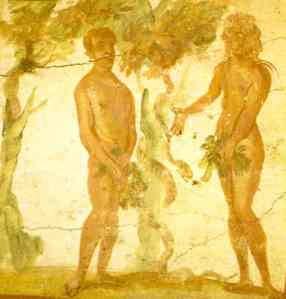
Adam and Eve, Catacombs of Saints Marcellinus and Peter
Here’s a follow-up on my previous post about connections between my current work-in-progress and a D&D setting. One thing I wanted to incorporate was the whole mythology around humans removed from the mortal world to live in the faery realm. Although we usually think of this as a trope European faery-lore, it is actually found in many places throughout the world, and it accounts for the presence of a large minority of humans inhabiting said faery realm in my WIP (to the tune of about 20% of the population).
So, how should I conceive of humans participating in a fantasy realm in which they are in the minority?
The Overbrought
The first thing to note is that humans are not native to this realm. I’m imagining that the humans one encounters in the faery realm are either “overbrought,” taken from the mortal world, or else the descendants of those so taken. They may have originally been taken for any number of reasons, both benign and sinister.
Benignly, some humans were removed as young children from situations of abuse or neglect. Others found refuge in in the faery realm after escaping from similar dire situations: domestic abuse, abject poverty, or systemic oppression. Still others were “recruited”—perhaps with selfish motivation—because they possessed certain qualities deemed desirable to a particular supernatural being or organization. For instance, folklore is riddled with stories of an elf or faery falling in love with a mortal and inviting him or her to join them on “the other side.”
Often, however, humans are overbrought for more sinister reasons. They might, for example, be taken as slaves to serve in either the harems or the armies of a powerful fae lord. They may even have been taken capriciously, for no discernible reason.
The Human Mystique
But why on (any) earth would an elf, troll, or whatever go to the trouble of bringing humans over and keeping them around? We must possess traits that are deemed desirable by at least some in the faery realm. What those traits might be largely boils down to adaptability and versatility. Robert Heinlein’s character Lazarus Long made an apt comment in this regard in Time Enough for Love:
A human being should be able to change a diaper, plan an invasion, butcher a hog, conn a ship, design a building, write a sonnet, balance accounts, build a wall, set a bone, comfort the dying, take orders, give orders, cooperate, act alone, solve equations, analyze a new problem, pitch manure, program a computer, cook a tasty meal, fight efficiently, die gallantly. Specialization is for insects.
I think this gets at why an elf, dwarf, troll, etc. might want to keep humans around: they are versatile and adaptable. They won’t be the most magically gifted, or the strongest, or the smartest, but they tend to acquire a larger and more diverse skill set. They are generalists, the Hufflepuffs of the faery realm. They’re “good enough” at a broad range of things without perhaps excelling at any.
As I’m conceiving it, underlying this versatility is human free will. The way magic works in my setting, the more powerful you are, the less free will you possess. Those at the top of the magical food chain are effectively archetypal figures with limited ability to innovate or even see things from a different point of view: they have a fixed personality, temperament, and overall approach.
Humans don’t experience this bondage of the will to nearly the same extent. To the other members of the fantasy world, therefore, they are fascinating—and formidable—because they are unpredictable.
Humans in Fae Society
So, what roles do humans play in fae society? Most agree they are not suited to be common slaves, although they may be bonded to a lord in a more high-status position of servitude as an adviser, teacher, bodyguard, or in some other capacity where quick, outside-the-box thinking is a bonus. I’m imagining a setting in which some powerful fae lords maintain elite military units of overbrought children raised to be warriors virtually from birth, and comparable to the janissaries of the Ottoman Empire. Whether bond or free, many humans end up in the officer corps of various principalities.
Others find a niche in careers where their adaptability and unpredictability are assets. Humans might be merchants and entrepreneurs, inventors, artists, theoreticians, spies, adventures, and treasure-hunters.
One niche that is filled almost exclusively by humans (and half-humans) is that of the knight (à la Spenser’s Faerie Queene). These individuals are champions who have sworn loyalty to a lord and serve on his or her behest as a champion or agent. Knights need not be strictly military in nature, though many are no doubt daunting fighters. Rather, the essence of knighthood is to serve as a lord’s right hand, furthering their agenda as one’s skills permit.
All of this is certainly not the only way to account for the wealth of mythology about changelings, human babies switched at birth, etc., but it suits my narrative purposes. It certainly, I think, opens up some interesting avenues for characterization and character development—not only of humans but of the majority non-human population.
A Note about Fantasy “Races”
TL;DR: When differentiating between humans, elves, dwarves, etc., “kind” is preferable to “race.”
In much fantasy literature, we hear of various “races,” meaning elves, dwarves, orcs, and so forth. The more I think about that terminology, the less I like it. A while back I looked at some of the fanciful humans or near-humans one encounters in the ancient and medieval geographies, populations traditionally called “monstrous races.” At that time, I took exception to that term because of the potentially hurtful connotations of both “monstrous” and “race.” In my introductory post, I wrote:
That can also be an awfully loaded term with a dubious past in pseudo-scientific pronouncements that attempted to justify the oppression and enslavement of some groups of human beings by other groups of human beings on the theory that some groups of human beings are naturally superior to others. Originally, a “race” (Latin gens, Greek ethnos) was simply a definable people-group: a tribe or culture, whether sparse or numerous, whether familiar or foreign. Even so, when talking about human beings—or supposed human beings—whose customs are disquieting or who possess animalistic traits, the word “race” can lead us down some paths we might not want to tread.
At that time, I wasn’t concerned with dwarves and the rest but only with cynocephali, monopods, and the like. But as I think of it, my concern with the word “race” still pertains and is perhaps even more pronounced when we use it to describe what makes Legolas different from Gimli.
It seems to me that “species” is an apter description of what these fantasy populations really are. There are clear genetic differences between elves, orcs, trolls, etc. Hybrid or mixed-lineage characters notwithstanding, the ability of at least some of these groups to interbreed seems at least problematic. That means we’re probably in the realm of using the term “race” to speak of what modern science would call a “species.” Dwarves are different from elves at a deep level that goes far beyond physical phenotype or genetic minutiae (e.g., blood types, lactose tolerance or intolerance, susceptibility to certain diseases, etc.). And explicitly, the term “race” is used to set certain groups apart from the “human race.” Once again, that doesn’t sit well with me.
Of course, “species”—a word used in English with a more or less precise scientific definition—doesn’t quite seem at home in a fantasy setting. Fortunately, there is a good English term from the pre-industrial era that can carry the same weight. That word is “kind.” In the King James Version of the Bible (1611), we read,
And God said, Let the earth bring forth the living creature after his kind, cattle, and creeping thing, and beast of the earth after his kind: and it was so. And God made the beast of the earth after his kind, and cattle after their kind, and every thing that creepeth upon the earth after his kind: and God saw that it was good. (Genesis 1:24-25, emphasis added)
“Kind” is thus, roughly speaking, an early English equivalent to what we usually understood by “species” today. I know I’ve read fantasy stories that speak of “Elfkind” or “Dwarfkind.” Perhaps it’s time to retire the idea of “race” as it is used in the genre and speak of “fantasy kinds” (or “fantasy kindreds”) instead.
What do you think?
 Darrell J. Pursiful