
Home » Posts tagged 'Fenodyree'
Tag Archives: Fenodyree
Ronald Hutton’s Typology of Faeries
In the video I mentioned in this post, Prof. Hutton provided a concise classification system for the faeries of northern Europe. It is but one part of a fascinating and expertly presented lecture, and I’m summarizing it here because it fits nicely (though not perfectly) with the way I developed the Fair Folk one meets in Children of Pride. Hutton speaks of three basic categories of faeries in the British Isles:
1. Faeries proper, which Hutton describes as “the neighbors from hell.” These are the frightening and often malicious faeries one encounters in the oldest strands of faerie lore: the daoine sídhe and their cohorts. They live underground in a society that mirrors that of human beings, with courts, royalty (usually queens), banqueting, dancing, and the like.
2. Household helpers, including all manner of brownies, hobs, fenodyrees, and the like. These creatures are more mischievous than malicious, and they can sometimes be persuaded to help with the domestic and agricultural chores. But be careful, because they are easily offended and may just leave if one does something of which they don’t approve.
3. Faerie tricksters such as Robin Goodfellow. These are practical jokers, generally harmless or amusing rather than hostile. They are a rather late invention according to Hutton, largely under the influence of Shakespeare’s Puck. He is most assuredly not a pooka, which would better be understood as a dreaded “night being.” He further compares Robin Goodfellow to Native American trickster archetypes like Coyote as a trickster and buffoon, but also sometimes a powerful cosmic force. (Hutton does not use the specific terminology of “faery trickster,” but I think this is a fair description.)
He also notes a fourth category:
4. Nature spirits such as the pans and nymphs of Greek mythology. Properly speaking, Hutton says there are relatively few of these in the folklore of the British Isles. He further insists that these creatures are not, properly speaking, faeries at all since they fit into the natural realm in a way that traditional Anglo-Celtic faeries do not. Unlike faeries proper, beings of this type seem to be nearly universal in human cultures. Although Hutton insists such creatures are not faeries, he does say that the trolls or faeries of Iceland (and the related trows of the Orkney and Shetland Islands) are something of a hybrid between this category and the first. They are “land wights” who exercise guardianship over the land, but they are also said to live in underground communities and are often less than hospitable to human beings.
If you’re interested in the faery lore of the British Isles, you really owe it to yourself to listen to Prof. Hutton’s lecture.
Five Helpful Clans of Little Folk
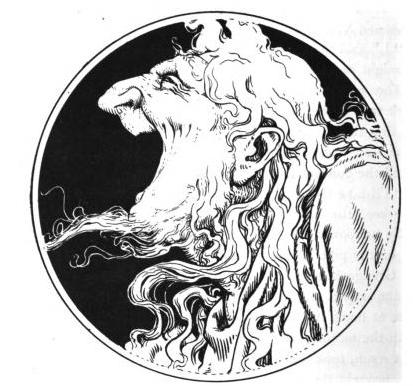 Not all faery beings can be imposing sídhe lords and ladies, sinister jinn, or wild, unpredictable satyrs. In world mythology, some of the inhabitants of the Otherworld are humble, unassuming, and even quite helpful to mortals. Today, I’ll highlight five types of little folk that you probably wouldn’t mind dropping by. They are all good with chores and domestic tasks of various sorts, and are usually happy to help mortals out for a modicum of remuneration. (Offerings of food or milk or cream usually does the trick.) All of these beings are all found in Scotland, Ireland, or surrounding regions.
Brùnaidh/Grogan
A brownie is called a brùnaidh in Scots Gaelic and grogan in Irish. These are domestic spirits who attach themselves to a house or family and often perform domestic chores when no one is looking. The house elves of Harry Potter are modeled largely on brownies.
Uruisg/Fenodyree
The uruisg (or urisk) is very much like a brownie, but is set apart by having goat-like hooves. They are called fenodyrees on the Isle of Man. The are said to have a mischievous nature and also tend to be inclined to perform farming or agrarian tasks. They are thus somewhat similar to a pooka.
Kilmouli
Kilmoulis are faery millers, an ugly form of brownies said to haunt mills. They also hail from the Border counties. They have enormous noses but no mouths, and therefore they have to inhale their food through the nose. Kilmoulis work hard, but also enjoy tricks and pranks.
Gruagach
Gruagachs (the Gaelic plural is technically gruagaichean) are field-folk native to Scotland. Their name literally means “long-haired one.” They love to help mortals with household tasks. Female gruagachs herd and protect cattle, and are also associated with water. They are described as having long blonde hair and wearing a green dress. Sometimes they are said to be attractive; more often, however, they are grotesques hags—although extremely kind-hearted.
Male gruagachs have thick fur, although occasionally they are described as handsome youths dressed in green and red. They commonly work as farm hands shredding and thrashing grain.
Clurichaun
A clurichaun (Irish clobhair-ceann) is thought by some to be a variant form of the leprechaun who goes out to drink after finishing his daily work. They are always drunk. If treated well, a clurichaun will protect a mortal’s wine cellar.
 Darrell J. Pursiful