
Home » Posts tagged 'Griffin'
Tag Archives: Griffin
Five Griffins and Griffin-like Creatures
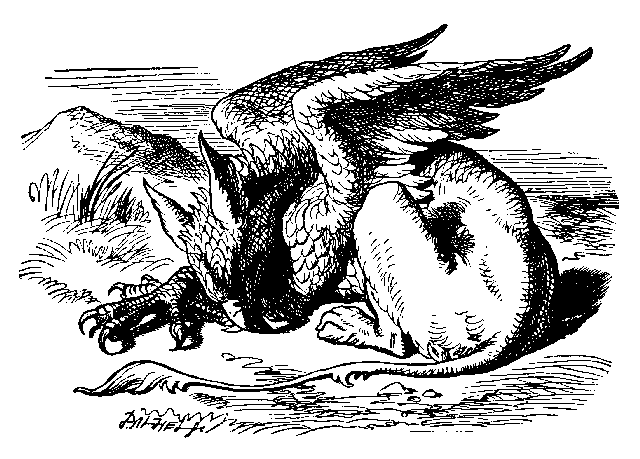 There is something about a majestic eagle in flight that fills most of us with wonder. And there is also something awe-inspiring about a powerful lion on the prowl. It doesn’t surprise me that mythology is full of fantastic beasts that combine the characteristics of these two powerful hunting beasts.
I’ve been pondering how to work a griffin into an upcoming novel, simply because large flying things are cool, and griffins are among the coolest. So I’ve done a little bit of research on griffins and other part-bird part-lion creatures from mythology and heraldry. Here are some of my favorites.
Griffin
The griffin of Greek mythology was said to hail either from the far north or from Ethiopia, “Ethiopia” being a Greek word meaning “too far away to verify, but you can take my word for it.” It is described as a creature with the head, wings, and talons of an eagle and the hindquarters of a lion. It has long, external ears and, sometimes, a snake-like tail. They are often seen guarding treasure, and they seem to be particularly fond of gold.
In medieval times, griffins came to be associated with Christ. Since they combined aspects of a lion, the “king of beasts,” and an eagle, the “king of birds,” it was deemed appropriate that they symbolize Christ, the “king of kings.” These creatures are also said to mate for life, even to the point of not seeking a new mate if the first one dies.
There are a number of magical properties associated with the relics of griffins. Their talons change color in the presence of poison, making them ideal to fashion into drinking vessels. Furthermore, the feather of a griffin is said to be able to restore sight to the blind.
Griffins are especially fond of horse meat.
Alce
The alce may have been the earliest form of griffin, although its name comes from medieval heraldry. Simply put, it is a wingless griffin. The ancient Scythians, inhabitants of the region north of the Black Sea, depicted wingless griffins in their art.
According to folklorist Adrienne Mayor, they may have been inspired by the fossil skeletons of Protoceratops and other beaked dinosaurs they found while mining for gold in the Tian Shan and Altai Mountains of Central Asia.
Hieracosphinx
Another creature that combines raptor and felid characteristics is the hieracosphinx of Egypt. Like the alce, the hieracosphinx is a wingless creature. It combines the body of a lion with the head of a falcon. In artistic depictions, the distinct coloring of a falcon’s face is plain to see on this creature.
The presence of a hieracosphinx is sometimes interpreted as an evil omen.
Opinicus
Like “alce,” “opinicus” is a fairly modern term. Most ancient and medieval peoples would have classified this creature as simply a griffin. Opinici can be distinguished from true griffins by their lack of external ears, cat-like rather than bird-like forelimbs, and short camel-like tail. The opinicus is more of a scavenger than are griffins proper.
Hippogriff
Harry Potter notwithstanding, the hippogriff is a joke—literally! They were first mentioned by the Latin poet Virgil, but only received their name in the 16th-century poem Orlando Furioso by Ludovico Ariosto where, it should be noted, it was a swift steed ridden by magicians.
But the hippogriff is also an impossibility, the offspring of a mare and a griffin. Since horse is one of a griffin’s favorite foods, the idea of a griffin and a horse mating was remarkable. Mention of such a creature would have likely been the Classical equivalent of “when pigs fly,” “hen’s teeth,” or (more to the point) “horsefeathers.”
Large Flying Beasties
Speaking of dragons, I’ve been trying to nail down the physiology of some large mythological flyers for possible inclusion in my third Into the Wonder novel. I’ve come across the following rules of thumb that may prove helpful to others trying to imagine dragons, griffins, and other creatures in something like a realistic way:
- Birds have a wingspan of roughly 2 times their head-body length (falcons average around 2.5)
- Bats have a wingspan of roughly 5 times their head-body length
- Pterosaurs had a wingspan of roughly 6 times their body length (first dorsal to last sacral vertebra)
Within these parameters—and assuming the creature is not too heavy to fly at all!—a smaller ratio (like a finch) provides greater maneuverability while a larger ratio (like an albatross) provides greater endurance.
Furthermore, you can make a guess about the weight of a flying creature, or at least avoid something impossible, by taking wing loading into account. This has to do with how much weight and pressure a wing can manage. For birds, five pounds of body weight per square foot of wing surface is about the limit.
Some cool sources I found along the way:
 Darrell J. Pursiful