
Home » Posts tagged 'Human'
Tag Archives: Human
Fantasy Kindreds of Saynim: Humans
I might not have included a post on humans in this survey of the fantasy kindreds you’d find in my work in progress Shadow of the King except for the distinctive role they play in the story world. So let’s go…
HUMAN (Homo sapiens sapiens)
 Humans are not native to the realm of Saynim. In fact, they are a distinct minority. Those who live there are either “overbrought,” taken from the mundane world either in infancy or at a later age, or the descendants of those so taken. These humans were taken from their own world for various reasons, both benign and sinister.
Benignly, some humans were removed as young children from situations of abuse or neglect. Others found refuge in Saynim after escaping from dire situations such as domestic abuse, abject poverty, or systemic oppression. There is a Cherokee legend about the Nunnehi rescuing the people of certain towns from the Removal by whisking them away to their own magical domain.
Still others were “recruited”—perhaps with selfish motivation—because they possessed certain qualities deemed desirable to a particular otherworldly party. For instance, an elf might fall in love with a human and invite him or her to join this alien world.
At other times, however, folklore describes humans brought into the Otherworld for more sinister reasons. They might be taken as slaves to serve in either the harems or the armies of a powerful fae lord. The Cherokees believed water cannibals would steal children for food. The okwa naholo (“white water people”) of Choctaw mythology would lure swimmers to their underwater domain and, if they stayed long enough, would become okwa naholo themselves. Of course, sometimes humans are taken capriciously, for no discernible reason.
So, what roles do humans play in Saynim society? There are certain stereotypes of humans at play, not least among them the idea that humans are tricky and unpredictable. They think outside the box. More than any other kindred, they seem able to resist the pull of magic to become conformed to particular ways of thinking and acting.
All of this makes humans fascinating to elves and the rest, and they are often objects of a benign and patronizing racism that admires them for these unique qualities while ultimately diminishing their personhood. Think of the way some white folks romanticize (and even fetishize) peoples and cultures that they see as “exotic,” and you won’t be far removed from the way many in Saynim think of humans.
Humans rarely serve as common slaves, though they may be bonded to a lord in a more high-status position of servitude as an adviser, teacher, bodyguard, or in some other capacity where quick, unorthodox thinking is desirable. Some fae lords have maintained elite military units of overbrought children raised to be warriors virtually from birth, comparable to the janissaries of the Ottoman Empire. Whether bond or free, many humans end up in the officer corps of various otherworldly principalities.
Other humans find a niche in careers where their adaptability and unpredictability are assets. They might be merchants and entrepreneurs, inventors, artists, theoreticians, spies, adventures, and treasure-hunters.
Humans as a “Fantasy Kindred”
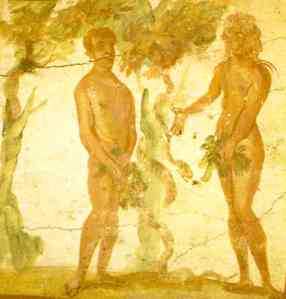
Adam and Eve, Catacombs of Saints Marcellinus and Peter
Here’s a follow-up on my previous post about connections between my current work-in-progress and a D&D setting. One thing I wanted to incorporate was the whole mythology around humans removed from the mortal world to live in the faery realm. Although we usually think of this as a trope European faery-lore, it is actually found in many places throughout the world, and it accounts for the presence of a large minority of humans inhabiting said faery realm in my WIP (to the tune of about 20% of the population).
So, how should I conceive of humans participating in a fantasy realm in which they are in the minority?
The Overbrought
The first thing to note is that humans are not native to this realm. I’m imagining that the humans one encounters in the faery realm are either “overbrought,” taken from the mortal world, or else the descendants of those so taken. They may have originally been taken for any number of reasons, both benign and sinister.
Benignly, some humans were removed as young children from situations of abuse or neglect. Others found refuge in in the faery realm after escaping from similar dire situations: domestic abuse, abject poverty, or systemic oppression. Still others were “recruited”—perhaps with selfish motivation—because they possessed certain qualities deemed desirable to a particular supernatural being or organization. For instance, folklore is riddled with stories of an elf or faery falling in love with a mortal and inviting him or her to join them on “the other side.”
Often, however, humans are overbrought for more sinister reasons. They might, for example, be taken as slaves to serve in either the harems or the armies of a powerful fae lord. They may even have been taken capriciously, for no discernible reason.
The Human Mystique
But why on (any) earth would an elf, troll, or whatever go to the trouble of bringing humans over and keeping them around? We must possess traits that are deemed desirable by at least some in the faery realm. What those traits might be largely boils down to adaptability and versatility. Robert Heinlein’s character Lazarus Long made an apt comment in this regard in Time Enough for Love:
A human being should be able to change a diaper, plan an invasion, butcher a hog, conn a ship, design a building, write a sonnet, balance accounts, build a wall, set a bone, comfort the dying, take orders, give orders, cooperate, act alone, solve equations, analyze a new problem, pitch manure, program a computer, cook a tasty meal, fight efficiently, die gallantly. Specialization is for insects.
I think this gets at why an elf, dwarf, troll, etc. might want to keep humans around: they are versatile and adaptable. They won’t be the most magically gifted, or the strongest, or the smartest, but they tend to acquire a larger and more diverse skill set. They are generalists, the Hufflepuffs of the faery realm. They’re “good enough” at a broad range of things without perhaps excelling at any.
As I’m conceiving it, underlying this versatility is human free will. The way magic works in my setting, the more powerful you are, the less free will you possess. Those at the top of the magical food chain are effectively archetypal figures with limited ability to innovate or even see things from a different point of view: they have a fixed personality, temperament, and overall approach.
Humans don’t experience this bondage of the will to nearly the same extent. To the other members of the fantasy world, therefore, they are fascinating—and formidable—because they are unpredictable.
Humans in Fae Society
So, what roles do humans play in fae society? Most agree they are not suited to be common slaves, although they may be bonded to a lord in a more high-status position of servitude as an adviser, teacher, bodyguard, or in some other capacity where quick, outside-the-box thinking is a bonus. I’m imagining a setting in which some powerful fae lords maintain elite military units of overbrought children raised to be warriors virtually from birth, and comparable to the janissaries of the Ottoman Empire. Whether bond or free, many humans end up in the officer corps of various principalities.
Others find a niche in careers where their adaptability and unpredictability are assets. Humans might be merchants and entrepreneurs, inventors, artists, theoreticians, spies, adventures, and treasure-hunters.
One niche that is filled almost exclusively by humans (and half-humans) is that of the knight (à la Spenser’s Faerie Queene). These individuals are champions who have sworn loyalty to a lord and serve on his or her behest as a champion or agent. Knights need not be strictly military in nature, though many are no doubt daunting fighters. Rather, the essence of knighthood is to serve as a lord’s right hand, furthering their agenda as one’s skills permit.
All of this is certainly not the only way to account for the wealth of mythology about changelings, human babies switched at birth, etc., but it suits my narrative purposes. It certainly, I think, opens up some interesting avenues for characterization and character development—not only of humans but of the majority non-human population.
 Darrell J. Pursiful