
Home » Posts tagged 'Indian'
Tag Archives: Indian
Five Vampires from Around the World

I grew up on Bela Lugosi’s interpretation of Bram Stoker’s Dracula. For the longest time, that was what a vampire was—and it was the only thing a vampire could be! Vampires were suave, aristocratic, and spoke with an Eastern European accent. They turned into bats, drank the blood of their victims, slept in a coffin, and were destroyed by sunlight.
Needless to say, it was an eye-opener when I learned there were other kinds of vampires out there. When I first read Dracula, I was amazed at how new and fresh Stoker’s original Count Dracula was compared to Lugosi and all of his many imitators. (Dracula can walk around in the daytime? Why didn’t I know this??)
In honor of Halloween, I thought I’d write a little about some of the unusual vampires or vampire-like creatures found in world mythology. These are not necessarily my “favorites,” but they perhaps show a little bit of the diversity of vampire lore.
Estrie
The estrie is a type of female vampire found in Jewish folklore. It is said to prey mainly on Jewish men, but it also has a taste for the blood of children. Estries are sometimes seen as comparable to succubi, seductive female demons. They are also shapeshifters, able to turn into birds or cats at will.
The earliest estrie legends describe them as demonic entities. Later stories depict them living among mortals as part of the community, possibly victims of some sort of demonic possession.
Unlike other demons or creatures of the night, estries are undeterred by holy symbols or holy places.
Neamh-mairbh
This Gaelic word signifies “the walking dead.” One famous example of a neamh-mairbh was the evil magician Abhartach, whose story is told in Patrick Weston Joyce’s The Origin and History of Irish Names of Places (1875). He says of Abhartach,
This dwarf was a magician, and a dreadful tyrant, and after having perpetrated great cruelties on the people he was at last vanquished and slain by a neighbouring chieftain; some say by Fionn Mac Cumhail. He was buried in a standing posture, but the very next day he appeared in his old haunts, more cruel and vigorous than ever. And the chief slew him a second time and buried him as before, but again he escaped from the grave, and spread terror through the whole country. The chief then consulted a druid, and according to his directions, he slew the dwarf a third time, and buried him in the same place, with his head downwards; which subdued his magical power, so that he never again appeared on earth. The laght raised over the dwarf is still there, and you may hear the legend with much detail from the natives of the place, one of whom told it to me.
In some versions of the tale, Abhartach rises from the grave to drink the blood of his former subjects. He is sometimes tauted as the (or an) inspiration for Bram Stoker’s Dracula.
Vetala
A vetala (also vetaal or baital) is a type of evil spirit from Indian folklore. They take possession of human or animal corpses to use as vehicles in which to hunt for blood to drink—although they are also able to move about without the aid of a material “host.” They can also possess living victims.
The vetala is not simply an aspect or residue of person it inhabits. It doesn’t possess that person’s memories. They are malicious creatures in every way. In addition to their blood-drinking, cannibalistic tendencies, they are also known to kill children, cause miscarriages, and drive people insane.
In at least one instance, however, these creatures are presented in a more positive light. In the story of Baital Pachisi, the vetala is a heroic character who saves the life of the king, the protagonist of the story.
Vetalas can be repelled by chanting and released from their undead condition by performing the proper funeral rituals on their behalf.
Ekimmu
Unlike many conventional understandings of vampires, the ekimmu (or edimmu) of ancient Mesopotamia (Assyria) do not drink the blood of their victims. Rather, they are phantom, demon-like creatures that draw sustenance from the “breath” of others, often babies or young children. (Other sources say the ekimmu drained both blood and life-force.)
Ekimmu were the spirits of deceased humans who could not find peace in death. It was possible to become an ekimmu in a variety of ways including dying violently from murder, dying young, being improperly buried, etc.
An ekimmu’s victims generally die after a few days. These creatures could also inflict disease or inspire criminal behavior.
Leannán Sídhe
The leannán sídhe (Scottish leannan sith, Manx lhiannan shee) or “faery lover” is another “psychic vampire” like the ekimmu. Rather than being an undead monster, however, this is a faery being. Specifically, it is a beautiful female faery that compels a mortal man to fall in love with her. In return for her love, she imparts great artistic or creative abilities. The price of this inspiration, however, is often insanity or a premature death. According to W. B. Yeats’s Fairy and Folk Tales of the Irish Peasantry (1888),
The Leanhaun Shee (fairy mistress) seeks the love of mortals. If they refuse, she must be their slave; if they consent, they are hers, and can only escape by finding another to take their place. The fairy lives on their life, and they waste away. Death is no escape from her. She is the Gaelic muse, for she gives inspiration to those she persecutes. The Gaelic poets die young, for she is restless, and will not let them remain long on earth—this malignant phantom.
Although Yeats focused on the parasitic aspects of the leannán sídhe, others highlight her positive role as a muse.
Five Dwarfish Varieties from Around the World
Properly speaking, dwarves are a feature of Norse mythology. They are a tribe of subterranean smiths and craftsmen noted for their arcane knowledge and especially their skill in fashioning powerful magical items.
But these aren’t the only wise and secretive earth-spirits in world mythology, although they are probably the most frequently encountered in fantasy fiction. Here is a list of five fantastic beings that combine (in various proportions) affinities for (1) the underground world, including associations with mining, metals, and precious stones and (2) secret skills or knowledge—craftsmanship, magic, the healing arts, etc.—which they may or may not share with mortals.
Dvergar

Alberich the dwarf and the Nibelungs
Let’s proceed roughly from the north and west to the south and east. We begin, therefore, with the dwarves of Scandinavia and their cousins in other Germanic cultures. The dwarves of northern England’s Simonside Hills, for example, are of this sort. These dwarves formed the basis for J. R. R. Tolkien’s depiction of dwarves. In fact, the dwarves in The Hobbit all have names drawn from Norse mythology. They are also seen in characters such as Alberich the dwarf in the Middle High German Nibelungenlied. As already stated, these dwarves are renowned metalworkers and blacksmiths. In Norse mythology, they fashioned many of the magical items used by gods and heroes, including Thor’s magic hammer Mjölnir and the chain that bound the great wolf Fenrir. In some later legends, they are also accomplished healers. They can, however, be highly distrusting of outsiders. They also have a reputation for being greedy.
Dvergar are ill-tempered, greedy, miserly, and grudging. They are known to curse objects they are forced to make or that are stolen from them. They almost never willingly teach their magical knowledge. At the same time, they can be surprisingly friendly and loyal to those who treat them kindly. Contrary to popular misconceptions, dvergar are not particularly illustrious warriors—although their strength and overall hardiness suggest they would generally be able to hold their own in a fight.
Like trolls, Norse dwarves are sometimes depicted as turning to stone if exposed to direct sunlight.
Karliki

Wrocław Krasnal, photo by Wikimedia user Puchatech K. / GFDL
Karliki (singular, karlik) are fiendish dwarves from eastern Europe, inhabitants of the lowest recesses of the underground world. In Polish, the appropriate terms are krasnal, karzeł, or karzełek, although they are sometimes called Skarbnik, “the Treasurer.” These beings are very similar to dvergar, living in mines and guarding hoards of metals, gems, and crystals. Apparently they are even more prone to malicious behavior than their Nordic cousins. According to Slavic Christian folk beliefs, these beings are, in fact demonic. One source relates, “When Satan and all his hosts were expelled from heaven, says a popular legenda, some of the exiled spirits fell into the lowest recesses of the underground world, where they remain in the shape of Karliki or dwarfs” (see Ralston, The Songs of the Russian People, 106–107).
Karliki can be helpful toward miners, willing to lead them to rich veins of ore and protect them from danger. To those who offend them, however, they can be deadly, sending tunnels crashing down upon them or pushing them into dark chasms.
Dactyls
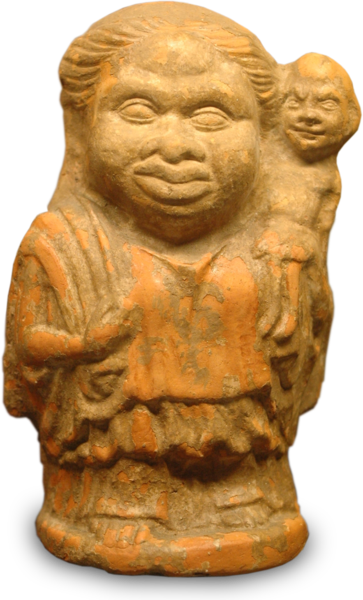 The daktyloi or dactyls are the dwarves of Greece and the Aegean. They are renowned smiths and healing magicians. In some legends, they taught metalworking, mathematics, and the alphabet to humans. The sisters of the dactyls are called hekaterides (singular, hekateris).
- Cretan dactyls are especially adept at healing magic, but they are also known for working in copper and iron.
- Idean (or Phrygian) dactyls may be the oldest tribe of dwarves in the Mediterranean region. They are rustic creatures from around Mount Ida in Phrygia and perhaps have their origin in earlier Hittite or Pelasgian earth-spirits. They claim to have invented the art of metalworking and even to have discovered iron.
- Kabeiroi are an offshoot of the Idean tribe that settled at Lemnos, Samothrace, and Thebes. They are divine craftsmen said to be descended from the god Hephaestus. They have an association with the sea and sailors that is quite unusual for dwarfkind. In some accounts, they are raucous wine-drinkers.
- Rhodian dactyls are dangerous underworld smiths and magicians sometimes called telkhines.
Khnumu
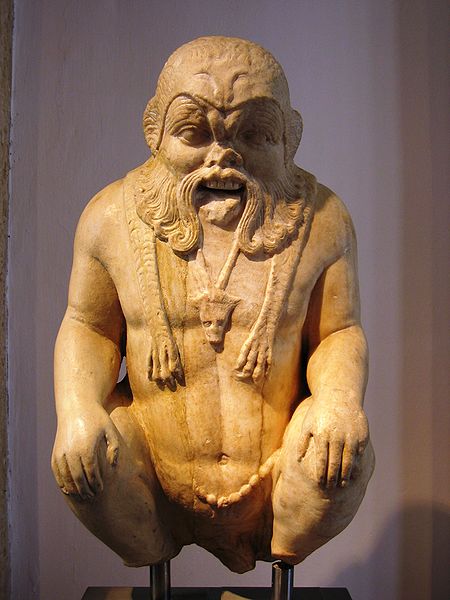
Bes, photo by Wikimedia user Archeologo / GFDL
Dwarves have an esteemed place in Egyptian mythology. Mundane dwarfs or little people apparently suffered little or no prejudice in ancient Egypt. Some gods, most notably Bes, were depicted as dwarfs. These gods were originally protectors of households.
In addition to Bes, there were the khnumu (singular, khnum), subterranean earth-spirits who were helpers of the god Ptah, the creator of the world. Their name means “the modellers.” They are represented with muscular bodies, bent legs, long arms, large broad heads, and intelligent faces. Some wear long mustaches; others have bushy beards. By some accounts, they have the power to reconstruct the decaying bodies of the dead. Other accounts say they were the ones who first taught humans the magical arts.
In later times, khnumu might be called pataikoi (singular, pataikos), “little Ptahs” in Greek. Phoenicians carved images of pataikoi on the prows of their ships. The Greek historian Herodotus compared them to the seafaring kabeiroi.
A similar figure occurs on early Babylonian seal cylinders, where it is given the Sumerian name “the god Nugidda” or “the dwarf.” This figure is sometimes depicted dancing before the goddess Ishtar. It is a matter of speculation whether this Mesopotamian dwarf-figure was the inspiration for the Egyptians and Phoenicians or whether it was the other way around.
Yakshas

Yaksha, photo by Wikimedia user Shakti / GFDL
Yakshas hail from India. They are found in Hindu, Jain, and Buddhist literature. They are a broad class of nature-spirits and caretakers of treasures hidden in the earth and in tree-roots. Their king is Kubera, the god of wealth and protector of the world. He is often depicted as a fat man holding a money-bag and adorned with jewels.
Yakshas function as stewards of the earth and of the wealth buried beneath it. Depending on the story, yakshas may be either benign nature-spirits associated with woods and mountains or foreboding monsters that ambush travelers.
Male yakshas are portrayed either as warriors or as stout, dwarf-like beings. Female yakshas, called yakshis or yakshinis, are often depicted as young, beautiful, and voluptuous.
Like the Egyptian dwarf-god Bes, yakshas are often protector figures. In Thai Buddhism, yakshas often feature in architecture as guardians of temples. These fearsome yakshas are depicted as green-skinned with bulging eyes and fangs. In Thai folklore, yakshas often figure alongside ogres and giants.
In Jainism, yakshas are often propitiated to bring fertility, health, and prosperity.
 Darrell J. Pursiful