
Home » Posts tagged 'J. K. Rowling' (Page 2)
Tag Archives: J. K. Rowling
Rowling Writes to Grieving Teen
This is what a classy celebrity does.
Fifteen-year-old Cassidy Stay lost both parents and four siblings to a gunman in Texas last month. Cassidy was shot in the head and survived the gunshot wound only because she played dead. Authorities have called her survival a miracle.
Cassidy had seen the unimaginable, but was still thinking about happiness. At a memorial for her family, Cassidy gave a speech in front of media saying she believed her family was “in much a better place.”
Quoting the words of Dumbledore, the wise headmaster of Hogwarts, she said “Happiness can be found even in the darkest of times, if one only remembers to turn on the light.”
The same day Cassidy gave her speech, a Facebook page called “We want JK Rowling to meet Cassidy Stay” formed and quickly gained traction.
While the group page acknowledges that Cassidy is not a follower of the page, the creator claims to know a friend of Cassidy’s who “confirmed that JK Rowling did, in fact, write her a personalized letter from ‘Dumbledore’ (hand-written with purple ink). She was also sent a wand, an acceptance letter to Hogwarts with a school supply list, along with the 3rd book with JK’s autograph” the group post said.
May you find peace, Cassidy Shay. God bless.
Sunday Inspiration: Taking Chances
Some failure in life is inevitable. It is impossible to live without failing at something, unless you live so cautiously that you might as well not have lived at all—in which case, you fail by default.
—J. K. Rowling
Ten Latin Spells from Harry Potter
Because you should never pass up the opportunity to learn something!
The magical world of J. K. Rowling is known by millions (if not billions) of children, teens, and adults. Especially those who grew up reading the books and then watched the magic come to life of the silver screen later on. J.K. Rowling created the world of Harry Potter from her vast imagination (and personal experience) and perhaps from other sources. These included Dickens and Tolkien, which she says filled her free time during her college years.
J. K Rowling attended University of Exeter and received her BA in French and Classics. It is evident that she received a degree in Classics, because the Harry Potter series is filled with Latin words and ancient mythology. While the mythological references may be easier to see in character names (i.e Minerva McGonagall as in Minerva the Roman goddess of wisdom); the Latin reference may not be as discernible.
Five Helpful Clans of Little Folk
 Not all faery beings can be imposing sídhe lords and ladies, sinister jinn, or wild, unpredictable satyrs. In world mythology, some of the inhabitants of the Otherworld are humble, unassuming, and even quite helpful to mortals. Today, I’ll highlight five types of little folk that you probably wouldn’t mind dropping by. They are all good with chores and domestic tasks of various sorts, and are usually happy to help mortals out for a modicum of remuneration. (Offerings of food or milk or cream usually does the trick.) All of these beings are all found in Scotland, Ireland, or surrounding regions.
Brùnaidh/Grogan
A brownie is called a brùnaidh in Scots Gaelic and grogan in Irish. These are domestic spirits who attach themselves to a house or family and often perform domestic chores when no one is looking. The house elves of Harry Potter are modeled largely on brownies.
Uruisg/Fenodyree
The uruisg (or urisk) is very much like a brownie, but is set apart by having goat-like hooves. They are called fenodyrees on the Isle of Man. The are said to have a mischievous nature and also tend to be inclined to perform farming or agrarian tasks. They are thus somewhat similar to a pooka.
Kilmouli
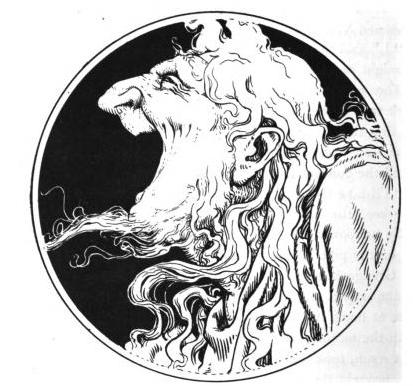
Kilmoulis are faery millers, an ugly form of brownies said to haunt mills. They also hail from the Border counties. They have enormous noses but no mouths, and therefore they have to inhale their food through the nose. Kilmoulis work hard, but also enjoy tricks and pranks.
Gruagach
Gruagachs (the Gaelic plural is technically gruagaichean) are field-folk native to Scotland. Their name literally means “long-haired one.” They love to help mortals with household tasks. Female gruagachs herd and protect cattle, and are also associated with water. They are described as having long blonde hair and wearing a green dress. Sometimes they are said to be attractive; more often, however, they are grotesques hags—although extremely kind-hearted.
Male gruagachs have thick fur, although occasionally they are described as handsome youths dressed in green and red. They commonly work as farm hands shredding and thrashing grain.
Clurichaun
A clurichaun (Irish clobhair-ceann) is thought by some to be a variant form of the leprechaun who goes out to drink after finishing his daily work. They are always drunk. If treated well, a clurichaun will protect a mortal’s wine cellar.
Abracadabra
This is a bit more highbrow than I usually want to get around here, but I’ve recently become aware of a couple of interesting posts about the supposed meaning of Abracadabra.
First, Steve Caruso of The Aramaic Blog sets out to refute the idea that the term is originally Aramaic and means something like “I create as I speak.” This has been the dominant assumption for the past fifty years or so, but Steve sees little to commend it. Along the way, he shades into Harry Potter territory by noting Stephen Jay’s 1977 conjecture that the term “may be from the Aramaic: Avada Kedavra, ‘May the thing be destroyed.'”
Next, Jim Davila of PaleoJudaica writes a brief note to caution us against so quickly dismissing the Aramaic hypothesis:
Technically [Steve] is correct, but I think it’s a little more complicated. Steve acknowledges that the first part of the phrase, “Abra,” could come from the Aramaic word “to create,” although it is badly pronounced (but ancient Greek-speaking magicians were less than rigorous about such things) and that the middle part, “ca” could be a preposition meaning “as” or “like.” The problem is the last part, “dabra” which looks like an Aramaic form (with the emphatic ending “-a”) of the Hebrew (not Aramaic) word davar (דבר), “word” (not “I speak”). As far as I can tell, this Hebraism is not attested in Aramaic, but we should be cautious about this, since the Hebrew root was borrowed into Aramaic, as we see in the word dibbura (דיבורא), “speech, “utterance,” etc., in Rabbinic Aramaic (Jastrow, 295; Sokoloff, Palestinian, 144; Sokoloff, Babylonian, 326). If we allow for the possible similar (and otherwise unattested) borrowing of davar, Abracadabra could be a badly pronounced rendition of “I create according to the word” or the like. It seems entirely plausible to me that an ancient Jewish or Greco-Egyptian magician could have come up with this sort of cool-sounding incantation.
Magicians in the Hellenistic world seem to have frequently adopted words of power from other languages. That is how the Hebrew name for God became mixed up with Greco-Roman magic in a number of different forms and spellings. I think Jim is right that this is at least a plausible explanation for this almost archetypical magic word.
Sunday Inspiration: Friendship
There are some things you can’t share without ending up liking each other, and knocking out a twelve-foot mountain troll is one of them.
—J. K. Rowling
Is the World Ready for a Harry Potter Stage Play?
Looks like it’s coming whether we’re ready or not.
Kindly Elves
The most recent development in elf-lore is to see them neither as tall, powerful, benevolent beings as in Norse mythology, nor as tall, powerful, sinister beings, as in later Germanic folklore, but rather as small, shy beings who are usually quite helpful to humans. Although they may still be mischievous, they are rarely malicious.
Germanic “House Elves”
One early depiction of this sort of elf is in 1812, in the Brothers Grimm fairy tale Die Wichtelmänner, known to English readers as the story of “The Elves and the Shoemaker.” In this story, two tiny naked imps help the shoemaker with his work. When he seeks to reward them with clothing, however, they are so delighted that they run away and are never seen again.
It is debatable whether these Wichtelmänner should be interpreted as elves at all or rather as some other sort of fairy being: kobolds, dwarves, or brownies, for example. The word, itself a diminutive of German Wicht, “wight,” which might better be translated imp or goblin. They seem to have a bit in common with the nisse or tomte of Scandinavia, kindly, diminutive sprites similar to the hobs and brownies of England. At any rate, due to the common translation, they have entered the constellation of images to which English-speakers attach the word “elf.”
Dobby and Company
The depiction of tiny, helpful, industrious elves certainly influenced the house elves of Harry Potter more than either of the previous types. There is even a mythological basis for their aversion to conventional clothing. In English folklore, brownies are a type of sprite that secretly tidy up the house and perhaps do other domestic chores. It is said that they always dress in rags, but are deeply offended if ever anyone offered them more suitable clothing to wear. Do this, the legends say, and they will promptly disappear, never to return.
These domestic sprites are often attached to a particular family. In fact, they are believed by some to be the departed spirits of an ancestor. Such is the case, for example, of the domovoi of Slavic folklore. They may be especially associated with the hearth.
In addition to the nisse and tomte already discussed, other iterations of this sort of “elf” are the Spanish duende, the Irish grogan, the Welsh bwbach. There are also an assortment of faery creatures involved in a number of “working-class” functions: the vazila of Russia takes care of horses; the bodachan buachailleen of the Scottish highlands is a herdsman while his neighbor, the bodachan sabhaill, inhabits the barn; the kilmouli of the Border region is a spinner.
Christmas Elves
Louisa May Alcott first mentioned elves in a Christmas story in 1856. Sadly, the publisher declined to print the story. A year later, however, Harper’s Weekly published an anonymous poem titled “The Wonders of Santa Claus,” which begins:
Beyond the ocean many a mile,
And many a year ago,
There lived a wonderful queer old men [sic]
In a wonderful house of snow;
And every little boy and girl,
As Christmas Eves arrive,
No doubt will be very glad to hear,
The old man is still alive.
In his house upon the top of a hill,
And almost out of sight,
He keeps a great many elves at work,
All working with all their might,
To make a million of pretty things,
Cakes, sugar-plums, and toys,
To fill the stockings, hung up you know
By the little girls and boys.
It would be a capital treat be sure,
A glimpse of his wondrous ‘shop;
But the queer old man when a stranger comes,
Orders every elf to stop;
And the house, and work, and workmen all
Instantly take a twist,
And just you may think you are there,
They are off in a frosty mist.
Thus, Christmas elves appear on the scene only thirty-five years after Clement Moore gave us the “canonical” depiction of Santa Claus himself. The depiction of these beings varies from story to story, but they are almost always shorter than normal humans. By temperament, they are cheerful and jolly—as befits Santa’s helpers. They usually dress in bright, festive colors.
 Darrell J. Pursiful