
Home » Posts tagged 'J. K. Rowling' (Page 3)
Tag Archives: J. K. Rowling
Diagon Alley in Google Maps Street View
No giants on motorcycles to be found, but I think I spotted a Death Eater.
Textual Analysis of Hunger Games, Twilight, and Harry Potter
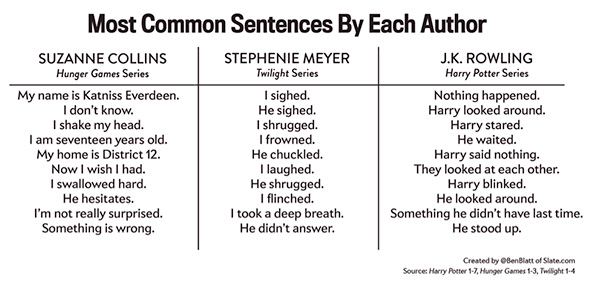 Ben Blatt has applied textual analysis to three wildly popular young-adult book series: Suzanne Collins’ Hunger Games, Stephenie Meyer’s Twilight, and J. K. Rowling’s Harry Potter. Very interesting!
This weekend, millions of preteens will flock to theaters to take in the Hunger Games sequel, Catching Fire, just as millions of preteens flocked to each of the five Twilight movies. For the most part, however, these will not be the same people. Of the tens of millions who identify themselves on Facebook as fans of either of the two series, less than 20 percent are fans of both. Though both series are set in fantasy worlds and feature female leads, readers and moviegoers seem to ally themselves with either Team Stephenie or Team Suzanne, but not both.
Why might a reader take a shine to one series and not the other? The content, of course, differs considerably: Twilight is filled with fantasy romance, Hunger Gameswith fantasy violence. But what about the authors’ approach to writing? Do their word choices, sentence structures, and other elements of their prose differ significantly? Is loving The Hunger Games but not Twilight a matter of style as well as substance?
To answer this question, I could have read all of the books and offered my opinion on the authors’ respective styles. But that’s so unscientific. (Also, who has the time?) Instead, I conducted a comprehensive textual analysis of the best-selling series. And to benchmark the comparison between Meyer and Collins, I decided to throw into the mix another wildly popular young adult series: Harry Potter by J.K. Rowling.
On Child-Proofing Harry Potter
In a word, don’t do it. Peter Damien explains why in a very thoughtful article at BookRiot, where he discusses the very experience I had several years ago reading Harry Potter to my then first/second grade daughter. I must confess, the thought never occurred to me to alter the details of the plot to make them more kid-friendly. What’s the point of reading a story if you’re going to change it?
The most I ever did is the same thing Peter confesses to doing: cleaning up the language every so slightly to tone down the “hells,” “damns,” and whatnot. My daughter is quite aware that people swear. She may even suspect that I swear when she’s not around. I prefer her to think that educated people can make themselves understood without recourse to vulgarity.
Anyway, Peter does an excellent job of highlighting this and other concerns so that parents can reflect on how to read material with their children that may just push their (the parent’s) comfort zones. And his bottom line is so blazingly obvious, it’s a shame he needed to say it: If you as a parent don’t feel comfortable reading something to your child, don’t. But there are benefits to reading stories like this “straight” (at the appropriate time):
My personal preference is, do read it, and do discuss it with your kids. You’re having a remarkable dialog which is itself a habit you want to continue for the rest of your lives. And there is a giddy high you’ll get when you go to discuss the book with your kids and they just get it. They get the plot, the people, they’re building theories. I’ve been tweeting with excitement my oldest son’s attempt to puzzle out the Harry Potter plots along the way, because it’s amazing and fun to watch his mind work, logically figuring things out.
I’ll suggest something else. Reading an early version of Children of Pride with my daughter, I later heard her comment about a particular detail of how my imagined faery world worked that I knew would resonate with things she was going through at the time. I realized that I had managed to give her a little bit of vocabulary with which to talk about things she was feeling. Looking back, I can see how Harry Potter, Percy Jackson, and other fantasy heroes (not to mention their respective villains, sidekicks, and mentors) have also broadened her ability to name and thus to some extent control or at least endure the challenges she faces.
Finally, if I might say so, J. K. Rowling has already done a masterful job of “child-proofing” her own stories. Ron’s language, for example, doesn’t even become an issue until the later books. Themes associated with dating and romance are handled with considerable tenderness and reserve. In my opinion, children who are perhaps a bit younger than Harry and his friends are in any given book should have no problems dealing with what they encounter there.
Plato or Dumbledore?
DISCOVERY: that the addition of “Harry” to almost any Plato quote makes it seem legitimately like a nugget of wisdom out of the mouth of Albus Dumbledore.
“Death is not the worst that can happen to men, Harry.”
“Harry, good actions give strength to ourselves and inspire good actions in others.”
“He who commits injustice is ever made more wretched than he who suffers it, Harry.”
“Harry, how can you prove whether at this moment we are sleeping, and all our thoughts are a dream; or whether we are awake, and talking to one another in the waking state?”
“Harry, astronomy at all events compels the soul to look upwards, and draws it from the things of this world to the other.”
“He was a wise man who invented beer, Harry.”
Sunday Inspiration: Choices
It is our choices, Harry, that show what we truly are, far more than our abilities.
—Albus Dumbledore (via J. K. Rowling)
 Darrell J. Pursiful