
Home » Posts tagged 'J. R. R. Tolkien' (Page 4)
Tag Archives: J. R. R. Tolkien
Five Dwarfish Varieties from Around the World
Properly speaking, dwarves are a feature of Norse mythology. They are a tribe of subterranean smiths and craftsmen noted for their arcane knowledge and especially their skill in fashioning powerful magical items.
But these aren’t the only wise and secretive earth-spirits in world mythology, although they are probably the most frequently encountered in fantasy fiction. Here is a list of five fantastic beings that combine (in various proportions) affinities for (1) the underground world, including associations with mining, metals, and precious stones and (2) secret skills or knowledge—craftsmanship, magic, the healing arts, etc.—which they may or may not share with mortals.
Dvergar

Alberich the dwarf and the Nibelungs
Let’s proceed roughly from the north and west to the south and east. We begin, therefore, with the dwarves of Scandinavia and their cousins in other Germanic cultures. The dwarves of northern England’s Simonside Hills, for example, are of this sort. These dwarves formed the basis for J. R. R. Tolkien’s depiction of dwarves. In fact, the dwarves in The Hobbit all have names drawn from Norse mythology. They are also seen in characters such as Alberich the dwarf in the Middle High German Nibelungenlied. As already stated, these dwarves are renowned metalworkers and blacksmiths. In Norse mythology, they fashioned many of the magical items used by gods and heroes, including Thor’s magic hammer Mjölnir and the chain that bound the great wolf Fenrir. In some later legends, they are also accomplished healers. They can, however, be highly distrusting of outsiders. They also have a reputation for being greedy.
Dvergar are ill-tempered, greedy, miserly, and grudging. They are known to curse objects they are forced to make or that are stolen from them. They almost never willingly teach their magical knowledge. At the same time, they can be surprisingly friendly and loyal to those who treat them kindly. Contrary to popular misconceptions, dvergar are not particularly illustrious warriors—although their strength and overall hardiness suggest they would generally be able to hold their own in a fight.
Like trolls, Norse dwarves are sometimes depicted as turning to stone if exposed to direct sunlight.
Karliki

Wrocław Krasnal, photo by Wikimedia user Puchatech K. / GFDL
Karliki (singular, karlik) are fiendish dwarves from eastern Europe, inhabitants of the lowest recesses of the underground world. In Polish, the appropriate terms are krasnal, karzeł, or karzełek, although they are sometimes called Skarbnik, “the Treasurer.” These beings are very similar to dvergar, living in mines and guarding hoards of metals, gems, and crystals. Apparently they are even more prone to malicious behavior than their Nordic cousins. According to Slavic Christian folk beliefs, these beings are, in fact demonic. One source relates, “When Satan and all his hosts were expelled from heaven, says a popular legenda, some of the exiled spirits fell into the lowest recesses of the underground world, where they remain in the shape of Karliki or dwarfs” (see Ralston, The Songs of the Russian People, 106–107).
Karliki can be helpful toward miners, willing to lead them to rich veins of ore and protect them from danger. To those who offend them, however, they can be deadly, sending tunnels crashing down upon them or pushing them into dark chasms.
Dactyls
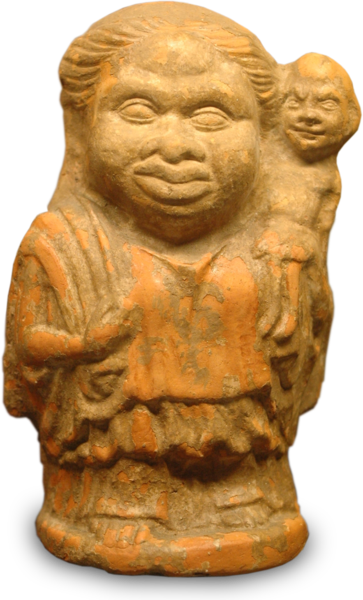 The daktyloi or dactyls are the dwarves of Greece and the Aegean. They are renowned smiths and healing magicians. In some legends, they taught metalworking, mathematics, and the alphabet to humans. The sisters of the dactyls are called hekaterides (singular, hekateris).
- Cretan dactyls are especially adept at healing magic, but they are also known for working in copper and iron.
- Idean (or Phrygian) dactyls may be the oldest tribe of dwarves in the Mediterranean region. They are rustic creatures from around Mount Ida in Phrygia and perhaps have their origin in earlier Hittite or Pelasgian earth-spirits. They claim to have invented the art of metalworking and even to have discovered iron.
- Kabeiroi are an offshoot of the Idean tribe that settled at Lemnos, Samothrace, and Thebes. They are divine craftsmen said to be descended from the god Hephaestus. They have an association with the sea and sailors that is quite unusual for dwarfkind. In some accounts, they are raucous wine-drinkers.
- Rhodian dactyls are dangerous underworld smiths and magicians sometimes called telkhines.
Khnumu
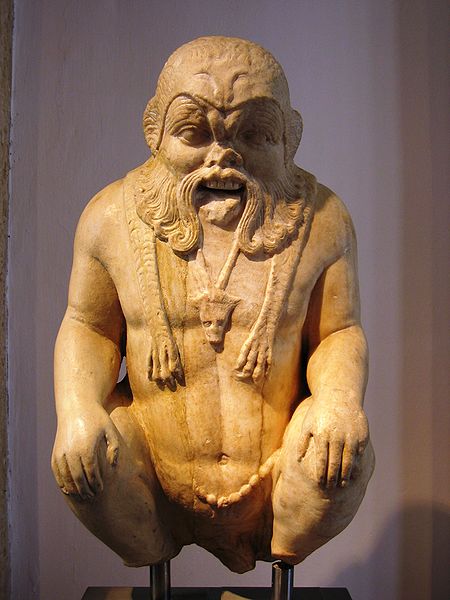
Bes, photo by Wikimedia user Archeologo / GFDL
Dwarves have an esteemed place in Egyptian mythology. Mundane dwarfs or little people apparently suffered little or no prejudice in ancient Egypt. Some gods, most notably Bes, were depicted as dwarfs. These gods were originally protectors of households.
In addition to Bes, there were the khnumu (singular, khnum), subterranean earth-spirits who were helpers of the god Ptah, the creator of the world. Their name means “the modellers.” They are represented with muscular bodies, bent legs, long arms, large broad heads, and intelligent faces. Some wear long mustaches; others have bushy beards. By some accounts, they have the power to reconstruct the decaying bodies of the dead. Other accounts say they were the ones who first taught humans the magical arts.
In later times, khnumu might be called pataikoi (singular, pataikos), “little Ptahs” in Greek. Phoenicians carved images of pataikoi on the prows of their ships. The Greek historian Herodotus compared them to the seafaring kabeiroi.
A similar figure occurs on early Babylonian seal cylinders, where it is given the Sumerian name “the god Nugidda” or “the dwarf.” This figure is sometimes depicted dancing before the goddess Ishtar. It is a matter of speculation whether this Mesopotamian dwarf-figure was the inspiration for the Egyptians and Phoenicians or whether it was the other way around.
Yakshas

Yaksha, photo by Wikimedia user Shakti / GFDL
Yakshas hail from India. They are found in Hindu, Jain, and Buddhist literature. They are a broad class of nature-spirits and caretakers of treasures hidden in the earth and in tree-roots. Their king is Kubera, the god of wealth and protector of the world. He is often depicted as a fat man holding a money-bag and adorned with jewels.
Yakshas function as stewards of the earth and of the wealth buried beneath it. Depending on the story, yakshas may be either benign nature-spirits associated with woods and mountains or foreboding monsters that ambush travelers.
Male yakshas are portrayed either as warriors or as stout, dwarf-like beings. Female yakshas, called yakshis or yakshinis, are often depicted as young, beautiful, and voluptuous.
Like the Egyptian dwarf-god Bes, yakshas are often protector figures. In Thai Buddhism, yakshas often feature in architecture as guardians of temples. These fearsome yakshas are depicted as green-skinned with bulging eyes and fangs. In Thai folklore, yakshas often figure alongside ogres and giants.
In Jainism, yakshas are often propitiated to bring fertility, health, and prosperity.
Steff Humm’s Desolation of Smaug Review
Steff Humm at Fantasy Faction has offered a thoughtful review of The Hobbit: The Desolation of Smaug.
The Simonside Dwarves
The Fairytale Traveler gives us the run-down on the dwarves of England’s Simonside Hills. There have been legends—strongly influenced by Norse mythology, apparently—of nocturnal, not-very-nice dwarves in this northern part of England since at least the thirteenth century, and some believe they played a role in Tolkien’s depiction of the wicked dwarves of the Iron Hills.
The Evolution of Fantasy Fiction
Leo Elijah Cristea has traced the roots of fantasy fiction, the “Grandfathers of Fantasy” as he calls them, in a brilliant essay at Fantasy Faction. In a single post, he gathers up everything from mythology to faery tales to Poe and Lovecraft and Tolkien and Eddings, showing how they all relate to one another in a vast fantastical “tree of life.” One of my favorite sections:
The ancestor of fantasy is mythology; fantasy’s great-uncle, thrice-removed, is the art of faerie tale; but fantasy’s true grandparents are the fantasists who crafted dreams, speculative realities, and visions of distant worlds, whether by means of the gothic, the early fantastic, or uncanny commentary on the future. Fantasy’s grandparents are far, far older than Tolkien, Eddings, Brooks, or Martin.
Due to our unswervingly human need to label, there are more subgenres of fantasy than you could shake a whole forest of ancient oaken sticks at. Helpfully, our predecessors were quite happy to call anything that didn’t mimic whole reality, fantasy. They were right, too. Anything that doesn’t fit into the neat little frame, within which the finite possibilities of our world sit, is left out, branded fantasy. Of course (and this won’t be the first time I’ve flirted with the admission of stating that I believe in what should probably not be believed in) the small grey areas outside of this accepted, built and well-maintained frame are what fuel a fantasist’s speculation—or at least, that’s how it used to be.
Imagine living and writing in the times of Mary Shelley, or Poe, or John Polidori and his Vampyre, imagine not having all the facts staring at you, and imagine not seeing the world broadcast at you on the news every day. Imagine the itch to write, to learn, to dream, to explore—to speculate.
This is where fantasy proper first appeared.
It’s well worth the time to read it all.
Tolkien’s Birthday
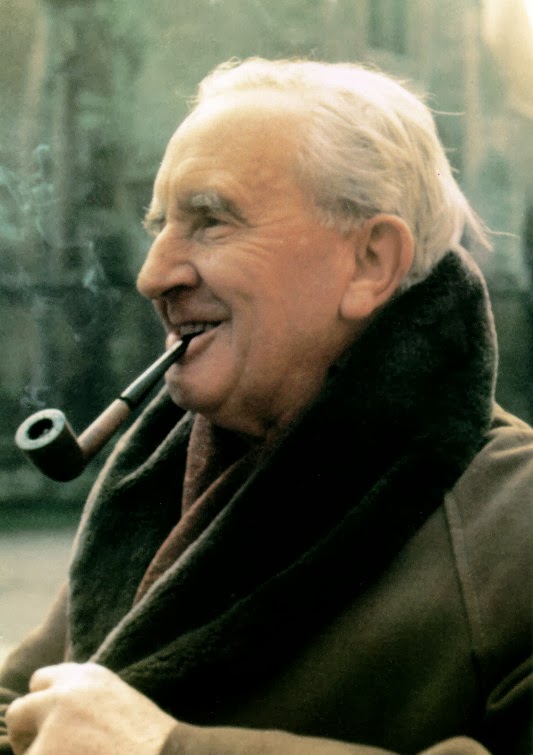
J. R. R. Tolkien was born on this date in 1892. Happy birthday, Tollers!
Tolkien Geek’s Review of The Hobbit: The Desolation of Smaug
Gary, the Tolkien Geek, gives the latest installment of Peter Jackson’s film adaptation of The Hobbit a very positive review.
The Darkling Diet?
I’ll admit, this article about goblins, trolls, and vitamin D deficiency has got me thinking. I really like it when fantasy fiction interacts with modern scientific knowledge, like when Harry Dresden comments about the law of conservation of energy and how it can effect the spell he is trying to cast. I even wrote a scene into Children of Pride that discusses the implications of the square-cube law to size-shifting faeries. I’m also kind of a fan of Food Network, so what follows might have been predicted.
In short, I’m wondering what sunlight-avoiding humanoids might eat on a regular basis.
Now, “sunlight-avoiding humanoids” (let’s call them “heliophobes”) is a pretty big, broad category. Many cultures have legends about creatures that live underground, only come out at night, or are in some way harmed by exposure to direct sunlight. For my purposes, I’ll eliminate vampires from consideration, as we all know what they’re having for dinner!
Let me, then, consider one small slice of the heliophobe population: the dwarves and trolls of Norse mythology. Both of these classes of beings are averse to sunlight. Various legends claim that both of them are turned to stone by the sun’s rays. Whether this is permanent or temporary—or whether this affects all members of these classes or only an unlucky few—are interesting questions, but not entirely relevant.
By narrowing my focus, maybe I can make some educated guesses about what the well-fed Scandinavian heliophobe is having for dinner. I expect it will be (1) some variation of a traditional Viking or later Scandinavian cuisine that is (2) altered where possible to provide increased consumption of foods rich in vitamin D.
So, what might a health-conscious Scandinavian denizen of the dark be eating? Here are a few suggestions.
1. Fish, and lots of it. Freshwater salmon would be readily accessible through night-time fishing expeditions in mountain streams and lakes, and it is a vitamin D goldmine with over twice the recommended daily dose in a 100g (~3.5-ounce) serving—assuming dwarves and trolls have the same nutritional needs as humans. Typically, raw fish contains more vitamin D than cooked, and fatty cuts more than lean cuts. I would imagine that salmon appears on the average troll’s menu nearly as often as chicken appears on the menu for North Americans.
Other freshwater fish would also be available, but most of the other oily fishes that are such a great source of vitamin D are ocean-going species like herring, mackerel, and tuna. I’m not sure trolls or dwarves are the deep-sea fishing types, but who knows? And of course, there may be underground lakes and streams in which light-averse creatures might fish. Gollum seemed to do all right in that regard.
Furthermore, our heliophobes are not likely to let any protein go to waste. Whatever is not consumed immediately would likely be preserved via drying, smoking, or pickling in salt water. Dried “stockfish” (the ancestor of lutefisk) is rock-hard, but can be pounded to break up the fibers and then served with butter. Pickled herring might be a delicacy if these heliophobes have access to the sea.
UPDATE: Wild-caught salmon, sardines, and herring are also an excellent source of DHA, the fatty acid that is a crucial component of the retina’s photoreceptors. They thus contribute to improved night vision.
2. Other proteins. It isn’t difficult to imagine trolls as nocturnal hunters, and some stories even describe them keeping livestock the way humans do. A health-conscious heliophobe will likely consider wild boar an especially valuable quarry. A 100g (3.5) ounce serving of pork ribs contains about 16% of the daily recommended value of vitamin D, although other cuts vary considerably. There is hardly any vitamin D in ham, for example. If pork isn’t their thing, beef liver is about half as rich in vitamin D as pork ribs. Venison of all types (red deer, elk, etc.) would also be a likely protein, though not a significant vitamin D source.
Trolls and dwarves might prepare sausages made with pork, beef liver, or other proteins mixed with herbs and spices. If they have access to grains (see below), they might bake their meat into meat pies or even serve it on an open-faced sandwich. The most common preparation for meat among the Vikings, however, was simply to boil it in a pot.
If folklore is to be believed, at least some of these creatures supplement their protein needs with human captives and/or each other.
3. Dairy products. If heliophobes either raise their own cattle or raid the cattle of their human neighbors, the milk may be more precious to them than the meat. A quarter-liter (~1 cup) of grass-fed cow’s milk contains nearly 40% of the daily recommended amount of vitamin D. I haven’t been able to track down the vitamin D content of reindeer milk, but it is definitely worth considering for inhabitants of northern Scandinavia!
Milk might be consumed raw, but would more likely be processed in various ways, creating other dairy foods that would last longer. Scandinavian heliophobes would certainly use butter as their primary cooking fat. Curds and cheese would likely be prominent in their diet. They might drink buttermilk or whey (which can also be used as a preservative to pickle meats). They might even let the whey ferment until it becomes blaand, a beverage similar to wine in alcohol content. Finally, they might enjoy a bit of skyr, similar to strained yoghurt, as a treat.
4. Mushrooms and such. This one should really go without saying, as it is probably the food most famous for growing without sunlight. Some species, such as the white bottom and the shiitake, are excellent sources of vitamin D. Scandinavian heliophobes might also gather other cave-dwelling organisms like cave-dwelling snails, salamanders, and insects.
5. Cereals. Like the Inuit and other human populations from the far north, cereals are not likely to form a significant part of a heliophobe’s diet. Unless we assume dwarves and trolls maintain above-ground farms, such items will have to be acquired through trade with others. This would also include products made from cereals such as ale made from barley.
6. Fruits and vegetables. Once again, we probably have to assume trade with others to account for many fruits and vegetables in a dwarfish or trollish diet. But there is no reason these beings couldn’t forage for wild plants at night. Wild apples and berries of many sorts could be found in abundance and dried for storage. Wild leeks, onions, and radishes might be prized as seasonings for otherwise bland foods. Wild cabbage, carrots, or turnips would likely be common fare.
UPDATE: Fennel and bilberries both contribute to enhanced night vision.
7. Other ingredients. Trade with non-heliophobic populations would likely be necessary for items beyond those mentioned above. Eggs, another good source of vitamin D, would be high on this list (unless we assume trolls and dwarves keep their own livestock). Unless these heliophobes have access to the sea, oysters would also be a desirable commodity.
UPDATE: Not only are they high in vitamin D, oysters and other shellfish are high in zinc, which works in concert with vitamin A to enhance night vision. (Dark chocolate is also high in zinc, though obviously not part of a traditional Norse diet.)
Dwarves and trolls would also likely trade for herbs and spices with which to season their food: garlic, dill, coriander, poppyseed, horseradish, etc., and even more exotic (from a Viking point of view) ingredients such as ginger, cinnamon, and bay leaves.
I can imagine a number of dietary scenarios for the heliophobes of Scandinavian folklore based on such factors as (1) the severity of their sunlight-aversion, (2) their access to seafaring technology, (3) the nature of their relations with non-heliophobes. One could definitely conceive of these creatures as malnourished, at best barely surviving in a food-poor environment. With the right set of circumstances, however, they might eat very well indeed in their underground domains.
Do the Forces of Evil Suffer from Vitamin D Deficiency?
I still don’t quite know what to think about this report from Marc Alpin at Fantasy Faction: “Medical Science Reveals Why Gollum & Smaug Lost to Hobbits.” Yes, apparently an article has been published in the Medical Journal of Australia contending that one of the reasons the good guys win in Middle Earth is because of the bad guy’s poor diet and lack of sunlight. According to the abstract,
Objective: Vitamin D has been proposed to have beneficial effects in a wide range of contexts. We investigate the hypothesis that vitamin D deficiency, caused by both aversion to sunlight and unwholesome diet, could also be a significant contributor to the triumph of good over evil in fantasy literature.
Design: Data on the dietary habits, moral attributes and martial prowess of various inhabitants of Middle Earth were systematically extracted from J R R Tolkien’s novel The hobbit.
Main outcome measures: Goodness and victoriousness of characters were scored with binary scales, and dietary intake and habitual sun exposure were used to calculate a vitamin D score (range, 0–4).
Results: The vitamin D score was significantly higher among the good and victorious characters (mean, 3.4; SD, 0.5) than the evil and defeated ones (mean, 0.2; SD, 0.4; P < 0.001).
Conclusion: Further work is needed to see if these pilot results can be extrapolated to other fantastic situations and whether randomised intervention trials need to be imagined.
Hobbits Have a Kentucky Connection
Apparently, J. R. R. Tolkien was somewhat taken with the Bluegrass, as Alan Cornett of Pinstripe Pulpit reveals:
But it was a chance encounter [Tolkien scholar Guy] Davenport had in Shelbyville, Kentucky with a former classmate of Tolkien—a history teacher named Allen Barnett—that changed Davenport’s perspective about his former professor’s clever tales. To Davenport’s amazement, Barnett had no idea that Tolkien had turned into a writer, and had never read any of the adventures of Middle Earth.
“Imagine that! You know, he used to have the most extraordinary interest in the people here in Kentucky. He could never get enough of my tales of Kentucky folk. He used to make me repeat family names like Barefoot and Boffin and Baggins and good country names like that,” Barnett told Davenport.
“And out the window I could see tobacco barns,” Davenport writes. “The charming anachronism of the Hobbits’ pipes suddenly made sense in a new way….Practically all the names of Tolkien’s hobbits are listed in my Lexington phonebook, and those that aren’t can be found over in Shelbyville. Like as not, they grow and cure pipe-weed for a living.”
Pretty cool.
Tolkien’s Myth-Making
Dan Berger has produced a wonderful and provocative article at Mythic Scribes titled “J. R. R. Tolkien: Myths that Never Were and the Worlds that They Became.” He explores Tolkien’s motivation for writing The Lord of the Rings and The Silmarillion and why he first wanted them to be published together as a set. It all had to do with what he perceived as a mythological deficit the English suffered when compared to the other great cultures of Europe. Tolkien wrote,
I was from early days grieved by the poverty of my own beloved country: it had no stories of its own (bound up with its tongue and soil), not of the quality that I sought, and found (as an ingredient) in legends of other lands. There was Greek, and Celtic, and Romance, Germanic, Scandinavian, and Finnish (which greatly affected me); but nothing in English, save the impoverished chap-book stuff. Of course there was and is all the Arthurian world, but powerful as it is, it is imperfectly naturalized, associated with the soil of Britain but not with English; and does not replace what I felt to be missing (Carpenter, Humphery. The Letters of J.R.R. Tolkien, p. 144 Houghton Mifflin, 1981).
This thought got Berger to thinking about mythology for Americans, who if anything are in an even poorer state with respect to our myths. He then goes on to explore some possible mythic themes that might resonate with Americans and even fleshes out how these themes might be developed in a fantasy setting. It’s all quite interesting, and well worth the read.
 Darrell J. Pursiful