
Home » Posts tagged 'Little Folk'
Tag Archives: Little Folk
Fantasy Kindreds of Saynim: Ell Folk
Ell folk are next in my survey of the fantasy kindreds of Saynim.
ELLING (Homo neanderthalensis parvus)
 You know what kind of creatures I’m talking about. You’ve seen them in popular culture since forever. These beings are represented by Old World brownies, nisse, and other domestic sprites as well as tiny but magically powerful “little people” of Native American lore.
But what do you call them? The easy answer would be to simply call them “little people”: a term often used especially for the North American branches of this family. But in the real world, “little people” can also refer to humans with certain genetic conditions that make them unusually short. The term is not a slur, but it can be confusing even so. There are plenty of terms that describe the little folk of a particular culture: brownies, duendes, kwanokasha, leprechauns, oogweshia, tomte, yunwi tsunsdi, yumboes, etc. But I needed a collective term that crossed cultural boundaries.
The ancient Greeks spoke of pygmies. Of course, this is also a highly problematic term, but it got me thinking. “Pygmy” comes from pygme, the Greek word for “cubit,” and members of this wondrous tribe were said to stand only about one cubit tall: about 18 inches. (Other groups were said to be three spans tall or about 27 inches.) I wondered if there was a unit of measurement that could become the basis for a made-up collective term for all of these various beings.
As it turns out, the ell is just such a unit, and it has the added benefit of being a bit ambiguous. Originally, an ell was the length of an adult male forearm, or anywhere from 18 to 24 inches, roughly the same as a cubit, so very fitting as a workaround to avoid using the word pygmy while keeping the connotation of “a person who is as tall as this particular unit of measure.” But in later times, a longer ell came into use. A Flemish ell is 27 inches long. A Scottish ell is 37 inches. and an English ell is 45. All of these fit nicely with the sizes that are usually reported of these sorts of tiny humanoids. Finally, “ell” is reminiscent of ellyll, a Welsh fairy being that is smaller than the tylwyth teg (the Welsh version of what I’m calling “elves”).
Ell folk (or ellings) are a dwarf subspecies (in the biological sense of the word) derived from Homo neanderthalensis. They are literally dwarf dwarves. Biologically, there are two ways a dwarf species can evolve. The first is to shorten the length of pregnancy and infancy. A second path is for the length of pregnancy to stay the same but slow down the growth of the fetus. This second path results in smaller brain size and tooth size. For my ell folk, the first path seemed best, as mythology certainly makes them no slouches in the intellect department. They’re usually about a Scottish ell tall, but there is a fair bit of variation in different populations. They don’t possess the brute strength of dwarves and trolls, but they are small enough to crawl through small or constricted passages.
As a rule, ell folk are hardworking and earnest. Most are content to farm the land or work as woodsmen, stonemasons, or in other professions. They are also often mischievous pranksters, however, especially against those who are lazy or negligent in their chores.
Wondrous Tribes: Pygmies
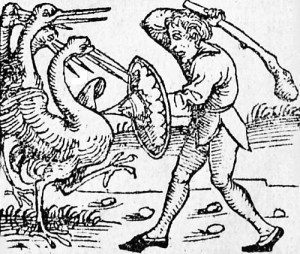 Pygmies were originally a tribe of very small humans.They were located at the southernmost reaches of the world, either in (you guessed it!) Ethiopia or India.
Their name comes from pygme, the Greek word for “cubit,” and they were said to stand only about one cubit tall, or about eighteen inches. Ctesias speaks of “three-span” pygmies (trispithamoi) who stand twenty-seven inches tall. Flavius Philostratus reports pygmies in India who live underground—which would make them both pygmies and troglodytes: perhaps a subject for another time!
Anthropologists define pygmies as any human population where the average adult male height is less than 4′ 11″. The term has been especially applied to certain peoples of central Africa, who may in fact have been the ultimate inspiration behind Greek mythological pygmies. Even so, calling these people “pygmies” is problematic if not outright offensive. To be on the safe side, kindly refer to them instead by their ethnic names: Twa, Efe, Mbuti, etc.
The mythological pygmies fought an endless war against flocks of migrating cranes in a story that goes back at least to Homer. Their battles against the cranes was a popular scene in classical art. They were often depicted as pudgy, comical figures.
Pygmies also made the jump from the Old World to the New, at least in the minds of European explorers. On his second voyage (1535–36), Jacques Cartier apparently met Donnacona, “King of Canada” (actually, a village at the present site of Québec City), who informed him that there were pygmies (“picquemyans”) in that region. There’s no telling what Donnacona actually said or whether Cartier interpreted it in culturally familiar terms that may not have done justice to what the king intended to say. At any rate, no doubt owing to this tidbit of information, Pierre Descelier’s world map of 1550 depicted pygmies in North America—battling cranes just as in the ancient myths!
There is an earlier reference to pygmies in North America, but it’s a bit more ambiguous. On Mercator’s world map of 1569, we find this note in the Arctic region: “Here live the Pygmies, at most 4 feet tall, like unto those they call Skraelings in Greenland.” At four feet, these “pygmies” are giants compared to the pygmies of the classical world!
Skraelingjar is the Old Norse word for indigenous people the Norse encountered when they began to settle Greenland and Vinland (aka Newfoundland). Mercator understood that this term translates—culturally if not etymologically—as “pygmies.” An even earlier map, Olaus Magnus’s Carta Marina (1539), depicts a Norseman and a very short adversary facing off with spears in southern Greenland. Olaus writes,
The little dwarf fearlessly attacks his bigger opponent and triumphs in victory, for at every opportunity he assaults taller men with no less courage than if he could boast a giant’s might and so have the upper hand.
Mercator apparently received his information from a fourteenth-century source, an unnamed friar who wrote a travelogue titled Inventio fortunata (“The Fortunate Discovery”) in the 1360s. This friar learned of “skraelings” (skraelingjar) in Greenland from Norwegian churchman Ívar Bárdarson. But which came first? Did the Norse call these people skraelingjar because that was already their word for “unusually short human,” or did a Norse cleric, conversing (no doubt in Latin) with a foreign colleague, land upon pygmaeus as the closest suitable translation of skraelingr?
In fact, the actual meaning of “skraeling” is up for debate. Some say it comes from an Old Norse word for skin and refers to the animal skins the native inhabitants of Greenland wore. Others say that, whatever the original meaning, the word is used in medieval Norse literature as a pejorative term implying small stature.
Finally, I should mention that the faery folk of many North American peoples are conceived of as tiny “little people,” often no more than two feet tall. Some older works even translate the various native terms as “dwarves” or “pygmies.” These, however, are creatures of a much more magical nature than the “picquemyans” of Cartier or the “skraelings” of the Norse: changing shape, becoming invisible, effecting magical cures, etc.
Some of these little folk are dangerous—though by and large you’re probably safer with the average Native American faery being than you are with the daoine sídhe or most European elves. The more “mundane” pygmies are probably easier to get along with if you show them due respect.
A Field Guide to Mythological Humanoids
In order to avoid having loads and loads of races in the Into the Wonder series, I’ve devised the following system to evaluate and categorize the entities found in various world mythologies. Mind you, this system won’t work in every fictional universe, so caveat lector!
Contrasted with a run-of-the-mill, plain vanilla human…
- Does this humanoid display vast magical powers?
It’s probably a fae (sídhe, elf, jinni, nunnehi, etc.)
Is it unusually good-looking?
Definitely a fae! - Is this humanoid secretive and crafty?
It’s probably a dwarf (dvergr, dactyl, etc.).
Does it live underground?
Definitely a dwarf! - Is this humanoid unusually short?
It’s probably one of the little people (brownie, kobold, yunwi tsunsdi, etc.).
Does it try to play tricks on you?
Could be a little person if the tricks aren’t too mean.
Does it try to clean your house or do your chores?
Definitely a little person! - Is this humanoid unusually tall?
It’s probably a giant (slant-eye, stonecoat, ispolini, etc.).
No other distinctive features like powerful magic or a taste for human flesh?
Definitely a giant! - Does this humanoid want to eat you?
It’s probably an ogre (Laestrygonian, zimwi, water cannibal, etc.).
But it’s no bigger than an ordinary human!
Doesn’t matter, it’s probably an ogre! - Does this humanoid want to scare you?
It’s probably a bogeyman (boggart, hey-hey man, nalusa falaya, etc.).
There’s no such thing as a bogeyman.
Tell that to him! - Is this humanoid just plain weird?
It’s probably a troll (jaettertroll, fomor, stallos, etc).
But I thought trolls were…
You thought wrong. Trolls are just plain weird.
 Darrell J. Pursiful