
Home » Posts tagged 'Wales'
Tag Archives: Wales
Bendith y Mamau: Ugly Welsh Faeries
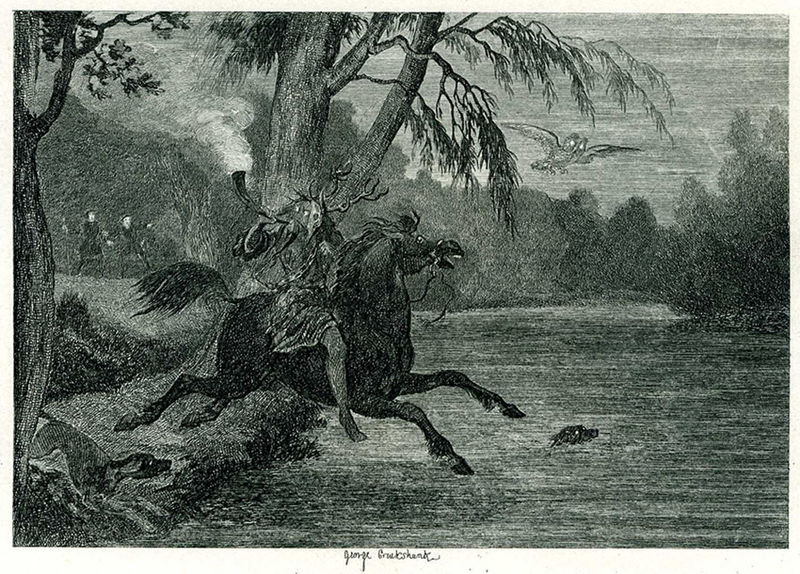
George Cruikshank, Herne the Hunter, 1840s
In Glamorganshire and Carmarthenshire, Wales, bendith y mamau (“mothers’ blessing”; roughly pronounced ben-dith uh mah-may) is a generic term for all faeries. The other Welsh term for faeries is tylwyth teg (“fair family” or “fair folk”). Some see these two terms as synonymous.
As in many faery legends, it was thought best to refer to the bendith y mamau with a flattering euphemism. In fact, there little that is “motherly” or “blessed” about these creatures. More often than not, they are, in fact, malicious and destructive in their dealings with mortals.
According to some accounts, these creatures are a grotesque cross-breed of goblin and faery. They possess the glamour or illusion-magic of faeries but the stunted and ugly appearance of goblins. Some say they have an affinity with either brownies or the pisgies (pixies) of the West Country.
The bendith y mamau are known to kidnap mortal children and replace them with their own hideous offspring, called crimbils. Stories suggest, however, that these mortal children might be returned many years later with only the faintest memory of their time among the Fair Folk. Bendith y mamau can be envious creatures, particularly of another’s beauty. They generally treat their captives well, however.
These faeries are also associated with Welsh underworld hounds. These beasts, usually called cwn annwn (“hounds of the underworld”) are sometimes also known as cwn bendith y mamau or simply cwn mamau. The appearance of these spectral dogs is thought to be an omen of death. They are also associated with the Wild Hunt.
Despite these unseemly characteristics, these faeries are also often skilled musicians and singers. Their music is capable of producing a trance-like reverie that erases a person’s memory, leaving them with only a faint recollection of the sweet music itself.
On the Trail of King Arthur in South Wales
A recent post at the Celtic Myth Podshow highlights stories of King Arthur from Blaenau Gwent in South Wales.
The Arthur of medieval Welsh literature – be it in Welsh or in Latin – is the archetypal Celtic hero – a rough, vigorous, splendidly barbarian figure fighting boars and serpents, witches, dog-headed warriors and other dreaded enemies. He is often seen in conflict with the Church, and echoes the values and life-style of the Heroic society of the “Dark Ages”. We can forget the Round Table, damsels in distress, tournaments and the glittering Christian emperor until much later… The Latin Historia Brittionum (“History of the Britons”) – conventionally attributed to Nennius (1)– was originally composed c. 829/30 A.D. (2) and attached to it are a series of Mirabilia or “Wonders”: There is another wonder in the country called Ergyng. There is a tomb there by a spring, called Llygad Amr; the name of the man who is buried in the tomb is Amr. He was a son of the warrior Arthur, and he killed him there and buried him. Men come to measure the tomb, and it is sometimes six feet long, sometimes nine, sometimes twelve, sometimes fifteen. At whatever measure you measure it on one occasion, you never find it again of the same measure, and I have tried it myself. (3)
Several legends are then summarized. Very interesting!
 Darrell J. Pursiful