
Home » Mythology (Page 5)
Category Archives: Mythology
Speaking of Mermaids
Gillian Finklea of mental_floss brings us the lowdown on nine mermaid legends from around the world:
Not all mermaids are the shimmering versions of femininity often seen in pop culture. In fact, those mermaids—which seem to be a combination of the Melusine and Greek mythology—barely skim the surface of this fish-human legend. Many countries and culture have their own versions of mermaids, from a snake water goddess to a fish with a monkey mouth. Some are benevolent, some ambivalent, and many are openly hostile to the poor humans who cross their paths.
Merrows: Irish Mermaids
Ruthie from the Celtic Myth Podshow introduces us to these underwater faeries.
The word merrow or moruadh comes from the Irish muir (meaning sea) and oigh (meaning maid) and refers specifically to the female of the species. Mermen – the merrows male counterparts – have been rarely seen. They have been described as exceptionally ugly and scaled, with pig-like features and long, pointed teeth. Merrows themselves are extremely beautiful and are promiscuous in their relations with mortals.
The Irish merrow differs physically from humans in that her feet are flatter than those of a mortal and her hands have a thin webbing between the fingers. It should not be assumed that merrows are kindly and well-disposed towards mortals. As members of the sidhe, or Irish fairy world, the inhabitants of Tir fo Thoinn (the Land beneath the Waves) have a natural antipathy towards humans. In some parts of Ireland, they are regarded as messengers of doom and death.
Ruthie goes on to equate merrows with selkies, women who take on the form of seals by wearing a magical seal skin. To my mind, these are separate creatures, though it is certainly true that legends tend to be fluid over time and distance. There are certainly points of overlap between them.
The Sídhe in Fantasy
Excellent post today from Leo Elijah Cristea about the nobles of the Gaelic supernatural realm, the sídhe.
If you’re not convinced you’re about to see the fae make a slow and distinguished comeback, think about elves: everyone said they were dead. Well, the elf is dead; long live the elf. I raise you Dwenda, Shict, and Chris Evans’ revamped “Iron Elves”. If we really want to split hairs, I raise you the elves from the Dragon Age games, where the once-regal race has been given a bit of a different approach.
But, we’re not here to talk about elves: we’re here to talk about my other love. Yes, I happen to love fae. The potential with fae is nearly infinite: such an underdone, unsung, untouched race, one brimming with potential and plenty of fresh ground to dig your heels into.
Of course, the daoine sídhe figure quite prominently in my Into the Wonder Series (Book 1, Book 2, Book 3), which you are of course at liberty to check out for yourselves. 🙂
The Yule Lads
Iceland’s Yule Lads get the VIP treatment in an excellent article over at Atlas Obscura introducing a new book on the subject:
Not every beloved holiday tradition escapes its native land. “Unless you are lucky enough to have been born an Icelander, or have lived in Iceland through a Christmas season, you probably won’t have heard of the Yule Lads,” reads The 13 Yule Lads of Iceland, a children’s book by Brian Plinkington, presumably for non-Icelandic kids to learn about the holiday myth.
Here’s something I wrote about the Yule Lads, complete with a video.
Trows
The Faery Folklorist has posted a wonderful introduction to the trows of the Orkney and Shetland Islands. In case you’re not quite up to speed on your trow-lore, the article begins,
According to Saxby and Edmondston’s ‘Home of a Naturalist’ (1888), “This interesting race of supernatural beings is closely allied to the Scandinavian Trolls, but has some very distinctive characteristics of its own. The Trow is not such a mischief-making sprite as the Troll, is more human-like in some respects, and his nature seems cast in a morbid, melancholy mould.”
From there, the article discusses what trows look like, where they live, and the sorts of things they do. There is even a brief but delightful list of trow names culled from Orkney and Shetland folklore.
Ancient Roman Ghosts: The Least You Need to Know
With Halloween coming up, I thought I’d do a few posts this months on ghosts. Let’s kick things off with the ghosts you’d have been likely to meet in ancient Rome. All of these are the same type of being, namely, the spirits of departed humans. They can be differentiated from one another based on how a person relates to them or possibly the mood they’re in.
Manes
Let’s start with the manes, whose name literally means “the good ones.” This is a pretty generic term for the dead when thought of collectively: those who have gone on to the afterlife. They are always spoken of in the plural.
As the Romans understood it, everyone who dies becomes one of the manes. With respect to their surviving family, however, they might be classed as one of the lares or as di parentes.
Lares and Di Parentes
The lares are almost always mentioned in the plural. They were the ancestral spirits or household gods of the ancient Romans, who borrowed the idea from the Etruscans before them. The Etruscans called these spirits the lassi.
Lares were conceived as the souls of mortals that were somehow attached to their former abodes. They functioned somewhat as “guardian angels” for the surviving members of their families: averting dangers and bestowing blessings. They received acts of worship at a special shrine within the home, where they were especially honored on special days for the family such as a birthday, wedding, anniversary, or departure or return from a journey.
The principal guardian spirit of a household was the lar familiaris, who might perhaps be the first in the line of ancestors (divine or human) or else a spirit that at some point became attached to a particular family to watch over it.
Related to the lares were the di parentes, spirits of one’s immediate ancestors, one’s father or mother, who had passed on. This group might also include the spirit or “genius” of a family member still living on earth.
Lemures or Larvae
The lemures were wandering and vengeful spirits of the dead, also sometimes called larvae, “masks.” They are always described in the plural, but a reconstructed singular Latin form would be *lemur. The primates we know as lemurs were saddled with this name because of their nocturnal habits.
Lemures were associated with fear and darkness. A few days every May were set aside to placate them with a ritual held at midnight, in which the head of each family would toss black beans over his shoulder for the lemures to feast on.
Lares could become lemures if the family didn’t make offerings and prayers in a satisfactory way. So be sure to always leave flowers at the graves of your ancestors, and always have some black bean salsa on hand, just in case!
Folletti: Italian Wind Sprites
![Alan Murray-Rust [CC BY-SA 2.0 (http://creativecommons.org/licenses/by-sa/2.0)], via Wikimedia Commons](https://pursiful.com/wp-content/uploads/2023/03/c8b93-weeping_willow_and_storm_sky.jpg)
Alan Murray-Rust [CC BY-SA 2.0 (http://creativecommons.org/licenses/by-sa/2.0)%5D, via Wikimedia Commons
Folletti are of ancient origin. They have probably been in the Italian consciousness since Roman times, although there is a bit of controversy over their precise lineage. They seem, in fact, to merge two distinct “portfolios” of activity.
According to some, folletti are a late variation on the Roman di penates, the gods of the pantry thought to guard a household’s food, wine, oil, and other supplies. It is said that folletti may remain on their chosen farm for centuries, protecting it from the worst kind of dangers. They are easily offended, however, so be sure to leave them a bowl of porridge on the front stoop every night if you want to keep the peace.
The other leading theory for the origins of folletti di vento links them to the mythology of the Celts who lived in northern Italy in ancient times. Indeed, folletti are similar in some ways to the spriggans of Cornwall—albeit with a somewhat nicer disposition. Like spriggans, folletti have impressive power over wind and weather. As stated above, they can fly by traveling in whirlwinds. They have also been known to cause rain, snow-storms, and floods, destroying both crops and homes. At other times, they might engage in less harmful activities like curdling milk or tangling horses’ tails.
Folletti sometimes take the form of snakes, hedgehogs, or other creatures with strong connections to the earth. They might use foxes as messengers and spies.
A Field Guide to Mythological Humanoids
In order to avoid having loads and loads of races in the Into the Wonder series, I’ve devised the following system to evaluate and categorize the entities found in various world mythologies. Mind you, this system won’t work in every fictional universe, so caveat lector!
Contrasted with a run-of-the-mill, plain vanilla human…
- Does this humanoid display vast magical powers?
It’s probably a fae (sídhe, elf, jinni, nunnehi, etc.)
Is it unusually good-looking?
Definitely a fae! - Is this humanoid secretive and crafty?
It’s probably a dwarf (dvergr, dactyl, etc.).
Does it live underground?
Definitely a dwarf! - Is this humanoid unusually short?
It’s probably one of the little people (brownie, kobold, yunwi tsunsdi, etc.).
Does it try to play tricks on you?
Could be a little person if the tricks aren’t too mean.
Does it try to clean your house or do your chores?
Definitely a little person! - Is this humanoid unusually tall?
It’s probably a giant (slant-eye, stonecoat, ispolini, etc.).
No other distinctive features like powerful magic or a taste for human flesh?
Definitely a giant! - Does this humanoid want to eat you?
It’s probably an ogre (Laestrygonian, zimwi, water cannibal, etc.).
But it’s no bigger than an ordinary human!
Doesn’t matter, it’s probably an ogre! - Does this humanoid want to scare you?
It’s probably a bogeyman (boggart, hey-hey man, nalusa falaya, etc.).
There’s no such thing as a bogeyman.
Tell that to him! - Is this humanoid just plain weird?
It’s probably a troll (jaettertroll, fomor, stallos, etc).
But I thought trolls were…
You thought wrong. Trolls are just plain weird.
Classifying Native American Little People (2)
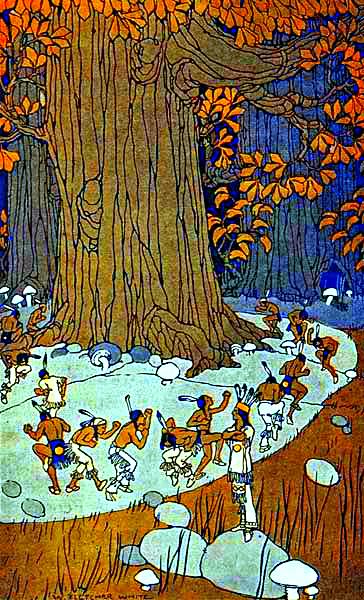 Mason Winfield has observed that Iroquois and Algonquin informants today generally speak of two distinct classes or tribes of “little people,” whom he designates “Healers” and “Tricksters.” The former are more magically potent and more beneficial to mere mortals. The latter are the ones most likely to interact with humans—especially children—but they are also more mischievous, if not outright malevolent.
This all got me wondering if the same typology might work in more southerly Native American cultures. This post, then, is going to be a ridiculously brief summary of my preliminary findings. I should also say up front that I am a complete and utter amateur and I know it! I’m sure there are details I’ve missed because I didn’t even know to look for them, and I welcome any constructive criticism.
At the outset, I should explain that “little people” seems to function in many Native American languages as a shorthand term for any sort of supernatural or uncanny humanoid. It is thus comparable to the way “troll” is used in later Scandinavian folklore. Even something like the “Deer Woman” can be called one of the “little people.” The Creeks even have a type of little people that they call the “tall people”! Size, therefore, seems at best a secondary concern—although, in fact, most of the beings we’re about to discuss are unusually short.
With that said, let’s get underway.
Cherokee
I expected to find a better fit with Winfield’s two-tribe model in Cherokee folklore than I did. They do, after all, speak an Iroquoian language—although they have been separated from their northern cousins for thousands of years.
There is definitely a two-tribe model in place among the Cherokee. They speak of a more powerful and more benevolent race called the nunnehi, “people who live anywhere” and a more morally mixed group called the yunwi tsunsdi, “little people” properly so called.
The nunnehi are not, though, strongly connected with growing plants or providing medicine. In other words, they don’t obviously fit Winfield’s “Healer” classification. I say they are not strongly connected because Donald N. Panther-Yates (The Eighth Arrow [Standing Bear, 2007] 42) asserts that nunnehi is a term not only for the “little people” but for those who commune with them: shamans, healers, medicine men, etc. So there is at least a passing association with healing roots, herbs, and so forth. But this doesn’t often find its way into the popular legends.
Rather, the Cherokees tell stories of nunnehi caring for lost travelers or perhaps showing up unawares at dances or other festive occasions. Sometimes they are depicted as fierce warriors who emerge from the ancient mounds to defend the Cherokees from invading armies.
On the other hand, though the yunwi tsunsdi can be kind and helpful, they are still definitely “Tricksters.” They are made up of three distinct clans:
- The Rock Clan is the most malicious, quick to get even when offended. Some say they are like this because their space has been invaded. Like many types of European fae, they are known to steal human children.
- The Laurel Clan is generally benevolent, humorous, and joyful. They are also mischievous, however, and love to play tricks on the unsuspecting.
- The Dogwood Clan is the most favorably disposed to humans, though they are also stern, serious, and prefer to be left alone.
Summary: Cherokee lore can definitely accommodate a two-tribe model, although it’s more “Protectors” and “Tricksters” than “Healers” and “Tricksters.”
Muskogee (Creek and Seminole)
I’m considering here not only the Muskogee (or Creek) proper but groups that spoke closely related languages such as Seminole, Mikasuki (Miccosukee), etc.
The Muskogee were close neighbors of the Cherokee in Georgia and South Carolina, and there seems to be at least a little bit of overlap in their beliefs about the little people. Like the Cherokee, for example, they populated the ancient mounds with invisible “ghost warriors” who might be heard dancing or singing in the early morning (James Mooney, Myths of the Cherokee [1900] 475). Unfortunately, the Muskogee rarely talk about these beings. They aren’t nearly as prominent as their Cherokee counterparts, the nunnehi.
There is, however, another type of little person who bears an even stronger resemblance to Winfield’s “Healers.” Especially among the Seminole and Mikasuki, one finds reference to a benevolent dwarf or little person who provides plants that are vital for human well-being.
Among the Mikasuki, this dwarf is called Fastachee, “little giver.” Fastachee is a provider of both corn and medicinal herbs. So once again, we’re in the realm of little people who make plants grow.
Fastachee is also sometimes called Este Fastachee, which links him with his Seminole equivalent, Este Fasta (“person-give”). William S. Lyon describes this figure in his Encyclopedia of Native American Healing (Norton, 1996):
Little is known of Seminole shamanism, but the medicines contained in a medicine bundle are given to the Seminole by Este Fasta, “person-give,” who acts as an intermediary between the Creator and the people. When a new medicine is needed, it is Este Fasta who brings it to Earth and places it in the shaman’s medicine bundle. Thus the concept of a shaman’s personal guardian spirit seems to be absent, certainly in the twentieth century. (106)
This figure is far different from the este lopocke (or este lubutke). According to Jack B. Martin and Margaret McKane Mauldin’s A Dictionary of Creek/Muskogee (University of Nebraska Press, 2000), these are “little people (said to cause people to get lost in the woods)” (266). When tormenting hapless travelers is part of your dictionary definition, you are definitely in the “Trickster” category! These little people are virtually identical to the yunwi tsunsdi of the Cherokee. Like their Cherokee cousins, they are divided into a number of separate clans or tribes, some of which were definitely worth avoiding!
Even these, however, are perceived as helpers and teachers. If mortals can’t always understand it, they still play a positive role. Carolyn Dunn relates,
Jean Hill Chadhuri wrote that when the Little People, who are great tricksters, are in the world then everything is right and safe as it should be. “The Little People,” she writes, “tell Creeks that the plant world is alive and well, for these Little People move when disaster is on the way.”
Summary: The two-tribe model is clearly at work here, with both well defined “Healers” and “Tricksters.” Overall, however, the Muskogee seem to have a more optimistic outlook than the Iroquois. Even the “Tricksters” have a positive role to play.
Choctaw
The Choctaw word for “little people” is hatak awasa (sometimes hutuk awasa). A particular sort of hatak awasa is called kowi anukasha or kwanokasha: “forest dweller.” The forest dweller seizes young boys who wander off into the woods and brings them to his cave, where three old, white-haired spirits subject him to a test of character: which of three gifts will he choose: a knife, a batch of poisonous herbs, or a batch of good, medicinal herbs? The legend continues,
[I]f he accepts the good herbs, he is destined to become a great doctor and an important and influential man of his tribe and win the confidence of all his people. When he accepts the good herbs the three old spirits will tell him the secrets of making medicines from herbs, roots and barks of certain trees, and of treating and curing various fevers, pains and other sickness.
Not all hatak awasa are so benevolent, however. Speaking of this other group, Carolyn Dunn says:
The function of the Little People is similar to the function of the fairies of Europe; sometimes to the Bogeyman of America. There are stories we were told when we were younger—that the Little People would come from the earth and swallow us up if we weren’t good.
Once again, we see the idea that the little people are to be feared—or at least treated with delicacy. We also see them paying particular attention to children: serving as a threat to make them behave.
Summary: Once again, we see the two-tribe model in play with both “Healers” and “Tricksters.”
Chickasaw
The Chickasaw word for “little people” is iyagȧnasha. As with other tribes, the term seems to be a catch-all term for all manner of supernatural humanoids. Robin R. Gunning describes the little people in terms of both trickery and healing:
In addition to the spirits of the animals, there were other creatures who lived in the forest but were not as easy to see. Perhaps the most important of these were the “Little People.” The Little People would sometimes help those in trouble or play tricks on those who offended them. They interacted most often with children. Sometimes a child would be chosen to live among the little people for a while. During this time the child would be given special powers of healing. When the child grew up, he or she would become a healer or herbal doctor. Healers could not teach or impart their skills to others because their magic came from the Little People.
A more detailed account of the “Trickster”-aspect of the Chickasaw little people is provided by Amos Hays, grandson of one of James Swanton’s original informants on Chickasaw culture. The younger Hays recalls,
I can’t recall too many specific examples, but the impression I have is that there were rules–I guess you’d call them—of one kind or another for almost every situation. And breaking or ignoring the rules often had serious consequences. My sisters and I understood that we were never to leave our playground the way we found it. We had to change it in some fundamental way before we left. If we didn’t, the little people could gain access to it and us and do some sort of mischief. They could play tricks on us, but the tricks weren’t fun.
We were told that some of the little people could harm us, and of course, we were afraid of them. So we were very careful about the rules. I never saw the little people, but there was no question among us that they existed. At some point in my childhood, I was told that only people born with the special powers of an Indian doctor could see little people. Though I couldn’t see the little people, anybody could see signs that they had been about.
Summary: It is not clear to me that the Chickasaw conceived of two distinct tribes of little people. Rather, these reports seem to say they conceived of one tribe fulfilling the functions of both “Healers” and “Tricksters.”
Classifying Native American Little People (1)
 When I first started writing Children of Pride, I knew I wanted the story to reflect great cultural diversity. That’s why you’ll find the world of Taylor Smart populated not only with the traditional faeries of European folklore but also with mythological creatures from North America and Africa. The mundane United States is a diverse melting pot, so why not its faery realm?
But how to bring together the often contradictory takes on spirit-folk, little people, or what have you? Admittedly, this would still be a problem if I had limited myself to a single culture’s folklore—the various stories aren’t easily harmonized. Adding in different cultures just ramped up a problem I already knew I’d face.
To deal with the problem, I made two decisions. First, I decided that no culture would be shown to be 100% correct in their faery beliefs. I would try to account for as much of the cultural data as I could, but in the end, I was the writer. It was my fantasy universe, and everybody would have to play by my rules.
Second, I decided that the countless faeries and faery-like beings of world mythology should actually fall into a small number of “templates” or “archetypes”: tricksters, satyrs, nature spirits, domestic spirits, elementals, etc. This provided a level of uniformity against which the beings found in particular cultures or mythologies could serve as variations on a theme.
In light of this second decision, I was delighted to find a recent blog post by Mason Winfield in which he has developed a different (to me) way of classifying the “little people” of Iroquois folklore. In this post, I want to summarize Winfield’s model. In a follow-up, I’ll see how the model might apply to the faery folk of other Native American cultures.
A Three-Tribe Model
Winfield’s post, by the way, is an excellent primer on the faery folk of northern Europe as well as their transatlantic cousins. His specialty, however, is in the legends of the Iroquois of upstate New York. He writes,
Most Algonquian-language groups call their Little People “Puckwudgies.” The Iroquois / Haudenosaunee people nickname them “Jungies.” Their correspondences to the Celtic wee folk are remarkable. Their wonted sites in New York State are intricate natural spaces: a stairstep waterfall, a natural gas well, a curious valley.
He goes on to explain how, in the older versions of these legends, the Iroquois conceived of three tribes of “Jungies” that “embody the three functions of the fairies worldwide.” These are the “Hunters,” who share a close connection with the Underworld; the “Plant Growers,” who are linked to the natural world and its cycles; and the “Stone Throwers,” who are most likely to be seen by human beings and hence, by human children. I have described these three tribes in an earlier post about the Jogaoh, from which the term “Jungies” no doubt comes.
A Two-Tribe Model
So, here we have what we might call a “three-tribe model” of the little people. Winfield notes, however, that by the mid-twentieth century, most people who held to these beliefs seemed to report only two tribes. He explains,
The American literary and social critic Edmund Wilson (Apologies to the Iroquois, 1960) found only two of the fairy nations surfacing in living report. Wilson (1895-1972) called them, “Healers” and “Tricksters.”
Winfield confirms that his own Native American contacts say the same. So does his colleague, Michael Bastine, whose area of specialty is the Algonquin culture (in Québec and Ontario). I can’t find reference to “Healers” and “Tricksters” in the Google Books version of Apologies to the Iroquois, but that can be chalked up to the relevant pages being blocked out.
Winfield proposes that the “Healers” are an updated version of the “Plant Growers.” Given the strong connection between plant lore and herbal medicine and Native American healing traditions, this makes perfect sense.
As for the “Tricksters,” their origins are a bit more murky—and they themselves are more foreboding. In 1975, Tuscarora Chief Elton Greene sat for an interview with Virginia Scipione, a librarian at the Lewiston (NY) Public Library. The typewritten transcript of this interview is preserved on the library’s web page. In it, Chief Greene discusses, among other things, legends he has heard about the “little people” from Elias Johnson. According to Chief Greene,
[H]e has told me a lot when I was small of the legends and traditions of what it used to be like in the early days. There is one that is very interesting to everybody about the dwarfs or very small persons. What we call in our language ______.* That means a degraded human race. He told me they were about 28 to 30 inches tall and he had seen them lots of times when he was a boy, when he was small. They liked to play around the trees. They liked to fool around with the children and the parents don’t like that because they claim that they will give peculiar spirits to the children if they let them fool around them because they are very smart. They have seen their tracks a lot of times on the highways. His mother at night (he used to live in a little log house just a little ways from there and they had a fireplace) said they would climb up there and go thru the chimney. They would come down there during the summer. They would make noise and wake them up and then they would run back up there. They would build a little fire to keep them out.
To summarize, Winfield perceives two basic categories of “little people.” On the one hand are the “Healers,” immensely powerful beings who are generally kind and helpful to humans (though they can still be dangerous if insulted). On the other hand are the “Tricksters,” a “degraded human race” whose members are mischievous and perhaps even malevolent. They are not, however, generally in the same “weight class” as those in the first category.
Furthermore, Winfield suggests this classification works cross-culturally. It holds up not only in the context of Iroquois culture but also Algonquin.
In my next post, I want to test this classification against some of the Native American cultures of the Southeast.
* The name is left blank in the typewritten transcript. Apparently, it should be “oogweshiya.” At least, that is how it is rendered on the Lewiston Public Library page where the interview is introduced.
 Darrell J. Pursiful