
Home » Mythology (Page 7)
Category Archives: Mythology
New Lizard Man Sighting
From Bishopville, South Carolina:
The fabled Bishopville swamp creature known as Lizard Man appears to have surfaced again Sunday afternoon.
Sarah, a Sumter woman who says she went to church with a friend Sunday morning, stepped out of the sanctuary to see the Lizard Man running along the tree line.
So she did what anyone else would do — took a picture with her phone.
“My hand to God, I am not making this up,” she wrote in an email to the ABC News 4 newsroom. “So excited!”
She says they were just a mile or so from Scape Ore Swamp, the site of a similar spotting of what may also be the Lizard Man in May.
A man who asked not to be identified submitted a short video of what he thought was the Lizard Man Monday morning. He said he took the video in May while coon hunting but kept its existence quiet — until he saw the reports of Lizard Man outside a church.
Which leads me to wonder, is the Lizard Man a Baptist or a Methodist?
Uncanny Georgia: Miscellaneous Water Beings
In Bill Grantham’s Creation Myths and Legends of the Creek Indians (University Press of Florida, 2002), he cites John R. Swanton to the effect that various sorts of aquatic creatures are found in Muskogee mythology:
Swanton mentions, with little description, several water beings. Among these are the water bear, water calf, water bison, water tiger, and water person. The last of these, the water person, was described as about four feet tall and having long hair. Also mentioned by Swanton with little description are Wiofû’tc miko (water king deer), which caused certain diseases, and a Spirit of War that appears to have been in human form.
Uncanny Georgia: The Georgia Mothman
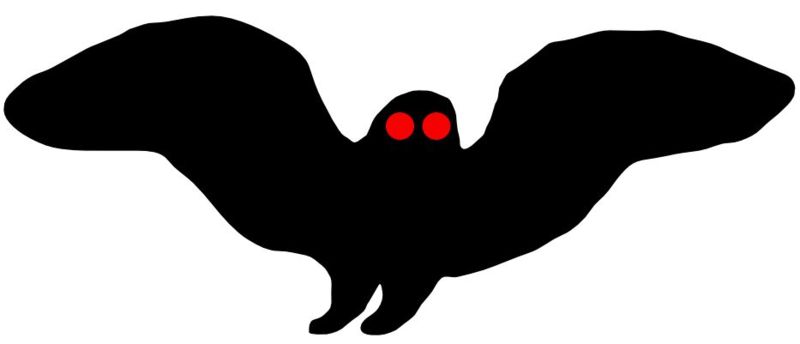 The Mothman, a purported giant winged humanoid, is associated with a string of sightings in West Virginia in the 1960s. A similar creature, however, was sighted in recent years in north Georgia. A woman who wished to remain anonymous reported an encounter on an old country road. She says,
Suddenly, something flew in front of the car and hit the windshield with enough size and force that it totally mangled the grill and hood. I immediately stopped the car. I heard what sounded like wings flapping on the roof, but then something rolled down the back window onto the trunk then eventually on to the road. I thought I killed whatever it was. A woman in a truck had pulled up from behind and said she saw the thing hit the road. She said that it’s eyes were glaring bright red. As we looked more closely at this thing it resembled a man with large bat-like wings….
This thing had the body of a well-built man. It had no feathers but charcoal gray skin like that of a bat with some hair on the shoulders and around the eyes and legs. When it spread it’s wings, it had the span of 12 foot or more. I estimate it was about 8 foot tall. It had no head however, just the eyes embedded on the shoulders that had brows. I didn’t noticed a mouth or nose.
Someone else in northern Georgia apparently had a similar encounter and managed to snap a photo of a glowing, winged creature. (Though it’s probably a fake.)
Uncanny Georgia: The Horned Serpent
 Horned serpents are powerful magical beings in many Native American mythologies. They feature in the legends of both the Creeks and the Cherokees. Both groups apparently got the idea from what is called the Southeastern Ceremonial Complex, network of cultural influences that spread across much of what is today the United States. As such, the creature is known by a number of names in various languages of the American Southeast, including:
cetto-yvprakko: Muskogee
chintoosakcho: Alabama (“crawfish snake”)
olobit: Natchez
sint holo: Chickasaw, Choctaw
sinti lapitta: Choctaw
uktena: Cherokee
The horned serpent is a creature of chaos, the underworld counterpart to the “thunderers” or “thunder beings” who represent order and live in the sky. Beyond that, there are some distinctions between the Cherokee and the Creek horned serpent.
In Cherokee mythology, the word for horned serpent is uktena. These malevolent and deadly monsters inhabit deep underwater pools as well as the high mountains.
An uktena is as large around as a tree trunk. Its scales glitter like sparks of fire. It has horns on its head, naturally, and a bright, diamond-like crest on its forehead. This crest is greatly prized, as one who can retrieve it is supposedly imbued with the power to become a great wonder-worker. This is a dangerous quest, however, because the uktena’s dazzling appearance draws people toward the creature when they should be running away.
For the Creeks, the story is pretty much the same, though their horned serpent does not seem as outright evil or destructive as that of the Cherokees. It might even appear to wise young men. The Creek horned serpent is a huge creature armed with crystalline scales, with an extremely bright crystal adorning its forehead. As with the uktena’s diamond crest, this crystal is said to grant mystical powers to whoever might retrieve it.
The Creeks have another supernatural serpent called the tie snake, and accounts differ as to whether they two are the same or whether they are, in fact, distinct creatures—though sometimes called by the same name. I’ll tackle tie snakes in a later installment.
Uncanny Georgia: Pterosaurs
 Yes, pterosaurs. Apparently, there have been several sightings of large flying creatures in north Georgia that strongly resemble pterosaurs, prehistoric flying reptiles believed extinct for 65 million years.
Sightings have been recorded in Waltonville/Gwinnett Counties (Loganville), Barrow County (Winder), Heard County (Franklin), and Towns County. According to one eyewitness,
[In] July of 2010, My wife and I were sitting outside when motion from above the tree tops to our left caught my attention; it’s very hard to explain how I felt at that moment. We were looking at two extremely large birds flying together and heading north . . . I can only guess to be 15-20′ wing spans and the motion of their wings as they flew was very slow. The head was long and ended in a point; wings ended in a point and appeared to be featherless . . .
Anyway, it happened again yesterday [Dec 9, 2012], this time there were three of us who saw this bird fly over, in plain sight, in daylight, up close . . .
. . . I have been trying to contact a whole lot of people (with not much success) I don’t know how to say this any other way except that I have seen these very large birds that don’t even come close to looking like anything else I’ve ever seen. I believe them to be Pterosaurs or something similar to them. . . . I have seen three of these birds in the past year and a half, I have also heard them. . . .
This last sighting has sparked me to do something about it. There were two other people with me when I saw the last one; this was three days ago. I am intent on identifying these large birds. This is not a joke, I, we have seen something that is not supposed to be here! (emphasis added)
Other accounts (linked under “Sightings” above) report the presence of a long tail on at least some of these creatures.
Uncanny Georgia: The Wog
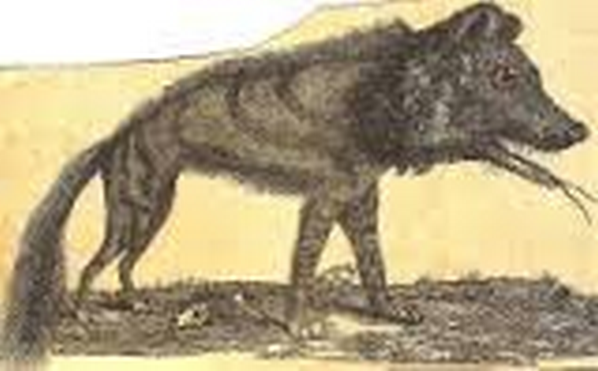 The wog, sometimes called the Georgia wog, is a fearsome beast associated with Jackson County. Think of it as a kind of black, demonic dog with characteristics of other animals as well.
G. J. N. Wilson described it, based on the accounts of early settlers, in his The Early History of Jackson County, Georgia (1914). He writes,
The wog was said to be a jet-black, long-haired animal about the size of a small horse, but his legs were much shorter, the front ones being some twelve inches longer than the hind ones. This gave him something of the appearance of a huge dog “sitting on its tail,” and when walking seemed to require him to carry forward one side at a time. His tail was very large, all the way of the same size, and at the end of it there was a bunch of entirely white hair at least eight inches long and larger in diameter than the tail itself. Whether sitting, standing or walking this curious appendage was in constant motion from side to side, not as a dog wags his tail, but with a quick upward curve which brought it down with a whizzing sound that could be distinctly heard at least when twenty-five or thirty steps distant. But the most distinguishing feature of this horrid tail was that it revealed the presence of the monster in the dark—the only time he ventured to go abroad. His great red eyes were very repulsive, but not so much so as his forked tongue, the prongs of which were thought to be eight inches long and sometimes played in and out his mouth like those of a mad snake. Really the meanest feature about the beast was that his bear-like head contained a set of great white teeth over which his ugly lips never closed. (46–47)
The wog is also known in nearby Barrow County, where it is sometimes said to protect a mud volcano called the Nodoroc Site: an odd, boggy, bubbling pond near the town of Winder. Local legends say the place was used by the Creeks to execute criminals and then throw the corpses into the bog. Nodoroc is purportedly a Creek word meaning “gateway to hell,” but I’m usually incredibly skeptical of claims about Native American etymologies—especially since there is no “r” sound in the Creek language!
At any rate, the wog seems to me very similar to monstrous dogs found throughout world mythology, from the hellhounds of Ancient Greece to the faery dogs of the British Isles. A while back, I suggested that the extinct Amphicyonids or “bear-dogs” would make a good stand-in for many such creatures.
If It Lived in the American South, It Never Would Have Survived This Long
Via Sky News:
The Loch Ness monster is most likely a large catfish, according to an expert who has spent 24 years searching for Nessie.
Steve Feltham, 52, gave up his home, his job and his girlfriend to move nearer the Scottish loch in pursuit of the legend.
Speaking to Sky News, Mr Feltham did not claim he had solved the mystery of Nessie.
But he said: “Looking at all the evidence, speaking to eyewitnesses, the most likely solution is a Wels catfish.”
The fish can grow up to four metres (13ft) long and weigh over 400kg (880lb).
Ten Legendary Islands
If you’re still looking for a place to go for summer vacation, maybe one of these imaginary islands highlighted today at mental_floss is just what the doctor ordered!
Shellycoats
Ruth at Celtic Myth Podshow is blogging today about shellycoats, a generally harmless if perplexing creature from Scottish folklore.
THIS is a freakish spirit, who delights rather to perplex and frighten mankind than either to serve or seriously to hurt them.
Shellycoat, a spirit who resides in the waters, and has given his name to many a rock and stone the Scottish coast, belongs to the class of bogles.
When he appeared, he seemed to be decked with marine productions, and in particular with shells, whose clattering announced his approach.
Uncanny Georgia: The Allatoona Toe Nibbler

The Toe Nibbler’s Next Victim?
Seriously, how can I not include a cryptid with a name like “the Allatoona Toe Nibbler”? Especially since it is popular enough to have an entire blog dedicated to it?
Lake Allatoona is a man-made reservoir lake northwest of Atlanta. It is also, if reports are to be believed, home to some sort of unknown aquatic creature. Reports of the Toe Nibbler began in the 1950s. Even in recent years, boaters and swimmers have reported occasional nipping of the fingers and toes that could not, they say, be attributed to ordinary and harmless fish. Some say they have seen the creature. According to the aforementioned blog,
Those that have seen the Toe Nibbler describe it as being smaller than a human (accounts range from three to four foot in length.) Most often it is said to be dark green, brown, or black in color and has been seen sliding along under the surface of the water. It seems to enjoy shaded areas of the lakes and is seen most often up in small, but deep, coves along the shoreline.
The few accounts of up-close confrontations with the creature agree that it has small, black beady eyes and one eye witness stated that they saw a three toed webbed hand or foot extend out of the water.
So, what is this odd creature? Is it a pygmy cousin to more famous lake-dwelling monsters like the Loch Ness Monster or Lake Champlain’s “Champ”? A joke or a hoax? A known aquatic animal misidentified by swimmers with overactive imaginations?
It beats me, but you’ve sure got to love the name of this thing. 🙂
 Darrell J. Pursiful