
Home » Mythology (Page 8)
Category Archives: Mythology
Uncanny Georgia: Water Cannibals
Cherokee mythology includes a number of supernatural beings: some friendly, some neutral, some definitely hostile. In this last category are the ama yvwigisgi or “water cannibals.”
Water cannibals live at the bottoms of deep rivers. As their name implies, they are partial to the taste of human flesh, especially that of small children. According to James Mooney’s Myths of the Cherokee (1900),
They come out just after daybreak and go about unseen from house to house until they find some one still asleep, when they shoot him with their invisible arrows and carry the dead body down under the water to feast upon it. That no one may know what has happened they leave in place of the body a shade or image of the dead man or little child, that wakes up and talks and goes about just as he did, but there is no life in it, and in seven days it withers and dies, and the people bury it and think they are burying their dead friend. It was a long time before the people found out about this, but now they always try to be awake at daylight and wake up the children, telling them “The hunters are among you.” (349)
Kidnapping children and replacing them with a magical decoy sounds like the tactic of a European troll or faery. I can’t help but wonder if this detail came about after the Cherokee had dealings with Europeans or whether it reflects a more universal mythical theme, perhaps a way to rationalize the sudden death or sickness of a child.
Water cannibals have yet to appear in the Into the Wonder Series, although a character refers to them at one point in Children of Pride. Similar creatures from Choctaw mythology called the okwa naholo do appear, however, in The Devil’s Due.
Uncanny Georgia: Fire Devils
This is the first in what will be at least a twenty-part series of posts on the weird and supernatural aspects of the state of Georgia. When I began research on the fourth book of the Into the Wonder series (working title, The River of Night), I knew I wanted it to be chock-full of as many references to native Georgia monsters and spirit-beings as I could fit. What I’ve found could easily fill several books! I’m sharing my findings here so I won’t feel guilty about all the cool beasties I’m going to have to leave out when I start writing. 🙂
Disclaimer: Some of the creatures to be featured here are cryptids, meaning people claim to have actually seen them though they are undocumented by science. Do not take the fact that I’m featuring them in this series as a statement that I believe they’re real—only that I think they’re cool and that they would make an awfully good story.
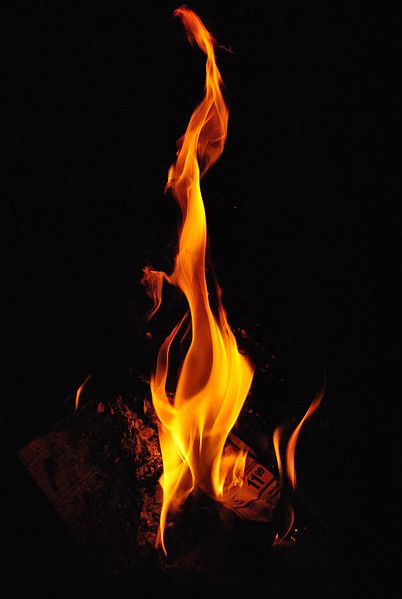 We’ll start in Rabun County in the extreme northwest of the state. Here, it is said, live a race of fire-breathing devils that stand guard over sacred caves and strange stone cairns deep in the forest. According to Indian legends (most likely Cherokee; Internet sources are vague), even the bravest warriors would refuse to go into certain deserted regions for fear of these “little demons.”
These creatures are apparently associated with strange sounds coming from the woods that the locals call “the music of the Bald” after nearby Rabun Bald, the highest peak in the county. The first published account of these sounds comes from the Monthly Weather Review in 1897. Ken Rasure summarizes this report as follows:
Two “reliable men” were camping one night on top of Rabun Bald…when they were awakened by “eerie, haunting melodies” coming from the woods. After some time, the melodies were replaced by sounds which reminded them of cannons being discharged in the distance. These noises went on for several minutes and then began getting closer and closer to them. Finally, the sounds seemed to be coming from deep in the ground right beneath their feet! The men later said they weren’t afraid, but they were very deeply perplexed. The sounds traveled on into the distance over the next few minutes and they were able to hear it for most of the night. The men reported this strange phenomena the next day to the sheriff who told them it was probably caused by bears rolling small boulders off the mountainsides while searching for worms and insects to eat. The boulders would sometimes roll downhill or off cliffs which would create the explosive sounds. The men were unconvinced as this explanation didn’t account for the eerie melodies or the way the noises traveled through the woods and it certainly didn’t explain how the sounds came from under the ground beneath their feet.
So, fire-breathing devils who love to play weird music with a hardcore rhythm section. Cool.
The Wild Hunt, British Style
This post by Sigurd Towrie on the Wild Hunt legends of the Orkney Islands is a great follow up to Dan McCoy’s explanation I linked to about a year and a half ago. While McCoy focuses more on Norse folklore, Towrie leans more heavily on British/Celtic tellings of the legend:
But traditions of a Wild Hunt also existed in areas away from Norse influence.
In Wales, for example, the leader of the Hunt was Gwynn ap Nudd. The “Lord of the Dead”, Gwynn ap Nudd was followed by his pack of white hounds with blood-red ears.
These red-eared hounds are also found in northern England, where they were known as Gabriel Hounds. Their appearance was also a portent of doom.
In southern England, it was Herne the Hunter who led the hunt, while elsewhere it is also referred to as “Herlathing” – from the mythical King Herla, its supposed leader.
According to the 12th century write, Walter Map:
“This household of Herlethingus was last seen in the marches of Wales and Hereford in the first year of the reign of Henry II, about noonday: they travelled as we do, with carts and sumpter horses, pack-saddles and panniers, hawks and hounds, and a concourse of men and women.
“Those who saw them first raised the whole country against them with horns and shouts, and . . . because they were unable to wring a word from them by addressing them, made ready to extort an answer with their weapons. They, however, rose up into the air and vanished on a sudden.”
New England’s Underwater Dwarves
New England Folklore shares this Penobscot legend:
It seems like Bigfoot is the monster most frequently sighted out in the woods these days. He’s been seen in every New England state, even Rhode Island. However, in the past a much greater variety of strange creatures could be seen lurking around New England, and many of them are documented in the region’s Native American lore.
One of the more interesting creatures was the water dwarf of Penobscot legend. I write in the past tense, implying that the water dwarfs are gone, but that may not be the case. Maybe they are just lying low and keeping out of sight. That might be OK, because seeing a water dwarf often brought trouble.
The Penobscot name for the dwarfs was alambegwinosis, which literally translates to “underwater dwarf man.” (That would be an awesome name for a superhero!) Sometimes singly and sometimes in villages, these creatures dwell in deep pools in rivers, or at the bottom of lakes. An alambegwinosis is quite distinctive looking. If you encounter a three-foot tall naked man with long straight hair down to his waist near an isolated deep body of fresh water you’ve probably stumbled on a water dwarf.
The Fairy Flag of Clan MacLeod
Some light reading for your Thursday:
Many, many years ago, the Chief of Clan MacLeod was a handsome, intelligent man, and all the young ladies in the area were very attracted to him, but none suited his fancy.
One day, he met a fairy princess, a bean sidhe, one of the Shining Folk. Like all the other females he met, she fell madly in love with him, and he with her….
A History of the Fae
Leo Elijah Cristea has posted the final installment of his series on the fae. (Links to all four parts here.) This has been a very informative series looking at the legends and myths surrounding the Fair Folk, and I heartily commend it.
In this final part of our exploration of the fae, it seems appropriate to take a look at not only the varied and expansive wealth of literature and that features fae, or any recognisable incarnation of them, but also a more comprehensive look at their time line. We’ve briefly explored the evolution of the fae, from Irish folklore, through to Shakespeare’s romantic depictions, and to their modern day Disney or urban fantasy cousins, but the long and fluid history of the fae makes it difficult to succinctly follow. As such, if we head as far back as a pre-Christian time, indeed touching on the relevance of Pagan faeries and early Greco-Roman fae we start to see that two things are true:
You’ll just have to click through to see what those two things are. 🙂
The Island of Hy Brasil
The mysterious island sometimes called “the Irish Atlantis” is the subject of a new post at the Celtic Myth Podshow by
Rónán Gearóid Ó Domhnaill.
It got its name from the Irish Uí, meaning descendant of Bresal, meaning beauty. Bresal was of the Fir Bolg and it was after one of his daughters, Galvia, that Galway got its name. It was suggested that the country of Brazil was named after the island, but it actually got its name after the red coloured Brazil wood. Other names for the island included Tir fo-Thuin (Land Under the Wave), Mag Mell (Land of Truth), Hy na-Beatha(Isle of Life), and Tir na-m-Buadha (Land of Virtue).
There is a description of the island the 9th century biography of Saint Brendan Navigatio Sancti Brendani which was a medieval bestseller. The island was described as being shrouded in mist, visible for one day only every seven years, circular in shape with a river running across its diameter. Though visible it could not always be reached.
Its exact location has never been clarified. In 1325 the Genoese cartographer Dalorto placed it west of Ireland, later it appeared southwest of Galway Bay. Some said it was off the Kerry Coast. On some 15th century maps, islands of the Azores appear as Isola de Brazil, or Insulla de Brazil. A Catalan map from 1480 labels two islands “Illa de brasil”, one to the south west of Ireland one south of “Illa verde” or Greenland.
The Science of Dragons (and Other Assorted Beasties)
Is “hard fantasy” a thing? Because I love it when there is at least the attempt to ground fantastic beasts, magic, and so forth in known science.
Maddie Stone has enlisted the help of some biology experts to uncover the science behind some of the creatures found in Game of Thrones. She looks at dragons, direwolves, manticores, lizard lions, krakens, and white walkers.
A while back I noted some prehistoric beasts that would make excellent stand-ins for some of the more notable monsters of mythology. One of those, the naked bear (aka the stiff-legged bear) even made its way onto the cover of The Devil’s Due.
The Tuatha Dé Danann
Here’s another excellent, concise summary of an aspect of Irish mythology from Ruth at the Celtic Myth Podshow:
The Tuatha de Danann, the people of the Goddess Danu, were one of the great ancient tribes of Ireland. The important manuscript ‘The Annals of the Four Masters’, records that they ruled Ireland from 1897 B.C. to 1700 B.C.
The daoine sídhe or faeries of Ireland are said to be the descendants of this noble lineage.
In the world of Taylor Smart, the sídhe sometimes swear by saying “Danu!” or “By Danu!” I haven’t gone into any detail how contemporary sídhe remember and/or reverence their distinguished ancestors. Perhaps a bit of that will trickle into the third book of the Into the Wonder series, Oak, Ash, and Thorn.
 Darrell J. Pursiful