
Home » Sighted Elsewhere (Page 4)
Category Archives: Sighted Elsewhere
Faeries and Pixies of Exmoor
The Faery Folklorist offers numerous tales of the Fair Folk of Exmoor and nearby areas in the West Country of England. The common name for such beings in this part of England is either pixie (in Devonshire) or pisgy/piskey (in Cornwall).
I think it’s about time more attention was paid to the extraordinary fairy folk and pixies of Exmoor! These wonderful little characters are often sadly overlooked and overshadowed by their more famous relatives, the Piskies of Cornwall and Pixies of Dartmoor. Below you will find a beginners guide to the fairies and pixies of Exmoor, including their habits and habitations, and an insight into their curious behaviour.
Enjoy!
Somebody Made a Children’s Book about Gilgamesh
Move over, Rick Riordan: somebody else is getting into the kid books about demigods business. According to the Times of Israel, a Hebrew-language version of the Epic of Gilgamesh is underway:
In writer Shirley Graetz’s mind, the Akkadian figure who stars in the ancient poem “Epic of Gilgamesh” sounded a lot like her eldest son. Big, strong, and not always able to delicately avoid things in his path.
“I got to thinking about Gilgamesh,” said Graetz, who at the time was finishing up her PhD on cuneiform, an ancient form of writing from the Mesopotamian region. “He was half human, half god and he was a tyrant. Until he found his match, and then he calmed down and went on adventures.”
Graetz then went on to write a chapter book geared to children aged 8–11.
Best sentence in the article? This one:
Ever practical, the academic turned popular fiction writer also considered the fact that neither Disney nor Pixar had ever touched the story of the Mesopotamian figure.
I wonder if the bit with Shamhat might have something to do with that.
(H/T: PaleoJudaica)
Two Flavors of Vermont Faeries
New England Folklore has a post up about two faery-type entities from the Abenaki folklore of Vermont:
One of them is called simply “the swamp spirit” or “swamp creature.” The swamp spirit was seldom seen, but could often be heard crying from the swampy areas where it lived. Lone travelers were the most likely to hear the creature’s cries…. [I]t liked to lure children into swamps where it either kept them forever or just outright killed them.
The Manogemassak [or “little people”] live in rivers and tend to avoid humans as much as possible. This is easy for them to do because of their unique anatomy. The Manogemassak are incredibly narrow, and their faces are described as being as thin as an axe blade. They are so thin that they can only be viewed in profile, not when faced head on. This makes it quite hard for humans to see them.
Of course, both now and in times past, the Abenaki are not limited to the borders of Vermont, but if you’re ever in the Green Mountain State, you might want to think twice about hiking in the swamp.
Understanding Tolkien
Thanks to Keitha Sargent for this engaging summary of some of the things that made J. R. R. Tolkien tick.
To get the most out of Tolkien’s works, it is important to understand a little about the man, his life, passions and views. Several things shaped the imagination from which Middle Earth emerged: his childhood in England, his experiences in the First World War, and his love for ‘Northern’ myth and literature.
Tolkien was born in South Africa to English parents. When he was 3, his father died, and in 1896 the family settled in a small village in central England. In 1966, Tolkien described the place as “a kind of lost paradise” and, for the rest of his life, it remained an ideal. Tolkien had a deep love for England, even suggesting that, thanks to a sort of race-memory, he recognised the Anglo-Saxon language when he first encountered it as a boy.
Closely related to his love for England was his distaste for the modern world. This extended even to literature. For a professor, he was remarkably ignorant of contemporary writers and used to joke “English Literature endedwith Chaucer”, inverting the cliché that Chaucer was ‘father’ of the language. For Tolkien, ‘modern’ was a word with negative connotations; to him it meant industrialism, machines, overcrowding, noise and speed. In 1933, he returned to the village of his childhood and wrote bitterly that the place had been engulfed by trams, roads, and hideous housing estates.
“Rowling is Better than Shakespeare”
I respectfully disagree with Max Freeman’s titular assertion, but I nevertheless endorse the substance of his post.
Tell me if you’ve ever read these stories before:
– A young male sociopath disapproves of everyone and everything around him, including any of his romantic interests. He changes nothing, learns nothing, and leaves.
– It’s the olden days, and terrible things are happening to good people. Terrible things continue to happen for 200 – 400 pages. Despite all this tragedy, there is little to no story, and no character development. Everyone is either 100% good or 100% bad, from start to finish. In the end, things either get marginally better, or they don’t.
– Wow, what a great dog! Whoops, he’s dead. (Or every character besides the dog is dead.)
– A metaphor commits a metaphor to another metaphor. Everyone is sad.
Do any of these scenarios sound familiar to you? If you went to high school in America, I bet the answer is a big yes. In fact, I bet these few plots encompass around 90% of everything you and I were both forced to read in English class while growing up….
Listen, I’m all for supporting good literature, but it’s not the wordiness or length of these “classics” that put people off. It’s their DULL, unlikeable characters. Wordiness and length didn’t keep kids from reading Harry Potter, did it?
We really need to expand our horizons and incorporate some more fantasy and sci-fi into our kids’ reading. Not only does it expand their imaginations, and introduce memorable characters and journeys, but so many of them are well written too. Here are some humble suggestions.
A Scientific Theory of the Origin of Dragons
I’ve just stumbled upon a scholarly article on the origin of dragon-lore in early human cultures: Robert Blust, “The Origin of Dragons,” Anthropos 95 (2000): 519–36.
This is far more highbrow than many of my readers will appreciate, but it’s the sort of thing that stokes my imagination as I think through how I want magic, dragons, and other mythological creatures to “work” in my writing. Here’s an intriguing paragraph from near the beginning:
[T]he idea of the dragon arose through processes of reasoning which do not differ essentially from those underlying modern scientific explanations. Far from being the product of a capricious imagination, the dragon was mentally constructed in many parts of the world as a by-product of 1. meticulously accurate observations of weather phenomena, and 2. an earnest but unsuccessful attempt to grasp the causality of natural events, particularly those relating to rainfall. The dragon thus stands as one of the supremely instructive examples of convergent evolution in the symbolic life of the mind.
By the way, dragons will make their first appearance in the Into the Wonder series with its fourth book, The River of Night, which is currently in the hands of my beta readers. 🙂
Reading Makes You a Better Person
This infographic by Raphael Lysander explains the many ways in which reading does a body—and a mind, and a soul, and a society—good. (H/T: mental_floss)
The Ogham Alphabet
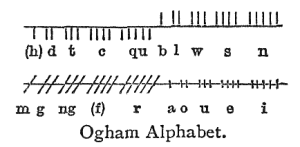 Sometimes called the “Celtic Tree Alphabet,” Ogham (pronounced, roughly, Oh-um) is made up of straight lines intersecting a staff at various angles. Atlas Obscura has posted an informative article about this unique writing system:
There are about 400 known Ogham stones in the world—360 in Ireland, and the rest scattered between Wales, the Isle of Mann, and Scotland. Most are monuments or border markers, engraved with the evocative names and genealogies of their owners—”Belonging to the Three Sons of the Bald One,” or “He Who Was Born Of The Raven.” More are almost certainly lurking—hidden stones can (and do) pop up occasionally, built into churches, unearthed at construction sites, or hiding out disguised as decorative stonework.
There’s a blink-and-you’ll-miss-it detail in Children of Pride in which an antagonist writes a line of Ogham script as part of a spell. But there was no way (or reason) to indicate that this was what was happening. I’ll leave it to my readers to see if they can track down the scene. 😉
Another Kelpie Sighting
The Faery Folklorist provides an in-depth article about the water horses of Loch a Gharbh-bhaid Beag (which, if you haven’t guessed, is in Scotland).
Many a Scottish loch lays claim to a water-horse, but how many can say they have a whole herd living beneath the still dark surface? Loch a Gharbh-bhaid Beag in the North West Highlands is said to be home to not one Each Uisge, but a whole herd! If you’ve not heard of the infamous water-horse, you can read more about them here in a previous blog. Unusually, this particular story has a reasonably happy ending with no deaths or gore, which does make a change from the usual ending of the water-horse dragging it’s victim into the deep murky waters to their doom.
Miniature Mischief Makers? Marvelous!
Via mental_floss:
Humans have always looked for an excuse when something goes wrong, and traditionally, mythical creatures have often provided the perfect scapegoat. The milk has curdled? Must be a brownie. Tools gone missing? Blame the knockers. Someone drank all your wine? Cellar must be infested with clurichauns.
Folklore around the world provides us with a host of these small fairy-like creatures, frequently treading a fine line between the malevolent and benevolent, and worryingly quick to take offense. So next time you break a vase or lose your keys, here are a sampling of miniature mischief-makers to take the blame.
If Friday the 13th brings you some bad luck, at least now you’ll know whom to blame. 🙂
 Darrell J. Pursiful