
Home » Uncategorized (Page 7)
Category Archives: Uncategorized
Uncanny Georgia: The Atcukliba
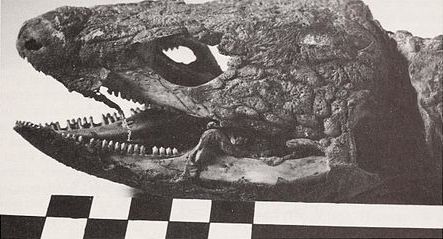 Here’s one last creature from Bill Grantham’s Creation Myths and Legends of the Creek Indians (University Press of Florida, 2002):
There was also a monster lizard that lived in hollow trees like a bear and was called Atcukliba, which was the same name used to refer to a “small, inoffensive striped lizard” found on trees. (37)
In standardized spelling, this would be vcoklepv (pronounced roughly uh-choo-glee-buh). If you’re walking in the woods and your Creek hiking partner says he sees an atcukliba, it would be a good idea to clarify whether he’s talking about the “small, inoffensive” kind or the “monster” kind. It might be important.
Does Your Pastor Practice Oikonomia?
Over at Internet Monk, Father Ernesto has written a brief introduction to oikonomia, a prominent feature of pastoral care in the Orthodox tradition. It basically boils down to dealing with people as if the goal were not to “fix” them but to bring them to God:
Americans have a strong built in idea that God is a law and order God. There is only one problem. That is not really what God seems to do in Scripture. He does support principles of justice. The prophets constantly rail against injustice. But, God’s purpose is to bring people into his kingdom. And, if a law appears to interfere with bringing someone into the Kingdom of God, then God has no problem in putting that law aside. Thus, the woman caught in adultery is forgiven outside the law because that unexpected forgiveness is precisely what she needs to hear in order to bring her into the Kingdom of God.
It should be noted, however, that although oikonomia can involve lessening the prescribed penance for sin, it could in some circumstances mean a hard-hearted (or headed) sinner might require a more severe penance in order to bring him to his senses. The bottom line is to deal with each personal individually rather than blindly applying the canons:
God understands people and God understands what will best work to give the best possibility that a person will truly come to him and be saved. In the same way, the bishop and his priests and deacons are called not to simply apply the canon, but to so come to know the person involved that when they apply the canon, they will do so in the way that is most likely to preserve that person’s salvation. Thus someone may be ordained much sooner than expected. A discipline for a sin committed by a church member may either be lightened or strengthened. But, at bottom, whatever action is taken must be based on a knowledge of a person and what will most help their journey to salvation.
So, oikonomia involves fulling admitting that rules and structure can be positive—and that there is such a thing as sin—but being willing to address these matters as if there were something more important than written laws and guidelines. It almost sounds like something Jesus would do, doesn’t it? 🙂
Review of Wandering Djinn
Here is my review of Wandering Djinn: An Anthology of Fantasy by Ahmed Al-Sheikh:
As the subtitle states, this is an anthology. The stories are loosely connected, but all involve Malik, a djinn who wanders the earth trying to do good and protect mortals from supernatural danger. I think this is a great concept for a story, but the execution is a bit uneven. At times, the author “tells” rather than “shows.” On other occasions, the point-of-view character shifts abruptly—at least once over the course of a single paragraph. Still, the author doesn’t burden these stories with an undue amount of background information. The worldbuilding is there, but usually subtle and unobtrusive.

Given the nature of this website, I would add that there are a couple of fairly gruesome scenes that would not be suitable for younger readers. It was, however, a halfway decent story. It’s currently available for free, and it might be something some of my readers are interested in.
If you’d like to learn more about the djinn (or jinn) of Arabic legend, I’ve got a post (or two) that might help you with that.
Uncanny Georgia: The Istipapa
 The istipapa (este papv in standardized spelling) or “man-eater” is a fierce creature from the mythology of several Native American nations of the Southeast. Though some groups conceived of the istipapa as bear-like, the Creeks and Seminoles though of it as a huge feline, something like a giant mountain lion. (Its name is, in fact, sometimes translated as “lion.”) As its name suggests, it has been known to devour not only livestock but also human beings.
Michelle Smith recounts the following Creek legend in Legends, Lore and True Tales of the Chattahoochee (The History Press, 2013):
One of the more famous stories of the Isti-PaPa states that one particular cat plagued a Creek tribe. Members of the tribe tried to kill it by digging a pit and covering it with a net made of bark. Then they lured it out of its cave by throwing in a rattlesnake. The beast rushed forward with more anger and chased them through the branches. The tribe decided it was better for one to die than all, so the members took a motherless child and threw him before the lion as it came near the pit. The lion rushed at the child and fell into the pit; tribe members jabbed at it with blazing pinewood and killed it. After killing the Isti-PaPa, they took its bones and laid them on either side of the pit. They tarried there seven days because the creature would come every seventh day to terrorize them. In remembrance of the Isti-PaPa, the tribe would fast for six days and begin war on the seventh. If warriors took his bones with them into war, they would have good fortune.
Heresy Discovered in Early Christianity
…Which is good news for the orthodox. Larry Hurtado explains:
I continue to see some scholars stating as unquestioned fact that “orthodoxy” and “heresy” really only emerged after Constantine, that only with the power of imperial coercion could these categories operate, and that in the pre-Constantinian period all we have is Christian diversity, with no recognizable direction or shape to it. In some cases, scholars will admit that with Irenaeus (late second century) and perhaps even Justin (mid-second century) we may see the early expressions of notions of “heresy.” But a recent study by Robert M. Royalty, Jr., The Origin of Heresy: A History of Discourse in Second Temple Judaism and Early Christianity (London/New York: Routledge, 2013), marshals effectively evidence and argument that should correct such views.
Uncanny Georgia: The Water Master
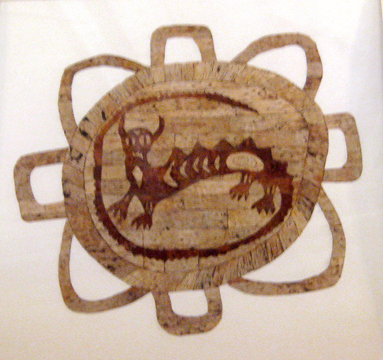 The Creek peoples speak of a creature called the Water Master or ue pucase (roughly prounounced oy poo-chah-see).
There is a bit of a debate, though, about what sort of creature this is. Some say ue pucase is just another term for the tie snake. Others, apparently among the eastern Creeks, say it is an aquatic feline creature, perhaps similar to the underwater panther of Algonquian lore.
Water Masters are cunning and deceitful creatures. According to one Hitchiti legend,
[T]he Water Master never tells the truth. The Water Master only tells half the truth and if the Water Master tells you the whole truth there is always a catch. (Bill Grantham, Creation Myths and Legends of the Creek Indians [University Press of Florida, 2002] 273)
Uncanny Georgia: Tie Snakes
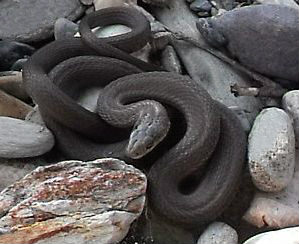 In some Muskogee accounts, “tie snake” is basically synonymous with “horned serpent.” In other versions of the myth, they are two separate creatures, of which the tie snake properly so called is much smaller than the horned serpent, and not quite as malevolent.
Tie snakes are most often associated with Muskogee culture, but they are also known, for example, to the Hitchiti, Yuchi, Natchez, and Chickasaw. In the Muskogee language, they are called estakwvnayv (ee-stah-kwuh-nah-yuh). In outward appearance, they aren’t terribly different from any ordinary snake. They are usually either black or dark blue in color. In some legends, their head is crooked over like the beak of a hawk.
But appearances can be deceiving. Tie snakes are almost always depicted as immensely strong. They often drag humans underwater, so be careful when you go near the water!
Tie snakes also exert control over water. One account has a tie snake summoning a flood large enough to overwhelm an entire town. Furthermore, these creatures are often shape-shifters. By some accounts, the tie snake was originally a man who was transformed into a serpent-like being after eating taboo food.
The most powerful tie snakes are expert animal charmers, able to command ordinary snakes to do their bidding. The “king of the tie snakes” is an almost godlike underworld being who claims to know “all things that are under the earth.” This figure might be depicted seated on a throne made of writhing snakes. He can be both frightening and demanding, but also willing to assist those who are worthy.
Uncanny Georgia: Tsul ‘Kalu
![Judaculla Rock, photo by Onmountain [CC BY-SA 3.0], via Wikimedia Commons](https://pursiful.com/wp-content/uploads/2023/03/dc831-800px-close_up_of_judaculla_rock_nc_taken_in_july_2013.jpg)
Judaculla Rock, photo by Onmountain [CC BY-SA 3.0], via Wikimedia Commons
The Cherokee of northern Georgia no doubt would have also been familiar with Tsul ‘kalu. But this “lord of the hunt” was not merely an individual. The plural form, tsunil ‘kalu refers to a race of mythological giants that live in the far west. According to James Mooney’s Myths of the Cherokee (1900),
James Wafford, of the western Cherokee, who was born in Georgia in 1806, says that his grandmother, who must have been born about the middle of the last century, told him that she had beard from the old people that long before her time a party of giants had come once to visit the Cherokee. They were nearly twice as tall as common men, and had their eyes set slanting in their heads, so that the Cherokee called them Tsunil’kälû’, “The Slant-eyed people,” because they looked like the giant hunter Tsul’kälû’.… They said that these giants lived very far away in the direction in which the sun goes down. The Cherokee received them as friends, and they stayed some time, and then returned to their home in the west.
In Children of Pride, my protagonists pass by Judaculla Rock on a couple of occasions, although I don’t bring up its associations with Tsul ‘kalu. In Oak, Ash, and Thorn, however, I did manage to find room for a slant-eyed giant as a secondary character.
Uncanny Georgia: The Honka
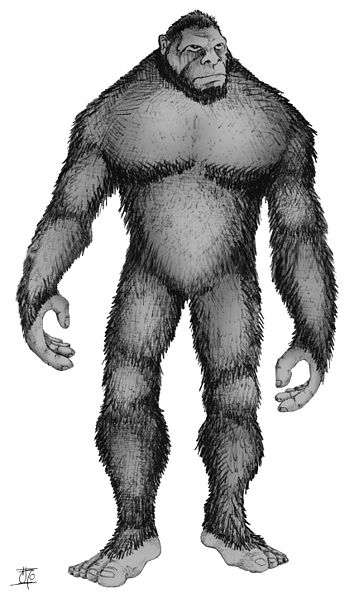 The honka is sometimes referred to as “Hairy Man.” More specifically, it is a hairy, man-eating ogre in Creek mythology. Another Creek term for this creature is kolowa, a term originally used by the Crow people but adopted by the Creeks after their forced removal to Oklahoma. Some recent Creek storytellers have translated kolowa as “gorilla.”
In many ways, the honka or kolowa is the Creeks’ answer to “Bigfoot”—although it is questionable whether Native Americans ever had a “Bigfoot legend” such as white Americans would conceive it.
Honkas are malicious creatures. One story reported by Michelle Smith in Legends, Lore and True Tales of the Chattahoochee (The History Press, 2013) describes how a female kolowa killed and ate the wife of a hunter—and other members of his village—while the hunter was away from home.
Uncanny Georgia: Sharp Ears
Here’s another creature described in Bill Grantham’s Creation Myths and Legends of the Creek Indians (University Press of Florida, 2002):
Sharp Ears were usually seen in pairs and never traveled east or west. Seen especially near the sources of small streams, they had sharp noses, bushy tails, and globular feet. The Oklahoma Seminoles called these Fire Dogs. Lena states that these creatures were about a foot tall and had ears, and that the male and female always traveled together. (36)
The Muskogee word for these creatures is hvcko fvske, which Grantham renders as håtcko fåski. By whatever spelling, the approximate pronunciation is “hutch-ko fuss-kee.”
 Darrell J. Pursiful