
Recent Comments


If Randy Queen Doesn’t Like Criticism of His Art then He Needs to Take an Anatomy Class
Randy Queen is a comic book artist with… a not great understanding of female anatomy. This landed several of his works on Escher Girls, the tumblr blog that highlights and critiques (and sometimes offers redraws) of ridiculous and needlessly sexualized depictions of female characters (hence the name, and which io9 has featured before).
So, instead of taking heed of said criticism (and it’s sad that no one has screenshots of the taken down posts because they would have been on point) he files some tenuous DMCA takedown notices to Tumblr. Which complies, no questions asked. Now, I’m no legal expert, but I’m pretty sure criticism falls under fair use. Techdirt has a good write up of why that is. And tumblr has not only taken down reposts of Randy Queen’s comic art, but also redraws – works that (to my mind) belong to whoever did the redrawing.
Not content with misusing the law once, this guy has since also threatened Escher Girls with defamation for posting about his DMCA takedown notices (because saying that something that happened happened is now “defamation”), and claiming a very bogus “right to protect the perception of my IP.” Which doesn’t exist. Ever.
(And in spite of his whining about art from 15 years ago, I either can’t find anything more recent from him or his style and understanding of said human anatomy has not changed significantly.)
As Popehat always says, “vagueness in legal threats is a hallmark of meritless thuggery.”
So this post is just me doing my bit to acquaint Randy Queen with the Streisand Effect.
Warning: Comments appearing at the original post may not be suitable for all readers.
Sunday Inspiration: Teachers
The best teachers are the ones who show you were to look but don’t tell you what to see.
—Alexandra K. Trenfor
The Science of Super Heroes
The Week has the rundown courtesy of Sulagra Misna of World Science Festival: “The Science behind Captain America’s Shield, the Hulk’s Anger, and More.”
Balamob: Maya “Masters of the Night”
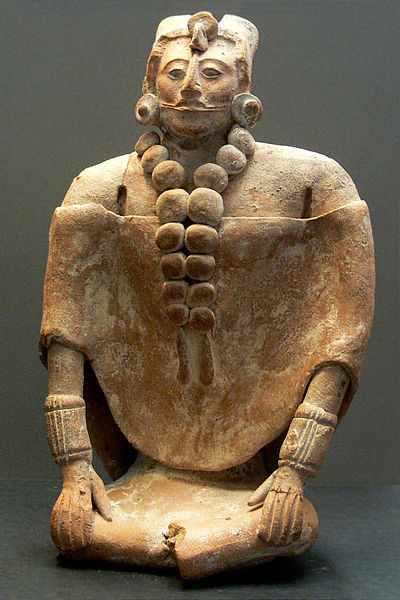
Maya dignitary
In the folklore of the Yucatec Maya exists a type of supernatural being called yumtsilo’b, “worthy or deserving lords.” This term designates a number of protector or guardian spirits who might be divided into three classes according to their functions or attributes:
- The balamob, charged with protecting people, farms, and villages.
- The kuilob-kaaxob (or ah canan k’aax), who watch over mountains.
- The chacob, who control the clouds and send the rain.
Though they can be distinguished by function, these are likely three names designating the same sort of being. According to Ascención Amador Naranjo,
In our opinion, these three categories are no more than invocations of a singular being that manifest according to the functions with which it identifies on a given occasion. In Maxcanú, the term used with the most frequency to refer to them as a whole is balam, which flows together with the other specific names in the references of the informants. (“Yumtsilo’b/balamob: los dueños de la noche,” Perspectivas antropológicas en el mundo maya, ed. María Josefa Iglesias Ponce de León and Francesc Ligorred Perramon [Sociedad Española de Estudios Mayas, 1993] 488. All translations of Dra. Amador Naranjo’s paper are my own)
Balamob (singular, balam) can thus refer either to all of these protective spirits or specifically to the first of Amador Naranjo’s three subtypes. Balam literally means “jaguar.” These beings are also sometimes called balam uincob or “jaguar people,” although the Spanish plural balames is also sometimes heard.
The jaguar was highly respected and venerated by the people of Central America. In pre-Columbian iconography, it is associated with gods and sacred structures. The Maya believed jaguars had the ability to cross between the mortal realm (associated with the day) and the realm of the spirit (associated with the night). Powerful kings and warriors also availed themselves of jaguar iconography.
The earliest depictions of balamob were as gigantic terrifying guardians of the four directions. In modern times, they are seen more as guardians of nature. They protect the people along with their villages and farms. Their main function is seen to be protecting people from evil or calamity during the night. One of Amador Naranjo’s informants describe them thusly:
“They are the ones that walk on the mountain, the masters of the mountain, who watch thus by night—or better said, who watch over us. They are ghosts, balam uincob.” (489)
Although their appearance is very similar to that of human beings—old men with white hair, beards or moustaches, dressed in traditional clothing also colored white—they are not of the same nature. Rather, they are described as creatures of “pure wind” or “pure air.”
Another function of the balamob is to instruct and help the h’men or medicine man. They feel a predilection for certain children, whom they take to their abodes to impart a knowledge of traditional medicine.
Like the mound-warriors of the American Southeast, balamob are sometimes said to dwell in ancient ruins. For this reason, many people fear to touch the ruins lest they provoke their ire.
Humans and balamob have a reciprocal relationship. Whenever a mortal takes something that belongs to the balamob, he or she must repay them. If they don’t, their crops might fail or they might fall ill. In this, the balamob sound quite similar to legends of “little people” all over the world.
Some contemporary Maya have folded their belief in balamob into their Catholic faith. They say, for example, that these beings are subordinate to the will of God although they have power over the forces and phenomena of nature that most influence people’s destiny. For many, the balamob‘s function of protecting mortals during the night takes on special significance on the night following Good Friday when, they say, the rule of the crucified Christ does not prevail upon the earth.
The Wonder of Chocolate
Thanks to Jesus Diaz for sharing this amazing video of cacao farmers in Côte d’Ivoire actually tasting chocolate for the first time!
Jesus adds:
Watching them marvel about this sweet food that comes from the beans they harvest is amazing to me. First, because it’s a joy to see their faces. Then, because it’s a stark reminder of how amazingly lucky we are.
For us westerners chocolate is just one more thing. It’s inconsequential. We like to eat it, sometimes we get delighted by it for a minute. But more often than not it’s just one more snack to stuff our fat faces with. We don’t think about it and the incredible effort and resources that are required to make it. We take it for granted along with the other billion foods and the other billion other technologies and privileges we didn’t fight for.
I’m not posting this to be preachy. This comes from a place of true wonder, to remind myself about my own comfortable numbness and the hundred things that I take for granted every day. One day something fatal will happen and then you will realize how much time you wasted whining about this or that rather than enjoying the infinite amount of awesome (yes, everything is awesome!) stuff that exists around you.
Indeed.
Of Cheshire Cats and Transubstantiation
Scientists have created an effect comparable to a subatomic Cheshire cat. Rather than a grin that has been separated from its cat, they have created a property of magnetic moment (I’ll not pretend I understand what that is) separated from its neutron. As Stephen Luntz explains,
In the classical world we are familiar with the idea that a property like magnetic moment cannot be separated from its object – it would be like taking the taste away from a chocolate bar so that the bar produced no sensation on the tongue, but a disembodied taste could be detected somewhere quite distinct.
However, things work differently in the world of the very small. In the 1990s, Professor Yakir Aharonov of Tel Aviv University proposed the properties could indeed be detached from particles (his book explaining it is delightfully subtitled Quantum Theory for the Perplexed). The idea develops on Schrödinger’s famous feline thought-experiment. However, instead of ending up with a live and dead cat, you have a cat without its properties, and properties without the cat. The naming after Carroll’s Cheshire moggy was inevitable.
Thus,
Denkmayr and his co-authors…temporarily removed the magnetic moment from the neutrons using an interferometer. They used a silicon crystal to split a neutron beam and reported, “The experimental results suggest that the system behaves as if the neutrons go through one beam path, while their magnetic moment travels along the other.” The beams were then reunited, leaving no disembodied magnetic moments prowling the universe.
It seems to me some enterprising Catholic theologian might jump on this as a way to realign the doctrine of transubstantiation with modern theories of physics (just as the original doctrine aligned with Platonic thought). To use the classical terminology, what might it mean to say that a set of “accidents” (properties) can be separated from its “substance” (objects)?
Quantum Cheshire Cats
Scientists have created an effect comparable to a subatomic Cheshire cat. Rather than a grin that has been separated from its cat, they have created a property of magnetic moment (I’ll not pretend I understand what that is) separated from its neutron. As Stephen Luntz explains,
In the classical world we are familiar with the idea that a property like magnetic moment cannot be separated from its object – it would be like taking the taste away from a chocolate bar so that the bar produced no sensation on the tongue, but a disembodied taste could be detected somewhere quite distinct.
However, things work differently in the world of the very small. In the 1990s, Professor Yakir Aharonov of Tel Aviv University proposed the properties could indeed be detached from particles (his book explaining it is delightfully subtitled Quantum Theory for the Perplexed). The idea develops on Schrödinger’s famous feline thought-experiment. However, instead of ending up with a live and dead cat, you have a cat without its properties, and properties without the cat. The naming after Carroll’s Cheshire moggy was inevitable.
Thus,
Denkmayr and his co-authors…temporarily removed the magnetic moment from the neutrons using an interferometer. They used a silicon crystal to split a neutron beam and reported, “The experimental results suggest that the system behaves as if the neutrons go through one beam path, while their magnetic moment travels along the other.” The beams were then reunited, leaving no disembodied magnetic moments prowling the universe.
Do You Support or Oppose the Homophone Agenda?
This post from Language Log’s Mark Liberman has me vigorously shaking my head. Quoting Paul Rolly of the Salt Lake Tribune:
Homophones, as any English grammarian can tell you, are words that sound the same but have different meanings and often different spellings — such as be and bee, through and threw, which and witch, their and there.
This concept is taught early on to foreign students learning English because it can be confusing to someone whose native language does not have that feature.
But when the social-media specialist for a private Provo-based English language learning center wrote a blog explaining homophones, he was let go for creating the perception that the school promoted a gay agenda.
Erm… What?
Of course, Liberman’s final sentence is the one that really has me worried:
Since intelligent people are not a protected group under U.S. employment law, Mr. Woodger was apparently on solid legal ground in firing Torkildson.
It’s a Good Thing She Didn’t Just Blow Up the Place
Check out Aaron Goldberg, “Powering Disney’s Frozen with a Carnot Refrigerator,” Journal of Interdisciplinary Science Topics 3 (19 Feb 2014). Here’s the abstract:
Frozen is Disney’s latest film, in which the character Elsa unleashes winter on her entire kingdom. This paper quantifies the amount of water frozen and the amount of work required by a Carnot refrigerator to do so, arriving at values of 5.49772788 x 10^2 moles and 5.8 x 10^15 Joules, respectively.
You can read about how a Carnot refrigerator works here. Basically, it is possible to harness a temperature difference between two reservoirs to generate work (a Carnot engine). But you can turn the equation around and harness work to create this difference of temperature. This effect is called a Carnot refrigerator.
In layman’s terms this means
It has been shown that in Frozen, Elsa froze approximately 5.5 x 10^12 moles of water. To accomplish Elsa’s feat, a Carnot refrigerator would require 5.8 x 10^15 Joules of energy. This amount is equivalent to the energy released by the Hiroshima nuclear bomb 115 times over, or that released by 63 Nagasaki nuclear bombs. This immense number puts Elsa’s power into perspective, implying either that the Snow Queen has enormous strength, or that Disney underestimated the ramifications of their animated fantasy.
I’m going with the second option on this one, but it would still be pretty cool if Elsa could generate enough energy to basically hold her own with the likes of Superman or the incredible Hulk. That’s a movie I’d go see.
(H/T: io9)
If Amazon Goes Bad…
I’ll be the first to tell you that my fiction writing is a hobby that (somewhat) pays for itself. I’m not trying to make a living doing this, just sharing a little bit of my craziness with the world. If that changes in the future, I’ll let you know. (Not the craziness: that’s not going to change.)
A rather significant conversation among those who are trying to make a living as an indie author has to do with Amazon and what happens if the company gets too big (if it isn’t already) and decides to use its monopolistic power inappropriately.
On that front, my friend Jennifer Becton has some helpful words. If anybody knows the indie author beat, it’s Jennifer. Listen to what she has to say.
 Darrell J. Pursiful