
Recent Comments


Seeing Fairies
This review of Marjorie T. Johnson’s Seeing Fairies: From the Lost Archives of the Fairy Investigation Society, Authentic Reports of Fairies in Modern Times may be of interest to some.
Reading Hagar with Paul (and a Bunch of Other Folks)
So, one of the reasons I haven’t been blogging as much lately is that I’ve been working working on the Galatians volume of the Smyth & Helwys Bible Commentary. Marion Soards has ably handled the exposition; I’m responsible for supplementary materials: sidebars, sermon/teaching ideas, and so forth. My deadline is still about a month away, so I’m still going to be fairly quiet around here, but I thought I’d repost a bit on the reception history of the Hagar story from Genesis that, you may know, figures prominently in Galatians 4.
Reading Hagar
In chapter 1 of Reading the Bible with the Dead, John L. Thompson surveys the history of Christian interpretation of Hagar, Abraham’s wife-concubine whose story is told mainly in Genesis 16 and 21. Hagar enters the biblical narrative as Sarah’s Egyptian slave, forced to sleep with her husband Abraham in an ill-advised scheme to produce for him an heir. She is used, abused, and then cast out of the family when, after the birth of Isaac to Sarah, it was deemed she had outlived her usefulness.
In Galatians 4, Paul used Hagar yet again—this time as an allegory for slavery to the Mosaic law. The “throw-away” sexual surrogate becomes a symbol of all that is second-rate in the economy of God. But such readings miss some amazing details of Hagar’s depiction in the book of Genesis, and Thompson credits feminist interpreters with bringing these details to light. Three observations and criticisms have registered with respect to Hagar’s story in Genesis. First, there is the concern “to recognize and recover the dignity, eminence, and even the exemplary character of Hagar” (15). Second, other feminist interpreters take an opposite approach by calling attention to what Hagar suffered and what this tells us about the character of Abraham (and Sarah). Finally, Hagar’s story has drawn attention to what may be called “the sins of the narrator” (16), the subtle clues in the text that betray the patriarchal biases of the storyteller himself, if not the Deity behind the action.
After this brief introduction to the problems surrounding the Hagar narratives, Thompson raises the question to which many modern interpreters believe they already have the answer: Has the church forgotten Hagar? In fact, Thompson finds that interpreters of previous generations had long struggled with the disparities of these biblical texts—and often came to conclusions quite similar to those of modern feminists.
Did Paul’s Allegory Win?
In answer to the first concern, that of recognizing the positive dimensions of Hagar’s character, Thompson notes that there were, in fact, two strands of allegorical thought surrounding Hagar. The one in Galatians 4 we know, but ancient interpreters realized this was only one piece of the puzzle. For Philo of Alexandria, the symbolism of Hagar was the “preliminary teachings” that the wise must study on their way to true wisdom (symbolized by Sarah).
For Origen as well, Hagar does not represent a literal wife or a fleshly union, “but rather the virtue of wisdom” (19). Abraham thus did not take on a second wife, but a second virtue. Her expulsion from Abraham’s camp provides a contrast between the meager skin of water with which she is provided and the divine spring she discovers in the wilderness. She is thus like the Samaritan woman of John 4: “both had their eyes opened to see a well of living water, which in each case was Jesus Christ” (19).
Later patristic interpreters likewise found in Hagar some symbol of godly virtues. For Didymus the Blind, Hagar could only symbolize these virtues because, as a historical person, she possessed them in a literal way, “as evidenced by her good behavior and her worthiness to receive heavenly visitations” (19). He even invokes Matthew 5:8, “Blessed are the pure in heart, for they shall see God,” to argue that, since she had a divine vision, Hagar must have been pure in heart.
In all of the patristic era, Augustine is virtually alone in attributing purely negative characteristics to Hagar. For him, she is a figure of heresy. Into the medieval period, the church’s assessment owes more to Origen and Didymus than to the bishop of Hippo.
Abraham on Trial
Nor does the early church let Abraham off the hook for his despicable treatment of Hagar. The earliest worries about Abraham expelling Hagar and her son Ishmael come from the rabbis. In Genesis Rabbah, there is great interest in the meaning of the Hebrew term in Genesis 21:9 where Ishmael is “playing” with Isaac. For the rabbis, this term was associated with shameful deeds—”fornication, or idolatry, or attempted homicide” (23). Whether these speculations are true, it must be said that they apparently arose out of a sense of discomfort with Abraham’s seeming extreme reaction against Ishmael’s otherwise innocent behavior.
The disparity between Ishmael’s “crime” and the “punishment” inflicted by Abraham captured the attention of Christian writers as well. John Chrysostom “attributes great reservations to Abraham over the severity and oppressiveness of Sarah’s plan to evice Hagar and Ishmael. A few years later, preaching on Galatians, he makes some similar moves, arguing that only the stirrings of divine providence can account for this event, for otherwise the penalty would be vastly more serious than Ishmael’s brashness warranted” (23).
Abraham’s severity in this episode was a preoccupation of Jewish and Christian interpreters throughout the Middle Ages, with varying success. Thompson explains,
Rashi reported that Hagar’s “wandering” in Genesis 21:4 may have implied her moral wandering into idolatry, while Abraham Ibn Ezra insisted that later on, after Sarah’s death, Abraham lavished gifts upon Ishmael’s children. None of the rabbis, however, nor any Christian commentator, can equal the blunt confession of Rabbi Nachman, writing in the thirteenth century: “Sarah sinned in afflicting her, and also Abraham for permitting it. God hearkened to Hagar’s cry, and as a result her descendants persecute and afflict the seed of Abraham and Sarah. (24)
Christian interpreters as well wrestled with the questionable morality of Abraham and Sarah’s treatment of Hagar. Thompson lists Cardinal Cajetán, Conrad Pellican, Wolfgang Musculus, Peter Martyr Vermigli, and Martin Luther as Christians who noted the ethical problems with this text. He quotes Luther’s assessment,
Abraham simply sends away his beloved spouse, she who first made him a father, along with his firstborn son, giving them only a sack of bread and a skin of water…. But does it not seem cruel that a mother burdened with offspring should be dismissed so miserably, and that, to an unknown destination, indeed, into a vast and arid desert? … If someone wanted to rant against Abraham at this point, he could make him the murderer of his son and wife…. Who would believe this if Moses had not recorded it? (25)
None of these precritical interpreters intended to hang Abraham without a trial. On the contrary, they strove to find a way to harmonize the actions of the biblical characters with the moral standards they learned in Christ. But as Thompson notes, “If some [commentators] appear to have worked overtime to exonerate Abraham, they never lost sight of the seriousness of the charge against the patriarch nor brushed aside the terror inflicted on Hagar and her son” (25-26).
Stereotypes…and Sympathy
What then about the “sins of the narrator” in how Hagar’s story is told? Feminist interpreters charge that traditional, patriarchal exegesis has locked Hagar into “a petty and stereotypical role” (26) and whitewashed the injustices committed against her. But Thompson argues the history of exegesis of these passages does not quite fit this billing. “They are admittedly patriarchal, albeit in an unconscious way,” Thompson argues, “and they are capable of succumbing to gender stereotyping, but they show a surprising tendency to rise above these traits in pursuit not only of ‘literal’ exegesis but also in defense of Hagar” (26).
Again, Thompson surveys numerous commentators, this time from the Reformation era. Zwingli, Pellican, Musculus, and Luther all characterize Hagar as a humble, pious woman, despite the culturally bound gender stereotypes within which they worked. Musculus in particular believed Hagar had every reason to complain of her treatment. He even admits that “Hagar would not have sinned had she voiced some of her complaints. AFter all, Job and Jeremiah offered laments, and even Christ cried out fromthe cross, ‘My God, my God, why have you forsaken me?’” (27). Luther could even speak of the godliness of “saintly Hagar” (28) and ponder how her experience is a figure of the Christian path from humiliation to faith and repentance.
Hagar in Church and Pulpit
Reading the story of Hagar with the dead offers a payoff to Christians today. Freely admitting that not every early interpreter saw Hagar in such a sympathetic light (Augustine and Calvin in particular are noted for being “curiously untouched by the various expressions of interest and sympathy that most commentators drew from this biblical text,” 29), Thompson suggests there are four key lessons we can learn from the history of exegesis of Hagar’s story (29-31):
- Hagar is Important. Any incursion into the patriarchal narratives that treats Hagar as the lectionary has mostly done, excising the dubious deeds of Abraham as well as Hagar’s own triumphs and travails, is at once a betrayal of the integrity of the biblical text and the squandering of a rich homiletical opportunity.
- Hagar’s Story Is Terrifying. Nothing is gained by “reading for the center” so as to pretend that Hagar’s misfortunes did not happen or that they weren’t so bad after all, given the happy ending that came her way.
- Hagar Is More than a Symbol. Despite the precedent offered by Paul’s allegory of Hagar as a figure or type of those who foolishly sought justification through the law, Galatians 4 should not erase or upstage the compelling portrait of Hagar in Genesis.
- Hagar Is Connected to Us by Our Own Tradition. If it is dysfunctional to ignore Scripture’s silences, it is hardly better for preachers to suppose they can fix the Bible alone, by exercising their own authority or creativity. Instead, congregations ought to be reconnected to Christian tradition by being reminded of the witness of past interpreters.
A final note: Thompson covers vast swaths of history of interpretation in only a few pages. While at one level I would have preferred more extensive quotation from the primary sources, I appreciate that this would make the book large and unwieldy. He provides a 28-page “Finding Guide” at the back, broken down by biblical book, of the major historical interpreters whose works are currently available in English. Readers who want to check Thompson’s citations and do additional research are thus armed for the task.
Sunday Inspiration: Books
What an astonishing thing a book is. It’s a flat object made from a tree with flexible parts on which are imprinted lots of funny dark squiggles. But one glance at it and you’re inside the mind of another person, maybe somebody dead for thousands of years. Across the millennia, an author is speaking clearly and silently inside your head, directly to you. Writing is perhaps the greatest of human inventions, binding together people who never knew each other, citizens of distant epochs. Books break the shackles of time. A book is proof that humans are capable of magic.
—Carl Sagan

Agriculture and Food in Worldbuilding
Because lunchtime:
Worldbuilding: Food for the People by B. Pine.
Five Little People from the American Southeast

George Catlin, “Tchow-ee-pút-o-kaw,” 1834
The indigenous peoples of the American Southeast lived alongside one another long enough that many of their beliefs about the little folk have at least partially blended together. Carolyn Dunn has written a short article on Southeastern little people that draws from several cultural sources. The picture that emerges from such a cross-cultural survey of the little folk is more often than not quite coherent. If we think of little folk as a species, then we are dealing with a number of closely related subspecies that generally display the following characteristics:
- These creatures are very good at not being seen. They are selective about whom they permit to see them at all—generally only children or medicine people.
- They are more often mischievous than truly evil, although their pranks can be quite destructive. It is unwise to speak disrespectfully even of those who are well-disposed toward humans, however, as they are quick to take offense.
- They are often more kindly hearted toward children, often leading them home when they get lost in the forest.
- They live deep in the forest or in other out-of-the-way natural settings.
- They are often (but not always) associated with the healing arts. Many of these groups, in fact, serve as spiritual helpers to healers and herbalists and are often instrumental in initiating youngsters into the healing arts.
Here are five types of Southeastern little folk arranged roughly from north and east to south and west.
Yunwi Tsunsdi
There are two prominent groups of faery-like beings in Cherokee legend. There are the nunnehi, tall “spirit warriors” who are indistinguishable from ordinary humans (except for their magical powers), and the yunwi tsunsdi (yoon-wee joons-dee) or “little people,” child-sized beings who live in the rocks and cliffs.
Like the nunnehi, the yunwi tsunsdi prefer to be invisible, although they do sometimes appear to humans. Seeing them, however, is sometimes taken as an omen of impending death. They are well-proportioned and handsome, with hair that reaches almost to the ground.
Yunwi tsunsdi are depicted as helpful, kind, and magically adept. Like many faery creatures, they love music and spend much of their time singing, drumming, and dancing. For all this, they have a very gentle nature and do not like to be disturbed. Even so, they are said to harshly punish those who are disrespectful or aggressive toward them.
In Cherokee lore, the yunwi tsunsdi are divided into three “clans” with varying attitudes toward humans. The Rock clan is most malicious, the Laurel clan is merely mischievous, and the Dogwood clan is most benevolent.
Yehasuri
These Catawba little folk, whose name can be translated roughly “the wild people,” are about two feet tall and usually depicted as hairy. They are trickster spirits that live in the forest. They often live in tree stumps and eat a varied died including acorns, roots, fungi, turtles, tadpoles, frogs and bugs.
These little folk are said to behave in ways very similar to the faeries of Europe. They kidnap children, for example, and like to braid the manes and tails of horses. Like the elves of northern Europe, their magical arrows are deadly to mortals. They are said to attack anyone who gets too close to them.
One of their favorite tricks is to prowl around after dark and place spells on any children’s clothing that had been hung up to dry. This bewitched clothing would give babies colic. Therefore, conscientious Catawba mothers would bring in their infants’ clothes at dusk, wet or dry.
Yehasuris are sometimes used as bogeymen to impress upon children the importance of good behavior. Indeed, they do seem to target children more than anyone else. The only way to stop them is to rub tobacco on one’s hands and recite a particular incantation against them.
Este Lopocke
As with the Cherokee, the Muskogee people (Creeks and Seminoles) distinguish between two sorts of little people, one taller and the other shorter. And among the shorter, some are more benign and others are more harmful to humans. George E. Lankford reports the observation of A. S. Gatshet in the 1800s that
The Creek Indians…call them i’sti lupu’tski, or “little people,” but distinguish two sorts, the one being longer, the others shorter, in stature. The taller ones are called, from this very peculiarity, i’sti tsa’ptsagi [i.e, este cvpcvke, “tall people”—DJP]; the shorter, or dwarfish ones, subdivide themselves again into (a) itu’-uf-asa’ki and (b) i’sti tsa’htsa’na…. The i’sti tsa’htsa’na are the cause of a crazed condition of mind, which makes Indians run away from their lodges. (Native American Legends of the Southeast [University of Alabama Press, 1987/2011] 133)
I don’t know if this tracks perfectly with the Cherokee distinction between taller nunnehi and a number of clans or tribes of shorter yunwi tsunsdi, but it at least seems plausible. I certainly welcome any insight readers might be able to give me!
The este lopocke or este lubutke (ee-stee loh-poach-kee) live in hollow trees, on treetops, or on rocky cliffs. Their homes can be identified by an extra thick growth of small twigs of branches in the trees. Despite their small size, they appear strong and handsome, with fine figures and long but well-kept hair. They might let their toenails grow long, however.
These beings are especially known to appear to medicine people and guide them in finding the herbs they need. Encounters with the little people are considered sacred and not to be shared.
The Muskogee sometimes speak of the little people simply as “Gee” (“Ce” in normalized spelling), meaning “little,” so as to avoid using their full name. Even the helpful ones object to being mentioned in a negative or disrespectful way.
Iyagȧnasha
The little folk of Chickasaw lore are sometimes identified as tribal ancestors who now take up residence in the forest. They are said to be about three feet tall. Although they might help those who are in trouble, they are also likely to play tricks on those who have offended them. They allow themselves to be seen only to a few, mostly hunters or medicine people.
They do, however, interact with children. Sometimes they choose a child to live among them for a while to be given special powers of healing. When this child grows up, he or she becomes a healer or herbalist. They might teach other children how to pursue game, as they are accomplished hunters themselves.
Even so, it is considered ill-advised to live near the iyagȧnashas. The Chickasaw would move away from an area if they thought there were little people there.
The worst enemy of the iyagȧnashas is the wasp, the sting of which is fatal to them.
Hatak Awasa
There are several types of little folk among the Choctaw. One, the kowi anukasha, serves much the same role as the Chickasaw and Muskogee little folk in initiating young children into medicinal lore.
Another type, simply called hatak awasa (or hutuk awasa), “little men,” are similar to both the bogeymen and little folk of European myth. Children are warned to be good lest the hatak awasa snatch them away. Although their role can be sinister, they also preserve otherworldly knowledge handed down from olden times.
Sunday Inspiration: Solitude
I think it’s very healthy to spend time alone. You need to know how to be alone and not be defined by another person.
—Oscar Wilde
A Cashless Fae Society?
In Children of Pride, the Fair Folk do not use money and do not understand the concept of “payment” the way ordinary mortals do. How can an advanced society exist without money? The simple answer, of course, is because magic.
This Crash Course World History video provides an alternative explanation grounded in anthropology.
Bendith y Mamau: Ugly Welsh Faeries
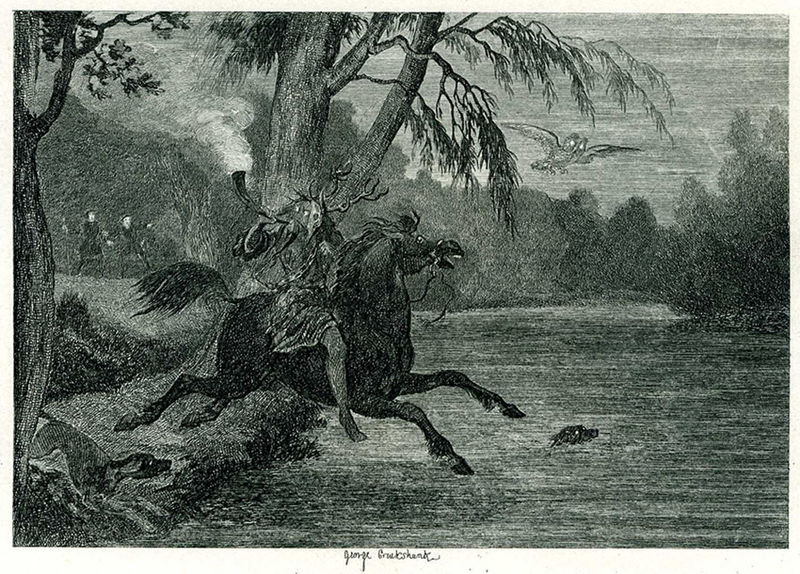
George Cruikshank, Herne the Hunter, 1840s
In Glamorganshire and Carmarthenshire, Wales, bendith y mamau (“mothers’ blessing”; roughly pronounced ben-dith uh mah-may) is a generic term for all faeries. The other Welsh term for faeries is tylwyth teg (“fair family” or “fair folk”). Some see these two terms as synonymous.
As in many faery legends, it was thought best to refer to the bendith y mamau with a flattering euphemism. In fact, there little that is “motherly” or “blessed” about these creatures. More often than not, they are, in fact, malicious and destructive in their dealings with mortals.
According to some accounts, these creatures are a grotesque cross-breed of goblin and faery. They possess the glamour or illusion-magic of faeries but the stunted and ugly appearance of goblins. Some say they have an affinity with either brownies or the pisgies (pixies) of the West Country.
The bendith y mamau are known to kidnap mortal children and replace them with their own hideous offspring, called crimbils. Stories suggest, however, that these mortal children might be returned many years later with only the faintest memory of their time among the Fair Folk. Bendith y mamau can be envious creatures, particularly of another’s beauty. They generally treat their captives well, however.
These faeries are also associated with Welsh underworld hounds. These beasts, usually called cwn annwn (“hounds of the underworld”) are sometimes also known as cwn bendith y mamau or simply cwn mamau. The appearance of these spectral dogs is thought to be an omen of death. They are also associated with the Wild Hunt.
Despite these unseemly characteristics, these faeries are also often skilled musicians and singers. Their music is capable of producing a trance-like reverie that erases a person’s memory, leaving them with only a faint recollection of the sweet music itself.
The Changing Face(s) of Fantasy
Adam Dalton describes the continuing relevance of the fantasy genre in this insightful article over at Fantasy Faction. He writes,
Things move on. Things evolve. It’s healthy that the fantasy genre does so too – it keeps it fresh, vibrant, progressive and alive. It keeps is strongly ‘relevant’ to new readers. There are some genres that are far less progressive (in literary terms), and that are beginning to fail. A clear example is the genre of horror. Book sales have all but died off entirely (although in TV and film horror still does well). Many Waterstones stores have entirely done away with their horror sections (hiding them in their Scifi/Fantasy sections or relabeling them as Dark Fantasy sections). Unless you’re Stephen King or James Herbert (RIP), you simply aren’t going to sell many books if your book is labelled ‘horror’. Horror is literally dead. Ironically dead. Dead. Justin Cronin’s The Passage was first launched as a horror, and it hardly sold. It was relabelled scifi and relaunched. Again no sales. Then it was launched as a literary fiction and it became a best-seller.
Because scifi in terms of book sales is also in massive trouble. Brian Aldiss…puts is down to the fact that we now ‘live in a scifi world’ and that we therefore no longer need to read scifi so much. ‘Every week there’s some new device or invention that comes out and we don’t know how it works! Strange and confusing technology is all around us.’ Mr Aldiss has put his finger on it for me – current readers just don’t see scifi literature as being as ‘relevant’ to them as past readerships did.
Yet fantasy survives and thrives! Where it was the poor cousin to scifi in the 1970s, it now utterly dwarfs (interesting verb!) scifi. How does fantasy do it? What’s the secret? Well, it’s the magic of fantasy, isn’t it? Magic is at the heart of that genre. It tricks, distracts, bewitches and bespells, where other genres merely appal or confuse. And it’s learnt to be relevant, to reflect the shifting dreams and fantasies of its readership, to reflect the current state of society. ‘The current state?’ you might frown. ‘But fantasy isn’t real. It’s precisely the opposite of that.’ Precisely. Look, you can’t get a job as a philosopher these days, so you have to become a reader or writer of fantasy. Fantasy is the fairground mirror to the real, the extension and twisted exploration of the real, the different way of seeing that enables real change.
I feel as if I owe an apology to the professors of philosophy I know for that line about not being able to get a job as a philosopher these days. But I didn’t say it, so you’re on your own.
 Darrell J. Pursiful