
Recent Comments


More Page Views from Finland than the US Today?
What’s up with that? Do I need to put some haltias or tonttus in my next novel?
Tervetuloa.
And Kiitos.
Sunday Inspiration: Taking Chances
Some failure in life is inevitable. It is impossible to live without failing at something, unless you live so cautiously that you might as well not have lived at all—in which case, you fail by default.
—J. K. Rowling
Ronald Hutton’s Typology of Faeries
In the video I mentioned in this post, Prof. Hutton provided a concise classification system for the faeries of northern Europe. It is but one part of a fascinating and expertly presented lecture, and I’m summarizing it here because it fits nicely (though not perfectly) with the way I developed the Fair Folk one meets in Children of Pride. Hutton speaks of three basic categories of faeries in the British Isles:
1. Faeries proper, which Hutton describes as “the neighbors from hell.” These are the frightening and often malicious faeries one encounters in the oldest strands of faerie lore: the daoine sídhe and their cohorts. They live underground in a society that mirrors that of human beings, with courts, royalty (usually queens), banqueting, dancing, and the like.
2. Household helpers, including all manner of brownies, hobs, fenodyrees, and the like. These creatures are more mischievous than malicious, and they can sometimes be persuaded to help with the domestic and agricultural chores. But be careful, because they are easily offended and may just leave if one does something of which they don’t approve.
3. Faerie tricksters such as Robin Goodfellow. These are practical jokers, generally harmless or amusing rather than hostile. They are a rather late invention according to Hutton, largely under the influence of Shakespeare’s Puck. He is most assuredly not a pooka, which would better be understood as a dreaded “night being.” He further compares Robin Goodfellow to Native American trickster archetypes like Coyote as a trickster and buffoon, but also sometimes a powerful cosmic force. (Hutton does not use the specific terminology of “faery trickster,” but I think this is a fair description.)
He also notes a fourth category:
4. Nature spirits such as the pans and nymphs of Greek mythology. Properly speaking, Hutton says there are relatively few of these in the folklore of the British Isles. He further insists that these creatures are not, properly speaking, faeries at all since they fit into the natural realm in a way that traditional Anglo-Celtic faeries do not. Unlike faeries proper, beings of this type seem to be nearly universal in human cultures. Although Hutton insists such creatures are not faeries, he does say that the trolls or faeries of Iceland (and the related trows of the Orkney and Shetland Islands) are something of a hybrid between this category and the first. They are “land wights” who exercise guardianship over the land, but they are also said to live in underground communities and are often less than hospitable to human beings.
If you’re interested in the faery lore of the British Isles, you really owe it to yourself to listen to Prof. Hutton’s lecture.
Faery Beliefs on the Isle of Man
The Celtic Myth Podshow has posted a video of Prof. Ronald Hutton discussing Manx faery traditions.
Watch and listen to this fantastic lecture given by the wonderful Prof. Ronald Hutton about the Fairy Folklore on the Isle of Man. As always, not only is the Prof. exceedingly entertaining to listen to, but his gives us some superb information about the Fae history of the Island as well its traditional folklore. He finally regales us with a personal tale to have you in stitches! Superb stuff!
In this lecture Professor Ronald Hutton looks at how the Isle of Man is famous as an island full of fairy traditions: in some ways it may be regarded as having the greatest concentration of them in the British Isles. It therefore seems a good place in which to address the question of what traditional fairy beliefs – those shared by ordinary people until recent times – actually were.
You might be interested to know that the title of Children of Pride comes from Manx cloan ny moyrn, which can be translated something like “children of pride” or “children of ambition.”
D&D’s New Edition
I haven’t played Dungeons & Dragons since college, but it still has a special place in my heart. Here is a rundown of how the 5th edition, shortly to be released, stacks up against the 4th edition. To judge by this review, it sounds like a return to the kind of storytelling-based gameplay that first hooked me way back in 5th or 6th grade.
Si’lats: Middle Eastern Shapeshifters
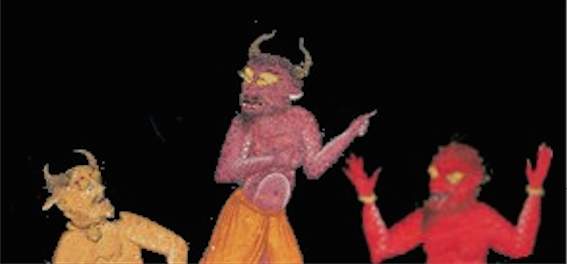
Ahsan-ol-Kobar, Ali and the Jinn (cropped), 1568
Si’lat, si’lah, or sila (plural sa’alin) literally means “she-jinn” or “she-ghul.” They are one of many types of jinn to inhabit the Middle Eastern world. In fact, they are often considered the smartest of jinn. They are talented shapeshifters who can easily pass as ordinary humans.
Sources vary on the morality of si’lats. Some assert they are the wickedest type of ghul; others that they are merely capricious tricksters who might either help or cause trouble for mortals.
Si’lats often dwell in woodlands, where they might capture travelers and force them to dance for their amusement.
Pre-Islamic traditions describe this jinn as sudden in appearance and disappearance, with a cat-like face, canine teeth, and a forked tongue.
Optics and Elvish Eyesight
Of course, this video doesn’t take account of magical elvish eyes! Still, I’m more and more convinced that a basic grasp of science and mathematics is a valuable tool for fiction writing in any genre.
Bracketology for Story Plotting?
Well, I certainly didn’t expect this! But it just might work, if you’ve got the mindset to pull it off:
Brackets in sports are used to match up opponents, and then show how the winners from those matchups go on to compete in turn.
The simplest kind of story to use this pattern would involve different characters who were each out to kill the others, ruin them, best them in a competition, or otherwise force them out of the plot.
Little Folk and Zoning: Not Just in Iceland
In September of 2012, a developer trying to build housing in Montville, Connecticut received some surprising news during a town hearing. They would need to alter their project because it threatened small stone structures that had been made by magical, dwarf-like creatures that lived underground.
Readers may be familiar with situations like this from Iceland, where construction projects are not allowed to harm the dwelling places of elves. But they are rare here in New England, where most people don’t believe in fairies, elves, and dwarves. (Bigfoot, ghosts, and UFOs are another story…)
However, magical little people are an ancient tradition among the Algonquian tribes that are native to this area, and the developer was planning to build 120 units of housing on Mohegan Hill, which is the historic and spiritual home of the sovereign Mohegan Tribe. Although the hill is not technically within the boundaries of the tribe’s reservation, it is still very important to them.
There follows an excellent introduction to the Makiawisug, the Fair Folk of the Algonquian traditions of New England.
 Darrell J. Pursiful