
Recent Comments


A Mythology-free Hercules Movie?
That’s apparently what we’re in store for with Renny Harlin’s Hercules: The Legend Begins. As Rob Bricken says,
When creating his Hercules: The Legend Begins movie, it appears that director Renny Harlin carefully researched every bit of the Hercules myth… so he could cross it all out and avoid doingany of it.
Sigh.
Google Middle Earth
As a tie-in to the upcoming Hobbit movie, the folks at Google Earth have expanded into the realm of fantasy with an interactive map of Middle Earth. Fantasy geeks: abandon any hope you may have had for work productivity leading up to Thanksgiving! (H/T: Fantasy Faction)
What Makes “Epic Fantasy” Epic?
Very thoughtful article up at Fantasy Faction on what it is that actually makes “epic fantasy” epic:
Epic Fantasy takes its name from the tradition of epic poetry that reaches back to antiquity and beyond. Epics, in this meaning of the word, were stories that stood as central pillars to the cultures that created them. Preserved orally, they were capable of being repeated thousands of times, so that listeners would grow up knowing the tales, not even able to remember a time before they had heard them. They were massively long and complex, and although they did have heroes, and often battles and dramatic adventure, their role was more complex than merely to entertain. They described a world not different from the one their authors lived in, but one in which the mysterious, the mythic, and the divine were made to speak openly and to make their actions clear. They helped explain the nature of the world.
Further, they showed how it changed. In all of the traditional epics, the narrative of events takes place on what historians call “a world historical scale.” This means that deeds of the main actors, the struggles and journeys that the epics recount, have an effect on the very nature of the world. They permanently change history. For better or worse, something is different at the end. When Odysseus returns home, Troy has been destroyed and the mythic age of heroes is over. At the end of the Aneaid, a city is established that will grow to become the largest empire the world had ever known. In vanquishing Ravenna, Rama establishes himself as the God-King on earth, fulfilling the destiny of the seventh avatar of the God Vishnu (I count the Ramayana as an epic in the traditional sense, although it is at the same time a living religious text). When Dante completes his journey through Hell, Purgatory, and Heaven, he has explained the fall and redemption of man according to the medieval Christian understanding.
Too Much? Not Enough?
Ever since this summer, I’ve been a smidge worried about the word count of Children of Pride. Chalk it up to my day job as an editor: I want the text to fit the space allotted, neither (terribly) too much nor (terribly) too little. My first novel looked a tad sparse when compared to the massive tomes my daughter usually reads!
So I was pleased to find this three-year-old post by Jacqui Murray about Word Count by Genre. It provides a basic rule of thumb for the desired word counts for various genres—yay!—and then goes on to list word counts for several famous novels—double yay!
Oh, and apparently I’m a worry wart. Children of Pride weighs in somewhere between The Adventures and Tom Sawyer (69,066) and Harry Potter and the Philosopher’s Stone (77,325). So we’re good to go. 🙂
Here Be Dragons
 Here is the PPT for the third and final installment of my recent Wednesday-night Bible study series, “Monsters: A Biblical Bestiary.” I think people have appreciated the series, even though it has been a bit challenging for some.
We looked at how to study the Bible in terms of translation, textual criticism, and understanding the cultural context in which it was written.
In “Here Be Dragons,” I talked about what happens when the monsters we find in the Bible are there because the biblical writers actually believed in monsters. In the process, we look a bit at the fact that the Bible describes the world in terms of ancient conceptions of cosmology, meteorology, and physiology.
Textual Analysis of Hunger Games, Twilight, and Harry Potter
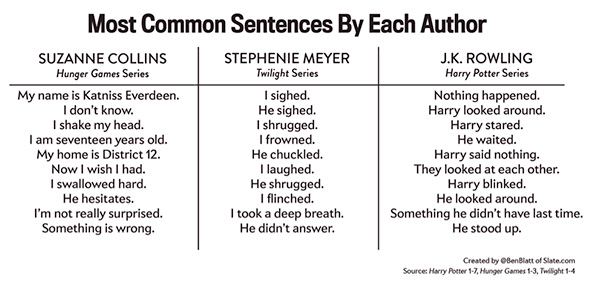 Ben Blatt has applied textual analysis to three wildly popular young-adult book series: Suzanne Collins’ Hunger Games, Stephenie Meyer’s Twilight, and J. K. Rowling’s Harry Potter. Very interesting!
This weekend, millions of preteens will flock to theaters to take in the Hunger Games sequel, Catching Fire, just as millions of preteens flocked to each of the five Twilight movies. For the most part, however, these will not be the same people. Of the tens of millions who identify themselves on Facebook as fans of either of the two series, less than 20 percent are fans of both. Though both series are set in fantasy worlds and feature female leads, readers and moviegoers seem to ally themselves with either Team Stephenie or Team Suzanne, but not both.
Why might a reader take a shine to one series and not the other? The content, of course, differs considerably: Twilight is filled with fantasy romance, Hunger Gameswith fantasy violence. But what about the authors’ approach to writing? Do their word choices, sentence structures, and other elements of their prose differ significantly? Is loving The Hunger Games but not Twilight a matter of style as well as substance?
To answer this question, I could have read all of the books and offered my opinion on the authors’ respective styles. But that’s so unscientific. (Also, who has the time?) Instead, I conducted a comprehensive textual analysis of the best-selling series. And to benchmark the comparison between Meyer and Collins, I decided to throw into the mix another wildly popular young adult series: Harry Potter by J.K. Rowling.
Sunday Inspiration: Commencement
“Make good art.”
Neil Gaiman Addresses the University of the Arts Class of 2012 from The University of the Arts (Phl) on Vimeo.
Homework
I learned everything I needed to know about Stephenie Meyer and Twilight when I heard that Meyer did not do any research on vampire folklore. Seriously? If you’re writing a series of novels about vampires, how do you not research vampires?
I have already admitted my tendency toward Tolkien Syndrome or World Builders Disease. Say what you will, I like to flesh out how a fantasy world “works” to the extent that things make sense at a macro scale. Part of that is being aware of one’s source material: the mythological store rooms from which we draw our common ideas about magic, gods and demons, mythical creatures, and the like. You won’t be surprised, then, to know that I like to read stories where it is clear the writer has done his or her homework.
Let me hasten to say, I certainly don’t object to writers doing something new and different with a mythological concept. I just want them to give me a wink to let me know that they know what they’re doing.
In Memoriam Clive Staples Lewis
As the world remembers today the 50th anniversary of the death of President John F. Kennedy, let us also remember that C. S. Lewis—writer, poet, theologian, and myth-maker—also died on November 22, 1963. Only an hour before President Kennedy died, Lewis also began, in his words, “Chapter One of the Great Story which no one on earth has read”:
And as He spoke He no longer looked to them like a lion; but the things that began to happen after that were so great and beautiful that I cannot write them. And for us this is the end of all the stories, and we can most truly say that they all lived happily ever after. But for them it was only the beginning of the real story. All their life in this world and all their adventures in Narnia had only been the cover and the title page: now at last they were beginning Chapter One of the Great Story which no one on earth has read: which goes on forever: in which every chapter is better than the one before.
Simon Usborne interviewed Lewis’s stepson, Douglas Gresham about his memories of the man.
Here is a reflection focusing on Lewis as a person of faith.
Spriggans: Unpleasant Cornish Sprites
 Spriggans are a type of faery being from Cornish mythology. They are associated both with storms and stone ruins. By most accounts, they are closely related to pisgies (aka pixies). In fact, some suggest they are the same sort of being, with pisgies more mischievous and spriggans more outright malevolent. Others say spriggans came originally from Brittany, where they were called korreds. If this is so, their affinity for winds suggest they may be descended from the Crion family of korreds, those most firmly associated with whirlwinds. Spriggans send storms to blight crops.
These fae are also closely associated with the cromlechs or standing stones that dot the Cornish countryside. Like all fae, they love to cause mischief to those who offend them. They sometimes steal away mortal children, leaving their ugly changelings in their place.
They are often found at old ruins, cromlechs, and barrows guarding buried treasure and generally acting as faery bodyguards. As guards to both standing stones and hidden treasures, they correspond very closely to the Breton korred. They are also busy thieves and expert kidnappers of children.
Spriggans serve as slaves or warriors of more powerful fae. Some believe they are the ghosts of former giants, as they have the ability to swell to enormous size. They are also said to have a giant’s strength. They are often charged with guarding buried treasure.
In addition to their sour disposition, these fae are described as being grotesquely ugly. Like their korred cousins, spriggans love music and dance. Though their appearance and temperament are often distasteful, it is said that their music is quite beautiful.
 Darrell J. Pursiful