
Recent Comments


Carmina Nativitatis in Lingua Latina!
Laura Gibbs of Bestiaria Latina has rounded up a month’s worth of Latin Christmas carols (and two Hanukkah songs, too!). I’m not just talking about “real” Latin hymns like “Adeste fideles,” “Gaudete,” “Hodie Christus natus est,” etc. She has also compiled Latin versions to more modern carols and holiday songs such as “Deck the Halls” (Aquifolia Ornate), “Silent Night” (Silens nox), and even “Grandma Got Run Over by a Reindeer” (Avia Renone Calcabatur).
Caucasian Rednecks?
Google.org has launched a new initiative called the Endangered Languages Project. According to the website,
With the Endangered Languages Project, Google puts its technology at the service of the organizations and individuals working to confront the language endangerment by documenting, preserving and teaching them. Through this website, users can not only access the most up to date and comprehensive information on endangered languages as well as samples being provided by partners, but also play an active role in putting their languages online by submitting information or samples in the form of text, audio or video files. In addition, users will be able to share best practices and case studies through a knowledge sharing section and through joining relevant Google Groups.
This is a commendable goal that a language-junkie like myself can only applaud.
I found one slight problem, however. Exploring on their interactive map, I decided to zoom in on the United States to see what endangered languages might be spoken near me. There are no state boundaries on the map, but I believe the dot representing the Bezhta language is placed somewhere in north Georgia.
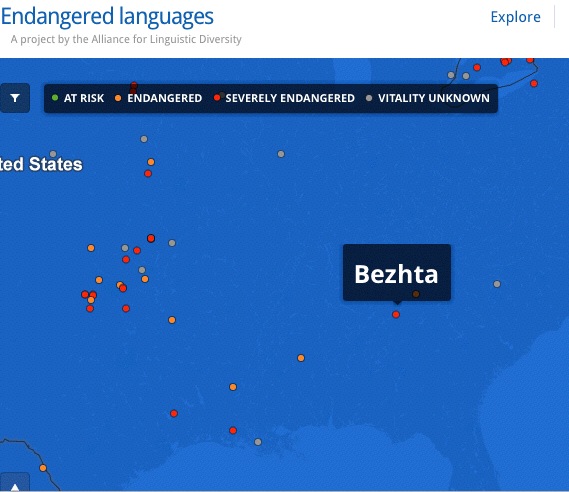 I had never heard of this language. Assuming it was a Native American dialect, I clicked for more information. This is what I found:
Caucasian language and it belongs to the Dido subgroup of the northwestern group (Avar-Ando-Dido) of the Dagestan languages. Bezhta is also called the Kapucha language, a name which originates in the Georgian name for the village of Bezhita. There is no scholarly agreement on the genealogical classification of the Bezhta (Kapucha) language. E. Bokarev considers it to belong to the Dido subgroup, whereas Georgian linguist, E. Lomatadze, thinks it is a dialect of the Kapucha-Hunzib language. Bezhta is divided into three dialects: Bezhta, Tljadali and Hochar-Hota. The vocabulary has been greatly affected by Avar and Georgian, through which there have also been some borrowings from Arabic, Turkish and Persian. During the Soviet era the biggest influence was Russian. (The Red Book of the Peoples of the Russian Empire)
As they say, I see what you did there. Someone apparently confused the STATE of Georgia in the USA with the REPUBLIC of Georgia in the Caucasus. There is, however, another dot for the Bezhta language in the Caucasus region where it belongs.
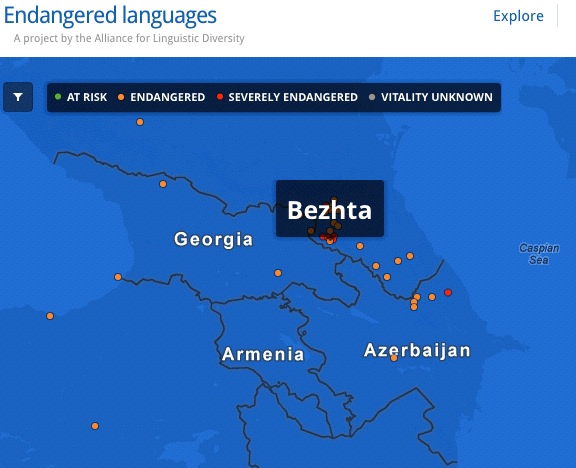 If there are, in fact, Bezhta-speakers hanging out somewhere between Rome and Chattanooga, I’d love to hear from you. Otherwise, I’m going to put this in the “somebody needs a geography lesson” file.
Thank you, Endangered Language Project, not only for the important work you’re undertaking, but also for providing me a much-needed chuckle today.
Comment to Dr. Dallemand
I left the following comment on the most recent blog post of Dr. Romain Dallemand. It is currently awaiting moderation.
Dr. Dallemand,
I am part of the Macon community that has attempted to make it “very plain” that your “Macon Miracle” plan has many substantive problems that are profoundly troubling to me as an educated and involved parent. It is desperately in need of “revisions, additions, and deletions,” as you say; and, your assurances to the contrary, I am not convinced that you intended the plan as it now exists to be the beginning of a conversation but rather its end.
If the plan being unveiled today were merely “a good start for us,” then why the fanfare? I fail to see the logic of balloons, confetti, and acrobats (!) to announce that you and the Board have put an opening bid on the table. And if this is how you roll out a proposal for extended discussion, then I can only imagine how much of the taxpayers’ money you intend to waste when the final product is unveiled.
If the plan were merely “a good start,” then why avoid meeting with Tanner Pruitt and Brett Felty when they arrived at your office—along with some two hundred of their classmates—to express their concerns about what was in the plan? Surely you knew they were coming and had ample time to clear your morning schedule. At the least, a brief meeting with concerned students would have signaled a willingness to listen to all the stakeholders. It may well have earned you some much-needed goodwill from people like me.
If you intended this plan to begin a conversation about what needs to change in the Bibb County School District, and I do not dispute for a moment that substantive changes must be made, then how did you and the Board manage to miscommunicate your intentions so utterly that large numbers of Bibb County residents were under the impression that there was going to be a vote on accepting the plan today? Could it possibly be because the original plan was to vote on the Macon Miracle at today’s “unveiling” event—as WMAZ and other news outlets have reported? If the vote was merely to put the plan on the table—not to ratify it as official policy— it would seem an able leader and communicator should have been able to explain this quickly and clearly and thus avoid the potential embarrassment of having to back-pedal on voting at all.
Don’t get me wrong, Dr. Dallemand. I am not necessarily opposed to every detail of your plan. But in my estimation the negatives far outweigh the positives, and even where I agree in principle (foreign language learning, year-round school), I have grave misgivings about the proposed implementation. Far more worrying than your proposals, however, I am deeply concerned about the heavy-handed manner in which they are being advanced. If I may be blunt, you have not assured me that your talk about openness to “revisions, additions, and deletions” is anything more than a last-minute damage control maneuver.
I will watch with interest how you and the Board proceed in the weeks to come. An attitude of transparency and humility would be a refreshing change, and a good start to a more fruitful and healthy relationship with the people who pay your salary.
Regards,
Darrell J. Pursiful, Ph.D.
The Macon “Miracle”?
Dispatched today to William Thomas Barnes III, President of the Bibb County School Board:
Mr. Barnes,
My parents were teachers at a public high school in the inner city of Detroit. They could tell you stories about incompetent teachers, school-board politics, disengaged parents, and unprepared students that would make your toes curl. And yet, they inculcated in me a deep appreciation for public schools. I am a product of a public school education, and it never entered my mind to send my child to a private school—until we moved to Macon.
It was with profound displeasure that I learned last week that Dr. Dallemand’s plan to revitalize the Bibb County School system involved closing schools and eliminating teachers. I cannot fathom how this will result in anything other than larger class sizes, less individualized attention to students, and further academic decline.
I am, furthermore, mystified at the idea of shifting fourth- and fifth-graders into middle school and what were once middle-schoolers into high school.
What leaves me most stupefied is that Dr. Dallemand is unable to answer legitimate questions about how much his so-called “miracle” will cost in the short term. It is simple due diligence to know what the plan is likely to cost and make that information available.
While I agree that we must do something for the good of Bibb County Public Schools, we don’t have to do this! A bad idea doesn’t become a good one just because we have to do “something.” Dr. Dallemand is asking for the largest and most radical change in the history of Bibb County Schools since integration, and he is asking for this change to be approved after only seven days of consideration. At the very least, one would have thought he would take the time to sell his plan to the stakeholders—the parents—rather than ramrodding it through the board. That is what leaders do when they have a grand vision. Only the insecure try to rush a decision before all the details are known and explored.
Among some of my closest friends—who represent a wide array of political perspectives but who all possess advanced degrees in their fields and are more than knowledgeable and involved in their children’s education—I am not aware of any who support this morass of a plan.
Rest assured, I will be looking very carefully into private school options for my child should the school board fail to apply the brakes to Dr. Dallemand’s half-baked agenda. The board may be willing to experiment on my child, but I do not have to like it, and I certainly do not have to stand for it.
Regards,
Darrell J. Pursiful, Ph. D.
UPDATE: Just learned about the petition at Change.org: “Stop the ‘Macon Miracle’ Plan.”
On Shakespeare
Here’s an apt description of William Shakespeare’s contribution to the English language. If you follow the link, there’s also an interesting story to go with it:
You know when you’re making a pot you put it on a wheel, you make it round, and then you put it in the fire and it gets hard? It was the same with English, and the fire was Shakespeare.
Let’s Hear It for Regional Accents, Y’all!
According to CNN, American regional accents are thriving quite nicely.
Celebrities Who Look Like Historical Personalities
Some of these are brilliant. I’m glad I wasn’t sipping a Pepsi when I saw Keith Richards and….
J. K. Rowling on Faith and Harry Potter
It deals extensively with souls — about keeping them whole and the evil required to split them in two. After one hero falls beyond the veil of life, his whispers are still heard. It starts with the premise that love can save you from death and ends with a proclamation that a sacrifice in the name of love can bring you back from it.
Harry Potter is followed by house-elves and goblins — not disciples — but for the sharp-eyed reader, the biblical parallels are striking. Author J.K. Rowling’s “Harry Potter” books have always, in fact, dealt explicitly with religious themes and questions, but until “Harry Potter and the Deathly Hallows,” they had never quoted any specific religion.
It is wrong to claim that the Harry Potter series is “Christian” literature. It is equally wrong to fail to recognize the pervasive Christian imagery and themes J. K. Rowling weaves into her story. She may or may not be as devout or orthodox J. R. R. Tolkien or C. S. Lewis (two other Brits who wrote about fantastic worlds were magic is real), but she has clearly drunk from the same spiritual streams.
(H/T: Scot McKnight)
Are Odd Spelling Rules Good for the Economy?
Mark Liberman of Language Log asks, “Is a bad writing system a Good Thing?” He wonders whether there is a correlation between the difficulty of a language’s writing system and cultural and economic advancement.
There are some simple factors that will guarantee such a correlation: national languages that were recently reduced to writing tend to have historically shallow and rationally-designed orthographies; and the countries for which this is true tend to be relatively poor and underdeveloped, simply because otherwise their literacy traditions would have started many centuries earlier. In some cases, like Turkish, special circumstances permitted a recent and radical orthographic reform. Spanish seems simply to have lucked out, by having a fairly shallow and transparent system to start with, and then undergoing relatively few orthographically-opaque sound changes. But around the world, countries who came late to the table of literacy tend to have relatively transparent and easy-to-learn orthographies; and the same countries tend, for roughly the same reasons, to remain relatively undeveloped economically, to have relatively little cultural influence outside their borders, and so on.
You could go beyond these trivial historical associations, and make an argument that an unnecessarily complex and hard-to-learn writing system is genuinely and causally a Good Thing from a political and economic point of view. According to this story, a crappy orthography — in a society where literacy matters — creates a meritocracy based on verbal aptitude and the willingness to work hard at difficult and arbitrary socially-prescribed tasks. Mastering the orthographic system is a necessary (and sometimes even sufficient) condition for economic success, and this tends to offer a path out of poverty to the bright and ambitious children of the masses, and to create a handicap for the most lazy and stupid children of the elite. You could point to the Mandarin system in Tang-dynasty China, or the English “grammar schools” back in the days when they taught Latin and then a standardized form of English.
But not so fast. Mark continues to say,
I’m skeptical that this argument remains valid, if it was ever valid to start with. For one thing, there are now many gatekeeper subjects that are more intrinsically useful, such as science, history, and math, (And of course we’ve levelled the global playing field by making it necessary for everyone to learn English, which has the third-worst orthography among modern languages, after Japanese and Chinese.)
….
Whatever its causes, the handicap is well documented. It’s true that we Americans (along with the British, the Japanese, and the Chinese) have collectively managed to overcome the handicap of our crappy writing system; but this is not evidence that the handicap has paradoxically done us good.
You’ll want to read the whole thing, especially if you’re not that terrific a speller.
Greece Offers Giant Horse
They really should have thought of this years ago. Oh, wait. They did:
In what many are hailing as a breakthrough solution to Greece’s crippling debt crisis, Greece today offered to repay loans from the European Union nations by giving them a gigantic horse.
Finance ministers from sixteen EU nations awoke in Brussels this morning to find that a huge wooden horse had been wheeled into the city center overnight.
The horse, measuring several stories in height, drew mixed responses from the finance ministers, many of whom said they would have preferred a cash repayment of the EU’s bailout.
But German Chancellor Andrea Merkel said she “welcomed the beautiful wooden horse,” adding, “What harm could it possibly do?”
(H/T: rogueclassicism)
 Darrell J. Pursiful