
Recent Comments


Sunday Inspiration: Character
Sunday Inspiration: Courage
Courage is what it takes to stand up and speak; courage is also what it takes to sit down and listen.
—Winston Churchill
Sunday Inspiration: Right or Righteousness?
Each of us must decide whether it is more important to be proved right or to provoke righteousness.
—Bernice King
Sunday Inspiration: Be Soft
Be soft. Do not let the world make you hard. Do not let the pain make you hate. Do not let the bitterness steal your sweetness.
—Iain Thomas
Sunday Inspiration: To Deal with Pain
I imagine one of the reasons people cling to their hates so stubbornly is because they sense, once hate is gone, they will be forced to deal with pain.
—James Baldwin
Sunday Inspiration: Thinking
Thinking is difficult, that’s why most people judge.
—Carl Jung
Fantasy Kindreds of Saynim: Giants and Ogres
Giants and ogres are found in practically every culture in the world. If you discount magically adept creatures like the frost and fire giants of Norse mythology (which I think are better accounted for as trolls), they are almost always savage, backward, and even cannibalistic. Their defining characteristics are incredible size and brutish demeanor. They aren’t truly members of Saynim society, but are sometimes pressed into service by a powerful master.
As I envision them, these beings all share a common ancestor in Homo erectus soloensis, a hominin from Indonesia that is a late variant of Homo erectus with a larger cranial capacity and an unusually advanced culture compared to other erectus subspecies. Giants and ogres share certain physiological features with soloensis, including:
- A have a wide, flat face with thick bones, heavy brow ridges, and large teeth. Their foreheads are shallow, sloping back from the brow ridges.
- A brain case is more elongated from front to back and less spherical than that of H. sapiens.
- Limb bones that are indistinguishable from modern H. sapiens.
- Differences in the upper respiratory tract, especially the mechanisms of breathing control, that result in a different approach to language. Generally speaking, these beings are not capable of uttering long sentences. Nor can they vary vocal intensity, pitch, or tone to the same degree that humans do. They are thus generally soft-spoken individuals whose voices don’t always convey emotion in ways that humans can decipher.
GIANT (Homo giganticus)
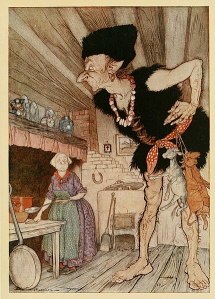 Giants range from 9–14 feet tall and are usually brutish and non-magical—although they may still have great resistance to magic being performed upon them. Apart from a far more robust, dense bone structure to anchor their impressive musculature, giants are anatomically much like humans, only larger.
To a greater or lesser extent, all large hominins (8’ or taller: mainly giants, ogres, and the largest trolls) share the same adaptations to extreme size. Working from the bottom up, one might mention the following:
• Short, stubby feet with a distinct leg structure. Long, plantigrade feet like a human’s prove inefficient for larger bodies. For hominins in the 7–10’ range, the changes to leg structure are minimal, but they become more pronounced as size increases.
Like elephants, the largest hominins have stubby feet that create a more columnar lower-leg structure that is not employed in lift and propulsion but rather is ideal for supporting their terrific weight.
This adaptation has several effects on limb structure and locomotion. The foot musculature (anchored to the shin) is reduced, lowering the overall weight of the limb and thus making movement more efficient. This structure also decreases foot mobility, however, limiting stride length and overall gracility. Some of these effects are countered by the elongated thigh region, which can swing the shortened lower leg over great distances with every step.
• Shorter, thicker legs. Compared to an average human, in which leg length is approximately half of total height, legs of the largest hominins are somewhat shorter. In ogres and large trolls, leg length is roughly 0.47–0.48 total body length. In true giants, leg length is roughly 0.45–0.46 total body length.
Despite their shorter legs, large humanoids have normally proportioned arms (0.34–0.35 body length), leading to a relatively higher intermembral index (forelimb/hindlimb x 100). A normal human has an intermembral index of 68–70; Australopithecus had an index of about 88; chimpanzees, about 106. By comparison, ogres and large trolls have an index of 71–74, while true giants have an index of 74–78.
• Maximized bone strength and stiffness with minimized bone mass and volume. Like birds, giant bones have greater density than normal mammalian bones, providing strong, stiff, but relatively lightweight support.
• A body frame that is wider at the hip than the chest. This puts more of the giant’s muscle mass in its lower limbs where it is most needed for locomotion.
• A higher overall percentage of muscle tissue. Giants are more robustly built than a normal human that has merely been scaled up to incredible height. This is a necessary adaptation to be able to function at all.
• A larger and more efficient heart and circulatory system. This is necessary to bring oxygen to every part of the giant’s enormous body in an efficient manner.
• A relatively smaller head. All animals tend to show a disproportionate reduction in skull length with respect to body mass. The same is true of giant hominins: the larger ones generally have proportionally smaller heads than the smaller ones.
As sizes rise above 10’ or so, certain weaknesses also come into play:
• Bone weakness. Giant bones are stronger than those of humans but must move around far more weight proportionally. By way of comparison, elephants have been known to break bones simply from tripping and falling over. The same can happen to giants.
• Slowness. Giants are unable to run—that is, to lift both feet off the ground at the same time—without incurring serious trauma. Their long strides make them capable of surprising speed at a leisurely gait, however. Giants can “speed-walk” at about 16 miles per hour for short bursts.
OGRE (Homo atrox)
 Ogres are the only hominins to regularly prey upon other hominins. They are at least human-sized and often quite a bit larger—though not as large as true giants. They are distinguished from the other hominin species by their animalistic nature.
The tallest ogres range from 8–11 feet tall. They are neither magically potent nor overly intelligent, although most can use glamour on an instinctive level to alter their appearance, and some may have a single additional magical talent they can use to their advantage. Their linguistic capacities are largely the same as that of giants.
Human-sized ogres are sometimes called bogeymen. Distinct subspecies populations can be as small as pygmies or as tall as the Maasai of East Africa. Despite their relative weakness, they can still be a threat to unsupervised human children.
Sunday Inspiration: Freedom
May we think of freedom, not as the right to do as we please, but as the opportunity to do what is right.
—Peter Marshall
Sunday Inspiration: True Peace
Peace is not the absence of war but the absence of fear.
—Ursula Franklin
Fantasy Kindreds of Saynim: Goblins
Here’s the part where my stubborn determination to carry through with a particular worldbuilding conceit backed me into a corner where I found gold. Goblins: Next on Fantasy Kindreds of Saynim!
GOBLIN (Homo neanderthalensis parvus x various)
 I had fallen in love with the conceit that dwarves, trolls, and ell folk would be derived species of Neanderthal. This made them sufficiently different from humans and elves (two subspecies of Homo sapiens that developed parallel to each other), but still creatures readers might identify with.
By this theory, humans and elves could freely produce viable offspring, namely half-elves. But that meant that dwarves, trolls, and ell folk could also interbreed and produce viable offspring of a rather surprising variety. At first, it doesn’t look that bad: you can have a dwarf-troll, dwarf-elling, or troll-elling hybrid. But what about the next generation? I had already stumbled upon “ayleck” as a useful term for a dwarf-troll hybrid, and arguably, a dwarf-ayleck hybrid is close enough to count as a dwarf who’s just a bit “off.” The same goes for a troll-ayleck hybrid being effectively the same as a troll.
But what happens when a dwarf-elling hybrid produces children with a troll-elling hybrid? Or what happens when an ayleck produces children with an elling? Before you know it, there are a fair number of elling hybrid types that needed some kind of label to keep them all straight.
And that’s where goblins came in. Early on in my worldbuilding, I thought “goblin” would be a name applied to some ell folk but not all of them, maybe based on culture or origins. It might have even been a racial slur of some sort. The more I thought about it, though, I kind of fell in love with the idea that all of these various hybrids should be called goblins, and that “goblin” would describe a diverse creole culture with connections to ell folk, dwarves, and trolls all at once.
Thus goblins became by basic term for any hybrid faery being with a predominantly ell folk heritage. The vast majority of the time, this means that a goblin is a mixture of elling, dwarf, and troll in various proportions. Though it is possible to have an elling-human or elling-elf hybrid, such beings are very rare and often have physical or mental disadvantages.
The upshot of all this is that I no longer had to come up with specialized terms for, for example, an elling-dwarf hybrid as opposed to an elling-troll hybrid. Rather, a goblin community is a blending of many tribes and cultures in which the strengths and contributions of each individual can shine.
Think of all the communities where distinct cultures have merged. I think especially of New Orleans, with its blending of African, Spanish, French, etc. cultures influencing everything from the food and music to the architecture and overall pace of life. Or New York City, one of America’s oldest melting pots. That’s what goblins are like at their best: eclectic borrowers, taking bits of this and scraps of that and blending it into something all their own. Which also means that goblins can be some of the most hospitable people you’d ever want to meet, especially if you don’t really fit in anywhere else.
This doesn’t mean goblins can’t be mischievous, malicious, or outright evil. I didn’t work out any of these fantasy kindreds with a D&D-type “alignment” system in mind, after all. If goblins are welcoming what is new or different, they can also be opportunistic in figuring out how things—and people!—can be manipulated to suit their own purposes. If they are pragmatic in latching on to whatever works, they can also be dispassionate about the sacrifices that “whatever works” might entail. In short, they can be as good or as bad as any human.
 Darrell J. Pursiful