
Recent Comments


Sunday Inspiration: Gratitude
Let gratitude be the pillow upon which you kneel to say your nightly prayer.
—Maya Angelou
Sunday Inspiration: Honesty
Being honest may not get you a lot of friends but it’ll always get you the right ones.
—John Lennon
Sunday Inspiration: A Franciscan Benediction
May God bless you with discomfort
At easy answers, half-truths, and superficial relationships
So that you may live deep within your heart.
May God bless you with anger
At injustice, oppression, and exploitation of people,
So that you may work for justice, freedom and peace.
May God bless you with tears
To shed for those who suffer pain, rejection, hunger and war,
So that you may reach out your hand to comfort them and
To turn their pain into joy.
And may God bless you with enough foolishness
To believe that you can make a difference in the world,
So that you can do what others claim cannot be done,
To bring justice and kindness to all our children and the poor.
Sunday Inspiration: Eight Rules
1. Be clean both inside and out.
2. Neither look up to the rich nor down to the poor.
3. Lose, if need be, without squealing.
4. Win without bragging.
5. Always be considerate of women, children, and older people.
6. Be too brave to lie.
7. Be too generous to cheat.
8. Take your share of the world and let others take theirs.
—George Washington Carver
Sunday Inspiration: Silence
What hurts the victim most is not the cruelty of the oppressor but the silence of the bystander.
—Elie Wiesel
Vampire Vednesdays: Sasabonsam

A sasabonsam is also called an asabonsam or asanbosam, a creature from Ashanti folklore. Reports of their presence in Jamaica go back to the eighteenth century.
Some people consider this creature to be a form of vampire because of its association with bats: it is able to take the form of a huge, bat-like creature (5’ tall, 20’ wingspan) with red fur, pointed ears, iron teeth, and iron hooks on feet and wings. In this form, it steals people from above and carries them away. Even when not in this form, though, the sasasabonsam is a horrible clawed and fanged monster.
As might be suspected given their hook-feet, sasabonsams are awkward on the ground. They live in the trees, dangling their limbs from the branches to snatch unwary travelers. They don’t seem particularly interested in drinking blood, but they will gladly devour the flesh of anyone who falls into their clutches. They can also inflict people with a wasting disease simply by looking at them with their deathly glare.
They sometimes work with obayifos, who are said to have the ability to summon them. On the other hand, it is sometimes said that obayifos work at the behest of sasabonsams, so the question of who is really in control in this relationship is a matter of dispute.
Vampire Vednesdays: Vampire Corpse
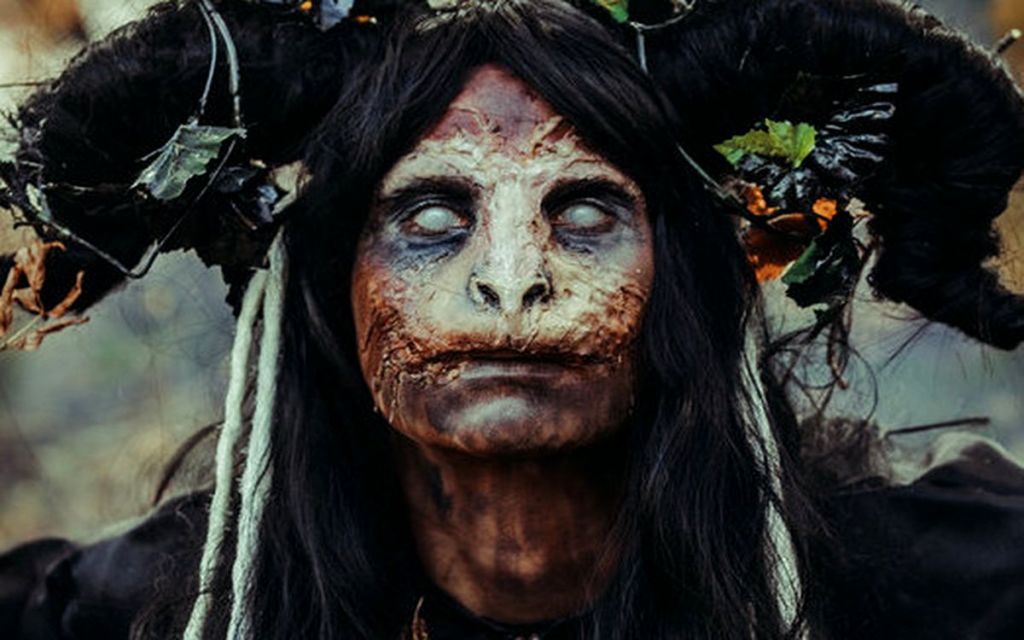
It is not entirely accurate to say that there are no vampire legends among Native Americans, but the few creatures native to North America that might (perhaps generously) classify as “vampires” are quite a bit different from their European cousins.
Among the Iroquois, for example, there is a monster sometimes called a “vampire corpse,” “vampire skeleton,” or “cannibal corpse.” Obviously, the name is a product of cultural cross-pollination with European settlers. In the Seneca language, the creature is called a tcis’gä, which simply means “corpse” or “skeleton.” Its nature is in some ways comparable to a European vampire, in other ways more like the zombie of popular culture. It has an emaciated, skeletal body and variety of magical powers. They are repelled, however, by redbud branches.
A vampire corpse can be a simple dead body that something evil has overtaken. Or, it could be the body of a sorcerer so full of its own magical potency that it endures after physical death. In either case, it is a ravenous undead creature with a frightening appearance and a hunger for human flesh.
These creatures’ bestial demeanor and cadaverous appearance make it impossible for them to impersonate normal human beings. They might lie in wait in their coffins in remote huts or cabins, preying upon lost travelers who hope to spend the night under their shelter.
A similar creature, the skudakumooch or “ghost witch,” is associated with the Wabanaki cultures of the Maritime Provinces and adjacent areas.
Vampire Vednesdays: Classic Vampires

The quintessential undead bloodsucker is associated with central and eastern Europe. It is known by numerous names: strigoi or strigoi mort in Romanian, izcacus in Hungarian, and a vampir (by various spellings) in Slavic languages.
Not to be confused with Hollywood depictions of Dracula and his ilk, the classic vampire’s main weapon is shapeshifting, of which it is a true adept. It is not necessarily stronger or faster than an ordinary human, but it is nevertheless a formidable foe. These creatures like to socialize with their own kind, though never in groups larger than twelve, but they are not generally inclined to cooperate with each other.
When vampires first rise in undeath, they are disoriented and unaware of their powers. Many of the expected weaknesses we associate with the undead operate in force for these “young” bloodsuckers. They must return to their coffins during the day and are especially prone to obsessive counting. At this stage, peasants can generally make short work of them. They are averse to holy objects (crosses, consecrated Host, etc.). They can be immobilized by a hawthorn stake through the heart. They are repelled by garlic, wild rose, hawthorn, and wolf’s bane. After about a hundred days, however, young vampires shake off their initial disorientation and become much more dangerous. They freely roam without being bound to their coffins, though if their burial shroud is ever lost or destroyed, they lose their powers.
Classic vampires eventually ranged far from their original homeland. The earliest European vampire legend, for example, involved a certain Conde Estuch, a creature of this type who originated in central Europe but operated in Catalonia.
There are several kinds of monster from surrounding regions that mostly conform to the “classic vampire” model, though with notable variations. Here are a few of them:
Blutsauger: This is a vampire from Bavaria and other parts of southern Germany. It is in nearly every respect identical to its Slavic counterpart.
Estrie: First attested in the 1460s, this Jewish female vampire may be a later development from the ancient lilit. They are not impeded by holy objects or places, and their preferred shapeshifting forms are birds (especially screech owls) and cats.
Mullo: This vampire of Roma folklore dresses all in white and has long, white hair that reaches to its ankles.
Obur: This rare Turkic vampire is especially attested in the Caucasus region. In life, it was a powerful wizard that gained its powers from consuming human blood. (Therefore, some oburs would better be classified as “living vampires.”) In death, it continues to prey on the living.
Strega: This Italian term can mean both witch and vampire. It commonly shapeshifts into an owl.
Strigoi Mort: This Romanian vampire, also called a moroi in rural areas, sometimes drains life energy rather than blood. It has poltergeist-like telekinetic powers.
Upir: This vampire from Poland and Russia has a barbed tongue instead of fangs.
Ustrel: On rare occasions, children become vampires. According to Bulgarian legend, this can happen when a child born on Saturday dies before being baptized. Ustrels (or istrals) lack the social skills to conceal their true nature. They are generally too weak to prey on humans, but will feed on livestock and other animals. These creatures are also known in parts of Poland.
Vrykolakas: Vrykolakas (both singular and plural) are native to Greece. They are similar to strigas, but most often drain life energy rather than blood.
Vampire Vednesdays: Jianshi

Jianghi is the Chinese form of the name of these Asian vampire-like monsters. They are also known as cuong thi (Vietnamese), gangshi (Korean), kyonshi (Japanese) and hantu pocong (Malay and Indonesian). They are sometimes created through arcane magic, and wear a paper talisman on their forehead containing their sealing spell. (One story about their origin is that, when someone dies far from home, it is easier for a Taoist priest to conduct a ritual to animate the corpse and “march” it to its proper burial place.) More often, however, they are created through an improper burial, suicide, or spirit-possession. Though they might rest in a coffin during the day, it is also common for them to hide in dark places such as caves.
They might have the appearance of a recently-deceased corpse or be horrifying to see—with greenish-white skin, long white hair, rotting flesh, etc. Their distinguishing feature, however, is rigor mortis, when results in them having to hop about rather than walking like an ordinary mortal. Their name, in fact, translates to “stiff corpse.” In the popular imagination, jiangshi dress in the robes of Qing dynasty bureaucrat. In general, they have more in common with popular depictions of zombies than vampires. Numerous Chinese “vampire movies” feature jiangshi and those who must contend with them.
Jiangshi feed on their victim’s qi or “life energy,” killing them in the process. The most powerful among them become ba or “drought demons” with shapeshifting powers and the ability to cause draughts and plague.
Sunday Inspiration: Good Trouble
Do not get lost in a sea of despair. Do not become bitter or hostile. Be hopeful, be optimistic. Never ever be afraid to make some noise and get in good trouble, necessary trouble. We will find a way to make a way out of no way.
—John Lewis
 Darrell J. Pursiful