
Recent Comments


Lidércek: Three Hungarian Creatures that Share a Name

An incubus, from The Encyclopedia of Secret Knowledge (public domain)
I don’t speak a word of Hungarian. I am, however, intrigued that there are three distinct types of entities that Hungarians call lidérc (pl. lidércek) or “incubus.” In English, an incubus is a type of seductive demon that visits women in their sleep and inspires erotic dreams. The female counterpart is a succubus. Although there are aspects of this understanding in play here, especially with the “devil lover,” the term lidérc seems to cover a broader swath of supernatural territory.
The Földi Ördög
The first type of lidérc is also called földi ördög or “tiny devil” (pl. földi ördögök). Often in the form of a tiny man, this being serves as a kind of good luck charm—though at the price of a mortal’s soul. In exchange for the soul, the “tiny devil” bestows great riches and as well can make the recipient capable of performing extraordinary feats.
The Ördögszeretö
The second type of lidérc is is also known as the ördögszeretö or “devil lover” (pl. ördögszeretöek). It is sometimes called a ludvérc or a lucfir.
This being attaches itself to a mortal, but might then take one of two courses of action. First, it might decide to bring good luck and prosperity and even help with household chores. At night, however, the lidérc assails its “host” with wild, erotic dreams.
The second course of action is simply to drain the mortal “host” of life force. It appears every night to trouble the person with erotic dreams and sleep paralysis, eventually causing the victim to waste away.
Burning incense and birch branches keep the ördögszeretö from entering a house.
The Csodacsirke
The third type of lidérc is the csodacsirke (pl. csodacsirkék), literally the “miracle chicken.” This is the Hungarian equivalent of the firedrake or pisuhand, a fiery bird that sprinkles flames as it flies. This creature is said to hatch from the first black egg of a hen kept warm either under the arm of a human or in a heap of manure. Like the other lidércek described above, the csodacsirke attaches itself to a mortal and becomes his or her lover, but slowly drains the body of either blood or life force. (It can take the form of either a beautiful woman or a handsome man from the mortal’s past, as appropriate.)
The csodacsirke hoards gold, which it shares to make its owner rich. The only way to stop the lidérc is to make it do impossible chores such as bringing water from the well in a leaky bucket.
Sunday Inspiration: True to Oneself
I prefer to be true to myself, even at the hazard of incurring the ridicule of others, rather than to be false, and to incur my own abhorrence.
—Frederick Douglass
Sunday Inspiration: Effort
All things are difficult before they are easy.
—Thomas Fuller
Sunday Inspiration: Individuality
Research your own experience; absorb what is useful, reject what is useless and add what is essentially your own.
Bruce Lee
Sunday Inspiration: Holding People Down
You can’t hold someone down without staying down with them.
—Booker T. Washington
Sunday Inspiration: Work
People might not get all they work for in this world, but they must certainly work for all they get.
—Frederick Douglass
Abikus: West African Changelings
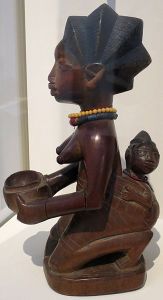
Kneeling Yoruba worshiper with child; photo by Hiart (Own work) [CC0], via Wikimedia Commons
An abiku is a “spirit child” sent by his or her other spirit playmates to be born into a family and terrorize them. The abiku spirit world is said to be populated by children who play all day long and are engaged in all sorts of merrymaking. They often choose a rich family as their victim. The child of this rich family then repeatedly falls sick, causing his or her parents to squander their wealth seeking for a cure.
Eventually, at a previously determined date (especially on a joyful occasion like a festival or marriage), the child falls sick and dies. Then he or she is reborn again and again to the same family until they are totally exhausted emotionally and financially.
There is no known way to divest oneself of an abiku. Sometimes, however, when a mother repeatedly gives birth to an abiku, he is branded at death so as to be recognized when he comes back again. They are often spoiled by their parents in a bid to persuade them to stay.
Certain Yoruba names suggest the suspicion that a child is, in fact, an abiku. Such names include Durojaiye (“stay and enjoy life”), Banjoko (“stay with me”), Malomo (“don’t go again”), and Durosinmi (“stay and rest”).
In Igbo folklore, ogbanje are often very beautiful girls.
Sunday Inspiration: Choirs
I love to hear a choir. I love the humanity to see the faces of real people devoting themselves to a piece of music. I like the teamwork. It makes me feel optimistic about the human race when I see them cooperating like that.
—Paul McCartney
Sunday Inspiration: Money
Money doesn’t change people. It merely unmasks them.
—Henry Ford
Fairies in the Bible?
Speaking of Jewish folk beliefs, a few years back I wrote a piece about fairies in the Bible at my other blog. Some of that material, with some elaboration, found its way over here in my post on “Shedim: Eldritch Beings from Jewish Folklore.” Here is the full, original post from July of 2013, only slightly edited:
Joel Hoffman has written a blog post about unicorns and other mythological creatures in the Bible—or at least in the King James Version. As he usually does, Dr. Hoffman raises an intriguing question about how the original Hebrew words the KJV rendered as “dragon,” “unicorn,” and so forth should be handled. Did the original writers intend their readers to understand these as real-world creatures (e.g., as serpents, rhinoceroses, etc.) or did they mean to depict creatures of fantasy? He writes,
More generally, I think the real translation question with all of these creatures is whether they were intended to be mythic or — for want of a better word — real.
Even if they were intended to be real, “dragon” and “unicorn” may have been right once. It seems that people thought that both existed. (As late as the 17th century, scholars in Europe argued that griffins were real, and the only reason we didn’t see them was that, quite naturally, these magnificent creatures tended to stay away from people who would steal their gold). But now those translations wrongly take the real and turn them into fantasy.
On the other hand, if they were not meant to be real, then attempts to identify the exact species may be misguided, and maybe we should stick with “dragon” and “unicorn” and so forth.
Hoffman deals mainly with “unicorns” (re’em) and “dragons” (tannin), although he makes passing reference to a possible merperson in the character of Dagon, the god of the Philistines.
Along these same lines, I would suggest that there are a handful of possible reference to fairies in the Bible—at least if the rabbis of the medieval period were interpreting these passages rightly.
Two Hebrew words are of interest: shedim and se’irim, both translated daimonia (“demons”) in the Septuagint. Shedim only appear twice in the Hebrew Bible, both times in the plural (although the singular form would be shed or sheid). Psalm 106:37 says, “They sacrificed their own sons and daughters to demons!” (CEB). In a similar context, Deuteronomy 32:17 says,
They sacrificed to demons, not to God,
to deities of which
they had no knowledge—
new gods only recently on the scene,
ones about which your ancestors
had never heard.
Shedim are therefore obviously bad news in the Bible. Oddly enough, the term seems to be related to the Akkadian shedu, a benevolent or protective spirit, perhaps something we might think of as a guardian angel. Then again, people around the world have made offerings to various local protective spirits to secure their goodwill. The biblical writers were obviously interested in discouraging such a practice. Thus, in the Bible, they are depicted not as helpful minor spirits but as false gods to be avoided.
The next word is se’irim (singular se’ir), meaning “hairy beings” or “shaggy beings.” In the KJV, the word is translated “satyrs.” There are a few more references to se’irim than there are to shedim. According to Leviticus 17:7, “The Israelites must no longer sacrifice their communal sacrifices to the goat demons that they follow so faithlessly. This will be a permanent rule for them throughout their future generations.” The LXX renders se’irim as mataiois, “to empty or vain things.”
Se’irim dwell in the desolate wilderness and are apparently fond of dancing. According to Isaiah 13:21,
Wildcats will rest there;
houses will be filled with owls.
Ostriches will live there,
and goat demons (LXX, daimonia) will dance there.
And again in Isaiah 34:14:
Wildcats will meet hyenas,
the goat demon will call to his friends,
and there Lilith will lurk
and find her resting place.
I saw you wondering about Lilith in that verse. We’ll come back to her in a minute. It should be noted, that the Septuagint translation removes Lilith from the picture but possibly gives us a completely new mythological creature. My fairly wooden translation of the Greek is as follows:
Demons will meet onocentaurs
and they will shout one to the other,
There onocentaurs will rest
for they found a resting place for themselves.
If you’re not up to speed on medieval bestiaries, let me quickly explain that an onocentaur is part man, part ass. (And please refrain from any comments about half-ass blog posts. Thank you.)
According to the Jewish Encyclopedia, the se’irim are “are satyr-like demons, described as dancing in the wilderness…identical with the jinn of the Arabian woods and deserts.” Azazel, the goat-like wilderness demon (Lev 16:10ff) and Lilith (whom we already encountered in Isa 34:14) are said to be of the same class of beings. Further, it should be noted that some see in Lilith a prototype for later vampire legends. The Jewish Encyclopedia also raises the possibility that “the roes and hinds of the field” (gazelles and wild deer in the CEB) in Song of Songs 2:7 and 3:5 are “faunlike spirits similar to the se’irim, though of a harmless nature.”
How does all this apply to fairies? Thomas Keightley argued in The Fairy Mythology (1870) that the prototypes of European fairy legends were to be found not only in the nymphs and satyrs of Greco-Roman mythology but also in Near Eastern stories of jinnis and peris (or jinn and parian, to use the correct Arabic and Persian plurals). He even argued that our English word “fairy” derives ultimately from Persian pari (or peri). This linguistic argument may or may not hold, but anyone who looks at Persian peri-stories will find many parallels to what was believed about fairies in rural Europe until fairly recent times.
If Keightley is correct, then the European conception of fairies owes a good deal to the Mediterranean and Near Eastern world(s) in which the Bible was written. It therefore would not be unusual to find references to the such creatures in biblical and other early Semitic materials.
After tracing the fairy mythology throughout northern Europe, Keightley makes quick reference to Jewish legends about similar creatures found in the rabbinic corpus. These beings are in fact called shedim and seirim (although Keightley transliterates them shedeem and shehireem). Another term, maziqin (or mazikeen in Keightley’s transliteration), is Aramaic and applies specifically to a malevolent spirit. According to rabbinic tradition, all these beings are in fact directly analogous to the jinn of Arabic folklore. Keightley writes,
It has long been an established article of belief among the Jews that there is a species of beings which they call Shedeem, Shehireem, or Mazikeen. These beings exactly correspond to the Arabian Jinn; and the Jews hold that it is by means of them that all acts of magic and enchantment are performed.
The Talmud says that the Shedeem were the offspring of Adam. After he had eaten of the Tree of life, Adam was excommunicated for one hundred and thirty years. “In all those years,” saith Rabbi Jeremiah Ben E’liezar, “during which Adam was under excommunication, he begat spirits, demons, and spectres of the night, as it is written, ‘Adam lived one hundred and thirty years, and begat children in his likeness and in his image,’ which teaches, that till that time he bad not begotten them in his own likeness.” In Berasbith Rabba, R. Simon says, “During all the one hundred and thirty years that Adam was separate from Eve, male spirits lay with her, and she bare by them, and female spirits lay with Adam, and bare by him.”
These Shedeem or Mazikeen are held to resemble the angels in three things. They can see and not be seen; they have wings and can fly; they know the future. In three respects they resemble mankind: they eat and drink; they marry and have children; they are subject to death. It may be added, they have the power of assuming any form they please; and so the agreement between them and the Jinn of the Arabs is complete.
Keightley shares three Jewish legends about the shedim: “The Broken Oaths,” “The Moohel,” and “The Mazik-Ass.”
As with dragons and unicorns, there are probably some who will pounce on “rational” or “scientific” explanations for fairies. Some do, in fact, attribute European fairy-lore to dim memories of diminutive tribes driven underground—and ultimately to extinction—by later invaders with the advantage of iron weapons (in both Europe and the Middle East, iron is a potent weapon against the Fair Folk).
In my experience, however, I think most interpreters would see shedim and se’irim as terms intended to describe supernatural or otherworldly beings and not merely misidentified pygmies or “wild men”—whether or not they judge such creatures to be “real.”
 Darrell J. Pursiful