
Recent Comments


Magic in Early Judaism
This is a bit afield of what I usually post on this blog, but some of you might be interested in a new book about magic in early Judaism. The book is called Jewish Magic before the Rise of Kabbalah. Blogger Alan Brill reviews the book and interacts with the author in a brief online interview.
Harari argues that the practice of magic was very much a part of early Judaism (and Christianity), even though we’re predisposed not to see it. (What I do is “ritual”; what the people I don’t like do is “magic.”) Here’s one small snippet:
Magic is may be considered as pre-scientific technology, a scheme of technical practices founded on the belief in the way reality is run. Given the traditional premises concerning what forces that reality, magic behavior was rational.
Jewish magic is founded on a belief in human aptitude to affect the world by means of rituals, at the heart of which is execution of oral or written formulas. It is not different from Jewish normative religious view, which ascribes actual power to sacrifice, prayer, ritual, and the observance of law. Magic also does not differ from the normative views regarding God’s omnipotence or the involvement of angels and demons in mundane reality. It has elaborated as a system parallel to, and combined with the normative-religious one, a system that seeks to change reality for the benefit of the individual, commonly in order to remove a concrete pain or distress or to fulfill a certain wish or desire.
Books of magic recipes from antiquity as well as from later periods show that magic was pragmatically required in every aspect of life. Magic fantasy of the kind of One Thousand and One Nights or Harry Potter is missing almost all together from recipe books, which usually offers assistance in achieving targets that may be achieved also without magic. According to these Jewish books, magic power can be implemented personally or by an expert. Expert magicians offered their help in choosing and performing the right ritual and in preparing adjuration artifacts and other performative objects, such as amulets of roots and minerals.
Brill’s review mentions connections between early Jewish magic and Greco-Roman magical practices, something I’d certainly be interested in checking out.
Yuval Harari: Early Jewish Magic
Alan Brill reviews Yuval Harari’s recent book Jewish Magic before the Rise of Kabbalah and interacts with the author in a brief online interview. He argues that the practice of magic was very much a part of early Judaism (and Christianity), even though we’re predisposed not to see it. (What I do is “ritual”; what the people I don’t like do is “magic.”) Here’s one small snippet:
Magic is may be considered as pre-scientific technology, a scheme of technical practices founded on the belief in the way reality is run. Given the traditional premises concerning what forces that reality, magic behavior was rational.
Jewish magic is founded on a belief in human aptitude to affect the world by means of rituals, at the heart of which is execution of oral or written formulas. It is not different from Jewish normative religious view, which ascribes actual power to sacrifice, prayer, ritual, and the observance of law. Magic also does not differ from the normative views regarding God’s omnipotence or the involvement of angels and demons in mundane reality. It has elaborated as a system parallel to, and combined with the normative-religious one, a system that seeks to change reality for the benefit of the individual, commonly in order to remove a concrete pain or distress or to fulfill a certain wish or desire.
Books of magic recipes from antiquity as well as from later periods show that magic was pragmatically required in every aspect of life. Magic fantasy of the kind of One Thousand and One Nights or Harry Potter is missing almost all together from recipe books, which usually offers assistance in achieving targets that may be achieved also without magic. According to these Jewish books, magic power can be implemented personally or by an expert. Expert magicians offered their help in choosing and performing the right ritual and in preparing adjuration artifacts and other performative objects, such as amulets of roots and minerals.
Djab: Caribbean Spirits for Hire
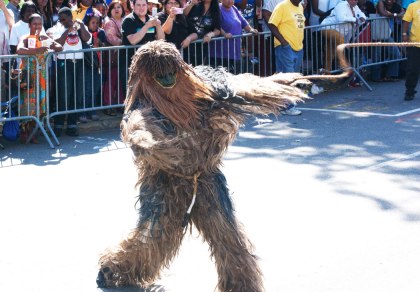
Djab are a feature of the Vodun religion, but are associated more with practical magic than with spirituality. Their name is derived from French diable, “devil.” In fact, the same word is found in Louisiana Creole. These beings are not necessarily diabolical, though. Rather, they are what might be called “mercenary spirits”: they are independent supernatural contractors that can be hired or bribed to perform magical work. They must be paid for every job and they can be very aggressive about collections, to the point that they can effectively be the equivalent of supernatural loan sharks.
Djab are conceived as a type of lwa or intermediate spirit between the mortal realm and the Creator. At least some djab are the spirits of deceased mortals—or at least present themselves in this way. It is possible that the “spirits of the dead” interpretation may be the result of Christian missionaries imposing their theological bias upon the legend.
Magical practitioners can summon a djab through spells and rituals. Such spells are typically aggressive and less than savory—means of invocation that other spirits will refuse. Furthermore, djab are willing to do malevolent work from which other spirits may shy.
Djab may serve as guardians to a spell-caster if so requested. They prove to be formidable bodyguards willing to search out and destroy enemies. They are also sometimes invoked to serve justice when it is otherwise not found. Some djab are truly scary and unpleasant while others are just exceptionally independent. Each djab tends to manifest somewhat differently.
Particular djab might be affiliated with a person or a family—who may or may not be able to exert control over it. Like a European-style domestic spirit, it passes itself down from one generation to the next and is treated like one of the clan. Other djab, however, are wild, autonomous spirits who play by no rules but their own.
A “djab-djab” (or “jab-jab”) is a traditional costumed figure of Carnival. They are described as:
men in jester costumes, their caps and shoes filled with tinkling bells, cracking long whips in the streets, with which they lashed at each other with full force, proclaiming in this display that they could receive the hardest blow without flinching at its coming, while feeling what, at its landing, must have been burning pain. (Richard and Jeannette Allsopp, Dictionary of Caribbean English Usage [Oxford University Press, 1996] 194)
A female djab might be called a djablès (diablesse), but usually djab serves for both male and female, both singular and plural. (Djablès or “devil woman” usually refers to an evil creature that appears on a lonely road in the form of a pretty young woman, who lures men into the woods. There, she reveals herself to be an old crone with cloven hooves and causes her victim to either go mad or die.)
Sunday Inspiration: Helpers
When I was a boy and would see scary things in the news, my mother would say to me, “Look for the helpers. You will always find people who are helping.”
—Fred Rogers
A Note about Fantasy “Races”
TL;DR: When differentiating between humans, elves, dwarves, etc., “kind” is preferable to “race.”
In much fantasy literature, we hear of various “races,” meaning elves, dwarves, orcs, and so forth. The more I think about that terminology, the less I like it. A while back I looked at some of the fanciful humans or near-humans one encounters in the ancient and medieval geographies, populations traditionally called “monstrous races.” At that time, I took exception to that term because of the potentially hurtful connotations of both “monstrous” and “race.” In my introductory post, I wrote:
That can also be an awfully loaded term with a dubious past in pseudo-scientific pronouncements that attempted to justify the oppression and enslavement of some groups of human beings by other groups of human beings on the theory that some groups of human beings are naturally superior to others. Originally, a “race” (Latin gens, Greek ethnos) was simply a definable people-group: a tribe or culture, whether sparse or numerous, whether familiar or foreign. Even so, when talking about human beings—or supposed human beings—whose customs are disquieting or who possess animalistic traits, the word “race” can lead us down some paths we might not want to tread.
At that time, I wasn’t concerned with dwarves and the rest but only with cynocephali, monopods, and the like. But as I think of it, my concern with the word “race” still pertains and is perhaps even more pronounced when we use it to describe what makes Legolas different from Gimli.
It seems to me that “species” is an apter description of what these fantasy populations really are. There are clear genetic differences between elves, orcs, trolls, etc. Hybrid or mixed-lineage characters notwithstanding, the ability of at least some of these groups to interbreed seems at least problematic. That means we’re probably in the realm of using the term “race” to speak of what modern science would call a “species.” Dwarves are different from elves at a deep level that goes far beyond physical phenotype or genetic minutiae (e.g., blood types, lactose tolerance or intolerance, susceptibility to certain diseases, etc.). And explicitly, the term “race” is used to set certain groups apart from the “human race.” Once again, that doesn’t sit well with me.
Of course, “species”—a word used in English with a more or less precise scientific definition—doesn’t quite seem at home in a fantasy setting. Fortunately, there is a good English term from the pre-industrial era that can carry the same weight. That word is “kind.” In the King James Version of the Bible (1611), we read,
And God said, Let the earth bring forth the living creature after his kind, cattle, and creeping thing, and beast of the earth after his kind: and it was so. And God made the beast of the earth after his kind, and cattle after their kind, and every thing that creepeth upon the earth after his kind: and God saw that it was good. (Genesis 1:24-25, emphasis added)
“Kind” is thus, roughly speaking, an early English equivalent to what we usually understood by “species” today. I know I’ve read fantasy stories that speak of “Elfkind” or “Dwarfkind.” Perhaps it’s time to retire the idea of “race” as it is used in the genre and speak of “fantasy kinds” (or “fantasy kindreds”) instead.
What do you think?
Sunday Inspiration: Anger
Be not angry that you cannot make others as you wish them to be, since you cannot make yourself as you wish to be.
—Thomas à Kempis
Sunday Inspiration: Children
It is easier to build strong children than to repair broken men.
—Frederick Douglass
Sunday Inspiration: Fear
Don’t let fear drive you, but it’s okay to bring it along for the ride, so it can help you stay alert.
—Faydra D. Fields
Iroquois Supernatural: Culture, Commodity, Sacred, and Spooky
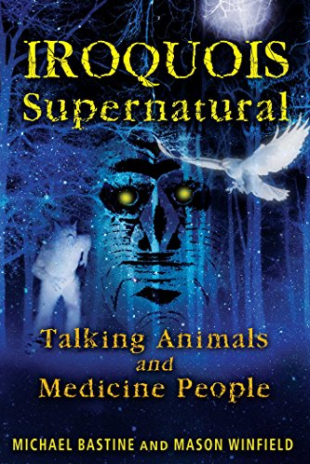 I have great friends. One of them recently found a copy of Iroquois Supernatural: Talking Animals and Medicine People by Michael Bastine and Mason Winfield at a yard sale and was kind enough to pick it up for me as a gift. Bastine is an Algonquin healer and elder. Winfield is a European American who describes himself as a “supernatural historian.”
This is a really neat, informative book. It is chock-full of fascinating tales, keen historical and cultural insights, and a pervasive sense of respect for the Iroquois culture(s) as a whole. I’m mentioning it not to provide a thorough review. My review can be summed up thusly: If you’re the sort of person who is interested in Native American cultures and particularly Native American mythology and folklore, get this book!
I’m bringing this book up, rather, for the guidance it may provide for writers wanting to handle mythological material from outside their culture with reverence and sensitivity. This is a topic that has recently come up in an article at Fantasy Faction by Brian O’Sullivan with respect to Celtic, and particularly Irish cultural artifacts. (You can also read my observations.)
As when I wrote about the uproar over J. K. Rowling’s handling of Native American mythology, I still believe that there are situations where leaving elements of Native American or African mythology out of a story can be more colonialistic than including them. I’m thinking particularly of stories in the contemporary fantasy genre that are set in North America—which happens to be what I write. Populating North America with unicorns and griffins rather than naked bears and great horned serpents strikes me as a lazy and Euro-centric way to tell a story.
Still, the challenge remains to handle these cultural artifacts with care and not treat them as mere commodities. Here is where Bastine and Winfield’s concerns in writing Iroquois Supernatural intersect with my own admittedly different concerns. First and most basically, writers who want to include these kinds of cultural artifacts need to read lots of books like this one, written from a clearly sympathetic viewpoint.
Second, the authors draw a distinction between what they classify as “the sacred” and “the spooky.” This is a distinction that especially writers from outside a given culture need to keep in mind. In the introduction, they write:
Figuring out what to include in this book has been tricky. Where do you draw the line between miracle and magic? Between religion and spirituality? Between the sacred and the merely spooky? This book doesn’t try to choose. How could anyone? (p. 2)
But then they proceed to explain their preference for the spooky over the sacred:
All religions are at heart supernatural. Throughout history most societies have had both a mainstream supernaturalism and others that are looked upon with more suspicion. The “out” supernaturalism is often that of a less advantaged group within the major society. What the mainstream calls “sacred” is its supernaturalism; terms like “witchcraft” are applied to the others. Someone’s ceiling is another’s floor, and one culture’s God is another’s Devil. To someone from Mars, what could be the objective difference? (p. 2)
This comment reminds me of the privileged place Judeo-Christian supernaturalism has in my own culture. Perhaps it will remind you of something else in your own frame of reference. But the writers go on to admit that within Iroquois society itself there are distinctions between the sacred and the spooky. They conclude,
This book is not about the sacred traditions of the Iroquois. It is a profile of the supernaturalism external to the religious material recognized as truly sacred. This is a book largely about the “out” stuff: witches, curses, supernatural beings, powerful places, and ghosts. (p. 3)
Even so, the authors admit that it isn’t always easy to draw firm lines between sacred and spooky. The fact that one of the authors is a practicing traditional healer within a neighboring Native American community is bound to help in this regard! Later on, we hear Winfield explaining further about their approach to this cultural material:
This is not a book about Iroquois religion or anything else we knew was sacred enough to be sensitive. Not only is that not our purpose, but, as a Mohawk friend said recently to me, “If it’s sacred, you don’t know it.” And coauthor Michael Bastine would not reveal it. (p. 22)
So perhaps we can isolate the following touchstones as the beginning of an approach to including cultural material from marginalized or minority groups within our society:
- Aim for the spooky, not the sacred. Frankly, I’m not interested in writing philosophical or theological treatises on the spirituality of marginalized peoples. (I will admit to a certain interest in reading such studies.) But I love stories about ghosts, monsters, trickster figures, or what have you. As Bastine and Winfield themselves note numerous times, these sorts of things are common to every culture. That suggests to me that, with suitable awareness, writers can fruitfully explore them. If something gets too close to the lived faith commitments of others, however, I tend to want to shy away from it in terms of worldbuilding and storytelling,
- If it is sacred enough to be sensitive, leave it out. I’m well aware that one reaches a point of sensitivity sooner in some cultures than others, and with different topics in some cultures than in others. Still, is there a better place to start?
- Strive to understand as much about the culture as a whole as possible. I don’t want to add a cultural element to a story without a firm grasp of how that element relates to others in its “native” environment. Understanding the ins and outs of a culture and its history is a great inoculation against a grab-bag approach.
Do you think it’s possible for writers to handle other world cultures with sensitivity? When have you seen a writer handle well the artifacts of a culture to which he or she was an outsider?
Sunday Inspiration: Learning
The great art of learning is to understand but little at a time.
—John Locke
 Darrell J. Pursiful