
Recent Comments


Sunday Inspiration: Forgiveness
Everyone says forgiveness is a lovely idea, until they have something to forgive.
— C. S. Lewis
What Is the Exchange Rate between Cattle and Cocoa Beans?
With Oathbreaker in the capable hands of my beta team, I’ve been doing a bit of worldbuilding for another project that’s kicking around in my head.
Unlike the cashless society of the Wonder, I’ve been pondering a world that uses some sort of commodity currency as a medium of exchange. In the process, I’ve found a few interesting options. Here are some random notes about three of them.
Irish Cattle
The Irish used cattle as a unit of exchange up until the fourteenth century. Specifically, the milk cow was universally recognized measure of worth. There were even ways to achieve fractions of that value without killing the cow. In medieval Ireland,
1 pregnant cow = 2/3 of a milk cow
1 three-year old heifer = 1/2 of a milk cow
1 two-year old heifer = 1/3 of a milk cow
1 one-year old heifer = 1/4 of a milk cow
1 one-year old bullock = 1/8 of a milk cow
Worth in milk cows could also be expressed in terms of other currencies such as “ounces” of some precious metal (usually silver), cumhala or “bondwomen” (i.e., female slaves), or séti or “jewels.” The sét seems to have been an ideal or an abstraction in Irish law, and it is not clear that transactions were ever literally conducted by the transfer of female slaves from one person to another. Still, everyone had a clear idea of what these things were worth and conducted their business accordingly.
Unfortunately, this system persisted for so long that the law codes prescribed different rates of exchange in different eras and in different regions of Ireland. A cumhal might be the same value as a milk cow or it might be two or three times as much. One source gives the value of a cumhal as two séti, another says six to seven, and yet another says up to forty.
Since 240 English pence were struck from a pound of silver, we can assume that an ounce of silver would be worth about 15 pence. At a rate of 1 milk cow = 9 ounces of silver, the price of a milk cow in silver would be about 135 pence, which is in line with some of the early medieval prices I’ve been able to find online—and, incidentally, very close to the price of 131.5 pence given for a female slave in this era.
Mexican Cocoa Beans
When the Spanish arrived in Mexico, they found a society in which cocoa beans were an accepted medium of exchange. Some of the customary prices I’ve found are:
a large tomato for 1 cocoa bean
a small rabbit for 30 cocoa beans
a female turkey for 100 cocoa beans
a male turkey for 300 cocoa beans
a copper hatchet for 8,000 cocoa beans
The Spanish adapted this system in dealing with the Aztecs. In fact, cultivation of cocoa beans was restricted in the 1700s in order to maintain their value as money.
By a royal decree of 1555, the value of one cocoa bean was set at 1/140 of a Spanish real. In 1587, this was dropped to 1/150 of a real. Since a peso or “piece of eight” was worth eight reales, we could also say that 1,200 cocoa beans = 1 peso. In the mid-sixteenth century, pesos traded in England at about 54 pence. Once again, that makes the commodity prices reasonable when compared to equivalent items in the same time frame.
Canadian Beaver Pelts
The Hudson Bay Company in Canada was a key player in the North American fur trade. Not only did their stores buy furs brought in by traders, they accepted furs as currency. The above linked article even provides a price list for the York factory in units of “made beaver” (i.e., a prime beaver pelt). Here is a selection of prices:
a hatchet for 1 beaver pelt
a pound of tobacco for 2 beaver pelts
a pair of shoes for 3 beaver pelts
a hat for 4 beaver pelts
a pistol for 7 beaver pelts
a long gun for 14 beaver pelts
In 1740, the Hudson Bay Company bought beaver pelts for about 7.88 shillings apiece (about 94.5 pence). But assessing the exchange rate isn’t that simple. In fact, the Company store customarily marked up their prices by about 50%. That means your 94.5 pence worth of beaver pelt would only buy you goods that cost 63 pence in silver at a different establishment.
And no, I have no intentions of writing a protagonist who works as a bank teller or a merchant at a company store! But I find that little touches like these add a depth of detail that can really make a setting seem real.
Plus, I’ve learned a few things along the way, and no new knowledge is ever a waste of time.
Wondrous Tribes: Blemmyes
Blemmyes were an actual African people described in ancient Roman histories who threatened Roman Egypt a few times in the third century AD. The name possibly derives from bálami, meaning “desert people” in the Beja language of Africa. (Note: The proper singular form is blemmyas or blemmye; the plural form is either blemmyae or blemmyes.) Along the way, the Blemmyes also became fictionalized as a tribe of headless humanoids whose faces are located on their torsos.
In various medieval sources, blemmyes are said to be six, eight, or even twelve feet tall and perhaps half as wide. Furthermore, they are often reported to be cannibals.
Herodotus described such creatures in the fifth century BC, calling them akephaloi (“headless ones”). How a real-live human population came to be seen as headless monstrosities is anybody’s guess. Certainly the nearly universal human tendency to demonize and dehumanize one’s enemies is at play. More concretely, some propose that the historical Blemmyes had an unusual fighting stance that involved tucking the head close to the chest, or else they had the ability to raise their shoulders to an extraordinary height, nesting their head in between. Others ponder whether these reports of “headless giants” involved the custom of painting faces on their shields.
At any rate, the blemmyes as a “wondrous tribe” apparently captured the imagination of ancient geographers and naturalists, not to mention the centuries of learned Europeans who had studied their tales. In time, the legend of these headless men shifted from Africa to India. From there, as with so many ancient wonders, they found their way to the New World just in time to be discovered by European explorers.
In 1595, Sir Walter Raleigh reported that, along the Caora river, there lived
a nation of people whose heads appear not above their shoulders which, though it may be thought a mere fable, yet for mine own part I am resolved it is true because every child in the provinces of Arromaia and Canuri affirm the same. They are called Ewaipanoma. They are reported to have their eyes in their shoulders and their mouths in the middle of their breasts, and that a long train of hair groweth backward between their shoulders. (Discovery of Guiana, spelling and punctuation updated)

Section of the Piri Reis map depicting a blemmye and a monkey
Raleigh reported that these blemmyes lived in the same general area as the fabled city of Manoa, which the Spanish called El Dorado.
But Raleigh wasn’t the first person to “find” blemmyes in the Americas. Nearly a hundred years previously, Ottoman admiral and cartographer Piri Reis depicted a blemmye in South America (near the coast of Brazil, to be specific) on his world map of 1513. Beside the drawing, he explains, “These wild beasts attain a length of seven spans [5′ 3″]. Between their eyes there is a distance of only one span [9″]. Yet it is said, they are harmless souls.” Thus, these blemmyes are a fair bit smaller than their Old World cousins—and apparently less hostile to humans.
When William Shakespeare wrote Othello in 1604, he included this fabled tribe among the oddities his title character reports as he describes his earlier exploits:
And portance in my travels’ history:
Wherein of antres vast and deserts idle,
Rough quarries, rocks and hills whose heads touch heaven
It was my hint to speak,—such was the process;
And of the Cannibals that each other eat,
The Anthropophagi and men whose heads
Do grow beneath their shoulders. (Act I, scene 3)
I should also note that the Hidatsa, a Siouan people from present-day Minnesota, have a myth about a “headless monster” with a gaping mouth in its shoulder. who kills the mother of the Twins, important culture heroes. I have no way of knowing if those who tell this story imagine a blemmye-like creature with eyes on its chest or shoulders, or else something else entirely. In any case, there are a few headless monsters in world mythology: in addition to the blemmyes and their New World kin, there is also the dullahan of Ireland, a headless horseman immortalized for Americans in Washington Irving’s The Legend of Sleepy Hollow.
I don’t want to think about blemmyes riding around on horses. Though perhaps the ones in Guiana could domesticate some Brazilian headless mules to ride.
Sunday Inspiration: A Hearty Mix
No motive is pure. No one is good or bad-but a hearty mix of both. And sometimes life actually gives to you by taking away.
—Carrie Fisher
Wondrous Tribes: Pygmies
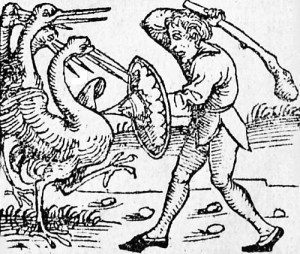 Pygmies were originally a tribe of very small humans.They were located at the southernmost reaches of the world, either in (you guessed it!) Ethiopia or India.
Their name comes from pygme, the Greek word for “cubit,” and they were said to stand only about one cubit tall, or about eighteen inches. Ctesias speaks of “three-span” pygmies (trispithamoi) who stand twenty-seven inches tall. Flavius Philostratus reports pygmies in India who live underground—which would make them both pygmies and troglodytes: perhaps a subject for another time!
Anthropologists define pygmies as any human population where the average adult male height is less than 4′ 11″. The term has been especially applied to certain peoples of central Africa, who may in fact have been the ultimate inspiration behind Greek mythological pygmies. Even so, calling these people “pygmies” is problematic if not outright offensive. To be on the safe side, kindly refer to them instead by their ethnic names: Twa, Efe, Mbuti, etc.
The mythological pygmies fought an endless war against flocks of migrating cranes in a story that goes back at least to Homer. Their battles against the cranes was a popular scene in classical art. They were often depicted as pudgy, comical figures.
Pygmies also made the jump from the Old World to the New, at least in the minds of European explorers. On his second voyage (1535–36), Jacques Cartier apparently met Donnacona, “King of Canada” (actually, a village at the present site of Québec City), who informed him that there were pygmies (“picquemyans”) in that region. There’s no telling what Donnacona actually said or whether Cartier interpreted it in culturally familiar terms that may not have done justice to what the king intended to say. At any rate, no doubt owing to this tidbit of information, Pierre Descelier’s world map of 1550 depicted pygmies in North America—battling cranes just as in the ancient myths!
There is an earlier reference to pygmies in North America, but it’s a bit more ambiguous. On Mercator’s world map of 1569, we find this note in the Arctic region: “Here live the Pygmies, at most 4 feet tall, like unto those they call Skraelings in Greenland.” At four feet, these “pygmies” are giants compared to the pygmies of the classical world!
Skraelingjar is the Old Norse word for indigenous people the Norse encountered when they began to settle Greenland and Vinland (aka Newfoundland). Mercator understood that this term translates—culturally if not etymologically—as “pygmies.” An even earlier map, Olaus Magnus’s Carta Marina (1539), depicts a Norseman and a very short adversary facing off with spears in southern Greenland. Olaus writes,
The little dwarf fearlessly attacks his bigger opponent and triumphs in victory, for at every opportunity he assaults taller men with no less courage than if he could boast a giant’s might and so have the upper hand.
Mercator apparently received his information from a fourteenth-century source, an unnamed friar who wrote a travelogue titled Inventio fortunata (“The Fortunate Discovery”) in the 1360s. This friar learned of “skraelings” (skraelingjar) in Greenland from Norwegian churchman Ívar Bárdarson. But which came first? Did the Norse call these people skraelingjar because that was already their word for “unusually short human,” or did a Norse cleric, conversing (no doubt in Latin) with a foreign colleague, land upon pygmaeus as the closest suitable translation of skraelingr?
In fact, the actual meaning of “skraeling” is up for debate. Some say it comes from an Old Norse word for skin and refers to the animal skins the native inhabitants of Greenland wore. Others say that, whatever the original meaning, the word is used in medieval Norse literature as a pejorative term implying small stature.
Finally, I should mention that the faery folk of many North American peoples are conceived of as tiny “little people,” often no more than two feet tall. Some older works even translate the various native terms as “dwarves” or “pygmies.” These, however, are creatures of a much more magical nature than the “picquemyans” of Cartier or the “skraelings” of the Norse: changing shape, becoming invisible, effecting magical cures, etc.
Some of these little folk are dangerous—though by and large you’re probably safer with the average Native American faery being than you are with the daoine sídhe or most European elves. The more “mundane” pygmies are probably easier to get along with if you show them due respect.
Wondrous Tribes: Patagonian Giants
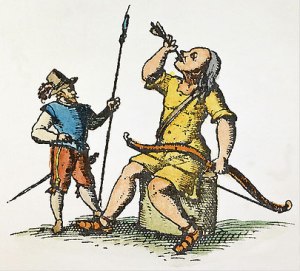
A European watches a Patagonian giant swallowing an arrow to cure his stomach ache (1602)
Giants are not, properly speaking, one of the wondrous tribes of the Greek and Roman classical writers. Virtually every culture on the planet has some kind of myth about incredibly large humanoids, from eight or ten feet tall up to the size of mountains—and beyond. In Norse mythology, the entire world was created from the dismembered body of the giant Ymir.
Nor are giants alien to North and South America, continents filled with slant-eyed giants, stone-skinned giants, and every possible variation of huge, man-eating ogre. There is one particular tribe of giants, however, that I should discuss in this series on the intersection of Old World myth and legend and the exploration of the New World. These are the giants of Patagonia at the extreme southern tip of South America.
Though the bones of “giants” (actually large prehistoric animals) have been discovered throughout North and South America, Magellan’s voyage to circumnavigate the globe brings us an account of a first-hand meeting between Europeans and a tribe of giants. The story is related by Antonio Pigafetta, an Italian nobleman who accompanied Magellan on his voyage. Pigafetta relates the following story that took place as they rounded the tip of South America in 1520:
One day we suddenly saw a naked man of giant stature on the shore of the port, dancing, singing, and throwing dust on his head. The captain-general sent one of our men to the giant so that he might perform the same actions as a sign of peace. Having done that, the man led the giant to an islet where the captain-general was waiting. When the giant was in the captain-general’s and our presence he marveled greatly, and made signs with one finger raised upward, believing that we had come from the sky. He was so tall that we reached only to his waist, and he was well proportioned.
It was once assumed that the name “Patagonian” is derived from Spanish pata, meaning “leg,” “paw,” or “foot.” (We saw that same root in Patasola in my post about monopods.) If the final syllable is taken as an augmentative, then Patagonia might then be translated something like “Land of the Bigfeet.” Nowadays, however, most people think Magellan took the name from Primaleon, a popular novel of the time. In that work, there is a race of wild people called by that name. Word of Magellan’s discovery spread, and later world maps would sometimes even label this region “Land of the Giants” (regio gigantum).
What are we to make of this report? It is possible that Magellan encountered members of the Tehuelche people, who were, in fact, unusually tall—at least compared to the relatively short 16th-century Europeans. We’re talking six-footers, not ten-footers. When Sir Francis Drake visited this same region in 1628, he encountered these tall native people. Though acknowledging their impressive size, he is quick to call Magellan out for his gross exaggeration:
Magellan was not altogether deceived in naming these giants, for they generally differ from the common sort of man both in stature, bigness and strength of body, as also in the hideousness of their voices: but they are nothing so monstrous and giant-like as they were represented, there being some English men as tall as the highest we could see, but peradventure the Spaniards did not think that ever any English man would come hither to reprove them, and therefore might presume the more boldly to lie.
Ah, the joys of professional rivalry!
It’s Not Rick Riordan Tackling Other World Mythologies, It’s Better
Next year, Rick Riordan’s Disney imprint will feature three new books by three different authors, each dealing with the mythology and folklore of “underrepresented cultures and backgrounds.” He writes,
Basically, our goal is to publish great books by middle grade authors from underrepresented cultures and backgrounds, to let them tell their own stories inspired by the mythology and folklore of their own heritage. Over the years, I’ve gotten so many questions from my fans: “Will you ever write about Hindu mythology? What about Native American? What about Chinese?” I saw that there was a lot of interest in reading fantasy adventures based on different world mythologies, but I also knew I wasn’t the best person to write them. Much better, I thought, to use my experience and my platform at Disney to put the spotlight on other great writers who are actually from those cultures and know the mythologies better than I do. Let them tell their own stories, and I would do whatever I could to help those books find a wide audience.
Who are these authors, you ask? Publishers Weekly introduces them as Yoon Ha Lee (Korean), Jennifer Cervantes (Maya), and Roshani Chokshi (Indian).
Can’t wait!
Wondrous Tribes: Monopods
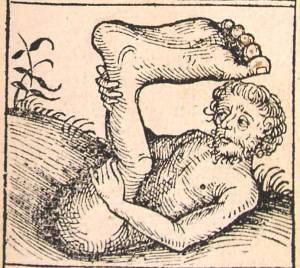 In the ancient geographies, monopods are people with a single, large foot on which they hop about. Pliny states that these unusual creatures, who are also found in Aristophanes’s play The Birds, are first mentioned by Ctesias in the late fifth century. He writes,
He speaks also of another race of men, who are known as Monocoli, who have only one leg, but are able to leap with surprising agility. The same people are also called Sciapodae, because they are in the habit of lying on their backs, during the time of the extreme heat, and protect themselves from the sun by the shade of their feet.
By whatever name, these one-legged creatures are usually said to be found in India or sometimes Ethiopia—the two regions most likely to be home to such fabulous beings in the minds of classical writers. According to Isidore of Seville, the monopods of Ethiopia were very fast hoppers.
By now, it shouldn’t surprise us to learn that European explorers reported tales of such creatures in the New World. Here, however, we find not merely a second-hand report of what some native told them but an actual (purported) first-hand account. In the thirteenth-century Saga of Erik the Red, one finds the story of a monopod sighting in Vinland, the Norse name for Newfoundland and the surrounding areas. Chapter 14 of the saga begins,
One morning Karlsefni’s people beheld as it were a glittering speck above the open space in front of them, and they shouted at it. It stirred itself, and it was a being of the race of men that have only one foot, and he came down quickly to where they lay. Thorvald, son of Eirik the Red, sat at the tiller, and the One-footer shot him with an arrow in the lower abdomen. He drew out the arrow. Then said Thorvald, “Good land have we reached, and fat is it about the paunch.” Then the One-footer leapt away again northwards. They chased after him, and saw him occasionally, but it seemed as if he would escape them. He disappeared at a certain creek. Then they turned back, and one man spake this ditty:
“Our men chased (all true it is) a One-footer down to the shore; but the wonderful man strove hard in the race…. Hearken, Karlsefni.”
Then they journeyed away back again northwards, and saw, as they thought, the land of the One-footers. They wished, however, no longer to risk their company.
I haven’t been able to track down the Norse original, but I suspect “one-footers” is a translation of einfótar (singular, einfótr). Of course, rendered in Greek, this would bring us back around to “monopod.”
Though never (to my knowledge) reported by the early Europeans, there are also legends of mythical monopods in South America. Saci (or Saci-pererê) is a one-legged trickster figure who lives in the forest. He originally appeared as a one-legged child with red hair. Later, he took on a more African or biracial appearance, his red hair became a red cap, and he took up smoking a pipe.
Saci has a sinister female counterpart, a vampiric monster called la Patasola, known mainly from Colombia. Both beings are seen as guardians of the forest, taking special delight in tormenting hunters, loggers, and others who wander into their territory.
The South American monopods are more “magical” than those the Norsemen reputedly encountered, but I’m not sure I’d care to meet members of either tribe.
Tolkien and Lewis Were Not Big Fans of Disney
So says Eric Grundhauser of Atlas Obscura:
It’s no secret that J.R.R. Tolkien and C.S. Lewis were legendary frenemies. But while they may have sparred over fantasy and religion, they shared one little-known viewpoint: a disdain for the works of Walt Disney.
Literary friendships are often thought of in the driest abstract, with learned people of letters sitting in stuffy rooms debating only the most important intellectual issues. But like anyone, sometimes a couple of authors just go to the movies. And on at least one occasion, the architect of Middle-earth and the father of Narnia went and saw Snow White and the Seven Dwarfs together.
According to an account in the J.R.R. Tolkien Companion and Guide, Tolkien didn’t go see Snow White until some time after its 1938 U.K. release, when he attended the animated film with Lewis. Lewis had previously seen the film with his brother, and definitely had some opinions. In a 1939 letter to his friend A.K. Hamilton, Lewis wrote of Snow White (and Disney himself):
Dwarfs ought to be ugly of course, but not in that way. And the dwarfs’ jazz party was pretty bad. I suppose it never occurred to the poor boob that you could give them any other kind of music. But all the terrifying bits were good, and the animals really most moving: and the use of shadows (of dwarfs and vultures) was real genius. What might not have come of it if this man had been educated–or even brought up in a decent society?
In another instance, Lewis called the evil queen’s design unoriginal, and described the dwarves as having, “bloated, drunken, low comedy faces.”
Wondrous Tribes: Cyclopes
In Greek mythology, a cyclops is a giant with a single eye in the middle of its forehead. Yet again, we are indebted to Christopher Columbus for our earliest European account of cyclopes in the Americas. On his first journey, he claims the Taíno people of Cuba described a race of one-eyed people who lived somewhere to the southeast in a land called Bohio. Bartolomé de las Casas and others have suggested that Bohio is (all or part of) the island of Hispaniola. According to de las Casas:
He also understood [i.e, from his informants] that, far away, there were men with one eye, and others with dogs’ noses who were cannibals, and that when they captured an enemy, they beheaded him and drank his blood, and cut off his private parts….
Beyond the cape which they saw before them, extended out another headland toward the East, which the Indians on board called Bohio, and said it was very large, and contained inhabitants with one eye in their foreheads and others which they called Canibales, and spoke of them with many marks of fear; as soon as they saw the ships were taking that course they were struck with terror, and signified that the people went armed, and would devour them. The Admiral declares that he believes there is some truth in their representations, but thinks that these people described as possessing arms, must be a race of some sagacity, and that having made prisoners of some of the other Indians, their friends not finding them to return, concluded they had eaten them. This, in fact, was the opinion entertained of the Spaniards by some of the natives at their first arrival.
Nothing is said about these cyclopes being of unusual size. I’m sure, though, that they were fearsome enough however tall they were!
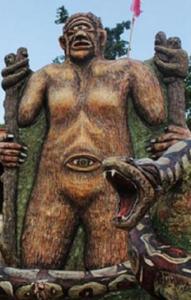 Whatever can be said for the accuracy of these reports, passed as they were through several layers of “interpreters” who didn’t understand each other’s languages, there are indeed legends in the Americas about one-eyed monsters. One of these is the mapinguari of the Brazilian and Bolivian rain forest. Mapinguaris are Bigfoot-like creatures with a horrendous—though not entirely fixed—appearance:
The body of a giant bear; the backward-turned clawed feet like those of a giant armadillo; the face appears monkey or even human-like; trailing a cloud of flying beetles; and a roar like endless thunder. In some areas, the creature is said to have two eyes, while other accounts talk of it having only one, like the Cyclops of Greek mythology. Some versions mention a gaping, stinking mouth in the monster’s belly through which it consumes humans unfortunate enough to cross its path. Some legends even attribute it the powers of the supernatural, and even speech. Classic stories describe it as a werewolf-like Indian shaman who discovered the secret of immortality, but paid for it by being transformed into a horrible monster. To see it is to come face-to-face with the devil himself!
Among those who believe such a creature might actually exist (hint: this is a small number!), the prevailing theory seems to be that it is, in fact, a giant ground sloth: an animal thought to be extinct for thousands of years.
Giant ground sloths notwithstanding, there are also cyclopes associated with the mythology of the American Southeast. In Choctaw mythology, the divine hero Hatakachafa once slew a one-eyed monster who had been terrorizing a forest. Similarly, the Cherokee sometimes (though infrequently) depict the forest monster Tsul ’Kalu or Judaculla as a one-eyed giant.
[Quick note: In preparing this blog, I ran across a very brief and informative discussion of Christopher Columbus and the creatures of Greek mythology by Jason Colavito. As I mentioned in my cynocephali article, I strongly suspect that Columbus’s ill-advised conviction that he had reached Asia colored his expectations of the sorts of wondrous things he stood to encounter, perhaps just over the next hill or on the next island. I commend Jason’s article to you.]
 Darrell J. Pursiful