
Recent Comments


Wondrous Tribes: Amazons

Probably not historically accurate
Of all the “wondrous tribes” European explorers reported to exist in the Americas, the Amazons are probably the most obviously human. They have the requisite number of eyes, legs, and other body parts. They don’t have the heads of animals. They’re just culturally anomalous—at least in sixteenth-century European terms.
Of course, the Amazons existed in Greek mythology long before Columbus. Actually, there were at least two distinct tribes of Amazons. First, there are the more famous ones associated with eastern Anatolia, whose most famous queen was Hippolyte. There was also a tribe of female warriors reputed to live in Libya.
As with the cynocephali, the first report of Amazons in the Americas comes from Christopher Columbus. In 1493, As Guy C. Rothery writes in The Amazons (1910), as Columbus was about to return to Europe from his first voyage, the people of the island of Hispaniola (present-day Haiti and Dominican Republic) told him of another nearby island called Mantinino that was inhabited solely by women. These women were accomplished archers who spent their time hunting and going to war.
Once a year, he was told, the women of this island receive male Carib visitors. The next year, the Caribs take away the male children such visits produced. The same custom was noted in ancient times among the classical Amazons of Themiscyra in Anatolia.
The island of Mantinino was a mystery, always “just over there” no matter who told the story. As Europeans explored more and more of the Caribbean, their mysterious island home continued to evade discovery. The Amazons seemingly retreated before these newcomers, defying any attempts to encounter them, eventually landing in the interior of South America.
In 1540, Francesco de Orellana undertook to travel through Peru to the Atlantic Ocean through the Amazon River basin. At that time, the river was known as the Marañon. Along the route, de Orellana heard fabulous stories of numerous wondrous tribes: pygmies, men with tails, men whose feet were turned backwards, etc. Most persistently, de Orellana heard about a tribe of warrior women who lived apart from any men.
Eventually, de Orellana’s party indeed encountered a warlike tribe somewhere upriver of the Trombetas River. Among them, de Orellana observed women who seemingly acted as leaders of the men. This wasn’t precisely what had been reported to them, but it was apparently close enough. Before long, de Orellana had renamed the Marañon River as the Amazon.
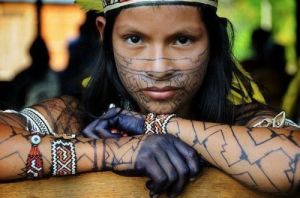
Probably more historically accurate
The story caught on, of course. Peruvian-born chronicler Garcilaso Inca de la Vega later said these women were tall, robust, fair-skinned, and wore their long hair twisted over their heads. By the end of the century, the report of warrior women in the rain forest was “confirmed” (as it were) later by Sir Walter Raleigh. In his 1595 The Discovery of Guiana, he reports the existence of a tribe of Amazons called the Aikeambenano—a word said to mean “women living alone”: that is, without men. The Aikeambenano lived in the upper Orinoco region of Guiana, so not awfully distant from de Orellana’s Amazons.
The Amazon myth was probably compelling for the early modern Spanish for the same reasons it was for the ancient Greeks: the idea of a self-sufficient tribe of women who violated expected gender roles by hunting, fighting, and being aggressive in their relationships with men was shocking in the extreme. For the Greeks, the Amazons served as a counterpoint to their supposedly more proper division of labor, a bogeyman—or bogeywoman—to warn men of what can happen if the natural order of things is ever violated.
Did any of these Amazon tribes actually exist in history? I seriously doubt it. But the idea of Amazon society continued to inhabit the fancies, and likely the nightmares, of patriarchs both ancient and modern.
Sunday Inspiration: Progress
It does not matter how slowly you go as long as you do not stop.
—Confucius
Wondrous Tribes: Cynocephali
 I’ve written about cynocephali (literally, “dog heads”) before. They are described by various classical authors, who locate various types or species of them in Libya, Ethiopia, Central Asia, and India. Some of them are said to be gentle, even civilized. In the Middle Ages, they are sometimes portrayed farming, wearing clothes, and inhabiting organized villages.
More often, they are more animalistic in their behavior. They are the only wondrous race that Isidore of Seville categorized as more animal than human. They are never said to speak but only to communicate with each other in barks and growls, though some learn to understand snippets of human language. They don’t have a material culture to speak of, but might use weapons or tools that human beings provide to them.
The status of cynocephali as humans was debated in classical and medieval times. Saint Augustine pondered whether they possessed human souls. In the ninth century, the monk Ratramnus of Corbie wrote to a colleague on the question of whether one should attempt to preach the gospel to cynocephali should one encounter them.
The first European to report the existence of cynocephali in the Americas was none other than Christopher Columbus, who reported native testimony of dog-headed cannibals. Others followed suit by repeating Columbus’s account. Among these are Lorenz Friez, who reports what Columbus was told in his Carta Marina (1525). The Piri Reis map of 1513, reportedly based on maps made by Columbus, depicts cynocephali on the northern coast of South America.
Since Columbus originally thought he had reached the mysterious East, it shouldn’t surprise us that he would expect to find the same wondrous tribes in the Americas that Pliny, Ctesias, and others had told them to expect in the islands off the coast of India. Indeed, he likely believed the account he was told confirmed the success of his voyage!
There do not seem to be any first-hand accounts by Europeans of actually encountering these creatures. I’m tempted to wonder what the natives actually told Columbus, and why. A perfectly human subject in a ceremonial mask, face paint, or some sort of facial body modification might well be described as possessing the head of an animal—especially as the story is heard by educated Europeans familiar with the classic geographies and their accounts of “monstrous races.”
Then again, who’s to say that the natives who told Columbus about the dog-headed men weren’t already actively de-humanizing members of a rival tribe? Europeans don’t, after all, have a monopoly on thinking of “the enemy” as less than human and exaggerating their more unsavory traits.
At the same time, the idea of a creature that combines the traits of both humans and animals, especially canines, seems to be nearly universal. That’s why werewolf stories are found in so many cultures. That’s why Egyptian gods like Anubis, Duamutef, and Wepwawet were depicted with canine heads (jackal, jackal, and wolf, respectively) 5,000 years ago.
As it turns out, there are some indications of similar phenomena in the Americas. An Adena culture burial mound in Eagle Creek, KY (1st millennium BC) contained the remains of a human body where the the jawbone and front portion of a wolf skull was cut to fit over the Adena man’s mouth. I can’t say why someone would modify a corpse to make it look like a cynocephalus, only that it points to something deeply rooted in the psyche of the people who did it.
Similarly, certain effigy mounds in southern Wisconsin, created by the ancestors of the Siouan Ho-Chunk people, take the form of a humanoid with wolf-like ears.
When Columbus returned to Europe with reports of dog-headed men, what had was he really talking about? Humans with distinctive canine adornments? Ceremonial artifacts that somehow suggested the existence of such beings?
Or was it all a strange concoction of wishful thinking mixed with notions of cultural superiority? If so, then perhaps Augustine’s conclusions about the cynocephali should be a word of caution for us all: “We are not bound to believe all we hear about all kinds of men” (City of God 16.8).
Pliny’s “Monstrous Races”: A Note on Words and Their Power
In classical and medieval literature, one finds references to so-called “monstrous races”: beings who are almost but not quite human such as the blemmyae, headless men with their faces on their chests; or the sciapods, one-legged men who hop about at lightning speed. Herodotus, Strabo, Pliny the Elder, and other ancient geographers and historians described these creatures, often in passing and with a degree of plausible deniability (“it is said that…,” “some report…,” etc.).
Before we begin, however, I’d like to pick a bone with the accepted terminology for these creatures. There are two possible sticking points here. One is the word “monstrous,” and the other is the word “race.”
“Monstrous” implies a threat (personally or to the order of society) if not outright malevolence. Though certainly unacceptable today, babies born with severe birth defects were once called “monsters” for this reason. There is definitely something “wrong” with a monster—as defined by society. But to apply this word to a “race” (we’ll get to that one in a minute) seems to beg the question. Are these “monsters” truly “monstrous” at all? In the fifth century, Saint Augustine discussed the so-called “monstrous races” such as the dog-headed cynocephali in book 8 of his City of God. Assuming such beings actually exist (and Augustine was not 100% convinced), he pondered how they might fit into the purposes of God. Are they descendants of Adam? If so, they are human beings despite their frightening appearance. They would then have souls, and might even be converted to Christianity.
What about “race”? That can also be an awfully loaded term with a dubious past in pseudo-scientific pronouncements that attempted to justify the oppression and enslavement of some groups of human beings by other groups of human beings on the theory that some groups of human beings are naturally superior to others. Originally, a “race” (Latin gens, Greek ethnos) was simply a definable people-group: a tribe or culture, whether sparse or numerous, whether familiar or foreign. Even so, when talking about human beings—or supposed human beings—whose customs are disquieting or who possess animalistic traits, the word “race” can lead us down some paths we might not want to tread.
Over the next little bit, I’ll be discussing some of the creatures (= “created beings”) that Pliny the Elder describes in his Natural History, and which became part of the medieval conception of the strange and marvelous diversity of life on earth, especially human life. But I’m hesitant to use the words “monstrous” and “race” in doing so. (I’ll add “monstrous races” as a tag to these posts, however, because that’s the more-or-less standard terminology, and I want people to be able to find this on the Internet.)
Instead of “monstrous,” I’ll use the word “wondrous.” This is suggested by The Wonders of the East, an Old English document from around AD 1000 that describes many of the same creatures found in the classical geographers. “Wondrous,” I think, gets closer to the full range of responses Europeans had to them: dread and revulsion, to be sure, but also (especially in later times) a sense of wonder at the amazing diversity to be found in God’s creation.
Instead of “races,” I’ll use the word “tribes.” Like “races,” “tribes” errs on the side of classifying these unusual beings as human. That will no doubt be more of a stretch for some than for others, at least if the old accounts are taken at face value! Unlike “races,” the word “tribes” doesn’t play into theories of racial superiority or inferiority. Both Rome and Israel were organized into several tribes, after all.
So in the coming weeks, we’ll take a look at some of the “wondrous tribes” the ancients described and particularly at how early European explorers went looking for them—and sometimes claimed to have found them—in the Americas.
Creeping Back into the Blogosphere
2017 has gotten off to a very rough start. It’s not all bad, but it started very badly with the death of my mother after an illness that had her hospitalized since just after New Year’s day. Around that time, the house we’d been trying to get out of so we could move in with my parents and take better care of them finally sold after about five years on the market. Timing, right? We finally closed last week, and still have loads and loads of boxes to unpack.
Along the way, I actually managed to finish the first draft of Oathbreaker, the fifth and final installment of Into the Wonder. We’ll finally see what Taylor has to do to satisfy her debt of honor to Mara Hellebore. (Hint: It won’t be anything Taylor would have chosen for herself!) And, with any luck, everybody—well, most everybody—will get their happy ending. Oathbreaker is now in the able hands of Team Beta, and I look forward to getting some good constructive feedback from them throughout the spring and early summer.
All this to say, I’ll soon be taking the blog off autopilot and putting up some new content. Look for an upcoming series on the “monstrous races” discussed in Pliny’s Natural History, with particular emphasis on how early explorers placed many of these bizarre not-quite-humans in the Americas.
So, thanks for your patience and for the “likes” on my Sunday Inspiration posts. More folkloric goodness will soon be on its way!
Sunday Inspiration: Heroes
Since it is so likely that children will meet cruel enemies, let them at least have heard of brave knights and heroic courage.
—C. S. Lewis
Sunday Inspiration: Hope
We must accept finite disappointment, but never lose infinite hope.
—Martin Luther King Jr.
Sunday Inspiration: Resentment
Resentment is like drinking poison and waiting for the other person to die.
—Carrie Fisher
Sunday Inspiration: All Things Can Be Mended
Do not be dismayed by the brokenness of the world. All things break. And all things can be mended. Not with time, as they say, but with intention. So go. Love intentionally, extravagantly, unconditionally. The broken world waits in darkness for the light that is you.
—L. R. Knost
Sunday Inspiration: Saints and Sinners
There is no saint without a past, no sinner without a future.
—St. Augustine
 Darrell J. Pursiful