
Recent Comments


The Physics of Vampires
As it turns out, vampires need to finish feeding in under seven minutes. Some physics students at the University of Leicester did the math:
A bite to the neck and a clean getaway—that’s what a vampire needs. A group of physics students from the University of Leicester calculated exactly how long a vampire would need to accomplish those two things: about 6.4 minutes. They published their findings in the university’s Journal of Physics Special Topics.
The human body can’t function during major blood loss. After 15 percent of the blood leaves the body, the heart rate changes, and blood drinking, even from the carotid artery, becomes a process of diminishing returns. The Leicester students set out to calculate how long it would take for 15 percent of the body’s blood to make it out through a couple of holes in the neck.
Sunday Inspiration: Unwise Love
We love what we love. Reason does not enter into it. In many ways, unwise love is the truest love. Anyone can love a thing because. That’s as easy as putting a penny in your pocket. But to love something despite. To know the flaws and love them too. That is rare and pure and perfect.
—Patrick Rothfuss
Some Random Observations on “History of Magic in North America”
This past week, J. K. Rowling has sketched out a “History of Magic in North America” in four brief daily installments. As you may have heard, Native Americans have expressed disapproval at how their culture is depicted especially in the first of these snippets. (Yes, I’m quite aware Native Americans represent more than one culture; that’s part of the problem.) Others have found these essays wanting for other reasons. Though I am unwilling to call it a “travesty from start to finish,” I do believe it is a disappointing effort. Given the nature of this blog, I thought I owed it to my readers to share a few random observations on the matter.
1. J. K. Rowling Is Not the Devil
On the contrary, she strikes me as a considerate and thoughtful person. She has certainly inspired many, both through her personal story and the stories she has written for the world. My daughter is a great Harry Potter fan—as am I. I will continue to enjoy Harry Potter, and I look forward to seeing Fantastic Beasts and Where to Find them, though I will admit that “History of Magic in North America” has caused me some misgivings about how this latest project will shape up…
2. J. K. Rowling Doesn’t Seem to “Get” America
I’m sure she has visited the States on many occasions. She probably has American friends. But her account of wizarding history in North America strikes me as somewhat tone deaf. As but one example, Rowling makes Puritanism and the Salem witch trials of 1692 a benchmark for all of wizarding North America with hardly a thought to the facts that (1) other colonies had different religious sensibilities and were founded purely in the interests of economic gain and (2) England, Scotland, and other parts of Europe were undergoing their own bouts of witch hysteria in this same era.
I understand this is most likely done to set up the plot of the Fantastic Beasts movie, but it strikes me as presenting a “theme-park” version of American history. One of the things I enjoy about Harry Potter is how British wizarding culture builds upon, parallels, and even satirizes British Muggle culture. For instance, even as a non-Brit, I know a bit about “A-Levels” in the British education system and can chuckle at their corresponding wizarding “OWLs.” It looks to me like Rowling has written the history of wizarding America in such a way that these parallels are not likely to exist, which is likely to diminish my enjoyment of Fantastic Beasts.
3. America’s History of Racial Violence Should Be Handled with Great Care
I’m not going to say Native American beliefs and folklore concerning magic, fantastic beasts, and so forth are off limits for fantasy writers. Nor, for that matter, should be the mythology of West Africans brought to North America as slaves. To be honest, leaving these elements out strikes me as more colonialistic than including them. Writing off black, Native American, or other non-white contributions to American life and culture leaves a story at best only half-told.
The challenge, especially for someone of European descent (something Ms. Rowling and I have in common), is to listen to these other cultures and go the second mile in attempting to depict them with dignity and integrity. Lumping all Native Americans together in one monolithic culture doesn’t do that. Neither do references to Native American medicine men as charlatans who only “fake” having supernatural powers. Nor do comments about Native Americans excelling at animal and plant-based magic, especially when paired with the observation that Europeans introduced the wand to North America. To me, this sounds like Native American wizards have plenty of raw power, but need the refinement and sophistication provided by European wand technology. I hope I don’t have to go into why that leaves a bad taste in my mouth.
4. Fanfic Might Have Fixed Some of This
Disclaimer #1: At least 90% of all fan fiction is crap.
Disclaimer #2: I have written my fair share of Harry Potter fan fiction.
But here’s the thing. Lots of Americans have wanted an American version of Harry Potter’s wizarding world for years, and some of them have wanted it enough to write their own. There is even a community at fanfiction.net for Potter stories set in America. Some of these spin out entirely new characters and settings in a world that is clearly the same as the one inhabited by Harry, Ron, Hermione, and the rest. Some of them send familiar characters across the Atlantic for new adventures in the States.
What makes even bad America in the Potterverse fanfic worthwhile is that it is all written by Americans. This means that even unimaginative, half-cocked stories depict an authentically American vision of what Magic in North America might be like.
I’m not saying Ms. Rowling should have done her research at fanfiction.net! (Heaven forfend!) I am suggesting, however, that it would not have been too difficult for her to have found some thoughtful American fans to take “History of Magic in North America” for a test drive and point out aspects that didn’t quite ring true.
Lamiak and Mairuak: the Fair Folk of the Basque Country
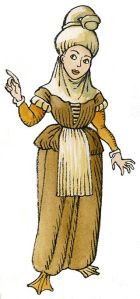 The lamia (plural lamiak) is a nymph-like being of the Basque country of northern Spain. They are associated with rivers and caves. Though their origin is within the Basque culture, but they are found in other parts of northern Spain. For example, they are similar in several ways to the mouras encantadas of neighboring Galicia. They are very beautiful and usually have long hair, which they love to comb with golden combs. Like the damas de agua of central Spain, lamiak often have animalistic traits: most often, webbed feet like a duck.
In Navarra and the Basque country, the term lamia is also commonly used for a sea nymph or mermaid. At the same time, some lamiak function as domestic spirits, helping those who leave them offerings with farm or household chores.
The masculine counterpart of the lamia is the mairu (plural mairuak). They are often described either as giants or as human sized but possessing immense strength. In this, they are comparable to the spriggans of Cornwall. It is said that mairuak built the dolmens of the Basque region. Their wives and sisters are also noted builders, as certain bridges in the Basque country were reputedly built by lamiak.
Other forms of lamia include lamina and amilamia. Other forms of mairu include maire, maide, and mainde.
Sunday Inspiration: Storytelling
The purpose of a storyteller is not to tell you how to think, but to give you questions to think upon.
—Brandon Sanderson
Speaking of Mermaids
Gillian Finklea of mental_floss brings us the lowdown on nine mermaid legends from around the world:
Not all mermaids are the shimmering versions of femininity often seen in pop culture. In fact, those mermaids—which seem to be a combination of the Melusine and Greek mythology—barely skim the surface of this fish-human legend. Many countries and culture have their own versions of mermaids, from a snake water goddess to a fish with a monkey mouth. Some are benevolent, some ambivalent, and many are openly hostile to the poor humans who cross their paths.
Did a Faery Once Run a General Store in Connecticut?
New England Folklore tells the story of Perry Boney, who lived in the 1920s in a Connecticut village now submerged beneath Candlewood Lake.
No one was really sure where Boney came from either. One day he and his tiny store were just suddenly there, almost magically. Small children were convinced he could talk with the fairies that lived near the mountain brooks, and some thought he was a fairy himself. He certainly looked the part. He was small and thin, with wild unruly hair, and large brown eyes that seemed to look right through whoever he talked to. His habit of playing the flute on moonlit nights added to his fairy mystique, but some skeptics said the music was really just the wind sighing in the trees….
Boney also had a very friendly relationship with animals that was quite unusual. A large, tame raccoon lived in Sherman, and came running out to meet Boney whenever he came into town. Boney would speak to the racoon in strange, whistling language that no one else had ever heard, and the racoon would wait for him on the steps of the Sherman general store. When Boney was done with this shopping the racoon walked him home to his tiny store near Green Pond Mountain.
Merrows: Irish Mermaids
Ruthie from the Celtic Myth Podshow introduces us to these underwater faeries.
The word merrow or moruadh comes from the Irish muir (meaning sea) and oigh (meaning maid) and refers specifically to the female of the species. Mermen – the merrows male counterparts – have been rarely seen. They have been described as exceptionally ugly and scaled, with pig-like features and long, pointed teeth. Merrows themselves are extremely beautiful and are promiscuous in their relations with mortals.
The Irish merrow differs physically from humans in that her feet are flatter than those of a mortal and her hands have a thin webbing between the fingers. It should not be assumed that merrows are kindly and well-disposed towards mortals. As members of the sidhe, or Irish fairy world, the inhabitants of Tir fo Thoinn (the Land beneath the Waves) have a natural antipathy towards humans. In some parts of Ireland, they are regarded as messengers of doom and death.
Ruthie goes on to equate merrows with selkies, women who take on the form of seals by wearing a magical seal skin. To my mind, these are separate creatures, though it is certainly true that legends tend to be fluid over time and distance. There are certainly points of overlap between them.
Sunday Inspiration: The Library Has a Soul
“What did you discover, Folly?” Master Ferus was saying to his apprentice.
The oddly dressed girl frowned for half a minute before she spoke. “Frozen souls.”
“Ah!” Ferus said, raising a finger. “Yes, near enough. Well-done, child.”
Folly beamed and hugged her jar of crystals to her chest. “But why haven’t I ever felt anything like that in our study?”
“It is primarily a matter of density,” Ferus replied. “One needs more than a handful of trees to see a forest.”
Folly frouwned at that. “It seemed as if…they spoke to one another?”
“Nothing quite so complex as that, I think,” the etherealist said. “Some sort of communication, though, definitely.”
Bridget cleared her throat and said tentatively, “Excuse me, Master Ferus?”
The etherealist and his apprentice turned their eyes to her. “Yes?” he asked.
“I do not mean to intrude, but…what are you talking about?”
“Books, my dear,” Ferus replied. “Books.”
Bridget blinked once. “Books do not have souls, sir.”
“Those who write them do,” Ferus said. “They leave bits and pieces behind them when they law down the words, some scraps and smears of their essential nature.” He sniffed. “Most untidy, really—but assemble enough scraps and one might have something approaching a whole.”
“You believe that the library has a soul,” Bridget said carefully.
“I do not believe it, young lady,” Ferus said rather stiffly. “I know it.”
—Jim Butcher, The Aeronaut’s Windlass
Sunday Inspiration: Living
It is often said that before you die your life passes before your eyes. This is in fact true. It’s called living.
—Terry Pratchett
 Darrell J. Pursiful