
Recent Comments


Repost: Boo! Five Bogeymen to Run Away From
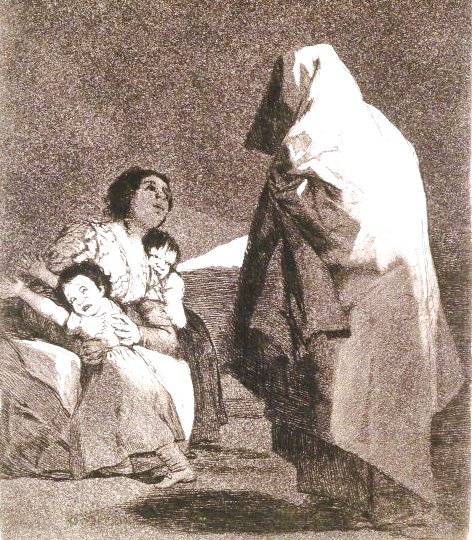
Francisco de Goya, “Que viene el Coco” (Here Comes the Bogeyman), 1797–98
In addition to the powerful, awe-inspiring sídhe nobles, wild satyrs, and helpful little folk, the world of Faerie is also inhabited by a variety of creatures whose purpose seems to be striking fear in the hearts of children. These are the bogeymen, also known as bogles, boggarts, boogers, bugaboos, etc.
The word “bogeyman” is derived from Middle English bogge or bugge. It is thought to be related to other words such as Scots bogle, Norse puki, and Gaelic púca. Whatever these creatures are called and whatever their appearance, they are the bane of children, especially those who misbehave! They might also lure people beyond the bounds of civilization—deep into the woods or too close to the water. They thus serve as cautionary tales to keep people in line be they young or old.
Here are five bogeymen that have inhabited the nightmares of children around the world.
1. El Hombre del Saco
Also known as el hombre del costal. Both mean “the sack man” or “the bag man.” This is a bogeyman found in many Latin countries including Brazil, Portugal, and Spain. He is portrayed carrying a sack in which he carries off naughty children.
2. El Coco (or el Cuco, el Cucuy)
El Coco is known in many Spanish-speaking countries. He is described as a ghost with a pumpkin head, an evil monster that hides under children’s beds at night and kidnaps or eats them when they don’t obey their parents or go to sleep at bedtime. In Latin America, el Coco more often takes the form of a small humanoid with glowing red eyes that hides in closets or under the bed.
3. Grindylow
Grindylows feature prominently in Harry Potter and the Goblet of Fire. The grindylow of folklore is an aquatic bogeyman from England (Yorkshire and Lancashire, to be specific). This creature is associated with marshes, bogs, and lakes. They are said to grab little children if they come too close to the water’s edge and drag them away Some have suggested that the name “grindylow” is related to the name of the monster Grendel from the Beowulf saga. .
4. Nalusa Falaya
The nalusa falaya or “Long Black Being” is a bogeyman from Choctaw legend who is also called impa shilup or “Soul-eater.” He is somewhat similar to Bigfoot as he is described as a hairy, manlike creature with wizened face, small eyes, and pointed ears. Some describe him as slithering on his stomach like a snake. These creatures call to unwary travelers in the woods. He sometimes frightens hunters. Seeing a nalusa falaya is said to be so horrifying that it will cause one to faint. While unconscious, the nalusa falaya transfers some of his own evil into his victim, making him aggressive and malevolent.
5. Abu Rigl Maslukha
For my money, this is one of the creepier bogeymen out there because his malevolence is rooted in his own experience of suffering. This Egyptian Arabic creature’s name means “the Man with the Burnt Leg.” The Abu Rigl Maslukha is a monster that got burnt when he was a child because he did not listen to his parents. Now, he hunts down naughty children to cook and eat them.
Medieval and Renaissance Werewolf Art
io9 has shared some, for no obvious reason (other than Halloween, of course). The post also includes the occasional cynecephalus.
Japanese Demons Just in Time for Halloween
I don’t write much at all about Far Eastern myths and legends simply because I don’t feel competent to do so. Thankfully, the good folks at mental_floss have put together a list of “10 Horrifying Demons and Spirits from Japanese Folklore.” Enjoy!
Ten Things You Might Not Know about J. R. R. Tolkien
There are plenty of things even the most ardent fans don’t know about John Ronald Reuel Tolkien.
My favorite is #10:
Tolkien’s academic writings on Old Norse and Germanic history, language and culture were extremely popular among the Nazi elite, who were obsessed with recreating ancient Germanic civilization. But Tolkien was disgusted by Hitler and the Nazi party, and made no secret of the fact. He considered forbidding a German translation of The Hobbit after the German publisher, in accordance with Nazi law, asked him to certify that he was an “Aryan.” Instead, he wrote a scathing letter asserting, among other things, his regret that he had no Jewish ancestors. His feelings are also evidenced in a letter he wrote to his son: “I have in this War a burning private grudge—which would probably make me a better soldier at 49 than I was at 22: against that ruddy little ignoramus Adolf Hitler … Ruining, perverting, misapplying, and making for ever accursed, that noble northern spirit, a supreme contribution to Europe, which I have ever loved, and tried to present in its true light.”
Looking for Bigfoot in North Georgia (and Elsewhere)
Via one of my local TV stations:
The Gulf Coast Bigfoot Research Organization (GCBRO) is convinced that not only is there a Bigfoot, but there are in fact bigfeet scattered across the countryside, even as many as 30,000 creatures (a number they admit is a “wild guess”) from the Pacific Northwest and across the South from Texas to Georgia….
During our conversation, Landsdale shared some of the best places in America to spot Bigfoot, including the following:
“Monster Central”
The so-called “Monster Central,” about 1500 acres, 30 miles south of Shreveport Louisiana, is actually on Landsdale’s property, where he first laid eyes on a Bigfoot 20 years ago and where the GCBRO does many of their hunts. They’ve most recently spotted a female bigfoot along with her child, though since the GCBRO team only wants to harvest a male specimen, they didn’t pursue. Landsdale says these are sharp, corn-feeding creatures, but they can also be fearless. When the creatures allegedly started killing Landsdale’s pets, he resolved to kill one for study.
Northwest Louisiana
The Toledo Bend Reservoir, on the Sabine River between Texas and Louisiana near the city of Natchitoches, is a prime area for Bigfoot sightings, sometimes generating two reports a month. The GCBRO has seen “packs” of Bigfoot here, roaming across four or five parishes.
East Texas
Landsdale reports there is heavy activity continuing along the Sabine River through Greg, Harrison and Panola counties in Texas. Five months ago a GCBRO group saw a total of five young creatures scampering around the area in a single day.
Southeast Oklahoma
The Kiamichi Mountains are a hotbed of Bigfoot activity. A GCBRO member that owns 40 acres in the area claims to routinely get Bigfoot visits around his cabin. A word of caution: The creatures in this area are said to be especially aggressive.
Mississippi
The GCBRO says they receive anywhere from three to five reports a week from up and down the river and its tributaries in the Mississippi Wildlife Management Area (WMA). Other times, an entire month will pass without a report. Based on this and other evidence, the group has concluded that Bigfoot individuals and families of up to 10 creatures are probably hunting in geographic loops on a roughly 72 hour cycle, originating from their bedding area, moving to various hunting grounds, and back to their bedding area. As with much of the South, it’s theorized that Bigfoot prefers this area for the climate and abundance of vegetation and animals.
Arkansas
This area is best known for the Fouke Monster, aka “Southern Sasquatch,” near the town of Fouke in Miller County, Arkansas. A book and a number of films have been made, based on this legend. Fouke was the first known variety of sasquatch, with only three toes (Bigfoot species can have three, four or five toes), and are aggressive, prone to killing pigs and terrorizing people. Landsdale believes the three toed creatures may be inbreeding, making them more aggressive than their four and five-toed cousins.
Georgia
The Appalachian Mountains in the northwest part of the state, particularly near the Benton-MacKaye Trail off Highway 515, are said to get sightings four or five times a month. Though this is one of the hottest parts of Georgia, caves provide refuge from the heat and there is abundant vegetation and animals.
Washington State
The west coastal areas of Washington State have several reports of sightings, including Kitsap County, which has had quite a few sightings in 2014 alone, as well as Bumping Lake and Skooum Valley. The coast is said to be preferred by these sasquatch for the climate, as it’s never really hot or cold, and there’s plenty of available vegetation and meat. Again, the sasquatch in this region tend to be less aggressive, more likely to be loners, and stay away from people.
Northern California
Bluff Creek is famous for the hotly debated Patterson film, showing footage of “Patty” in 1967. Since then, male tracks have been found in the snow in the area. Caves provide protection from the elements between hunts, which persist all winter, as Sasquatch don’t hibernate.
Sunday Inspiration: Humility
Humility, after the first shock, is a cheerful virtue.
—C. S. Lewis
Booking My Flight to Gondor
This is, indeed, the most epic airline safety video in the history of ever.
The Science of Aquaman
Pondering merfolk and whether they might make an on-stage appearance in a future volume of Into the Wonder, I stumbled upon a deep-sea biologist’s attempt to explain the physiological problems DC’s Aquaman might face as a marine humanoid and some of the adaptations he might have evolved to deal with them. I commend Andrew David Thaler’s musings to you:
- The Horrifying Physiological and Psychological Consequences of Being Aquaman
- The Importance of Being Aquaman, or How to Save the Atlantean from His Briny Fate
Enjoy!
The Hobbit in 72 Seconds
It’s epic, even though especially since it leaves out all the fluff Peter Jackson added in.
(H/T: io9)
Paissake: Forest Spirits of the American Midwest
 Paissake are magical little people of Central Algonquian folklore, similar to European gnomes or fairies. Paissa is singular; the proper plural form is paissake. There is a wide range of spellings in the various Central Algonquian languages (Sauk, Fox, Kickapoo, Menominee, Miami-Illinois, etc.), but the pronunciation is roughly similar across languages, approximately pah-ee-sah.
Paissake means “little ones,” and they are said to be diminutive creatures—perhaps as little as two feet tall. In most stories, paissake are portrayed as mischievous but generally benign nature spirits who live in the forest and play tricks on mortals. Though they are tricky, they are not generally dangerous.
In other stories, however, paissake have more formidable magic powers and pose a threat to humans or even to the divine culture hero Wisake, but usually only if they are provoked. In some Miami traditions, paissake played a more important religious role as guides to lead the spirits of the dead along the Milky Way to the afterlife.
In the Fox and Sauk tribes, the native names for the Little People also include the twin heroes Lodge Boy and Thrown Away. These heroes are also little people, but are not really dwarves or pygmies. Rather, they are magical children who never grow up. In the folklore of these peoples, the names “Paia’shiwuk” or “Apayashihaki” can be seen referring either to the magical boys or to the forest-dwelling tricksters. In other Algonquian cultures, these magical twins are not referred to as paissake.
The paissake have been associated with the so-called “Piasa Bird,” a kind of Native American dragon depicted in a mural in Illinois on the bluffs above the Mississippi River. This creature is not, however a paissa at all. The name became attached to it due to misunderstanding or simple ignorance on the part of early European settlers in the region. Piasa (by any spelling) definitely does not mean “the bird that devours men” or anything of that nature.
 Darrell J. Pursiful