
Recent Comments


Deer People: Native American Forest Folk
 Several Native American peoples have legends of a half-deer, half-human being that lives in the forest and is sometimes dangerous to humans. In the Southeast, the Choctaw tell of a mischievous deer man called kashehotapolo. Cherokee folklore has a shapeshifting “deer woman.” These two apparently have little in common except their deer-like attributes and the general part of the world in which they live.
The kashehotapolo love to frighten hunters in the woods but are otherwise more mischievous than malicious.They inhabit the marshes and swampy woodlands. The Choctaw say these beings screech and wail as they dash past lone hunters at lightning speed.
What does a kashehotapolo look like? Reports vary. Some say its true form is an antlered humanoid, although it can take the form of an ordinary deer. Others report the creature has an undersized head. Yet others say he has a shriveled face, the body of a man and the legs and hooves of a deer. This confusion about its appearance is explained by the Choctaw by saying the creature ran so fast that few ever saw it clearly enough to clearly state what it looked like.
In contrast to the Choctaw deer man’s mostly harmless demeanor, the Cherokee “deer woman” is a seductive shapeshifter. They are able to assume the form of a deer, although they may retain some deer characteristics even in human form (most often possessing hooves instead of human feet). Although they can be helpful to women, especially those hoping to conceive children, they are often dangerous to men. Men who are adulterous or promiscuous are their favorite targets. Deer women might lead such men to their deaths or else leave them to pine away from lovesickness.
Deer women are also found in the folklore of the Great Plains. In the Lakota language, they are called Anukite (“double face”) or Sinté Sapela Win (“black-tailed woman”). Plains legends tend to paint them as irredeemably evil. In Cherokee and other eastern folklore, however, they can be helpful to humans, although they are still considered dangerous and unpredictable.
Sunday Inspiration: Friendship
There are some things you can’t share without ending up liking each other, and knocking out a twelve-foot mountain troll is one of them.
—J. K. Rowling
Maine’s Goatman
I knew there were (supposedly) goatmen in Maryland and, of course, Fisherville, Kentucky (just outside Louisville, where I used to live). I hadn’t heard they ranged as far north as Maine. Here is the scoop from Peter Muise of the New England Folklore blog:
The story goes something like this. Back in the 1950s a Cherryfield man was driving his truck through the woods outside town. He was a local and had spent most of his time hunting, fishing, and logging in the forests of Maine. Those decades of experience didn’t prepare him for what he encountered that day.
He had filled up his gas tank before he left home that day, so he was very surprised when his truck came to a gradual stop on a lonely road. His gas gauge read empty.
He got out and checked the tank. It indeed was empty. He checked the bottom of the truck but couldn’t see a leak, and he didn’t see any sign of gas dripping on the road. He was annoyed and puzzled, but when he got out from beneath those truck those emotions turned to surprise – and maybe a little terror.
Standing in the middle of the road was a man who was half-human and half-goat. His lower body and legs were naked, hairy and shaped like a goat’s, while his torso was human-shaped and covered in a flannel shirt. Goat horns grew out of his head and his ears were pointed like an animal’s. Other than the flannel shirt, the goatman looked like a mythological satyr or the Greek god Pan.
I wonder if all these New-World satyrs have a big family reunion somewhere?
Grandmothers of Fantasy Fiction
Nyki Blatchley has a great follow-up at Fantasy Faction to Leo Elijah Cristea’s previous post on the “grandfathers” of fantasy, highlighting classic female fantasy writers (up to about 1980) from Ann Radcliffe and Mary Shelley to Marion Zimmer Bradley and Anne McCaffery. He concludes,
Today, whatever inequalities still remain, fantasy written by women is too common to need any special note. It’s unlikely, though, that this would have been possible without pioneers like Shelley, Nesbit, Moore, Norton, LeGuin, Bradley and the rest. They deserve to be honoured for what they made possible, as well as for the classic quality of their works.
As with the aforementioned post from Cristea, this one is definitely worth a read.
What Do You Know about Global Christianity?
Take the Pew Research Center’s ten-question quiz on the word’s Christian population.
Amen and Amen
Larry Hurtado offers “A Plea for Affordable Book-pricing.”
This Ended Up about the Way I Thought It Would
Images of Dyer’s kill began circling the internet this week, and it wasn’t long before mainstream outlets like TIME magazine were giving valuable press to the “man who shot Sasquatch”, running stories about how Dyer baited the beast with Wal-Mart ribs nailed to a tree outside San Antonio. He claims that after the big guy was studied (we’re never told by whom), his body was stuffed and preserved. Now Dyer is touring the country with the dead body in the back of his trailer, charging curious onlookers a few bucks a pop for a peek behind the curtain.
If this all sounds a little, well, fake.. that’s because it is. What the media isn’t mentioning is that this isn’t the first time that Rick Dyer has “killed Bigfoot”.
Huldras: Scandinavian Wood Nymphs
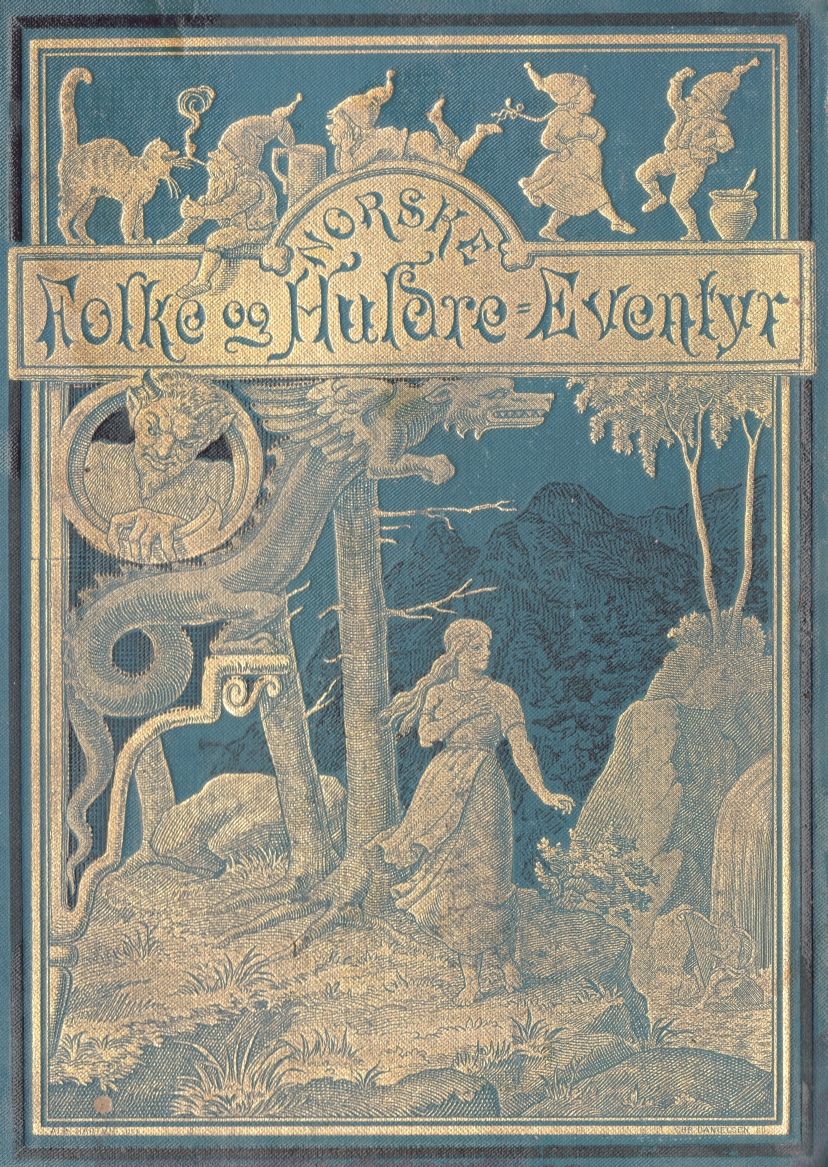 The word huldra comes a Scandinavian word “hidden” or “secret.” This word also lies behind the Icelandic term huldufólk, a euphemism used to avoid speaking directly about elves. Huldras are not the same as the bright and benevolent elves of Norse mythology, however. They are, in fact dangerous and seductive woodland sprites.
Huldras appear as stunningly beautiful women who are sometimes dressed in simple peasant garb. They are usually depicted with uncanny or animalistic features when viewed from behind, however. They might have a cow’s tail, for example, and in some stories, they have a hollow or bark-covered back.
In some legends, huldras lure men into the woods for romantic encounters. If a child results, they might reappear to the father to present him with their unearthly child. In other stories, they steal human infants and replace them with their own babies
Sometimes, it seems, a huldra finds true love with a mortal, but the glamour or illusion that conceals her inhuman aspects is broken at her wedding, either when she enters the church or when the priest places his hand on her. At the same time, other stories state that, once married to a Christian man, the huldra will loose her tail but retain her beauty.
Huldras can be fiercly vindictive if they are mistreated or betrayed. They are sometimes depicted with superhuman strength.
Huldras are known by other terms as well. In Norway, she might be called a skogsfru or skovfrue, “lady (or mistress) of the forest.” She might also be called a skogsrå (“forest-guardian”) or Tallemaja (“pine-tree Mary”) in Sweden or, among the Sámi, Ulda. She is likely related to the Germanic myth of Holda, a protectress of agriculture and women’s crafts.
The male counterpart of a huldra is called a huldu or (in Norway) a huldrekarl. By all accounts, the males are often just as seductive—and dangerous—as the females.
The Simonside Dwarves
The Fairytale Traveler gives us the run-down on the dwarves of England’s Simonside Hills. There have been legends—strongly influenced by Norse mythology, apparently—of nocturnal, not-very-nice dwarves in this northern part of England since at least the thirteenth century, and some believe they played a role in Tolkien’s depiction of the wicked dwarves of the Iron Hills.
The Evolution of Fantasy Fiction
Leo Elijah Cristea has traced the roots of fantasy fiction, the “Grandfathers of Fantasy” as he calls them, in a brilliant essay at Fantasy Faction. In a single post, he gathers up everything from mythology to faery tales to Poe and Lovecraft and Tolkien and Eddings, showing how they all relate to one another in a vast fantastical “tree of life.” One of my favorite sections:
The ancestor of fantasy is mythology; fantasy’s great-uncle, thrice-removed, is the art of faerie tale; but fantasy’s true grandparents are the fantasists who crafted dreams, speculative realities, and visions of distant worlds, whether by means of the gothic, the early fantastic, or uncanny commentary on the future. Fantasy’s grandparents are far, far older than Tolkien, Eddings, Brooks, or Martin.
Due to our unswervingly human need to label, there are more subgenres of fantasy than you could shake a whole forest of ancient oaken sticks at. Helpfully, our predecessors were quite happy to call anything that didn’t mimic whole reality, fantasy. They were right, too. Anything that doesn’t fit into the neat little frame, within which the finite possibilities of our world sit, is left out, branded fantasy. Of course (and this won’t be the first time I’ve flirted with the admission of stating that I believe in what should probably not be believed in) the small grey areas outside of this accepted, built and well-maintained frame are what fuel a fantasist’s speculation—or at least, that’s how it used to be.
Imagine living and writing in the times of Mary Shelley, or Poe, or John Polidori and his Vampyre, imagine not having all the facts staring at you, and imagine not seeing the world broadcast at you on the news every day. Imagine the itch to write, to learn, to dream, to explore—to speculate.
This is where fantasy proper first appeared.
It’s well worth the time to read it all.
 Darrell J. Pursiful